Coffee vs Red Bull: The Caffeine Comparison Goes the Other Way
By Coffee Studies Editorial·Published October 12, 2026·4 min read
Quick answer
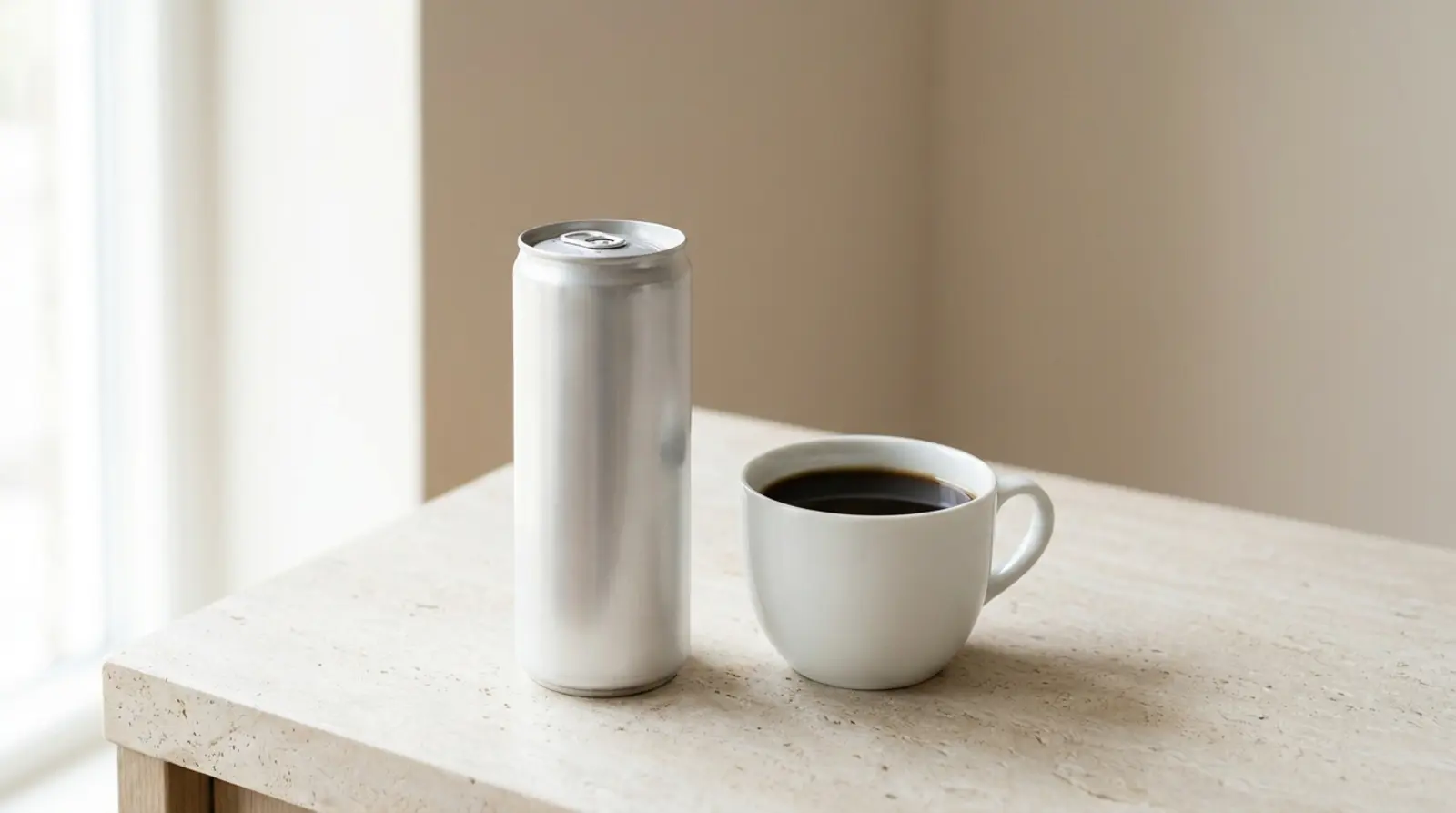
The assumption behind this comparison is that an energy drink is the stronger of the two. For Red Bull specifically, the numbers say otherwise, and they say it twice.
The arithmetic
A can of Red Bull Energy Drink contains 80 mg of caffeine in 8.4 fl oz, stated on Red Bull's own product page[1]. An 8 fl oz cup of brewed coffee carries roughly 80 to 100 mg[2].
Two things follow, and the second one is the part almost nobody computes.
Per serving, the coffee is stronger — same caffeine at the bottom of its range, up to 25% more at the top, from a smaller glass.
Per ounce, the coffee is also stronger. Red Bull works out at 9.5 mg per fluid ounce. Coffee runs 10 to 12.5. At the midpoint, coffee is about 18% more concentrated. Red Bull is, in the most literal sense, a more dilute caffeine solution than filter coffee.
And most people do not drink 8 oz of coffee. A 12 oz mug lands around 120 to 150 mg, which is comfortably past a can.
So why does it feel stronger
Three reasons, none of them dose.
Speed. A can is cold and carbonated and goes down in a few minutes. A coffee is too hot to rush and gets sipped over fifteen or twenty. The same quantity of caffeine arriving faster produces a sharper peak.
Sugar. There are 27 g of sugar in an 8.4 oz can[1] — close to seven teaspoons. That carries its own short, steep lift which is easy to attribute to the caffeine.
Tolerance. Habitual coffee drinkers have blunted their response to the dose. Someone who reaches for a can occasionally has not, and the same 80 mg does more to them.
The difference that actually matters
Strip out the caffeine, where the two drinks are near-identical, and what is left is the sugar.
27 g
sugar in an 8.4 oz can of Red Bull
0 g
sugar in black coffee
9.5 vs 11.2
mg caffeine per fl oz, Red Bull vs coffee
Seven teaspoons in a small can is the entire nutritional story of this comparison, and it is much larger than anything to do with the stimulant. Red Bull Sugarfree and Red Bull Zero exist precisely because that is the part worth removing.
Coffee is not automatically on the right side of this. A flavoured coffee-shop drink can carry more sugar than a can of Red Bull. The comparison that favours coffee is specifically with black coffee.
The small can is unusual, and it matters
Red Bull's 8.4 fl oz (250 mL) format is the original and it never grew. Most of the category moved to 16 oz cans, which doubles both the caffeine and the sugar in one container.
That has a regulatory consequence in Canada, where a caffeinated energy drink may contain no more than 180 mg of caffeine per serving from all sources[3]. An 80 mg can sits a long way inside that limit. A 16 oz can at the same concentration is much closer to it.
A large takeaway coffee faces no such ceiling at all, because coffee is not a formulated product — the broader version of that argument is in coffee vs energy drinks.
What else is in the can
Taurine, an amino acid present in ordinary foods, and the B-group vitamins niacin, pantothenic acid, B6 and B12[1].
Taurine attracts most of the suspicion and deserves the least of it. It is not where the research concern about energy drinks sits, and it is not what separates this can from a cup of coffee.
Common misconceptions
"Red Bull has way more caffeine than coffee." It has less, per can and per ounce.
"It's the taurine." It is the sugar, the speed and the tolerance.
"Energy drinks are unregulated." In Canada they are more regulated than coffee: capped at 180 mg per container and required to carry cautionary labelling. Coffee has neither.
"Sugar-free versions are just as bad." Removing 27 g of sugar removes the largest measurable difference between the two drinks. What is left is 80 mg of caffeine, which is less than your coffee.
The honest summary
Red Bull contains 80 mg of caffeine in 8.4 fl oz, which is less than a cup of coffee in total and slightly weaker per ounce. It feels stronger because it is drunk quickly, carries seven teaspoons of sugar and is often consumed by people without caffeine tolerance.
If you are comparing the two for caffeine, the coffee wins and the gap widens with every ounce above eight. If you are comparing them for anything else, look at the sugar — that is where the two drinks actually diverge, and it is the one difference a sugar-free can removes entirely. Health Canada and EFSA both put the adult ceiling near 400 mg of caffeine a day from all sources[4], and both drinks fit inside it easily.
Frequently asked questions
- What has more caffeine, coffee or Red Bull?
- Coffee, on both measures that matter. A can of Red Bull states 80 mg of caffeine in 8.4 fl oz on the manufacturer's own product page. An 8 fl oz cup of brewed coffee carries roughly 80 to 100 mg. So the coffee wins on total caffeine despite being the smaller serving, and it also wins per ounce: 10 to 12.5 mg against Red Bull's 9.5. A 12 oz mug, which is what most people actually pour at home, lands around 120 to 150 mg and is comfortably ahead of a can.
- Is Red Bull stronger than coffee?
- Not as a caffeine solution. It is weaker per ounce and smaller per serving. Red Bull feels stronger to many people for reasons unrelated to dose: it is cold and carbonated so it goes down in a few minutes rather than fifteen, it carries 27 g of sugar which produces its own short-lived lift, and it is usually drunk by people who are not habitual coffee drinkers and therefore have less caffeine tolerance.
- How much sugar is in a can of Red Bull?
- 27 g in an 8.4 fl oz can, stated on Red Bull's own product page. That is close to seven teaspoons in a small can. Black coffee has none, and this is the single largest nutritional difference between the two drinks — considerably larger than anything to do with caffeine. Red Bull Sugarfree and Red Bull Zero exist for exactly this reason.
- Why does Red Bull come in such a small can?
- The 8.4 fl oz (250 mL) size is the original format and it never grew. That is unusual in the category: most competitors moved to 16 oz cans, which doubles the caffeine and the sugar in a single container. It also means Red Bull sits comfortably inside Canada's 180 mg per-container limit for caffeinated energy drinks, while a 16 oz can at the same concentration is much closer to it.
- What is in Red Bull besides caffeine and sugar?
- Taurine, which is an amino acid found in ordinary foods, and the B-group vitamins niacin, pantothenic acid, B6 and B12. Red Bull's own description attributes the alertness effect to the caffeine and the B vitamins to reducing tiredness and fatigue. None of these is where the interesting difference from coffee lies; the sugar is.
- Can I swap a Red Bull for a coffee?
- On caffeine, a can is a slightly light cup — swapping one for the other will under-dose rather than over-dose you if you are used to coffee. The practical differences are that you will add about seven teaspoons of sugar unless you choose a sugar-free version, and that you will drink it faster, which produces a sharper peak from the same amount of caffeine.
References
Every factual claim in this article is drawn from the sources below. See the source library for how we grade evidence.
- [1]Red Bull Energy Drink product information (caffeine and sugar content)Red Bull · Reference work · Tier 3 · Contextual
- [2]FoodData CentralU.S. Department of Agriculture · Official dataset · Tier 1 · Strong
- [3]Caffeinated energy drinksHealth Canada · Agency guidance · Tier 1 · Strong
- [4]Caffeine in foodsHealth Canada · 2022 · Agency guidance · Tier 1 · Strong
Related reading
- Caffeine & HealthCoffee vs Energy Drinks: What the Research Actually Compares→
- Caffeine & HealthHow Much Caffeine Is in Coffee?→
- Caffeine & HealthHow Much Caffeine Is Too Much?→
- Caffeine & HealthThe Caffeine Crash: What It Is and Why It Happens→
- Caffeine & HealthCoffee and Vyvanse (and Other ADHD Medications)→
- Caffeine & HealthCoffee and Weight Loss: What the Research Actually Shows→