Camping Pour-Over: Cones, Filters and Pouring From a Pot
By Coffee Studies Editorial·Published November 15, 2026·4 min read
Quick answer
Figure
Camp pour-over cones by weight
Values in grams
A pour-over at camp is the home method with your kettle swapped for a pot. The cone is the only new object, and the cones made for this weigh from under half an ounce to a few hundred grams, so the choice is between the lightest thing that makes one cup and a fold-flat one that makes a pot. Here are the cones by the makers' figures, the filters you carry, the ratio, and how you pour without a gooseneck. None of this gear has been field-tested by us, so check the fit on your own mug before the trip. [1] [2]
under 14 g
GSI’s Ultralight Java Drip, a nylon mesh cone on three legs that clips to a mug and takes a #2 or #4 paper filter or none[1]
1 to 12 cups
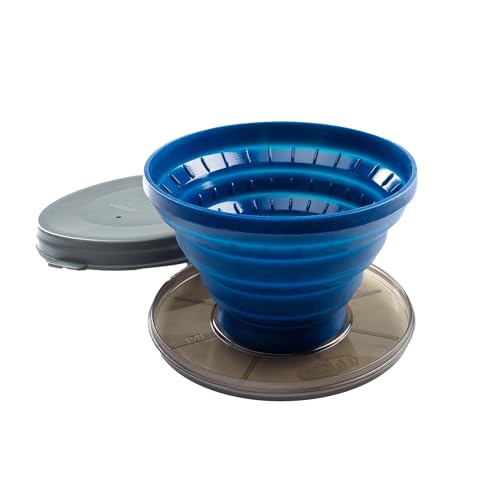
what GSI says its Collapsible JavaDrip brews over a mug, a bottle or a pot, from a silicone cone that folds to an inch high[2]
13 g
of medium-ground coffee per 8 oz cup, the standard 55 g per litre ratio, with water thirty seconds off the boil[6]
Which cone should you carry?
| Cone | Filter | Weight | Makes | Sits on | Best for |
|---|---|---|---|---|---|
| GSI Ultralight Java Drip | #2 or #4 paper, or bare mesh | under 14 g | one cup | a mug, by three legs | a pack |
| Sea to Summit Frontier UL | its own steel mesh | 59 g | one cup, about 30 g of grounds | most mug and bottle rims | a pack, no paper to carry |
| GSI Collapsible JavaDrip | #4 paper | 160 g | 1 to 12 cups | a mug, a wide-mouth bottle or a pot | a car, a canoe, a group |
Two things the table settles for you. Paper or mesh is a cleanup-and-taste trade: paper takes out the oils and fine sediment and goes into your trash bag wet; mesh stays in the cone, rinses with a splash, and lets a little oil and silt through. And the big silicone cone is a different tool from the small ones: it is the only pour-over here that makes a pot, which is why it weighs ten times the GSI mesh. [1] [2] [4]
How do you pour without a gooseneck?
Slowly, low, and in passes, with whatever pot you boiled in. A gooseneck kettle exists to give you a thin, steady stream so the bed of grounds stays level and the water passes through evenly; at home it pairs with a scale and a timer. At camp you have a pot with a lip. Our guidance:
- Dose. 13 g of medium-ground coffee per 8 oz cup. A heaping tablespoon. [6]
- Water off the boil. Thirty seconds after your pot stops rolling. Boiling water on a paper cone makes a harsh cup; the brewing standards put the sweet spot a few degrees under. [7]
- Wet the grounds. A small pour, just enough to soak the bed, and wait twenty or thirty seconds while it puffs.
- Pour in two or three passes. Fill the cone about halfway each time, aiming for the middle of the bed and keeping the stream low so you do not blast a hole in it. Let it drain between passes; you are not in a hurry.
- Stop at the dose. 237 mL of water for one 8 oz cup. If you have no measure, your mug is the measure.
- Filter out. Paper into your trash bag; mesh rinsed with a splash and the rinse into the bag too. [8]
If you want one object that boils and pours well, GSI's Halulite kettle has a spout and a folding handle and weighs 431 g by the maker; it is a car and canoe object, not a pack one, and our camping coffee kit page puts it in context. The pour-over guide covers the home technique in full. [3]
Pour-over or AeroPress or press?
Pour-over is the lightest real coffee you can carry and the cleanest cup. The AeroPress is heavier, faster, more forgiving of a sloppy pour, and its puck packs out drier than a wet paper cone. A press makes four cups at once and is the heaviest and the wettest to clean. For one person counting grams, the cone; for one person who wants a two-minute brew, the AeroPress; for a group, the press or a percolator. Our backpacking coffee page has the five-day weights side by side.
- The lightest real-coffee brewer there isThe lightest real-coffee brewer there isThe lightest real-coffee brewer there isA nylon mesh cone on three legs that clips to a mug, takes a #2 or #4 paper filter or none, and folds flat under a fuel canister. GSI says it weighs less than half an ounce; the Amazon catalogue lists 0.02 lb.no price from amazon.comno price from amazon.caView on Amazon
- A fold-flat pour-over cone for backpackingA fold-flat pour-over cone for backpackingA fold-flat pour-over cone for backpackingSilicone body with a fine stainless mesh, no paper filters, folds to about 1.7 cm and sits on most mugs. Holds one serving of about 30 g of grounds; the Amazon catalogue lists it at 0.13 lb, about 59 g.no price from amazon.comno price from amazon.caView on Amazon
- A fold-flat cone that brews a whole potA fold-flat cone that brews a whole potA fold-flat cone that brews a whole potSilicone bellows cone for a standard #4 paper filter that collapses to an inch high; GSI says it brews 1 to 12 cups over a mug, a bottle or a pot. The catalogue lists 0.35 lb (160 g), so it is a car and canoe cone, not the ultralight one.no price from amazon.comno price from amazon.caView on Amazon
- A camp kettle that pours, for cones and pressesA camp kettle that pours, for cones and pressesA camp kettle that pours, for cones and pressesHard-anodised aluminium, 1.8 L, with a folding handle and a spout you can aim at a pour-over cone; GSI says 15.2 oz (431 g). Pair it with any cone, press or AeroPress.no price from amazon.comnot sold on amazon.caView on Amazon
Product prices and availability are accurate as of the date/time indicated and are subject to change. Any price and availability information displayed on Amazon at the time of purchase will apply to the purchase of this product. Certain content that appears on this site comes from Amazon. This content is provided ‘as is’ and is subject to change or removal at any time.
What to do
- Backpacking? GSI Ultralight Java Drip and a few #2 papers, or the Sea to Summit mesh and no papers.
- Car or canoe, a pot at a time? GSI Collapsible JavaDrip with #4 papers.
- No gooseneck? Pour low, slow, in passes. Your pot's lip is fine.
- Dose? 13 g per cup, medium grind, water thirty seconds off the boil.
- Filters? One per cup plus spares, in a zip bag you keep dry. Out with you when wet.
The short version
A camp pour-over is a cone on your mug and water from your pot. GSI's mesh cone is under 14 g and takes a paper or none; Sea to Summit's is 59 g with its own mesh; GSI's silicone JavaDrip is 160 g and brews a pot. Thirteen grams of medium coffee per cup, water off the boil, a wetting pour then two or three slow passes, and the filter goes in your bag. No gooseneck needed.
Watch
See it, not just read it
3 videos picked for this page. They play right here, full screen on a phone, and you come straight back to the article.
Hosted on YouTube. Credit belongs to the channels named.
Frequently asked questions
- What is the best pour-over coffee maker for camping?
- For a pack, GSI's Ultralight Java Drip: a nylon mesh cone on three legs that clips to a mug, takes a #2 or #4 paper filter or none, and weighs under half an ounce by the maker. For a car or canoe where you want a whole pot, GSI's Collapsible JavaDrip holds a #4 filter, folds to an inch high and brews over a pot. Sea to Summit's Frontier sits between them with its own steel mesh and no paper to carry.
- Do I need a gooseneck kettle for camp pour-over?
- No. A gooseneck gives you a thin, steady stream, which helps at home with a scale and a timer; at camp a pot with a lip and a slow hand does the job. Pour in two or three passes rather than one, keep the stream low over the grounds, and stop when the cone is half full each time. GSI's Halulite kettle has a spout you can aim, if you want one object that boils and pours.
- What filters do I need for camping pour-over?
- Whatever your cone takes: #2 or #4 paper for the GSI cones, nothing for the Sea to Summit mesh. Count one paper per cup plus a few spares and keep them in a zip bag so they stay dry and flat. A mesh cone means no paper to carry or pack out, at the cost of a little more sediment and oil in the cup.
- What grind for camping pour-over?
- Medium, like table salt. Finer slows the drip and over-extracts; coarser rushes through and tastes thin. Pre-ground supermarket coffee is about right for a paper cone and a touch fine for a mesh one. Grind at home for a trip under a week and seal the bag.
- How much coffee per cup for pour-over?
- About 13 g for an 8 oz cup, which is the standard 55 g per litre ratio. A heaping tablespoon if you have no scale. The cone does not change the dose; the water temperature and the pour speed do the rest.
- Can you make pour-over for a group at camp?
- Yes, with a cone that holds a #4 filter over a pot. GSI says its Collapsible JavaDrip brews one to twelve cups; use 55 g per litre, wet the grounds, and pour in several passes so the bed never floods. For more than four people a percolator is faster; our percolator how-to covers it.
References
Every factual claim in this article is drawn from the sources below. See the source library for how we grade evidence.
- [1]Ultralight Java Drip: weighs less than half an ounce, nests under a fuel cartridgeGSI Outdoors · 2026 · Reference work · Tier 3 · Contextual
- [2]JavaDrip Collapsible Pour Over: silicone bellows cone for a #4 filter, collapses to 1 inch high, brews 1 to 12 cupsGSI Outdoors · 2026 · Reference work · Tier 3 · Contextual
- [3]Halulite Tea Kettle: 1.8 L hard-anodised aluminium, folding handle, nests a 110 g fuel cartridgeGSI Outdoors · 2026 · Reference work · Tier 3 · Contextual
- [4]Amazon catalogue item weights and maker feature text read through the Creators API on 15 November 2026 (ASINs B0CV9NLSNY, B0000CF3Q6, B01F24EL5S, B07YVL8SF3, B0FGZW7M84, B001LF3I20)Amazon.com product catalogue · 2026 · Reference work · Tier 3 · Contextual
- [5]Amazon catalogue item weights and maker feature text read through the Creators API on 15 November 2026 (ASINs B01GPMH590, B082L26FLX, B0CJ4YFMQ9, B097DCNLL6, B0BRKFWPF3, B0F1ZNB476, B01NGZ2MOY, B0DXQC9B14)Amazon.com product catalogue · 2026 · Reference work · Tier 3 · Contextual
- [6]Brewing FundamentalsCoffee Science Foundation · Reference work · Tier 2 · Moderate
- [7]Coffee Standards (Revised 2018)Specialty Coffee Association · 2018 · Reference work · Tier 2 · Moderate
- [8]The 7 Principles: Dispose of Waste Properly (bringing back waste that was carried in)Leave No Trace Canada · 2026 · Reference work · Tier 3 · Contextual
Related reading
- Camping CoffeeCoffee Bags and Instant Coffee for Camping: Which to Pack→
- Camping CoffeeCamping French Press: Is It the Right Brewer for Your Trip?→
- Camping CoffeeBest Camping Coffee Maker: Every Type, by the Numbers→
- Camping CoffeeCamping Coffee Kit: The Full Packing List by Trip Type→
- Camping CoffeeCanoe Trip Coffee: Steel Brewers, Lake Water and Portages→
- Camping CoffeeCar Camping and RV Coffee: Brewing for a Crowd→