How to Start a Coffee Roastery
By Coffee Studies Editorial·Published July 18, 2026·8 min read
Quick answer
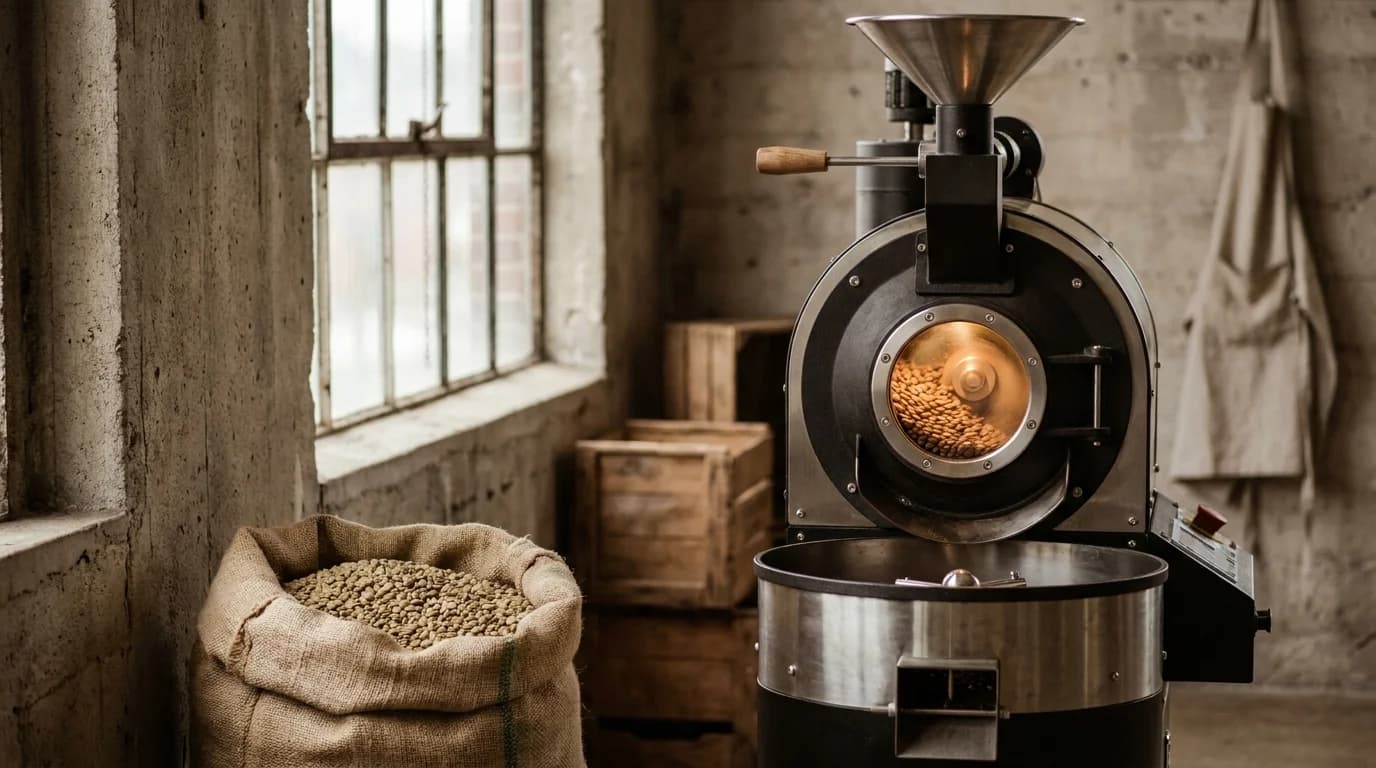
A coffee roastery and a coffee shop are different businesses. They share the word "coffee" but the operations, economics, licensing, equipment, and skill sets are largely distinct. A café is a food service business; a roastery is a food manufacturing business.
This matters from the first day of planning. A café operator learns hospitality, staff management, and customer service. A roaster learns sourcing, production chemistry, quality control, and wholesale sales. Some operators do both — owning a roastery that supplies their own café and sells wholesale — but these are two skill sets and two businesses that need to be managed separately.
$5k–$60k+ for a roaster
commercial roasting machines range from $5,000–$15,000 for a small 1–3 kg sample/startup roaster to $60,000–$200,000+ for larger drum roasters capable of production volume[2]
Food manufacturing licence
coffee roasting is food production, not food service — it requires a food manufacturer's or food production licence, ventilation for smoke and chaff, and a suitable production space[1]
3 distribution channels
a roastery can sell wholesale to cafés and restaurants, direct-to-consumer in retail bags (physical or online), and through its own café — each channel has different margin, volume, and relationship requirements[4]
What a roastery actually is
A coffee roastery purchases unroasted (green) coffee beans, roasts them to specification, and sells the roasted coffee through one or more channels. The value added is the roasting process: transforming green beans (which are inert, stable, and mildly flavoured) into the volatile, complex, perishable product that consumers buy.
The roastery's skill is in two areas:
- Sourcing: identifying and purchasing green coffee of the right quality for the target market and price point.
- Roasting: consistently producing a roasted profile that matches the intended flavour, at the intended roast level, across different origins and batches.
Both skills take time to develop. Most professional roasters spend 1–3 years developing their palate and roasting consistency before they consider themselves skilled. The equipment can roast coffee on day one; producing coffee that is consistently excellent takes significantly longer.
The equipment
The roasting machine is the central piece of equipment. Commercial drum roasters are described by batch capacity: a 1 kg roaster processes 1 kg of green coffee per batch; a 12 kg roaster processes 12 kg.
Figure
Commercial coffee roaster price ranges (new)
Values in USD (approximate)
Supporting equipment:
- Sample roaster (if not already included): for cupping and evaluating green coffee before committing to large orders
- Cooling tray: most roasters have a built-in tray; large operations may use a standalone cooler
- Chaff collector: fine outer skin (chaff) releases during roasting and must be captured
- Scale (high-capacity): 30–60 kg capacity scale for weighing green and roasted coffee precisely, $500–$1,500
- Coffee grinder (for cupping/QC, not customer cups): a cupping grinder or lab grinder, $500–$2,000
- Packaging equipment: bags, bag sealer, one-way degassing valves (coffee off-gases CO₂ for days after roasting; bags need valves to avoid pressure buildup), label printer
Space requirements: a roaster requires adequate ceiling height (many drums are 1.5–2 m tall), ventilation for smoke and chaff exhaust (typically a duct run to the outside), and clearance around the machine. Fire suppression may be required by local code. Electrical requirements vary by machine size (small roasters: 220V single-phase; larger roasters: 3-phase commercial power).
Green coffee sourcing
Green coffee is purchased in 60–70 kg burlap bags (sometimes in Grain-Pro liner bags for moisture protection). Most importers and brokers have minimum orders of one to five bags per origin, typically $400–$800 per bag depending on quality and origin.
Importers: companies that buy from multiple origins and hold inventory in North American warehouses, selling in smaller quantities to roasters. This is where most small roasters start. You can buy one bag of a specific Colombian farm lot or Ethiopian natural-processed coffee, evaluate it, and reorder if it works. Importers handle logistics, customs, and quality screening.
Direct trade: buying from farms, cooperatives, or exporters at origin. True direct trade requires either travel to origin or strong relationships with trusted agents. It is typically only viable at volumes that matter to the producer (a minimum order of a half-container or full container is common for direct farm relationships). Many roasters who claim "direct trade" are buying from importers who have direct farm relationships — that is legitimate sourcing transparency but not the same as the roaster trading directly[1].
Price signals: specialty-grade green coffee at the quality level required for a specialty roastery runs $3–$10+ per pound green. Commodity-grade coffee for a commercial dark roast runs $2–$4/pound. The roasted retail price needs to reflect these sourcing costs plus roasting labour and overhead.
Licensing
In Canada, coffee roasting falls under provincial food safety legislation as food manufacturing — not food service. The licensing requirements differ from opening a café:
- Food manufacturer's licence or food processing establishment registration: required in most provinces before commercial production and sale
- Premises inspection: the production space must meet food manufacturing standards (cleanable surfaces, pest control, appropriate ventilation, hand-washing stations)
- Municipal business licence
- Zoning compliance: some municipalities restrict manufacturing or smoke-producing operations in certain zones. Confirm zoning before signing a production space lease.
The licensing process is typically less complex than opening a café (no public-facing food premises) but takes a similar timeline: four to eight weeks once paperwork is filed[4].
Distribution channels and margins
A roastery can sell through three channels, each with different economics:
1. Wholesale to cafés and restaurants
Selling roasted coffee in bulk (typically 2–5 lb bags or larger) to cafés, restaurants, and offices. Wholesale pricing is typically 40–60% below the retail bag price — a coffee retailing at $22/250g may wholesale at $10–$14/250g (depending on volume).
Gross margin on wholesale is lower than retail but volume can be high. The challenge: cafés are buyers who switch roasters regularly, and relationships require ongoing sales and service effort. A wholesale account that goes from six bags per week to zero because a competitor undercut the price is a significant revenue loss.
2. Direct-to-consumer retail bags
Selling 250g or 340g bags directly to consumers, online or through your own café or market stall. Retail pricing at $18–$28/250g for specialty coffee gives the highest gross margin — often 60–70% above the green coffee cost.
This channel is relationship-intensive and growth is slow without significant marketing investment. Building a direct subscriber base (coffee subscriptions) provides predictable revenue and higher average order value.
3. Own café
If you operate a café alongside the roastery, your beverage sales are priced at retail (the café's menu price) while your COGS for coffee is at cost. This is the highest-margin channel for the coffee itself — but it adds the full complexity of running a café business.
Most successful small roasteries operate across all three channels rather than depending on one[3].
The economics vs a café
A roastery has different economics from a café:
Higher gross margin on the product: roasted coffee sold at retail has 60–70% gross margin vs the 70–80% on espresso drinks — comparable. But you're selling bags, not individual cups. A 340g bag sells for $22; 340g of coffee makes roughly 20–25 cups sold at $5.50–$7.00 each in a café. The café captures far more revenue from the same beans.
Lower labour intensity: a roastery with two drum roasters running full production can be operated by one to three people. A café with 150 customers per day needs four to six. Labour as a percentage of revenue is typically lower in a roastery than a café.
Higher equipment cost: a commercial roaster is a larger capital investment than espresso equipment. The payback timeline depends on volume.
Lower customer-facing complexity: no tables to bus, no milk to steam, no customers to manage in the space. The customer interaction is in the sales and tasting room, not in service.
Learning to roast
Roasting skill is not learned quickly. Commercial roasting requires understanding the Maillard reaction, the development of aromatic compounds at different temperature profiles, the difference in roasting behaviour between origins and processing methods, and the sensory evaluation (cupping) to assess what the roasted coffee actually tastes like.
Pathways to building roasting skill:
- Apprenticeship at an existing roastery: working as a production roaster for one to two years is the most common professional route
- SCA roasting pathway: the Specialty Coffee Association offers a structured certification programme for roasting
- Home roasting → sample roasting → production: starting small, developing sensory skills through cupping, and scaling up slowly
- Commercial roaster training: most roaster manufacturers offer basic training with equipment purchase
Most roasters who launch a business have spent two to five years developing the skill before commercial launch.
The cheapest step on that path is the first one. A home air roaster costs about as much as a week of green coffee at production scale and answers the question the business plan cannot: whether you actually enjoy roasting, and whether your palate can tell a profile apart.
Before the $8,000 decision
 Air roaster, 120g batchesFresh Roast SR540 Automatic Coffee Bean Roaster | Roast Coffee At Home | Variable Heat Settings | Convection Fan Control | Digital Status Display | Speed Roasting System | The Freshest Roast On EarthThe cheapest honest way to find out whether you actually like roasting before committing to a machine that costs as much as a car. Fluid-bed air roasting, small batches, and enough control to learn what a profile does.amazon.com $219.00 USDamazon.ca $412.34 CADPrice and availability as of View on Amazon
 Air roaster, 230g batchesFresh Roast SR800 Coffee Roaster – Roast Coffee at Home – Variable Heat and Fan Control – Digital Display – Roasts 6–8 oz (170–226g) Per Batch – Easy to Use – Fast Roast TimeThe larger batch matters once you are cupping rather than just drinking: 120 grams does not leave enough roasted coffee to evaluate properly and still have some to brew. Same control, roughly double the batch.amazon.com —amazon.ca $612.93 CADPrice and availability as of View on Amazon
Product prices and availability are accurate as of the date/time indicated and are subject to change. Any price and availability information displayed on Amazon at the time of purchase will apply to the purchase of this product. Certain content that appears on this site comes from Amazon. This content is provided ‘as is’ and is subject to change or removal at any time.
And the reading that goes with it
 Roast theory and profilingThe Coffee Roaster's Companion by Scott Rao (2014-05-04)Rao writes for people operating a roaster rather than reading about one, so it assumes you have heat, airflow and a drum to apply them to. Dense and short. Worth it once you are roasting and trying to make a profile repeatable rather than deciding whether to start.amazon.com $45.00 USDamazon.ca $65.00 CADPrice and availability as of View on Amazon
Product prices and availability are accurate as of the date/time indicated and are subject to change. Any price and availability information displayed on Amazon at the time of purchase will apply to the purchase of this product. Certain content that appears on this site comes from Amazon. This content is provided ‘as is’ and is subject to change or removal at any time.
If the plan includes a cafe alongside the roastery, the bar equipment is a separate list with its own constraints — see the coffee shop equipment list.
The honest summary
Starting a coffee roastery means starting a food manufacturing business, not a food service business. The core requirements are a commercial drum roaster ($5,000–$60,000+ depending on capacity), a food manufacturing licence, ventilation for smoke and chaff, green coffee sourcing relationships, and roasting skill — which takes years to develop properly. The three distribution channels (wholesale to cafés, direct-to-consumer retail bags, and your own café) each have different margin and volume profiles; most small roasteries combine them. A startup roastery can be operational for $20,000–$80,000 at small scale; a mid-sized wholesale operation requires $100,000–$300,000. The business differs from a café in having lower labour costs, higher equipment investment, and a production rather than service orientation.
Frequently asked questions
- How much does it cost to start a coffee roastery?
- A small startup roastery can launch for $20,000–$60,000: a 1–3 kg sample or small-batch roaster ($5,000–$15,000 used or $10,000–$20,000 new), green coffee inventory (first order: $1,000–$5,000), packaging, a food production licence, and a basic website for direct sales. A mid-sized roastery supplying wholesale accounts at meaningful volume requires a 5–15 kg roaster ($20,000–$60,000 new), dedicated production space, ventilation and fire suppression, and working capital — total $80,000–$200,000.
- How do you source green coffee?
- Green coffee (unroasted beans) is purchased from importers, brokers, or directly from farms or cooperatives. Most small roasters start with importers — companies that buy from origins and sell in smaller quantities (one to several bags of 60–70 kg each). Direct trade — buying directly from farms or exporters at origin — is possible but typically requires volume and established relationships. Green coffee importers in Canada include Genuine Origin, Cafe Imports, Coffeehunter, and several regional brokers. Prices range from $3–$12+ per pound green depending on quality and origin.
- What licence do you need to roast coffee commercially?
- Coffee roasting is food manufacturing, not food service — it requires a food production or food manufacturer's licence, not a café food premises permit. In most Canadian provinces, this involves registering with the provincial food safety authority, meeting food production premises requirements (cleanable surfaces, pest control, proper ventilation), and potentially passing an inspection. Some municipalities also require a business licence and may have zoning requirements for operations that produce smoke (roasters require exhaust ventilation). Budget 4–8 weeks for licensing.
- What is direct trade coffee?
- Direct trade means sourcing green coffee directly from the farm or producer rather than through a broker or importer. The claimed benefits are better price to the farmer (higher than Fair Trade minimums in many cases), stronger quality control (the roaster can specify and cup-test specific lots), and traceability. In practice, true direct trade requires travel to origin, volume commitments meaningful to the farmer, and ongoing relationships. Most small roasters use importers who specialise in traceable, relationship-sourced coffees — which gives many of the quality and transparency benefits without the logistical complexity of fully direct sourcing.
- Can I start a coffee roastery at home?
- Home roasting for personal use is legal and common. Selling roasted coffee commercially from a home requires a home food production licence in most Canadian provinces — the rules vary by province and municipality. Some provinces allow cottage food production for low-risk products (roasted coffee qualifies in many cases); others require a licensed production space separate from your home. Check your provincial food safety authority's cottage food rules before assuming home roasting for sale is permitted.
References
Every factual claim in this article is drawn from the sources below. See the source library for how we grade evidence.
- [1]Specialty Coffee Consumer Trend ReportSpecialty Coffee Association (SCA) · 2023 · Industry report · Tier 3 · Contextual
- [2]Coffee & Snack Shops — US Industry Report (IBISWorld, NAICS 722515)IBISWorld · 2024 · Industry report · Tier 3 · Contextual
- [3]World Coffee Statistics DatabaseInternational Coffee Organization · Official dataset · Tier 1 · Strong
- [4]National Coffee Data Trends 2024National Coffee Association (NCA) · 2024 · Industry survey · Tier 3 · Contextual
Related reading
- Coffee BusinessHow to Open a Coffee Shop: Costs, Steps, What to Expect→
- Coffee BusinessCoffee Shop Profit Margin: What the Numbers Show→
- Coffee BusinessMobile Coffee Cart: Costs, Formats, and What to Expect→
- Coffee BusinessCoffee Shop Equipment List: What You Need, and What You Don't→
- Coffee BusinessCoffee Shop Franchise vs. Independent: Cost and Trade-offs→
- Coffee BusinessWhy Coffee Got So Expensive→