Does Coffee Dehydrate You? What Studies Show
By Coffee Studies Editorial·Published July 15, 2026·6 min read
Quick answer
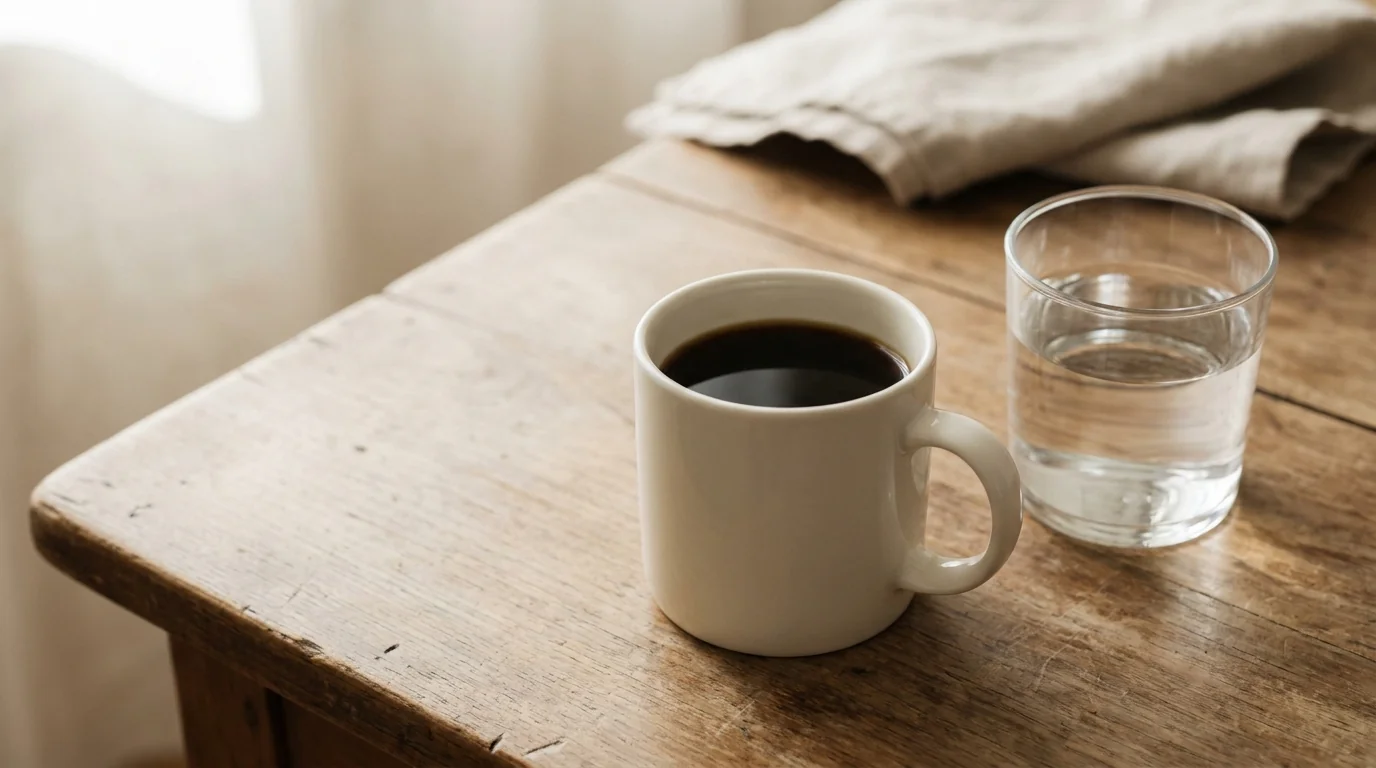
"Coffee dehydrates you" is one of the stickiest pieces of health folklore around coffee — repeated for decades, still cited casually by trainers and wellness writers. It's also straightforwardly wrong for most people at typical intake. Controlled research has directly tested the claim and found it doesn't hold up. Understanding why the myth persists — and where the small kernel of truth actually sits — helps you drink coffee without inventing a hydration problem you don't have.
Myth, mostly
controlled studies find no evidence of dehydration from moderate daily coffee intake in free-living populations[1]
High doses
a real acute diuretic effect appears at high caffeine doses (400+ mg at once), not at typical single cups[2]
Coffee counts
coffee at moderate intake contributes to daily fluid balance, per current public-health guidance[5]
The direct test
The cleanest study on this question is a 2014 PLoS ONE paper titled — plainly — "No Evidence of Dehydration with Moderate Daily Coffee Intake." Researchers used a counterbalanced crossover design in a free-living population, directly comparing four cups of coffee per day against equivalent water. They measured multiple hydration markers: body mass, blood and urine electrolytes, plasma osmolality, urine volume, and total body water.
The result: no evidence of dehydration in the coffee condition compared to the water condition. Habitual moderate coffee intake did not cause the fluid loss that the popular myth claims[1].
This wasn't a small-sample outlier. The study directly addressed the specific claim ("moderate coffee causes dehydration") and found no support for it.
Figure
Hydration markers: coffee vs water (4 cups/day for 3 days)
Values in difference vs water condition
Where the myth came from
The dehydration myth has a real biological basis — it's just that the basis has been overstated for decades.
Caffeine does have a diuretic effect — it increases urine output somewhat by acting on the kidneys. This effect is measurable in controlled settings, especially at higher doses. A 2017 Frontiers in Nutrition study specifically documented that coffee with high but not low caffeine content augments fluid and electrolyte excretion at rest — meaning the diuretic effect scales with dose and appears meaningfully only at higher intakes[2].
But two things break the "therefore coffee dehydrates you" inference:
1. Coffee is mostly water. An 8 oz cup of coffee contains about 240 mL of water — a substantial fluid contribution. Caffeine's diuretic effect increases urine output by less than this — so the net fluid balance is positive, not negative.
2. Tolerance develops. Regular coffee drinkers show substantially blunted diuretic responses to their habitual doses. Someone who drinks 3 cups a day doesn't excrete proportionally more urine on those 3 cups than a non-drinker would — the body has adapted.
Both factors together mean the "coffee is dehydrating" claim doesn't survive contact with actual data on typical drinkers.
When the diuretic effect is real
The diuretic effect isn't zero — it's just small at typical intake. The situations where it's more meaningful:
Very high single doses. 400+ mg of caffeine consumed at once (a large cold brew, multiple espressos, or caffeine pills) produces a measurable acute diuretic response even in habitual drinkers[2]. This is one reason EFSA's 200 mg single-dose limit exists — beyond it, acute effects become more pronounced.
Non-drinkers who suddenly consume caffeine. Someone who rarely drinks coffee will experience a more noticeable diuretic effect from a first-time large cup. Tolerance develops with regular consumption.
During periods of dehydration risk. If you're already dehydrated — hot climate, heavy exercise, illness — coffee's small diuretic effect might matter more relative to your overall fluid status. Water and electrolyte drinks are better primary hydration in those conditions.
With alcohol. Alcohol is a real, meaningful diuretic. Coffee stacked with alcohol (irish coffee, espresso martinis) doesn't add much diuretic burden — alcohol dominates. But after-alcohol coffee doesn't "sober you up" and doesn't rehydrate you either.
How coffee fits in daily hydration
Public-health hydration guidance has evolved. The old advice was often "drink X glasses of water per day, and don't count coffee." The current view — supported by controlled research — is that coffee at moderate intake contributes to daily fluid balance similarly (though not identically) to water[5].
Rough guidance for coffee's contribution to fluid intake:
- A typical 8 oz cup of coffee = roughly equivalent to 7 oz of water in terms of net hydration contribution (the slight discount reflects the mild diuretic effect)
- 3-4 cups of coffee per day contributes ~600-800 mL of net fluid to your daily intake
- Water is still the best default beverage, but coffee doesn't work against your hydration
Total daily fluid needs vary by climate, activity, body size, and diet. General guidance is around 2.5-3.5 L of fluid per day from all sources (drinks + food).
What about black coffee vs coffee with milk?
Milk adds fluid and some electrolytes — a milk-based coffee drink is arguably slightly more hydrating than black coffee at the same caffeine dose. This is marginal at typical intake and not worth optimising around, but if you're specifically combining hydration and coffee, a latte does hydrate slightly better than a black cup.
What about cold brew specifically?
Cold brew is often served in larger volumes (16 oz vs 8 oz for hot coffee) and can contain more caffeine per serving (150-200 mg vs 80-100 mg). A large cold brew is closer to the caffeine threshold where acute diuretic effects become noticeable. But the larger volume also means more fluid — so on balance, cold brew is still fluid-positive.
What the FDA and Health Canada say
Both agencies frame caffeine within a total-intake safety framework (400 mg/day for healthy adults, 300 mg during pregnancy) rather than as a hydration concern[3][4]. This reflects the current evidence — caffeine intake matters for cardiovascular effects, sleep, and other outcomes, but dehydration isn't the primary concern at typical doses.
Practical implications
For most healthy adults:
- Coffee counts toward your daily fluid intake
- Moderate consumption (up to 400 mg/day of caffeine) does not cause dehydration
- You don't need to "match every coffee with a glass of water" for hydration reasons (though it's fine practice)
During exercise:
- Water and (for longer or more intense sessions) electrolyte drinks remain primary hydration
- Coffee is fine before exercise and doesn't create a hydration emergency, but shouldn't be your sole fluid during long activity
- Post-exercise, both coffee and water are fine
In hot climates:
- Coffee is not disqualifying, but water and electrolyte drinks are more reliable primary hydration
- Heavy sweating means larger total fluid needs
- Watch for salt loss alongside water loss
During pregnancy:
- Health Canada's 300 mg/day caffeine ceiling still applies
- Hydration is important during pregnancy; coffee counts but water and other unsweetened drinks are also worth prioritising
After alcohol:
- Coffee doesn't rehydrate you from alcohol-related fluid loss
- Coffee doesn't sober you up either
- Water and time do the work
Common misconceptions
- "Coffee dehydrates you." Not at moderate intake in most healthy adults[1].
- "You need to drink an extra glass of water for each coffee." No, this practice isn't necessary based on current evidence. It's a good habit for overall hydration but not specifically to "offset" coffee.
- "Athletes shouldn't drink coffee because of dehydration." Coffee before exercise doesn't cause meaningful dehydration problems in habitual drinkers. Endurance research shows coffee/caffeine improves performance without impairing hydration in most conditions.
- "Decaf hydrates but regular doesn't." Both hydrate. Regular has a very small diuretic offset, but both are net fluid-positive.
The honest summary
Coffee does not dehydrate you at moderate intake. Controlled studies have directly tested and disproven this common claim. The small kernel of truth — caffeine has a mild diuretic effect at high doses — doesn't translate to net dehydration from typical coffee consumption. Coffee counts toward your daily fluid intake, and you don't need to match every cup with an extra glass of water. Water remains the best default beverage for baseline hydration, but coffee isn't working against you.
Frequently asked questions
- Does coffee dehydrate you?
- For most healthy adults at moderate intake, no. A 2014 controlled crossover study directly compared moderate coffee consumption with water in a free-living population and found no evidence of dehydration from coffee. The water in coffee more than compensates for any mild diuretic effect from caffeine.
- Is coffee a diuretic?
- Caffeine has a mild diuretic effect at high doses, but the water in the coffee itself provides substantially more fluid than caffeine causes you to lose. The net effect at moderate intake is fluid gain, not loss. High single doses (400+ mg) can produce a measurable acute diuretic response — but this is well above typical single-cup intake.
- Does coffee count toward daily water intake?
- Yes. Coffee at moderate consumption levels contributes to your daily fluid intake similarly to water, though slightly less efficiently because of the small diuretic effect. Public-health guidance from major organisations now includes coffee and other caffeinated beverages in daily fluid recommendations.
- Do habitual coffee drinkers develop tolerance to the diuretic effect?
- Yes, largely. Regular coffee drinkers show substantially blunted diuretic responses to their usual doses. Someone who rarely drinks coffee may notice more urinary urgency after a large cup than a daily drinker, whose body has adapted.
References
Every factual claim in this article is drawn from the sources below. See the source library for how we grade evidence.
- [1]No Evidence of Dehydration with Moderate Daily Coffee Intake: A Counterbalanced Cross-Over Study in a Free-Living PopulationPLoS ONE · 2014 · Controlled trial · Tier 2 · Moderate
- [2]Coffee with High but Not Low Caffeine Content Augments Fluid and Electrolyte Excretion at RestFrontiers in Nutrition · 2017 · Controlled trial · Tier 2 · Moderate
- [3]Spilling the Beans: How Much Caffeine Is Too Much?U.S. Food and Drug Administration · 2024 · Agency guidance · Tier 1 · Strong
- [4]Caffeine in foodsHealth Canada · 2022 · Agency guidance · Tier 1 · Strong
- [5]Coffee — The Nutrition SourceHarvard T.H. Chan School of Public Health · Reference work · Tier 2 · Moderate
Related reading
- Caffeine & HealthHow Much Caffeine Is in Coffee?→
- Caffeine & HealthIs Coffee Healthy? What Large Studies Actually Show→
- Caffeine & HealthHow Much Caffeine Is Too Much?→
- Caffeine & HealthBlack Coffee Benefits: What Large Studies Actually Show→
- Caffeine & HealthCaffeine and Dopamine: Why Coffee Feels Rewarding→
- Caffeine & HealthThe Caffeine Chemical Structure→