Irish Coffee: Whiskey, Cream, and Hot Coffee
By Coffee Studies Editorial·Published July 16, 2026·9 min read
Quick answer
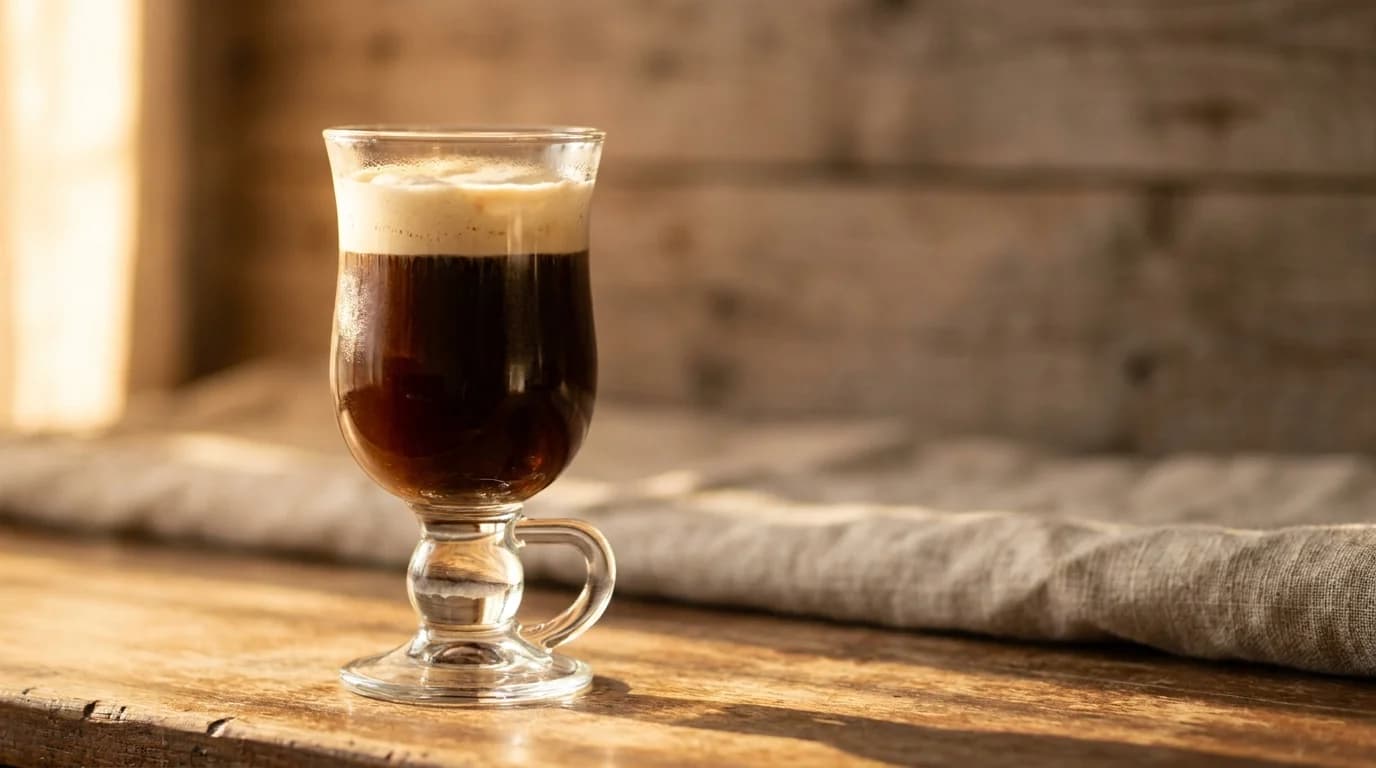
Irish coffee is one of the world's most beloved hot cocktails — and one of the most abused. The mediocre versions (coffee with a splash of whiskey, drowned in whipped cream from a canister) are unfortunately more common than proper Irish coffee (specific technique, floated hand-whipped cream, warmed footed glass). The difference between the two is substantial, and knowing what an actual Irish coffee is transforms both how you make it at home and what you order at bars.
Foynes 1940s
invented at Foynes Airport in Ireland by chef Joe Sheridan for cold transatlantic passengers[3]
Buena Vista 1952
brought to the US by Stanton Delaplane and popularised at the Buena Vista Cafe in San Francisco[2]
Floated cream
the defining technique — lightly-whipped cream floated on top so hot coffee is drunk through cool cream[1]
What Irish coffee actually is
Four ingredients, one specific technique:
- Strong hot coffee — filter drip or French press, brewed strong. Espresso works but the volume is small.
- Irish whiskey — traditionally Jameson, Tullamore Dew, or Bushmills. 1-1.5 oz per drink.
- Brown sugar — 1-2 tsp, or 2 sugar cubes. Dissolved in the coffee before adding whiskey.
- Lightly-whipped heavy cream — the critical distinguishing ingredient. Whipped just enough to thicken but still pour — not stiff peaks.
Served in: an Irish coffee glass — a footed heat-safe glass, typically 6-8 oz capacity, with the specific shape that makes cream floating easier. Traditional footed shape also stays cooler in the hand than a mug would.
Consumed by: drinking the hot coffee through the cool floated cream. Never stir. The temperature contrast and texture layer are the drink's defining sensory experience.
The Foynes origin story
Foynes, County Limerick, Ireland, mid-1940s.
Before transatlantic jet flights (roughly pre-1958), long-distance flights between Europe and North America used seaplanes — flying boats that landed on water. Foynes, on the Shannon River estuary in western Ireland, was the European terminus for these flights. Passengers landing at Foynes had often endured long, cold, uncomfortable journeys and needed warming up before continuing their travels.
Joe Sheridan, chef at Foynes Flying Boat Terminal, is generally credited with creating Irish coffee around 1943- 1945 as a warming welcome drink. The original story (possibly embroidered):
- A flight arrived in miserable weather with cold, wet passengers.
- Sheridan added whiskey to the coffee to warm them faster.
- A passenger asked "Is this Brazilian coffee?"
- Sheridan reportedly replied, "No, that's Irish coffee."
Whether the exchange happened exactly as told or not, Foynes is genuinely the origin location. Foynes hosts the annual Irish Coffee Festival and a Flying Boat Museum that celebrates this history. When commercial jet aviation moved flying to Shannon Airport (about 20 miles away) in the late 1940s, Irish coffee moved with the transportation[3].
The Buena Vista Cafe and American adoption
Irish coffee reached the United States through a specific journalistic and hospitality chain:
Stanton Delaplane was a Pulitzer Prize-winning San Francisco Chronicle travel writer. On a trip through Shannon Airport in 1952, he tried Irish coffee and became enthusiastic about the drink.
Jack Koeppler owned the Buena Vista Cafe near Fisherman's Wharf in San Francisco. Delaplane and Koeppler collaborated to recreate the Foynes-style Irish coffee in San Francisco. Their initial attempts failed — the cream wouldn't float properly.
The breakthrough: they eventually discovered that the cream needed to be aged in a refrigerator for 48 hours and whipped only lightly. With this technique combined with warm glasses and properly-strong coffee, they achieved the floating layer.
November 10, 1952: the Buena Vista Cafe began serving Irish coffee. It became the cafe's signature drink and remains so today. The Buena Vista has served over 50 million Irish coffees since — several thousand per day at peak times. Their preparation technique became the American standard: two sugar cubes, HOT coffee, Tullamore Dew, and carefully-floated cream in a specific glass[2].
The Buena Vista recipe (canonical version)
Ingredients (per drink):
- 6 oz strong hot coffee
- 1 jigger (1.5 oz) Irish whiskey
- 2 sugar cubes (or 2 tsp brown sugar)
- Fresh heavy cream, aged 48 hours in refrigerator, whipped just to thicken
Equipment:
- Irish coffee glass (footed, heat-safe)
- Small whisk or milk frother for cream
- Bar spoon for stirring
Process:
- Pre-warm the glass — fill with hot water, let sit for 20-30 seconds, then empty. Cold glass will cool the drink and break the cream layer.
- Add sugar cubes to the warm glass.
- Fill 3/4 with hot coffee — Buena Vista uses a specific blend brewed strong; any decent strong drip works.
- Stir to fully dissolve the sugar. This must happen before adding whiskey.
- Add the jigger of whiskey. Stir briefly to combine.
- Whip the cream: in a small bowl, whisk cold heavy cream just until it thickens noticeably but still flows. Not stiff peaks — you should be able to pour it. ~15-20 seconds of vigorous whisking. Practice matters.
- Float the cream: hold a spoon curved-side up above the drink, and slowly pour the whipped cream over the back of the spoon so it lands gently on top of the coffee. The cream should sit as a distinct 1-1.5 cm layer.
- Serve immediately. Do not stir before or during consumption.
Drinking technique: sip the hot coffee through the cool cream layer. The temperature and texture contrast is the drink's signature experience.
Why proper technique matters
Common Irish coffee failures:
Cream problems
Cream sinks or mixes in: cream was over-whipped (won't pour) or under-whipped (too thin to float). The right level is thickened but still flowable — like a thick pouring consistency.
Cream layer is thin and unstable: cream may have been at wrong temperature, or the pour was too fast, breaking the surface tension.
Balance problems
Drink is too sweet: too much sugar. Traditional recipe uses 2 cubes (about 2 tsp); some drinkers prefer 1 cube.
Drink is too weak: coffee wasn't strong enough. Irish coffee needs strong coffee to balance the whiskey and sugar. Weak coffee produces a weak drink.
Ingredient shortcuts
Whipped cream from a can: don't. Canned whipped cream has stabilisers and air that don't produce the right texture; it sits on top but as pretend-cream rather than proper floated cream.
Milk instead of cream: doesn't float. Won't work.
Stirring after cream added: ruins the layered structure.
Variations
National spirit variants
Gaelic Coffee, Scotch Coffee, French Coffee, Spanish Coffee, Jamaican Coffee — same technique with different national spirits (Scotch, brandy, tequila, rum) and sometimes different sweeteners. Each has its own name and loyal following.
Whiskey choice
Irish coffee with different Irish whiskeys:
- Jameson — standard Buena Vista choice; smooth, mild.
- Tullamore Dew — original Buena Vista choice; slightly sweeter.
- Bushmills — Northern Irish; slightly grainy character.
- Redbreast or Green Spot — premium single pot still Irish whiskeys; makes an elevated version.
Baileys variant
Irish cream (Baileys) Irish coffee — a variant using Baileys instead of straight whiskey. Different drink; sweeter, creamier throughout, no floated cream layer.
Espresso variant
Espresso Irish coffee — espresso base instead of drip coffee. Smaller volume, more intense. Some contemporary bars serve this — closer to a Spanish carajillo in construction.
Vegan variant
Vegan Irish coffee — with coconut cream or oat cream substituted. Doesn't quite achieve the same floating behaviour but approximates.
Making at home
The Buena Vista technique adapted for home:
Ingredients
Ingredients:
- 6 oz strong French press or drip coffee
- 1.5 oz Jameson (or preferred Irish whiskey)
- 2 tsp brown sugar (or 2 sugar cubes)
- 2-3 oz heavy cream
Cream preparation
Cream preparation:
- Use heavy cream (35%+ fat).
- Aged in fridge for a day or two if possible.
- Whip with a small whisk or milk frother.
- Stop when cream visibly thickens but still pours easily.
- Practice: the first few attempts often fail.
Coffee preparation
Coffee preparation:
- Brew strong: use slightly more coffee than usual (say 1:14 ratio instead of 1:16 for pour-over).
- Very hot: coffee needs to be near-boiling in the glass.
Assembly
Assembly:
- Warm the glass with hot water first.
- Sugar in glass, add hot coffee, stir to dissolve.
- Add whiskey, stir briefly.
- Float cream over the back of a spoon.
- Serve immediately.
Practice tips
Practice tips:
- Cream floatation is the hardest part; practice with water and cream first to develop technique.
- Small footed glasses work better than mugs — the curved shape helps cream layer stability.
- Use a bar spoon or long teaspoon for cream floating.
Nutrition and caffeine
Standard Irish coffee (Buena Vista style):
- Coffee: 6 oz strong drip ≈ 130-160 mg caffeine.
- Whiskey: 1.5 oz Irish whiskey ≈ 100 calories, 15g alcohol.
- Brown sugar: 2 tsp ≈ 30 calories, 8g sugar.
- Cream: 2 tbsp lightly-whipped ≈ 100 calories, 11g fat.
- Total: roughly 230-260 calories per drink.
Alcohol content: approximately 5-6% ABV of the full drink volume. About the same alcohol as a beer.
Caffeine: approximately equivalent to a cup of coffee. Note the combination of caffeine + alcohol produces distinctive effects; caffeine can mask the perception of intoxication without reducing actual alcohol impairment. Drink accordingly.
Common misconceptions
- "Irish coffee is coffee with whiskey." Coffee with whiskey is a spiked coffee. Irish coffee has a specific technique — floated cream layer, warm glass, dissolved sugar — that distinguishes it.
- "Any whiskey works." Traditionally and for the name to be honest, Irish whiskey. Scotch works but that's Gaelic coffee; bourbon works but it's not really Irish coffee.
- "Canned whipped cream is fine." Not really. Fresh lightly-whipped cream floats and sits differently than canned whipped cream (which is aerated and stabilised differently).
- "You should stir before drinking." No — the layered structure is the point. Never stir.
- "Irish coffee is a modern invention." Foynes 1943-45 is old enough for the drink to be considered classical. Buena Vista's 1952 American introduction is 70+ years old.
Practical rules
When ordering at bars:
- Specialty cocktail bars usually make Irish coffee properly.
- Chain restaurants and bars often make poor versions (canned cream, weak coffee, no glass warming).
- The Buena Vista Cafe in San Francisco makes the canonical version — worth visiting if you're there.
When making at home:
- Invest in a small Irish coffee glass set ($15-25 for a set of 4 or 6).
- Use quality Irish whiskey — cheap whiskey doesn't hide in Irish coffee.
- Practice cream whipping to the right consistency before serving to guests.
When drinking:
- Never stir. Drink through the cream.
- Enjoy the temperature contrast — that's the drink's point.
- Pair with something hearty (Irish coffee is a great after-dinner drink).
When to avoid:
- Late at night if caffeine sensitivity would prevent sleep.
- Combined with substantial other alcohol (caffeine can mask intoxication without reducing impairment).
The honest summary
Irish coffee is a hot coffee cocktail with a specific, particular construction: strong hot coffee, Irish whiskey, brown sugar dissolved in the coffee, and lightly-whipped cream carefully floated on top so the hot coffee is drunk through the cool cream. Created at Foynes Airport in Ireland in the mid-1940s by chef Joe Sheridan, popularised in the US by the Buena Vista Cafe in San Francisco from 1952. The specific technique — particularly the cream whipping and floating — is what makes an Irish coffee proper rather than just spiked coffee. Bad versions are common; good versions are one of the most satisfying hot cocktails in the world. Worth learning to make properly.
Frequently asked questions
- What is Irish coffee?
- Irish coffee is a hot coffee cocktail with four ingredients: strong hot coffee, Irish whiskey, brown sugar, and lightly-whipped cream. The classic construction: dissolve brown sugar in hot coffee, add Irish whiskey, then float lightly-whipped cream on top so it sits as a distinct layer. Served in a footed heat-safe glass (Irish coffee glass) so the layering is visible. The drink is consumed by drinking the hot coffee through the cool cream — you never stir.
- Where did Irish coffee come from?
- Foynes Airport in Ireland, in the 1940s. Chef Joe Sheridan created the drink to warm up cold, wet passengers arriving from transatlantic flying-boat flights (which landed in Foynes before jet-age airports existed). When passengers asked if they were being served Brazilian coffee, Sheridan reportedly answered 'no, that's Irish coffee' — and the name stuck. American travel writer Stanton Delaplane brought the recipe to San Francisco in 1952, and the Buena Vista Cafe developed the iconic version that spread across America.
- What's the correct Irish coffee recipe?
- Traditional Buena Vista Cafe recipe: pre-warm a 6 oz footed glass with hot water, empty it, add 2 sugar cubes (or 2 tsp brown sugar), fill 3/4 with strong hot coffee, stir to dissolve sugar completely, add 1 jigger (1.5 oz) Irish whiskey, top with lightly-whipped heavy cream (whisked just enough to thicken but still pourable — not stiff peaks). The cream should float on top as a distinct 1-1.5 cm layer. Serve immediately; do not stir.
- Why float the cream instead of stirring it in?
- The temperature contrast is the point. You drink the hot sweet whiskey-coffee through the cool unsweetened cream — the temperature difference and the cream's texture layer are the drink's signature sensory experience. Stirring the cream in would give you a mediocre coffee-and-cream drink; floating creates the distinctive Irish coffee experience. The technique requires cream at the right whip level — thick enough to float, thin enough to still be pourable.
- What whiskey works best in Irish coffee?
- Irish whiskey specifically — Jameson is the standard choice at most bars; Tullamore Dew and Bushmills also common. The characteristic smoothness of triple-distilled Irish whiskey (less peaty than Scotch, less rye-forward than American whiskey) integrates well with coffee. Scotch, bourbon, or rye all work in coffee cocktails but produce different flavour profiles. Traditionalists insist on Irish whiskey specifically for a drink called Irish coffee.
References
Every factual claim in this article is drawn from the sources below. See the source library for how we grade evidence.
- [1]Brewing FundamentalsCoffee Science Foundation · Reference work · Tier 2 · Moderate
- [2]CoffeeEncyclopaedia Britannica · Reference work · Tier 3 · Contextual
- [3]Uncommon Grounds: The History of Coffee and How It Transformed Our World (revised edition)Basic Books (Mark Pendergrast) · 2010 · Reference work · Tier 2 · Moderate
Related reading
- Espresso & Coffee DrinksWhat Is Espresso? Pressure, Extraction, the Shot→
- Espresso & Coffee DrinksCappuccino: The Classic Italian Espresso Drink→
- Espresso & Coffee DrinksWhat Is an Americano? Espresso with Water, Explained→
- Espresso & Coffee DrinksSpanish Coffee: The Flambéed Rum Cocktail→
- Espresso & Coffee DrinksVietnamese Egg Coffee: The Hanoi Original→
- Espresso & Coffee DrinksLatte Art: How to Pour Designs in Milk Foam→