French Press Guide: Ratios, Steep Time, and Technique
By Coffee Studies Editorial·Published July 15, 2026·6 min read
Quick answer
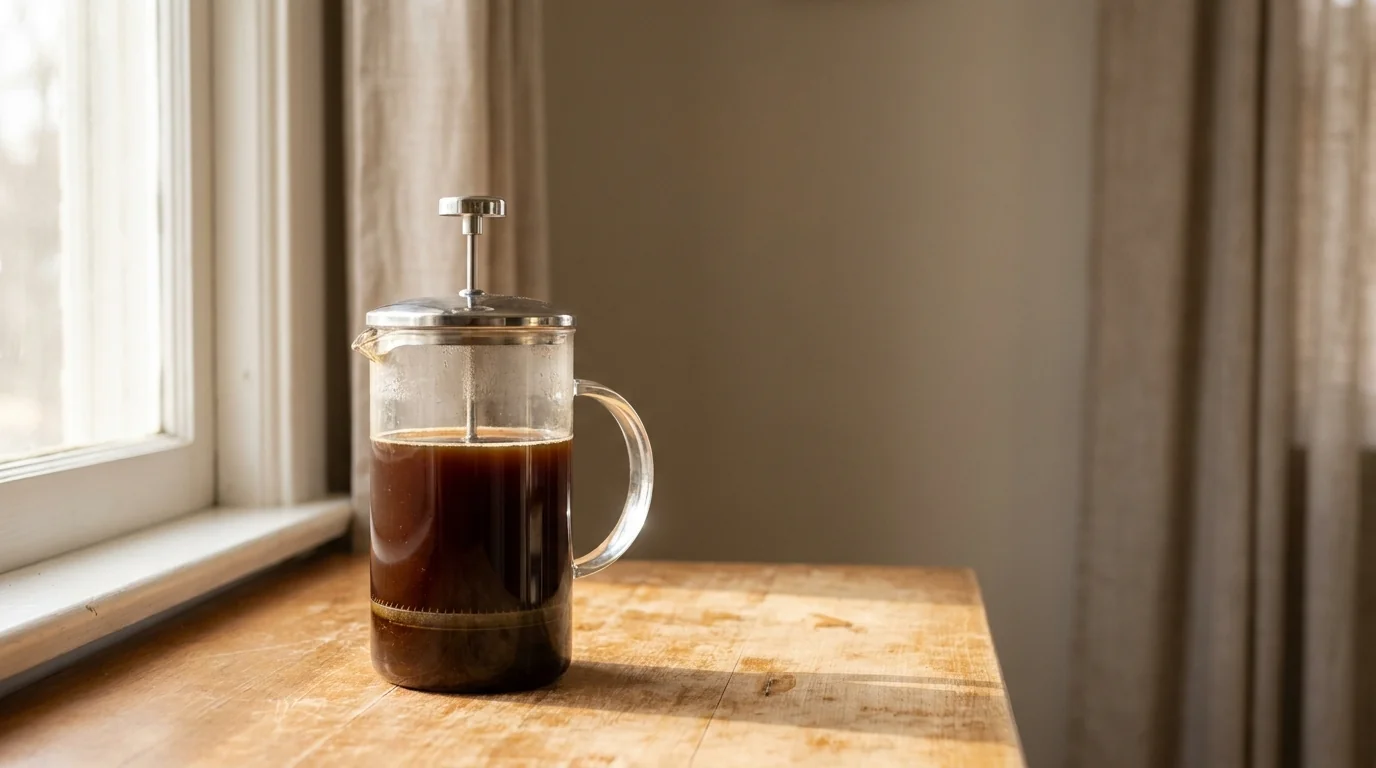
French press is the second-easiest brewing method after cold brew and one of the most forgiving. There's no filter to fold, no gooseneck kettle required, no pouring technique to master. What you get is a fuller-bodied, more textured cup than paper-filtered methods produce — which some drinkers love and some don't.
1:15 ratio
a good French press default — 30 g coffee to 450 mL water for a two-mug batch[3]
4 minutes
the classic French press steep time before pressing the plunger[2]
Full body
mesh filtration lets oils and micro-particles through — more body, more sediment than paper-filter brewing[1]
What you need
- A French press — 3-cup, 8-cup, or 12-cup capacity. Glass is traditional; stainless steel keeps heat better.
- A scale — for consistent ratios.
- A burr grinder — French press is especially sensitive to grind uniformity; blade grinders produce fines that pass through the mesh and make the cup gritty.
- A kettle — no gooseneck required. Any kettle works.
- A timer — 4-6 minute steep matters.
The basic recipe
For a two-mug batch (about 450 mL of finished coffee):
- Boil water. Turn off the heat and let it sit for 30 seconds — aim for ~95 °C. Boiling water is too hot and can over-extract.
- Grind 30 g of coffee coarse — texture like breadcrumbs or coarse sea salt.
- Warm the press with a splash of hot water; discard.
- Add ground coffee to the empty press.
- Start your timer. Pour in ~450 g of hot water, wetting all the grounds evenly. The grounds will form a "crust" on top — that's expected.
- Wait 4 minutes.
- Stir the crust gently with a spoon to break it up. Some grounds will sink; that's fine.
- Wait another 30 seconds for heavier particles to settle.
- Insert the plunger and press slowly and evenly. Should take about 20 seconds — no faster.
- Pour immediately into your mugs. Don't let the coffee sit in the press with the plunged grounds; it will continue extracting and turn bitter.
Grind size for French press
Coarse. This matters more than for most other methods, for two reasons:
1. Sediment. French press uses a metal mesh filter that lets some sediment through by design — that's part of the character. Fine grind produces "fines" that pass through the mesh and make the cup gritty. Coarse grind minimises this.
2. Extraction time. The 4-minute steep is long. Fine grind at 4 minutes over-extracts and produces bitter, harsh coffee.
If your French press coffee is gritty, grind coarser before anything else. A burr grinder is much better for French press than a blade grinder because it produces uniform particles without the fines problem.
Troubleshooting
Bitter, harsh, dry finish:
- Grind coarser
- Reduce steep time to 3 minutes
- Water temperature too hot — let it sit longer off the boil
Sour, thin, weak:
- Grind slightly finer
- Extend steep to 5 minutes
- Water too cool
Gritty, muddy:
- Grind coarser
- Let the press stand 30 seconds after plunging before pouring
- Consider a metal mesh with finer weave, or add a paper filter disc over the mesh (some sellers make these)
Coffee tastes fine but doesn't stay hot:
- Pre-warm the press with hot water
- Pour into pre-warmed mugs
- Use a stainless-steel press instead of glass — much better heat retention
What makes French press coffee different
Compared to paper-filter methods (pour-over, drip):
- More body. Mesh filtration lets oils and colloidal particles through. The cup has a richer, more textured mouthfeel.
- More sediment. Some fine particles inevitably pass the mesh. Most drinkers accept a small amount; too much means the grind is too fine.
- Different chemistry. A 2020 Foods study compared brewing methods for mineral and antioxidant content — French press preserved more minerals and produced a different antioxidant profile than paper-filtered methods[1].
- Higher cafestol and kahweol. These are coffee oil compounds (diterpenes) that paper filters trap effectively but mesh filters don't. See the cholesterol question below.
- Full immersion. All the coffee is in contact with all the water for the full time, which gives more consistent extraction than pour-based methods (where water moves through the coffee bed unevenly).
The cafestol and cholesterol question
Unfiltered coffee — French press, moka pot, espresso, Turkish coffee — contains higher levels of two compounds called cafestol and kahweol. These are diterpenes present in coffee oil, and paper filters remove them very effectively (up to 99%+) while mesh filters let them through.
Cafestol in particular can raise LDL cholesterol at high habitual intakes. The effect is dose-dependent:
- Occasional French press or 1-2 cups a day: not a meaningful concern for most people.
- Multiple cups a day of unfiltered coffee in people with already-elevated cholesterol: worth considering, especially in the context of overall cardiovascular risk.
- Paper-filtered coffee: essentially no cafestol; no cholesterol effect.
This isn't a reason to avoid French press. It's a reason to be aware of what you're drinking — and if cholesterol is a concern, switching to paper-filtered methods for daily coffee (keeping French press as an occasional treat) is a reasonable choice.
French press vs other immersion methods
French press isn't the only immersion brewing method:
Aeropress: shorter steep, then push through a paper or metal filter. Much smaller batch (single serving). Very versatile.
Clever dripper: hybrid — steep like French press, then drain through a paper filter at the end. Combines immersion evenness with paper filtration.
Cold brew: immersion at cold temperature for 12-24 hours. Different chemistry entirely.
Moka pot: not really immersion — pressure-driven, closer to espresso than French press despite the stovetop simplicity.
When French press is the right tool
Best for:
- Drinkers who like fuller-bodied, more textured coffee
- Making 2-4 cups at once (household mornings)
- Camping, travel, or situations without electricity
- Low equipment budget — a decent press is $20-40
- Beans that lean bright and want body to balance them
- Drinkers who don't mind minor sediment
Not the best for:
- Anyone who wants very clean, tea-like clarity — pour-over is better
- Single-serving purists — Aeropress or V60 are better
- Beans that are already very heavy or over-roasted — the added body compounds this
- People with elevated cholesterol worried about cafestol
- Anyone bothered by even small amounts of sediment
Common misconceptions
- "French press is the strongest coffee method." Not really. Espresso is much stronger per unit volume. French press is fuller-bodied than pour-over but not stronger in terms of dissolved solids at typical ratios.
- "You have to press hard." Slow, even pressure. Fast pressing can push grounds through the mesh and produce muddy coffee.
- "French press coffee tastes bad because I use the same grind as drip." Yes. Grind coarser.
- "Metal filters filter everything." Metal mesh filters let oils and fine particles through. That's a feature, not a bug — but it means French press coffee has meaningfully different chemistry than paper-filtered methods[4].
The honest summary
French press is the most forgiving fuller-bodied brewing method you can make at home. Coarse grind, 4-minute steep, 1:15 ratio, and slow press — that's the whole recipe. It produces a different kind of cup than pour-over — more textured, more oily, more body — and neither is objectively better. Cafestol is worth knowing about if you drink a lot of unfiltered coffee and have cholesterol concerns; otherwise, drink and enjoy.
Frequently asked questions
- What ratio should I use for French press?
- 1:14 to 1:17 by weight. 1:15 is a good default — about 30 g of ground coffee for 450 mL of water. Stronger drinkers go to 1:14; lighter cups sit at 1:17. French press tolerates a wider range than pour-over because the full-immersion brewing evens things out.
- How long do I steep French press coffee?
- 4 minutes is the classic time. Some drinkers extend to 5-6 minutes for a heavier cup; anything past 8 minutes tends toward bitter over-extraction. The steep time is one of your extraction levers along with grind and water temperature.
- Why is my French press coffee gritty?
- Grind is likely too fine. French press uses a metal mesh filter that lets some sediment through by design — fine grind means more fines make it into the cup. Use a coarse grind (closer to breadcrumb texture) and let the press stand for 30 seconds after plunging to let heavy particles settle.
- Is French press coffee bad for cholesterol?
- Unfiltered coffee (French press, moka pot, espresso) contains higher levels of cafestol and kahweol — diterpenes that can raise LDL cholesterol. Paper-filter methods remove most of these. The effect is dose-dependent and mostly matters if you drink large amounts of unfiltered coffee and already have elevated cholesterol. Occasional French press cups aren't a concern.
References
Every factual claim in this article is drawn from the sources below. See the source library for how we grade evidence.
- [1]Mineral Composition and Antioxidant Potential of Coffee Beverages Depending on the Brewing MethodFoods · 2020 · Observational study · Tier 2 · Moderate
- [2]Comparison of nine common coffee extraction methods: instrumental and sensory analysisEuropean Food Research and Technology · 2013 · Controlled trial · Tier 2 · Moderate
- [3]Brewing FundamentalsCoffee Science Foundation · Reference work · Tier 2 · Moderate
- [4]Coffee extraction kinetics in a well mixed systemJournal of Mathematics in Industry · 2016 · Review · Tier 2 · Moderate
Related reading
- Brew MethodsPour-Over Coffee Guide: Ratios, Bloom, and Technique→
- Brewing ScienceCoffee-to-Water Ratio Explained→
- Brewing ScienceCoffee Grind Size Guide: Which Grind for Which Method→
- Brew MethodsAeroPress Brew Guide: Ratios, Inverted Method, Tips→
- Brew MethodsHow to Make Turkish Coffee: Cezve, Grind, and Serving→
- Brew MethodsV60 Pour-Over Guide: Ratios, Technique, Step by Step→