Burr vs Blade Grinder: Which Makes Better Coffee?
By Coffee Studies Editorial·Published July 15, 2026·8 min read
Quick answer
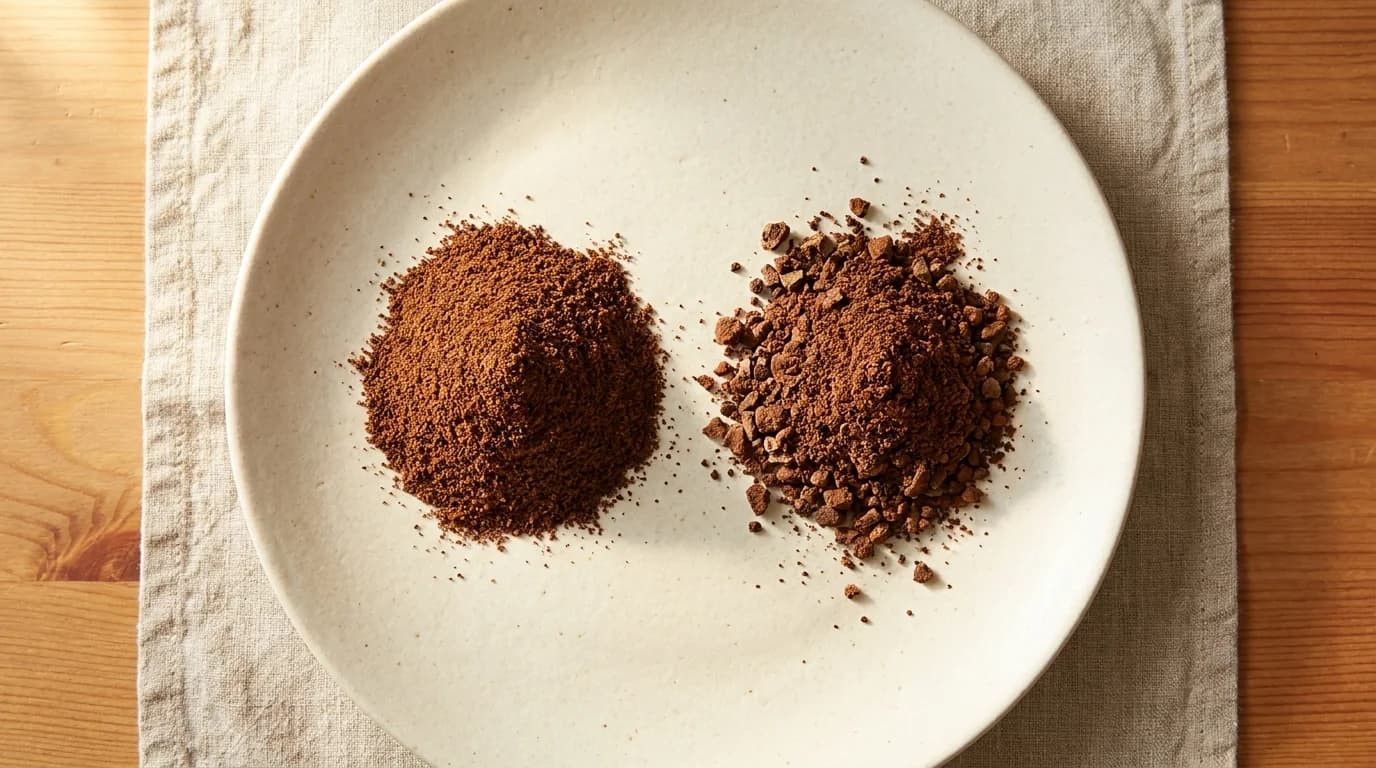
If you're going to buy exactly one piece of coffee equipment that will make your coffee meaningfully better, it isn't a fancier brewer or more expensive beans — it's a burr grinder. Grind consistency drives extraction consistency, and extraction consistency drives flavour. The difference between a blade grinder and a burr grinder is not incremental; it's the difference between coffee that tastes cleanly of one thing and coffee that tastes like several conflicting things at once.
Burrs crush
two rotating abrasive plates grind beans to a controlled particle size[1]
Blades chop
spinning blades break beans randomly into a mix of dust and boulders[4]
Bimodal grind
blade grinders produce fine dust and coarse chunks with almost nothing in between — the worst particle distribution for even extraction[2]
Why grind consistency matters
Coffee extraction is fundamentally about water dissolving compounds out of coffee particles. Different compounds dissolve at different rates:
- Fastest to extract: acids and lighter aromatic compounds (contribute brightness and floral notes).
- Medium: sugars and pleasant bitters (contribute sweetness and body).
- Slowest to extract: heavy bitters, dry tannins, and chemical compounds that produce off-flavours (astringency, dry harshness).
Extraction rate depends on particle surface area. Smaller particles have more surface area per gram, so they extract faster. Larger particles have less surface area, so they extract slower[2].
Here's the problem with uneven grind:
If you grind coffee to a mix of very fine dust and very coarse chunks (a blade grinder result), and you brew the whole thing together:
- The fine dust extracts to the point of over-extraction before the brew is done — you get bitter compounds, dry tannins, and astringency from those particles.
- The coarse chunks are still under-extracting when the brew ends — they give you sour, weak, hollow flavours.
- Both problems land in your cup at the same time.
And no brewing adjustment fixes both simultaneously. If you brew longer to extract the coarse chunks properly, the fine dust becomes even more over-extracted. If you brew shorter to protect the fine dust, the coarse chunks are more under-extracted.
The only way out of this is to have particles that extract at similar rates — which requires a burr grinder.
What burrs actually do
A burr grinder has two burrs (grinding plates) with abrasive surfaces. In an electric burr grinder, one burr is fixed and the other spins; in a hand grinder, one is fixed and the other rotates as you turn the crank. Coffee beans fall into the space between the burrs and are progressively crushed into smaller particles until they're small enough to fall through the gap and out.
The key feature: the gap between the burrs determines particle size. You set the gap; the burrs grind everything to approximately that size. Particle distribution is much more uniform than what blades produce — mostly clustered around your chosen setting with a much narrower spread[1].
Different burr geometries exist:
Conical burrs
Conical burrs. A cone-shaped inner burr rotates inside a ring-shaped outer burr. Coffee falls in from the top and progressively works its way down through decreasing gap sizes. Conical burrs are common in both hand grinders and espresso grinders. They tend to produce slightly more fines than flat burrs but are compact and efficient.
Flat burrs
Flat burrs. Two parallel disc-shaped burrs, one above the other, spinning against each other. Coffee falls between them and grinds outward. Flat burrs tend to produce more uniform particles than conical (fewer fines, tighter distribution) but require more power and are usually more expensive. Common in high-end café espresso grinders.
Ghost and hybrid burrs
Ghost burrs, hybrid designs, "unibody" burrs. Various manufacturers produce burr designs with modified geometry — generally aimed at producing more uniformity for specific brewing methods (espresso vs filter).
What blades do (and don't do)
A blade grinder is a small chamber with a spinning propeller- shaped blade at the bottom. You put beans in, press the button, and the blades chop the beans by impact.
Fundamental limitations:
- No size control. The blades just chop until you stop. Length of grind time roughly correlates with average particle size, but there's no direct way to set a target size.
- Bimodal distribution. Blade grinders reliably produce a mix of very fine particles (created by repeated chopping of the coffee that gets stuck near the blades) and much larger chunks (the coffee that spends less time near the blades). The particle size distribution has two peaks — fines and boulders — with less in between. This is approximately the worst particle distribution possible for even extraction[2].
- Heat generation. The high-speed blade action generates friction heat, which can slightly begin roasting-adjacent chemical changes in the coffee — a small effect but real.
- Inconsistent batch to batch. Even the same operator can't reproduce grind exactly from day to day with a blade grinder.
What blade grinders are OK for:
- Spices (uniform grind matters much less for cooking).
- Emergency coffee grinding when you have no better option.
- Very coarse grinds where the mix of particles is closer to workable (though even here a burr is significantly better).
Figure
Grind uniformity by grinder type
Values in % of grounds within target particle-size band
The practical difference in the cup
Try this experiment if you have both grinder types:
- Same beans, same brewing method, same amount of coffee and water, same water temperature, same total brew time.
- Brew one cup with blade-ground coffee, one with burr- ground coffee.
- Taste them side by side.
Almost every taster identifies the burr-ground brew as cleaner, more balanced, and more clearly flavoured. The blade- ground brew often tastes muddled — bitter and sour at the same time, harder to identify individual flavour notes.
This isn't subtle. It's usually the biggest single flavour difference in coffee brewing.
Espresso vs filter — grinder sensitivity
Filter brewing is less grind-sensitive than espresso, but still substantially benefits from a good burr grinder.
Espresso is extremely grind-sensitive
Espresso is extremely grind-sensitive:
- The high pressure and short brewing time (25-30 seconds) means any particle-size unevenness produces very noticeable channelling and extraction problems.
- Espresso requires a much narrower particle distribution than filter brewing — usually a step-up to a dedicated espresso grinder.
- Entry-level burr grinders for espresso start around $300-400 (Baratza Sette, Eureka Mignon Filtro, DF64).
- High-end espresso grinders (Mahlkönig EK43, Mazzer Robur) are $2000+.
Filter brewing is more forgiving
Filter brewing is more forgiving:
- Longer brewing time (3-5 minutes) and lower pressure gives particles more time to extract evenly even with some variation.
- Entry-level burr grinders ($100-200) produce excellent filter coffee.
- Diminishing returns above about $500 for filter-only use.
If you brew both
If you brew both:
- A single grinder that does espresso well will also do filter well.
- A grinder that does filter well may not do espresso well — filter grinders often can't grind fine enough.
- Two-grinder households (one for espresso, one for filter) are common among serious home baristas.
What to spend
The short version: the jump from blades to any burr grinder is the large one, and a hand grinder crosses it for the price of a blade grinder. After that, money buys consistency and serviceability rather than a dramatically better grind, and espresso capability is only worth paying for if you pull shots.
For most home users, an entry-level electric burr grinder paired with an inexpensive pour-over will produce outstanding coffee. Spend more on the grinder than on the brewer[3]. The tier-by-tier breakdown, and what each step actually buys, is in how much to spend on a coffee grinder.
Two that meet the specification
 Manual burr grinderCEVING Mini Manual Coffee Grinder With 40 Adjustable Settings, Black | Portable Hand Coffee Bean Mill with Ceramic Conical Burrs, 30g Capacity, Ideal for Travel, Camping, French Press, Pour OverA hand grinder gets you real burrs for the price of a blade grinder, with the trade that you turn the handle. For one or two cups a day the time cost is under a minute and the particle distribution is in a different class from a blade.amazon.com $17.99 USDamazon.ca $24.25 CADPrice and availability as of View on Amazon
 Entry-level conical burr grinderBaratza Encore Coffee Grinder ZCG485BLK, Black | Beginner-friendly grinder with powerful motor and 40mm conical steel burrs for consistent, brew-ready performanceThe usual answer to "the cheapest grinder worth owning" for filter coffee. Conical burrs, forty steps, and — the part that matters over years — every wear part is a listed spare, so it is repairable rather than disposable.amazon.com $149.95 USDamazon.ca $199.00 CADPrice and availability as of View on Amazon
Product prices and availability are accurate as of the date/time indicated and are subject to change. Any price and availability information displayed on Amazon at the time of purchase will apply to the purchase of this product. Certain content that appears on this site comes from Amazon. This content is provided ‘as is’ and is subject to change or removal at any time.
Ceramic vs steel burrs
Both burr materials can produce excellent grinds. Real differences:
Steel burrs
Steel (usually stainless steel):
- Slightly faster grinding.
- More durable under abusive use (foreign objects, overheating).
- Can be sharpened by manufacturer.
- Most common in mid-to-high-end grinders.
Ceramic burrs
Ceramic:
- Stays cooler during grinding (less friction heat).
- Holds edge longer at moderate use.
- Chips if you grind pebbles, over-tightened burrs, or a hard foreign object.
- Common in entry-level and hand grinders (cheaper to manufacture).
For most home users, the burr geometry matters much more than the material. Both perform well in appropriately- designed grinders.
Common misconceptions
- "A blade grinder is fine if I brew carefully." No brewing technique fully compensates for bimodal particle distribution. The particle problem happens before the water touches the grounds.
- "I have a $500 espresso machine so I don't need a good grinder." You have this exactly backwards. A good espresso machine paired with a bad grinder produces bad espresso. A modest espresso machine paired with a good grinder produces good espresso.
- "Pre-ground coffee is the same as blade-ground." Pre- ground coffee from a proper commercial burr grinder is much more consistent than blade-ground, but suffers from oxidation the moment the bag is opened. Freshly-burr- ground is best; pre-ground is second; blade-ground is distant third.
- "Higher RPM grinders are better." Not directly — high- RPM grinders (blade grinders and some low-quality electric burrs) generate more heat. Lower RPM with quality burrs is generally preferable for flavour.
Practical rules
If you have a blade grinder:
- The single biggest coffee upgrade you can make is replacing it with a burr grinder — even an entry-level one.
If you're buying your first burr grinder:
- Hand grinder ($60-80) if you only brew 1-2 cups per session and don't mind the effort.
- Electric ($150-250) if you brew larger batches or want convenience.
If you're upgrading from a decent burr grinder:
- Only worth spending significantly more if you're brewing espresso or you notice specific limitations of your current grinder.
- Filter brewing benefits diminish above $500 for most users.
Cleaning matters:
- Old ground coffee residue in the grinder chamber contributes stale flavours to fresh grinds.
- Wipe the grind chamber and burr area regularly.
- Grinder cleaning tablets (Grindz or similar) periodically remove built-up oils.
The honest summary
Grinder type is the single most consequential coffee- equipment decision. Burr grinders produce reasonably uniform particle sizes, allowing even extraction and clean flavour. Blade grinders produce a bimodal mix of dust and chunks that extracts both over and under simultaneously, producing muddled cups that no brewing technique fully rescues. Any real burr grinder — even an entry-level one — outperforms any blade grinder. If you're serious about coffee flavour and you have a blade grinder, upgrade to a burr grinder before you upgrade anything else in your setup. Spend more on the grinder than the brewer for filter coffee; grind quality dominates the flavour result.
Frequently asked questions
- What's the difference between burr and blade grinders?
- Burr grinders crush coffee beans between two rotating abrasive plates (burrs), producing particles of consistent size. Blade grinders chop coffee with spinning blades, more like a small propeller — producing a random mix of very fine dust, medium particles, and coarse chunks. The mechanical difference is fundamental: burrs grind, blades chop.
- Why does grind consistency matter for coffee?
- Extraction is a chemical process that depends on particle surface area and water contact time. Uniform particles extract at the same rate, giving even flavour. When particles vary widely in size — as with a blade grinder — small particles over-extract (bitter, dry, astringent) while large particles under-extract (sour, thin, hollow). Both problems appear in the same cup at the same time, and no brewing adjustment can fix them simultaneously.
- Is a burr grinder really that much better?
- Yes — grind consistency is one of the two biggest levers on coffee flavour (the other being bean freshness). Upgrading from a blade grinder to a decent burr grinder produces a bigger flavour improvement than any other single equipment change. A $100-200 burr grinder plus a $30 pour-over produces noticeably better coffee than $500 of espresso machine paired with a blade grinder.
- What's the difference between ceramic and steel burrs?
- Both can produce excellent grinds. Steel burrs (usually stainless) grind slightly faster and are more durable under abusive use. Ceramic burrs stay cooler during grinding (less heat transfer to coffee) and hold sharpness longer at typical use levels, but chip if you grind pebbles or foreign objects. For most home users, either is fine — the burr geometry matters more than the material.
- Do I need an expensive grinder?
- No — but you do need a real burr grinder. Entry-level conical-burr manual grinders (Hario Skerton, 1Zpresso) start around $50-80. Entry-level electric burr grinders (Baratza Encore) start around $150. These significantly outperform any blade grinder. Higher-end grinders ($400-1500+) matter mostly for espresso, which is much more grind-sensitive than filter brewing.
References
Every factual claim in this article is drawn from the sources below. See the source library for how we grade evidence.
- [1]The effect of bean origin and temperature on grinding roasted coffeeScientific Reports · 2016 · Controlled trial · Tier 2 · Moderate
- [2]Coffee extraction kinetics in a well mixed systemJournal of Mathematics in Industry · 2016 · Review · Tier 2 · Moderate
- [3]Effects of brew strength, brew yield, and roast on the sensory quality of drip brewed coffeeJournal of Food Science · 2020 · Controlled trial · Tier 2 · Moderate
- [4]Brewing FundamentalsCoffee Science Foundation · Reference work · Tier 2 · Moderate
- [5]Comparison of nine common coffee extraction methods: instrumental and sensory analysisEuropean Food Research and Technology · 2013 · Controlled trial · Tier 2 · Moderate
Related reading
- Brewing ScienceCoffee Grind Size Guide: Which Grind for Which Method→
- Brewing ScienceCoffee Extraction Explained: TDS, Solubles, and Yield→
- Brewing ScienceUnder-Extracted vs Over-Extracted Coffee→
- Brewing ScienceDoes Coffee Have Tannins? Yes, But Far Less Than Tea→
- Brewing ScienceHow Long Does Coffee Last? Freshness and Shelf Life→
- Brewing ScienceLow Acid Coffee: Best Varieties for Sensitive Stomachs→