Coffee Extraction Explained: TDS, Solubles, and Yield
By Coffee Studies Editorial·Published July 15, 2026·7 min read
Quick answer
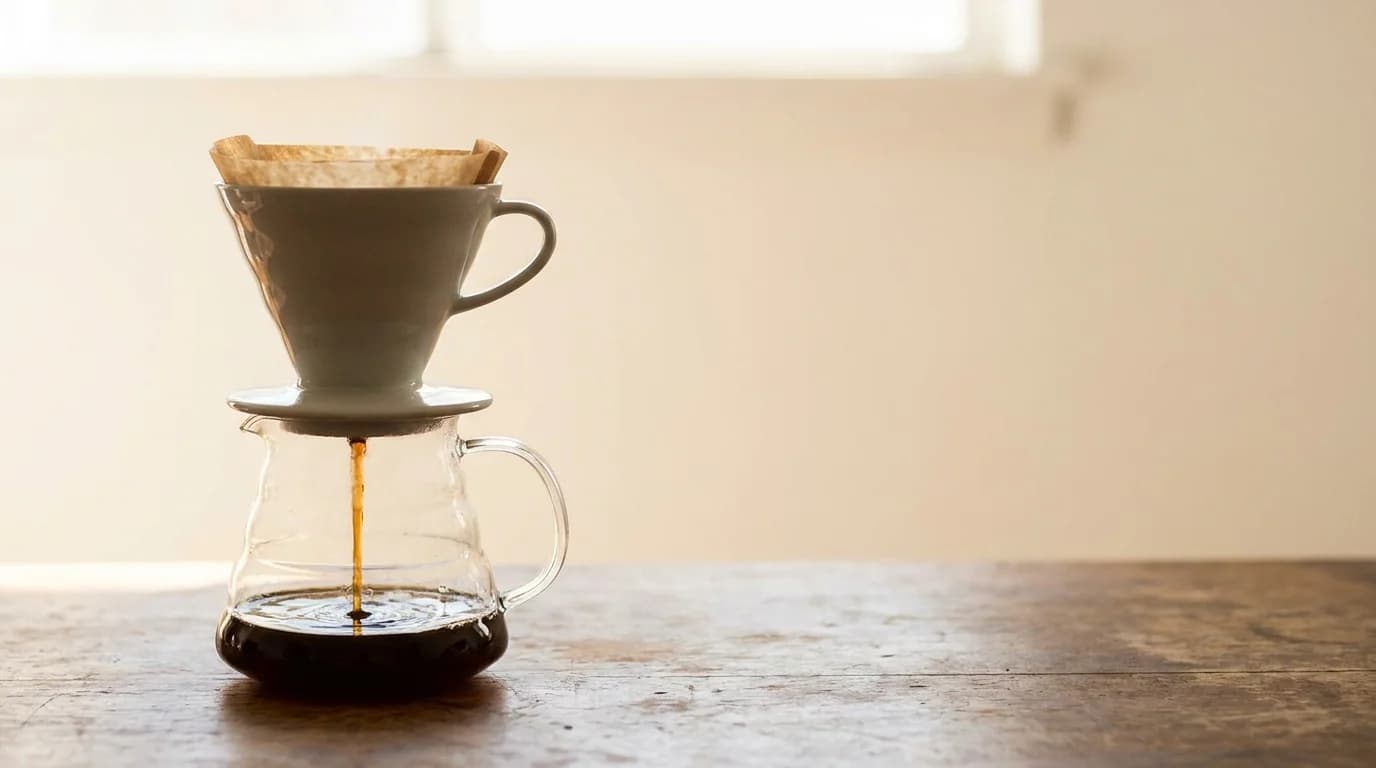
Extraction is the concept that ties every brewing method together. Espresso, drip, French press, cold brew — they all do fundamentally the same thing: use water to dissolve compounds out of ground coffee. Understanding extraction is what lets you troubleshoot a bad cup and improve a good one.
18–22%
the classic 'golden cup' extraction yield target — coffee mass that ends up dissolved in your cup[4]
Not the same
extraction (grind, time, temp) and strength (ratio) are independent variables — both matter[2]
Order matters
different compounds extract at different rates — early extraction is bright and sweet; late extraction is bitter[1]
What extraction actually means
When you brew coffee, hot water flows over or through ground beans and dissolves out some of their contents. Extraction yield is the percentage of the coffee's total dry mass that ends up in your cup:
- Start with 15 g of ground coffee
- Brew a cup that contains 3 g of dissolved solids
- Extraction yield = 3 / 15 = 20%
A gram of roasted coffee contains about 28-30 percent water-soluble compounds by mass. So the theoretical ceiling for extraction is around that number — but you don't want to hit the ceiling. Everything above about 22% starts to taste bad.
The "golden cup" range and why it exists
The Specialty Coffee Association's golden cup guidelines identify 18-22% extraction yield as the range where most drinkers find balanced, pleasant flavour. The reason isn't arbitrary — it maps to which compounds have finished extracting by the time you've reached that percentage.
Different compounds in coffee dissolve at different rates:
Early extraction (the first minute):
- Fruit-like and citric acids
- Simple sugars
- Bright, sour-forward flavours
- Caffeine (largely, but not entirely, in the first phase)
Middle extraction (through most of the brew):
- Melanoidins (brown pigments, moderate bitterness, sweetness)
- Balanced flavour compounds
- Body
Late extraction (past the ideal window):
- Larger, less-soluble bitter compounds
- Astringent tannins
- The bitter, dry finish of over-extracted coffee
The "golden cup" range is where you've collected the good early and middle compounds without pulling too much of the late-extraction bitters[4].
The three variables that control extraction
Extraction yield is determined by four things — but three you can easily control, and one usually follows from the others:
1. Grind size (surface area)
Finer grind = more surface area = faster extraction. This is why espresso needs fine grind for a 25-second contact time, and French press uses coarse grind for a 4-minute steep. Detailed in the grind size article.
2. Water temperature
Hotter water extracts faster. The SCA range for brewing is around 92-96 °C for hot methods; cold brew works at cold temperatures over 12-24 hours instead of 4 minutes.
Interestingly, temperature effects are more subtle than most home brewers assume. A 2020 Scientific Reports study found that when brew strength and extraction yield were held constant, brew temperature had little effect on the finished sensory profile[5]. In practice this means that if you hit the same extraction yield at 90 °C vs 95 °C by adjusting other variables, the cups taste more similar than you might think. The temperature matters mostly because of how it affects extraction rate.
3. Contact time
The longer water is in contact with coffee, the more extraction happens. This ranges from ~25 seconds for espresso to 12-24 hours for cold brew, spanning three orders of magnitude.
4. Agitation and flow (usually indirect)
More turbulence and better flow through the coffee bed means more even extraction. This is why "channeling" (water finding a fast path through the puck) produces bad coffee — some of the coffee over-extracts, other parts under-extract, in the same brew.
A 2016 Journal of Mathematics in Industry paper models coffee extraction as a kinetic process where all these variables interact — fundamentally, extraction is a set of dissolution rates and transport processes that home brewers control by adjusting the inputs[1].
Extraction vs strength — the crucial distinction
The single most useful concept in home brewing is that extraction and strength are separate variables.
- Extraction = what percentage of the coffee mass dissolves
- Strength = how concentrated the resulting brew is (TDS, total dissolved solids)
You can have any combination:
- High extraction, high strength: strong and possibly bitter. Fine grind, long time, and lots of coffee.
- High extraction, low strength: watery but bitter/astringent. Fine grind, long time, but not enough coffee.
- Low extraction, high strength: strong but under-developed (sour, thin). Lots of coffee but coarse grind or short time.
- Low extraction, low strength: weak and sour. Not enough coffee, extracted poorly.
A 2020 Journal of Food Science study explicitly varied brew strength and extraction yield independently and confirmed that both affect the sensory profile in distinct ways — you can taste the difference between low-extraction and low-strength coffees[2].
The practical implication: if your coffee tastes weak, don't grind finer — add more coffee. If your coffee tastes bitter, don't use less coffee — grind coarser or reduce time.
The extraction chart
| Extraction | Flavour profile | Common cause |
|---|---|---|
| Under 15% | Very sour, salty, empty | Extremely coarse grind or very short contact |
| 15-18% | Sour, thin, under-developed | Coarse grind, cold water, or short time |
| 18-22% | Balanced, sweet, developed | The golden cup range |
| 22-25% | Bitter, dry finish | Fine grind, long time, or hot water |
| Over 25% | Harsh, ashy, astringent | Way over-extracted |
Numbers are the SCA framework[4]; individual tastes vary within the golden range.
How to hit the right extraction
You don't need a refractometer at home. The subjective test works:
Under-extracted cup (sour, weak, quick to swallow):
- Grind finer
- Use hotter water (if you have temperature control)
- Extend contact time (slower pour, longer immersion)
Balanced cup (sweet, clean finish, satisfying):
- Don't touch it. Note what you did.
Over-extracted cup (bitter, dry, harsh):
- Grind coarser
- Cooler water (if you can adjust)
- Shorter contact time
Change one variable at a time. If you're making pour-over and adjust both the grind and the water temperature at once, you won't know which one moved the flavour.
Two of the three variables above are set by equipment rather than by technique: grind size by the grinder, ratio by the scale. Neither is adjustable by eye.
 Scale with a timer, 0.1gMaestri House S2 Espresso Coffee Scale with Timer 0.1g Precision Shot Scale | USB-C Rechargeable, Dual Timing Modes, 2kg/0.1g Digital Scale with Borosilicate Glass Top for Espresso and Pour-Over BrewingDose and ratio are the two variables you can fix for free, and neither is fixable by eye: a scoop of beans varies by several grams depending on bean size and how it was filled. A timer on the same device means you are reading one instrument instead of two.amazon.com $30.39 USDamazon.ca $34.19 CADPrice and availability as of View on Amazon
 Entry-level conical burr grinderBaratza Encore Coffee Grinder ZCG485BLK, Black | Beginner-friendly grinder with powerful motor and 40mm conical steel burrs for consistent, brew-ready performanceThe usual answer to "the cheapest grinder worth owning" for filter coffee. Conical burrs, forty steps, and — the part that matters over years — every wear part is a listed spare, so it is repairable rather than disposable.amazon.com $149.95 USDamazon.ca $199.00 CADPrice and availability as of View on Amazon
Product prices and availability are accurate as of the date/time indicated and are subject to change. Any price and availability information displayed on Amazon at the time of purchase will apply to the purchase of this product. Certain content that appears on this site comes from Amazon. This content is provided ‘as is’ and is subject to change or removal at any time.
Method-specific extraction dynamics
A 2013 European Food Research and Technology study compared nine common coffee extraction methods on identical beans and found substantial differences in the compound profile extracted by each — and how the same target extraction can be achieved through very different brewing mechanics[3].
Practically:
- Espresso hits ~20% extraction in 25-35 seconds under ~9 bar of pressure. Fine grind, small volume, huge pressure gradient.
- Pour-over hits ~20% in 3-4 minutes at atmospheric pressure. Medium grind, gravity-fed.
- French press hits ~20% in 4 minutes of immersion. Coarse grind, no filter (just mesh).
- Cold brew hits ~20% in 12-24 hours at cold or room temperature. Coarse grind, immersion.
All target similar extraction yields; they get there through different combinations of grind, temperature, time, and pressure.
Common misconceptions
- "Extraction and strength are the same thing." They're not. Grind fixes extraction; ratio fixes strength. Both matter[2].
- "More extraction means more caffeine." Not really. Caffeine extracts largely in the first minute of most brewing methods; going from 18% to 22% extraction pulls in mostly other compounds.
- "Colder water means better extraction." Colder water means slower extraction. Cold brew works because 12+ hours makes up for the temperature deficit.
- "You have to have a refractometer to brew good coffee." No. Refractometers help calibrate scientifically; your palate works fine for the golden cup range if you know what to look for.
Brewer geometry is one of the levers here: cone, flat-bottom and hourglass drippers drain at different rates and so extract differently at the same grind — see pour-over brewers.
The honest summary
Extraction is what turns ground coffee into a drink. Aim for the 18-22% range and everything else about brewing gets easier — flavour gets balanced, method choice becomes less critical, and you stop guessing about what "wrong" tastes like. Grind, temperature, and time are your levers; the ratio controls something separate. Change one thing at a time.
Frequently asked questions
- What is a good coffee extraction yield?
- The Specialty Coffee Association's classic 'golden cup' target is 18-22 percent extraction yield — meaning 18-22 percent of the coffee's dry mass ends up dissolved in your cup. Below that range, the coffee tastes sour and under-developed. Above it, coffee tastes bitter and harsh.
- How is extraction different from brew strength?
- Extraction is what percentage of the coffee dissolves. Strength is how much dissolved coffee is in your cup (also called TDS, total dissolved solids). You control extraction with grind, temperature, and time. You control strength with ratio. Two independent variables.
- Why does my coffee taste sour or bitter?
- Sour means under-extracted — water didn't have enough contact, grind was too coarse, or temperature was too low. Bitter means over-extracted — too fine a grind, too long a contact, too hot. The fix is to change extraction variables, not the ratio.
- Does extraction change with brew method?
- The target extraction range is similar across brew methods — around 18-22 percent for most brewed coffee. What differs is how you get there. Espresso hits 20 percent extraction in 25 seconds under high pressure; French press hits similar extraction in four minutes at atmospheric pressure. Different tools, similar target.
References
Every factual claim in this article is drawn from the sources below. See the source library for how we grade evidence.
- [1]Coffee extraction kinetics in a well mixed systemJournal of Mathematics in Industry · 2016 · Review · Tier 2 · Moderate
- [2]Effects of brew strength, brew yield, and roast on the sensory quality of drip brewed coffeeJournal of Food Science · 2020 · Controlled trial · Tier 2 · Moderate
- [3]Comparison of nine common coffee extraction methods: instrumental and sensory analysisEuropean Food Research and Technology · 2013 · Controlled trial · Tier 2 · Moderate
- [4]Brewing FundamentalsCoffee Science Foundation · Reference work · Tier 2 · Moderate
- [5]Brew temperature, at fixed brew strength and extraction, has little impact on the sensory profile of drip brew coffeeScientific Reports · 2020 · Controlled trial · Tier 2 · Moderate
Related reading
- Brewing ScienceCoffee-to-Water Ratio Explained→
- Brewing ScienceCoffee Grind Size Guide: Which Grind for Which Method→
- Brew MethodsAeroPress Brew Guide: Ratios, Inverted Method, Tips→
- Brewing ScienceBest Water Temperature for Coffee→
- Coffee EquipmentPour-Over Coffee Makers: Cone, Flat Bottom, or Chemex→
- Brewing ScienceWhat Is Coffee Bloom? CO₂, Degassing, and Why It Matters→