Pour-Over Coffee Makers: Cone, Flat Bottom, or Chemex
By Coffee Studies Editorial·Published October 11, 2026·5 min read
Quick answer
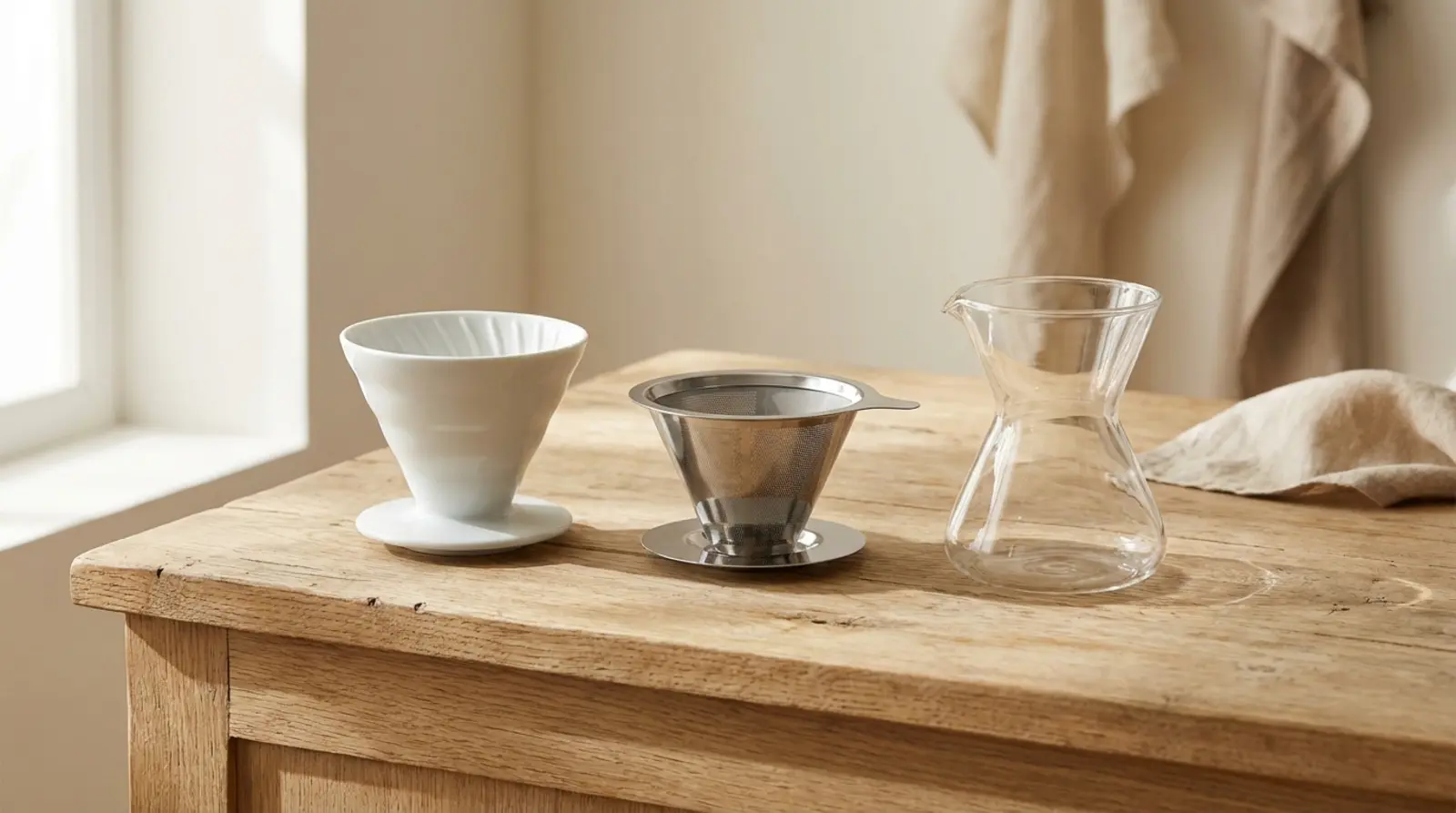
There are only three real shapes in pour-over, and once you know what each one does, the hundred models on a shelf collapse into a choice about how much of the brewing you want to be responsible for.
The shape is the specification
The cone, one large hole. The V60 is the reference. Steep sixty-degree walls, one wide opening at the bottom, and spiral ribs that hold the paper off the wall so air can escape as water moves through. Every one of those features reduces how much the dripper restricts flow. The restriction is instead your pour rate and the grind, which means a cone does exactly what you tell it — including when you tell it something careless.
The flat bottom, two or three small holes. The Kalita Wave is the reference. The coffee sits in a flat bed rather than a cone, so depth is even across the puck, and the small holes mean the dripper sets the flow rate rather than your technique. The same recipe made by two different people lands in roughly the same place. That is the appeal, and if you enjoy steering a brew it is also the objection.
The Chemex, a cone with a much thicker filter. The glass body is one piece and looks like the point, but the filter is the design decision. Chemex bonded paper is several times the weight of a standard cone filter. It traps more oils and more fine particles than any paper in common use, which produces a notably clean, tea-like cup — and it slows drainage enough that the grind has to be coarser than a V60's to avoid stalling.
A fourth category exists and is worth naming so you can avoid it by accident: metal mesh drippers with no paper. These pass oils and fines, so what comes out has more in common with a French press than with pour-over.
What the filter does
The filter is doing more work than the plastic or ceramic around it. Paper removes insoluble fines and much of the lipid fraction. Fines matter because they keep extracting after the brew should be finished and they contribute a drying, muddy edge; oils matter because they carry body and some aroma.
So the thickness ladder is also a clarity-versus-body ladder: thicker paper, cleaner and thinner cup; thinner paper, more body and more aromatic weight; no paper, most body and most sediment.
Rinse paper filters before brewing regardless of which you use. Dry paper of any weight contributes a taste, and on Chemex-weight paper it is obvious.
One of each geometry
 Cone dripper, 60-degreeHARIO V60 Ceramic Coffee Dripper, Size 02, WhiteThe reference cone: steep walls, one large hole, and spiral ribs that keep the paper off the wall so air can escape. All three features hand flow control to the person pouring, which is why the V60 rewards technique and punishes inattention.amazon.com $25.00 USDamazon.ca $32.00 CADPrice and availability as of View on Amazon
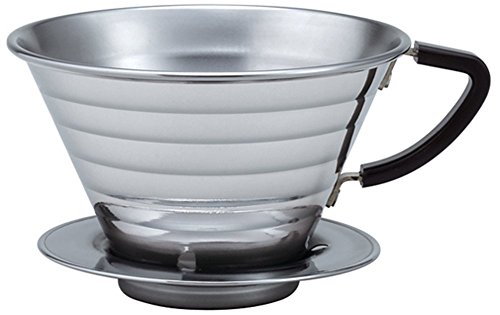 Flat-bottom dripper, three holesKalita Wave 185 DrippersA flat bed and three small holes instead of one big one, so the restriction is in the dripper rather than in your pour. That makes the result far more repeatable than a cone and far less responsive to technique, which is either the whole appeal or the whole objection.amazon.com $38.90 USDamazon.ca $65.72 CADPrice and availability as of View on Amazon
 Dripper and carafe in one pieceChemex Pour-Over Glass Coffeemaker - Classic Series - 6-Cup - Exclusive PackagingA cone with a much thicker bonded filter and a sealed glass body. The filter is the design decision: it traps more oils and fines than any other paper in common use, giving a very clean, tea-like cup, and it slows the brew down enough that grind has to be coarser than a V60's.amazon.com $47.03 USDamazon.ca $70.00 CADPrice and availability as of View on Amazon
 The filters a Chemex needsChemex Unbleached, Pour Over FSU-100, 100ctNot optional and not interchangeable with ordinary cone papers: the thickness is the whole reason the brewer tastes the way it does. Unbleached and bleached behave the same once rinsed; rinse either way, because dry paper of this weight contributes a noticeable taste.amazon.com $19.48 USDamazon.ca $29.99 CADPrice and availability as of View on Amazon
Product prices and availability are accurate as of the date/time indicated and are subject to change. Any price and availability information displayed on Amazon at the time of purchase will apply to the purchase of this product. Certain content that appears on this site comes from Amazon. This content is provided ‘as is’ and is subject to change or removal at any time.
The kettle question
A gooseneck kettle gives a slow, narrow, placeable stream. On a cone that is most of the technique — an ordinary kettle spout delivers water faster than you can steer it, which collapses the bed and channels. On a flat-bottom dripper it matters considerably less, because the dripper is doing the restricting.
Variable temperature is the feature people overvalue. It is useful while you are learning, because it removes one unknown. But a 2020 study in Scientific Reports found that at fixed brew strength and extraction, brew temperature itself had little effect on the sensory profile of drip coffee[4]. Buy the kettle for the spout; treat the display as a convenience.
 Variable-temperature gooseneckCosori Gooseneck Electric Kettle with Temperature Control, 0.8L, BlackThe spout gives you a slow, placeable stream, which is most of pour-over technique. Temperature control matters less than people assume at fixed extraction, but it removes a variable while you are learning, and it is the difference between guessing and knowing what went into the cup.amazon.com $69.99 USDamazon.ca $100.89 CADPrice and availability as of View on Amazon
Product prices and availability are accurate as of the date/time indicated and are subject to change. Any price and availability information displayed on Amazon at the time of purchase will apply to the purchase of this product. Certain content that appears on this site comes from Amazon. This content is provided ‘as is’ and is subject to change or removal at any time.
Grind does more than any of it
If you change one thing, change the grind. Extraction in a filter brew is governed mostly by particle size and contact time, and grind sets both at once — finer particles have more surface area and also slow drainage, so the effect compounds[2]. Work on brew strength and yield across drip coffee found sensory quality tracks extraction far more closely than it tracks any piece of hardware[3].
Practical starting points:
- Cone: medium, around table salt. Aim for a total brew of 2:30 to 3:30 on a single-cup dose.
- Flat bottom: medium, similar or a touch finer, 3:00 to 4:00.
- Chemex: a click or two coarser, 4:00 to 5:00 on a larger batch.
Then adjust by taste rather than by number. Fast and sour means go finer; stalled, bitter and drying means go coarser[1].
Which to buy
Not a ranking, a match:
- You enjoy the ritual and want control: a cone.
- You want the same cup every morning without thinking: flat bottom.
- You brew for two or three and like a very clean cup: Chemex.
- You want body above clarity: you want a French press, not a pour-over.
The method itself, dose by dose, is in the pour-over guide, and the head-to-head on the two most-compared brewers is in Chemex vs V60.
Common misconceptions
"A more expensive dripper makes better coffee." Dripper price tracks material and brand, not extraction. A $6 plastic V60 brews what a $60 ceramic one brews, slightly more forgiving of a skipped preheat.
"The Chemex is the premium V60." Different filter, different cup, different grind. Not a tier.
"You need the temperature readout." You need the spout.
"Any filter fits any cone." Geometry and weight are both part of the design.
The honest summary
Three shapes, and the shape decides who controls the brew: a cone hands it to your pour, a flat bottom keeps it, a Chemex trades body for clarity through a much heavier filter and asks for a coarser grind in return. A gooseneck kettle earns its place on a cone through the stream rather than the thermostat. And the variable that moves the cup most is still grind size, which costs nothing to change and which no dripper on the shelf can compensate for.
Frequently asked questions
- What is the difference between a cone and a flat-bottom dripper?
- Where the restriction lives. A cone such as the V60 has one large opening, so the bed shape and your pour rate set how fast water moves through — the dripper barely restricts anything. A flat-bottom dripper such as the Kalita Wave has a flat bed and two or three small holes, so the dripper itself sets the flow rate and your pour matters much less. Cones reward technique and punish inattention; flat bottoms are far more repeatable and less responsive to what you do.
- Is a Chemex better than a V60?
- They make different cups. The Chemex uses a bonded filter several times thicker than a standard cone paper, which removes more oils and fine particles and gives a very clean, almost tea-like result. The V60's thinner paper lets more through, so the cup has more body and more aromatic intensity. The Chemex filter also slows the brew considerably, which is why Chemex recipes call for a coarser grind than a V60 at the same dose.
- Do I need a gooseneck kettle for pour-over?
- For a cone, effectively yes — the slow, placeable stream is most of the technique, and a normal kettle spout dumps water faster than you can steer it. For a flat-bottom dripper it matters much less, because the dripper is controlling flow rather than your pour. Variable temperature is the part people overvalue: it removes a variable while you are learning, but research comparing brew temperatures at fixed extraction found little sensory difference, so it is not where the cup is won.
- What grind size for pour-over?
- Medium, around table salt, as a starting point for a cone, and a click or two coarser for a Chemex because the thicker filter slows drainage. Then adjust by taste rather than by number: if the brew runs fast and tastes sour and thin, go finer; if it stalls and tastes bitter and drying, go coarser. Grind is the main lever on extraction in any pour-over and it does more than any hardware choice.
- Can I use any paper filter in any dripper?
- No. Filters are cut for a specific geometry, and a mismatch either leaves gaps for water to bypass the bed or folds in a way that blocks flow. Chemex filters in particular are not interchangeable with ordinary cone papers — the thickness is the whole reason the brewer tastes the way it does. Rinse paper filters before brewing whatever you use, because dry paper of any weight contributes a noticeable taste.
- Are ceramic, glass, plastic and metal drippers different?
- Material affects heat retention more than anything else. Ceramic and glass hold heat but need preheating or they steal it from the brew; plastic has very low thermal mass and is the most forgiving if you skip the rinse; metal sits between. Metal mesh drippers with no paper are a separate category, closer to a French press in the cup because they pass oils and fines.
References
Every factual claim in this article is drawn from the sources below. See the source library for how we grade evidence.
- [1]Brewing FundamentalsCoffee Science Foundation · Reference work · Tier 2 · Moderate
- [2]Coffee extraction kinetics in a well mixed systemJournal of Mathematics in Industry · 2016 · Review · Tier 2 · Moderate
- [3]Effects of brew strength, brew yield, and roast on the sensory quality of drip brewed coffeeJournal of Food Science · 2020 · Controlled trial · Tier 2 · Moderate
- [4]Brew temperature, at fixed brew strength and extraction, has little impact on the sensory profile of drip brew coffeeScientific Reports · 2020 · Controlled trial · Tier 2 · Moderate
Related reading
- Brew MethodsPour-Over Coffee Guide: Ratios, Bloom, and Technique→
- Brew MethodsChemex vs V60: Which Pour-Over Makes Better Coffee?→
- Brew MethodsV60 Pour-Over Guide: Ratios, Technique, Step by Step→
- Brew MethodsKalita Wave Brew Guide: Ratios, Technique, and Results→
- Coffee EquipmentHow Much to Spend on a Coffee Grinder→
- Coffee EquipmentCold Brew Coffee Makers: What You Are Actually Buying→