Cold Brew Coffee Makers: What You Are Actually Buying
By Coffee Studies Editorial·Published October 11, 2026·5 min read
Quick answer
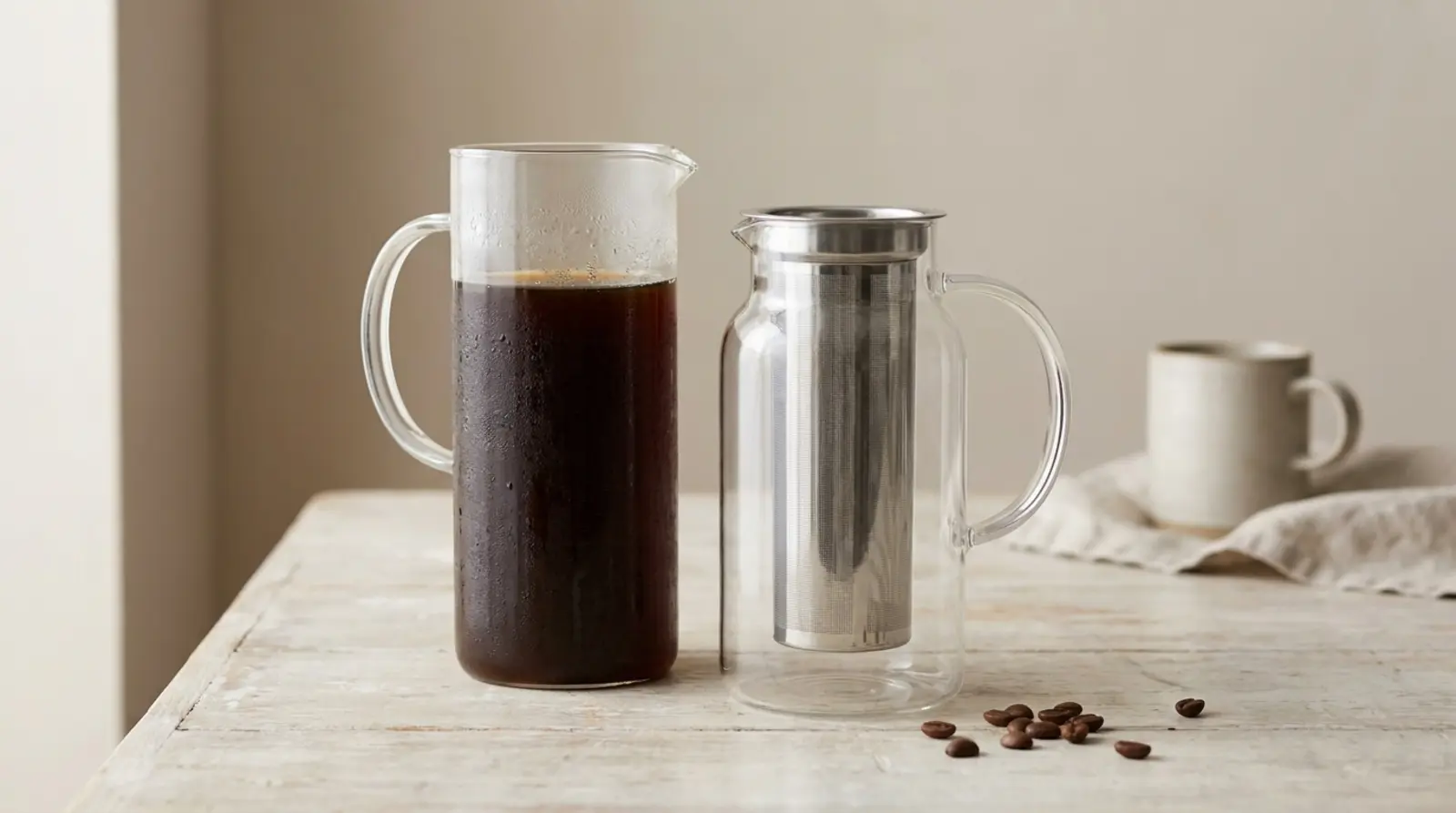
A cold brew maker has no heating element, no pump, no boiler and no valve. It is a container, a strainer and a lid. That is the entire machine, and it is why the price range on these things — roughly twenty dollars to several hundred — tells you almost nothing about what comes out.
So the useful way to shop is to ask which of the differences between them actually reach the cup, and which are paying for a nicer afternoon.
The three formats
Immersion. Grounds sit in cold water for 12 to 24 hours, then get separated out. This is what almost every maker sold as a "cold brew maker" does, whether it is a jug with a mesh column, a pitcher with a sealed basket, or a bucket with a felt pad in the bottom.
Slow drip, sometimes called cold drip or Kyoto style. Cold water drips through a bed of grounds over three to eight hours. Contact time per particle is far shorter than immersion, the extraction is gentler, and the result is lighter and more tea-like. It is a different method, not a premium version of the same one.
Fridge-door convenience brewers. Pitchers whose selling point is shape, lid or pouring rather than brewing. Functionally immersion.
Nothing in that list is an upgrade path. A $300 tower does not make a better version of what a $25 jug makes; it makes a different drink.
The one decision that reaches the cup
Filtration. Everything else is ergonomics.
Metal mesh holds back the grounds but passes fine suspended particles. Those fines keep extracting in the jug and they give the finished brew more body, more texture, and a slightly muddy finish. Mesh makers never need a consumable.
Paper removes nearly all of it. The cup reads thinner, cleaner, and sweeter in the way filter coffee does next to French press. You buy filters forever.
Felt or cloth, which is what the original commercial systems use, sits between the two: most of the fines gone, more body left than paper.
If you have ever found cold brew heavy or slightly gritty at the bottom of the glass, that is mesh, not the beans and not the steep time.
What actually changes strength and caffeine
Grind size and time, both of which are free.
A 2017 study in Scientific Reports measured caffeine and chlorogenic acid across cold brew made at different grind sizes, roast levels and steep times, and found grind and time to be the levers that move concentration[1]. Finer grind and longer steep extract more; the gains flatten rather than continuing upward, which is why pushing past about 24 hours in the fridge buys very little.
Work comparing hot and cold brewing of the same coffees found the two produce measurably different compound profiles rather than one being a weaker version of the other[2]. That is worth knowing before you try to make cold brew taste like your hot cup by brewing it stronger.
On the acidity question, which is most of cold brew's marketing: measured differences in pH between cold and hot brew are small and not consistent across studies[3]. Cold brew does usually taste less sharp. Those are not the same claim, and the second one does not need the first to be true.
What the formats cost, and what the money buys
The honest tiers, in order of what you are actually paying for:
- A jar and a sieve. Free if you have them. Works. Decanting is messy and you will get sediment.
- A mesh-column jug or a basket pitcher. Clean separation, one vessel, fridge-shaped. This is the step that is worth money.
- A paper-filter immersion maker. Adds the filtration stage that genuinely changes the cup, and a consumable.
- A felt-filter bucket system. Brews large batches; built for cafés making concentrate daily.
- A drip tower. A different drink and a conversation piece.
Most people are best served at step two or three, and the gap between them is the only one on the list that changes what is in the glass.
One of each filtration type
 Immersion brewer, smallest sensibleHario "Mizudashi" Cold Brew Coffee Maker, 1000ml, BlackA jug with a fine mesh column down the middle. There is nothing to it, which is the point: immersion cold brew is grounds, water and time, and anything beyond a vessel that lets you lift the grounds out cleanly is paying for convenience rather than for the cup.amazon.com $20.50 USDamazon.ca $28.99 CADPrice and availability as of View on Amazon
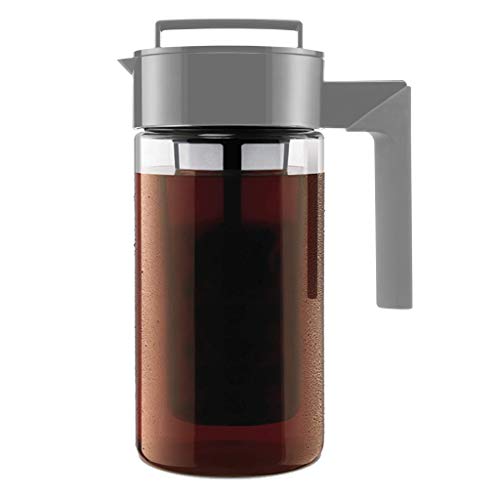 Pitcher with a sealed basketTakeya Deluxe Cold Brew Coffee Maker - BPA-Free Tritan Pitcher with Airtight Leakproof Lid, Silicone Grip Handle, Fine-Mesh Filter - Shatter-Proof, Dishwasher Safe, Made in USA - 1 Quart/StoneThe basket seals and the pitcher is airtight, so it brews and then stores in the same vessel without decanting. Plastic rather than glass, which matters mostly for whether you trust it in a crowded fridge door.amazon.com $24.99 USDamazon.ca $35.54 CADPrice and availability as of View on Amazon
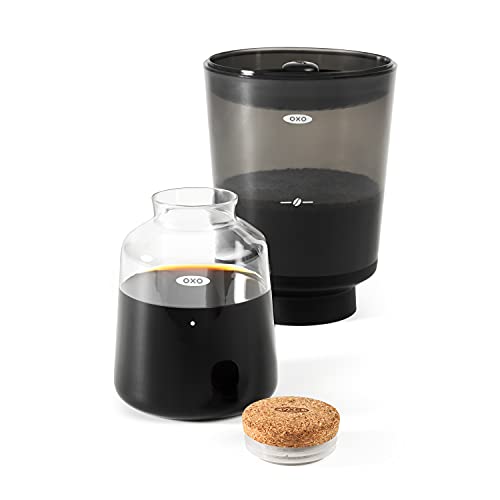 Immersion with a paper filter stageOXO Brew Compact Cold Brew Coffee Maker - 24 ozThe only one of these three that puts paper between the grounds and the jug. Paper removes the fine suspended particles that mesh lets through, which is the difference between cold brew that reads clean and cold brew that reads heavy. It is also the one with a consumable to keep buying.amazon.com $39.92 USDamazon.ca $48.87 CADPrice and availability as of View on Amazon
Product prices and availability are accurate as of the date/time indicated and are subject to change. Any price and availability information displayed on Amazon at the time of purchase will apply to the purchase of this product. Certain content that appears on this site comes from Amazon. This content is provided ‘as is’ and is subject to change or removal at any time.
Grind, ratio and time
Hardware chosen, the recipe is where the cup is actually made:
- Grind coarse. Coarser than French press. Fine grounds in a long steep over-extract and are miserable to filter[4].
- Ratio. 1:8 by weight for concentrate to dilute later, 1:15 to 1:17 for ready-to-drink.
- Time. 12 to 24 hours refrigerated, 8 to 12 at room temperature. Room temperature extracts faster.
- Store it. Finished cold brew holds up well refrigerated for about a week; concentrate a little longer. Keeping grounds in past the steep keeps extracting.
The full method is in the cold brew guide.
Common misconceptions
"A better maker makes better cold brew." Above a clean separation, no. Grind, ratio and time make the cup.
"Cold brew needs a special machine." It needs a container.
"Towers are the serious option." They are the method with the most equipment, which is not the same thing.
"Cold brew is low acid, so it is a gentler coffee." The sensory impression is reliable; the chemistry claim behind it is weaker than the marketing suggests.
The honest summary
A cold brew maker is a vessel and a strainer, so the specification worth comparing is the strainer. Metal mesh gives body and sediment and no consumables; paper gives clarity and an ongoing cost; felt sits in between. Slow-drip towers are a separate method, not a higher tier. Beyond picking a filtration type that matches the cup you want, spend your attention on grind size, ratio and steep time, which are the only variables that meaningfully change what ends up in the glass — and which cost nothing.
Frequently asked questions
- Do you need a special maker for cold brew?
- No. Cold brew is grounds steeped in cold water and then separated from it, so a jar and a fine sieve lined with a cloth will make it. What a dedicated maker buys you is a clean separation without a messy decant, a vessel shaped to fit a fridge, and in some cases a paper filter stage. Those are real conveniences and they are the honest reason to spend money; none of them changes extraction.
- Does a cold brew maker change how the coffee tastes?
- Only through its filter. Metal mesh passes fine suspended particles that keep brewing in the jug and add body and a slightly muddy finish; paper or felt removes them and gives a thinner, cleaner cup. Vessel material, lid design and brand make no measurable difference. If you want a different taste from the same maker, change grind size or steep time rather than the hardware — grind and time are the variables that move caffeine and chlorogenic acid content.
- Is a slow-drip tower better than immersion?
- It is different, not better. Immersion holds grounds in water for 12 to 24 hours; a tower drips cold water through a bed over several hours, so contact time per particle is much shorter and the result is usually lighter and more tea-like. Towers are also fussier to dial in and far more expensive for the same volume. Choose one on the cup you want, not on a ranking.
- How long should cold brew steep?
- Twelve to twenty-four hours at refrigerator temperature, or eight to twelve at room temperature, is the usual working range. Longer steeps extract more caffeine and more dissolved solids, with the increase flattening out rather than continuing indefinitely. Past about twenty-four hours in the fridge there is little left to gain and the risk of woody, over-steeped flavours rises.
- Can you make cold brew in a French press?
- Yes, and it is the cheapest decent option if you already own one. The mesh plunger is coarse, so expect sediment and plan to decant off the grounds rather than leaving them in the press. Treat it as the metal-mesh category: good body, less clarity, no consumable to buy.
- Is cold brew less acidic?
- Measured pH differences between cold brew and hot brew are small and inconsistent across studies, so the common claim that cold brew is dramatically less acidic overstates what the research shows. What does differ reliably is the sensory profile: cold brew tends to read smoother and less sharp, which people often describe as lower acidity even where the pH is nearly identical.
References
Every factual claim in this article is drawn from the sources below. See the source library for how we grade evidence.
- [1]The Effect of Time, Roasting Temperature, and Grind Size on Caffeine and Chlorogenic Acid Concentrations in Cold Brew CoffeeScientific Reports · 2017 · Controlled trial · Tier 2 · Moderate
- [2]Physiochemical Characteristics of Hot and Cold Brew Coffee Chemistry: The Effects of Roast Level and Brewing Temperature on Compound ExtractionFoods · 2020 · Controlled trial · Tier 2 · Moderate
- [3]Acidity and Antioxidant Activity of Cold Brew CoffeeScientific Reports · 2018 · Controlled trial · Tier 2 · Moderate
- [4]Brewing FundamentalsCoffee Science Foundation · Reference work · Tier 2 · Moderate
Related reading
- Brew MethodsCold Brew Coffee Guide: Ratios, Steep Time, Technique→
- Brew MethodsCold Drip Coffee: How Slow Drip Differs from Cold Brew→
- Brew MethodsCold Brew vs Iced Coffee: The Real Difference→
- Coffee EquipmentHow to Store Coffee Beans to Keep Them Fresh→
- Coffee EquipmentHow to Clean an Espresso Machine: The Full Guide→
- Coffee EquipmentCoffee Machine Descaler: What It Is and What It Fixes→