Cold Brew vs Iced Coffee: The Real Difference
By Coffee Studies Editorial·Published July 15, 2026·6 min read
Quick answer
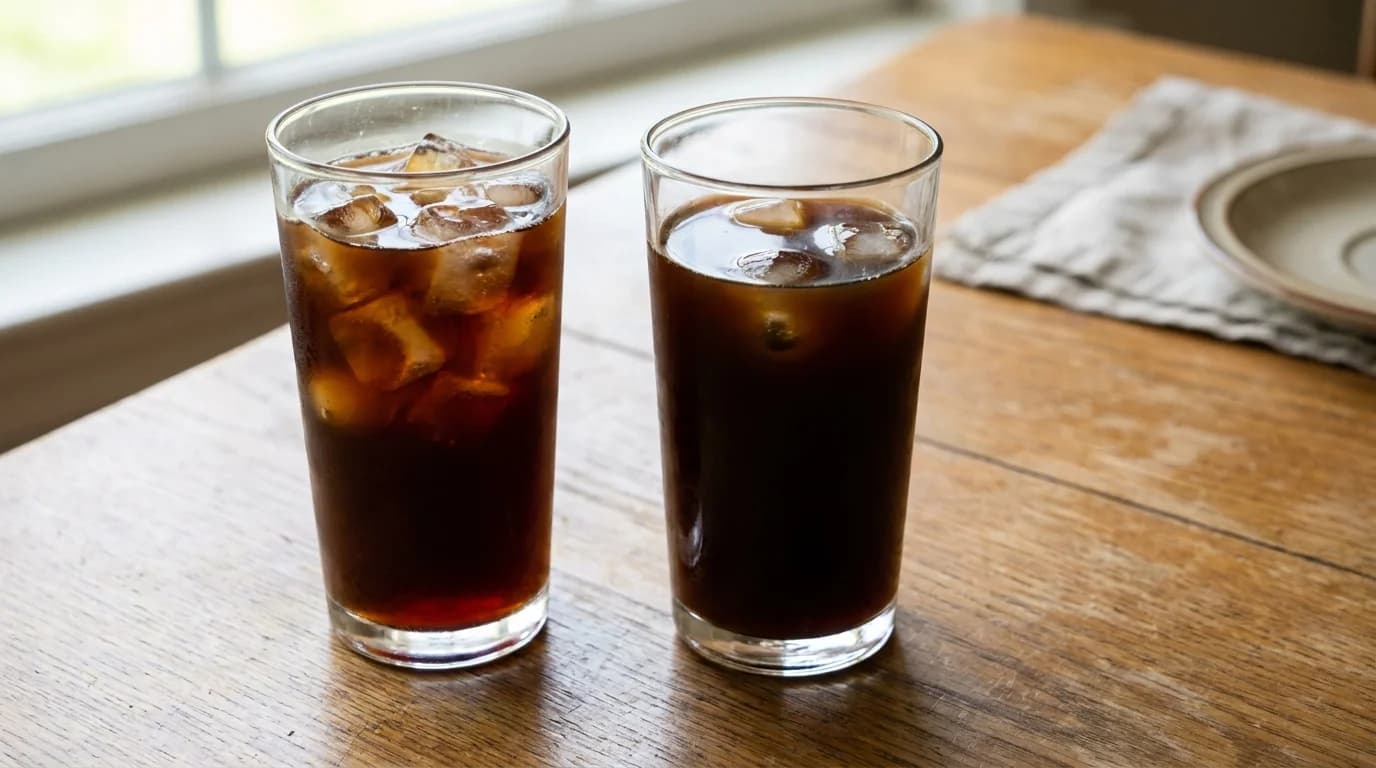
The terms are used interchangeably in casual conversation, but cold brew and iced coffee are genuinely different drinks made by different processes. The chemistry differs, the taste differs, and knowing which one you actually want makes it much easier to enjoy either.
Hot then cold
iced coffee: brewed hot with standard chemistry, then chilled or poured over ice[1]
Cold throughout
cold brew: coffee steeped in cold or room-temperature water for 12–24 hours, never heated[2]
Lower acidity
peer-reviewed chemistry consistently finds cold brew has lower titratable acidity than hot-brewed coffee[3]
The one-sentence difference
Iced coffee is regular hot-brewed coffee that has been chilled or poured over ice. Cold brew is coffee brewed with cold or room-temperature water over many hours, without any heat step.
Everything else — taste, chemistry, cost, caffeine per cup — follows from that distinction.
How the chemistry differs
Hot water and cold water extract different things from ground coffee at different rates. This isn't a small effect; it's the central reason cold brew tastes noticeably smoother.
Hot brewing (iced coffee's base) extracts:
- All the caffeine and much of the aromatic volatiles quickly
- Chlorogenic acids and related acids, contributing to perceived brightness and sourness
- Bitter compounds if extraction goes past the ideal range
- The full spectrum of what's dissolvable in the coffee
Cold brewing extracts:
- Caffeine, but more slowly (which is why cold brew steeps overnight rather than for minutes)
- Fewer of the delicate aromatic volatiles (some are lost)
- Substantially less of the acids that hot water extracts quickly[2]
- A different profile overall — smoother, rounder, less "bright"
A 2018 Scientific Reports study directly measured the acidity and antioxidant activity of cold brew across six different bean origins. Cold brew consistently showed lower titratable acidity than the hot-brewed equivalents at similar concentrations, along with slightly different antioxidant profiles[3].
A 2020 Foods study confirmed and extended these findings, showing that the effects of brewing temperature interact with roast level — light roasts show the biggest acidity difference between hot and cold brewing[1].
Figure
Titratable acidity: hot brew vs cold brew across roast levels
Values in % titratable acidity (as citric acid equivalent)
Direct comparison
| Iced coffee | Cold brew | |
|---|---|---|
| Brewing method | Hot water, then chilled | Cold/room-temp water, long steep |
| Contact time | Minutes | 12–24 hours |
| Grind size | Medium (like normal drip) | Coarse |
| Typical ratio | 1:15–1:18 (same as hot) | 1:6–1:8 concentrate, or 1:12–1:15 ready-to-drink |
| Coffee-to-serving | Standard | Higher (per finished serving) |
| Acidity | Same as hot brew (moderate to high) | Lower |
| Bitterness | Standard | Lower |
| Aromatic complexity | Higher (fresh volatiles) | Different profile — flatter top notes |
| Body / mouthfeel | Lighter | Fuller, sometimes syrupy |
| Time to ready | Minutes | Hours |
| Cost per cup | Lower | Slightly higher |
Caffeine: the frequent misunderstanding
You'll see "cold brew has more caffeine than iced coffee" claimed frequently. It's usually true, but for reasons other than most people assume.
Per gram of coffee grounds, hot water extracts caffeine more efficiently than cold water. A gram of coffee steeped in 200°F water for 4 minutes yields more caffeine than the same gram steeped in 65°F water for 12 hours (though cold brew's much longer contact time closes the gap).
Per finished cup, cold brew often does have more caffeine. Why? Cold brew is typically served in larger sizes (16 oz vs 8 oz for hot coffee), and uses more coffee per unit of water in the recipe (1:8 concentrate vs 1:16 drip). The higher caffeine per serving comes from more coffee, not stronger extraction.
Practically:
- A 12 oz iced coffee made from a standard drip pot: ~120–150 mg
- A 12 oz cold brew made from 1:8 concentrate diluted 1:1: ~150–200 mg
- Per gram of coffee used, hot brew wins
If you're tracking caffeine, know your specific brew's dilution.
Taste: which one is "better"
Depends on what you're chasing.
Cold brew tends to be preferred by drinkers who:
- Find hot coffee's acidity too sharp
- Like a smoother, rounder body
- Are drinking coffee with lots of milk or sugar (cold brew's low-acid profile blends with dairy particularly well)
- Prefer sweetness over brightness in their coffee
Iced coffee tends to be preferred by drinkers who:
- Like coffee's brightness and complexity
- Want to taste the specific character of a single-origin bean (hot brewing extracts more of the aromatic compounds that give coffee its distinct origin flavour)
- Are drinking black coffee and want more flavour interest
- Don't want to wait 12+ hours
Neither is objectively better. They're different extractions of the same starting material[1].
The ice problem — and how to solve it
The most common complaint about iced coffee is that it gets watery. The fix is not to make cold brew — the fix is to brew iced coffee correctly:
Japanese-style iced coffee (flash chill):
- Brew hot coffee at a stronger ratio (about 1:12 instead of 1:16)
- Brew directly onto ice, so the ice melts as it chills the coffee
- Total water = strong hot brew + melted ice = normal strength chilled coffee
- Preserves the aromatic complexity of hot brewing while eliminating the watery result of pouring hot coffee over ice that's already there
This produces excellent iced coffee that tastes like a bright, clean version of a fresh cup — very different from cold brew's smoother profile.
Cold brew, poured over ice:
- Because cold brew is already at drinking temperature, ice serves only to keep it cold. Less dilution risk.
- Alternative: use coffee ice cubes (frozen coffee) so melting doesn't dilute.
Cost and effort
Iced coffee:
- Minutes to make
- Same equipment as normal coffee
- Standard coffee ratio — no extra beans
- Cheapest per cup
Cold brew:
- 12–24 hour steep, but hands-off (5 minutes of active work)
- Optional dedicated equipment (Toddy, cold brew maker) — a mason jar works fine
- Uses more coffee per finished cup (higher ratio)
- Slightly more expensive per cup, less time-flexible
For daily drinkers, cold brew is more efficient overall — batch brew once a week, have iced coffee ready every day. For occasional iced-coffee drinkers, Japanese-style iced coffee is easier.
Common misconceptions
- "Cold brew is stronger." Only per serving, and only because the recipe uses more coffee. Per gram of coffee, hot brewing is more extractive.
- "Iced coffee is just cold brew served hot." No — they're brewed by fundamentally different processes.
- "Cold brew is healthier because it's less acidic." Lower titratable acidity is real, but "less acidic" doesn't automatically translate to "healthier." Both drinks share most of coffee's health profile[3].
- "You need special equipment for cold brew." A mason jar and a coffee filter work fine.
If it is cold brew you want to make rather than buy, the equipment is simpler than the category suggests — see cold brew makers.
The honest summary
Cold brew and iced coffee are two different drinks solving similar problems. Cold brew is smoother, less acidic, uses more coffee per finished cup, and takes 12–24 hours. Iced coffee is faster, cheaper, brighter, and more aromatic — done right (Japanese-style), it's not watery.
If you dislike coffee's acidity, cold brew is worth the wait. If you love coffee's brightness and complexity, iced coffee via the flash-chill method is often the better choice. Try both.
Frequently asked questions
- Is cold brew stronger than iced coffee?
- Usually yes, per serving — but because cold brew tends to use more coffee per unit of water and be served in larger portions, not because cold brewing is more extractive. Per gram of coffee, hot brewing actually pulls out more caffeine and dissolved solids.
- Is cold brew less acidic than iced coffee?
- Yes, measurably. Peer-reviewed chemistry shows cold-brewed coffee has lower titratable acidity than hot-brewed coffee at similar ratios. Iced coffee is chemically hot coffee, so it has the same acidity as the hot version, just at a lower serving temperature.
- Which is better for you?
- Neither has a clear health edge. Both come from coffee and share most of coffee's health profile. Cold brew is lower in acids that some people find harsh; iced coffee often includes more of the volatile aroma compounds that hot brewing extracts.
- Which is cheaper to make at home?
- Iced coffee is cheaper per cup — you brew a normal cup of coffee (say, 15g of coffee for 8oz) and pour it over ice. Cold brew concentrate uses more coffee per unit of water (roughly double), and you have to wait 12–24 hours. Over time, the cost difference is meaningful but small.
References
Every factual claim in this article is drawn from the sources below. See the source library for how we grade evidence.
- [1]Physiochemical Characteristics of Hot and Cold Brew Coffee Chemistry: The Effects of Roast Level and Brewing Temperature on Compound ExtractionFoods · 2020 · Controlled trial · Tier 2 · Moderate
- [2]The Effect of Time, Roasting Temperature, and Grind Size on Caffeine and Chlorogenic Acid Concentrations in Cold Brew CoffeeScientific Reports · 2017 · Controlled trial · Tier 2 · Moderate
- [3]Acidity and Antioxidant Activity of Cold Brew CoffeeScientific Reports · 2018 · Controlled trial · Tier 2 · Moderate
- [4]Brewing FundamentalsCoffee Science Foundation · Reference work · Tier 2 · Moderate
Related reading
- Brew MethodsCold Brew Coffee Guide: Ratios, Steep Time, Technique→
- Brewing ScienceCoffee-to-Water Ratio Explained→
- Brew MethodsCold Drip Coffee: How Slow Drip Differs from Cold Brew→
- Espresso & Coffee DrinksEspresso Tonic: The Sparkling Coffee Drink→
- Coffee EquipmentCold Brew Coffee Makers: What You Are Actually Buying→
- Brew MethodsGreek Coffee: The Briki, the Frappe, and the Freddo→