Coffee-to-Water Ratio Explained
By Coffee Studies Editorial·Published July 15, 2026·5 min read
Quick answer
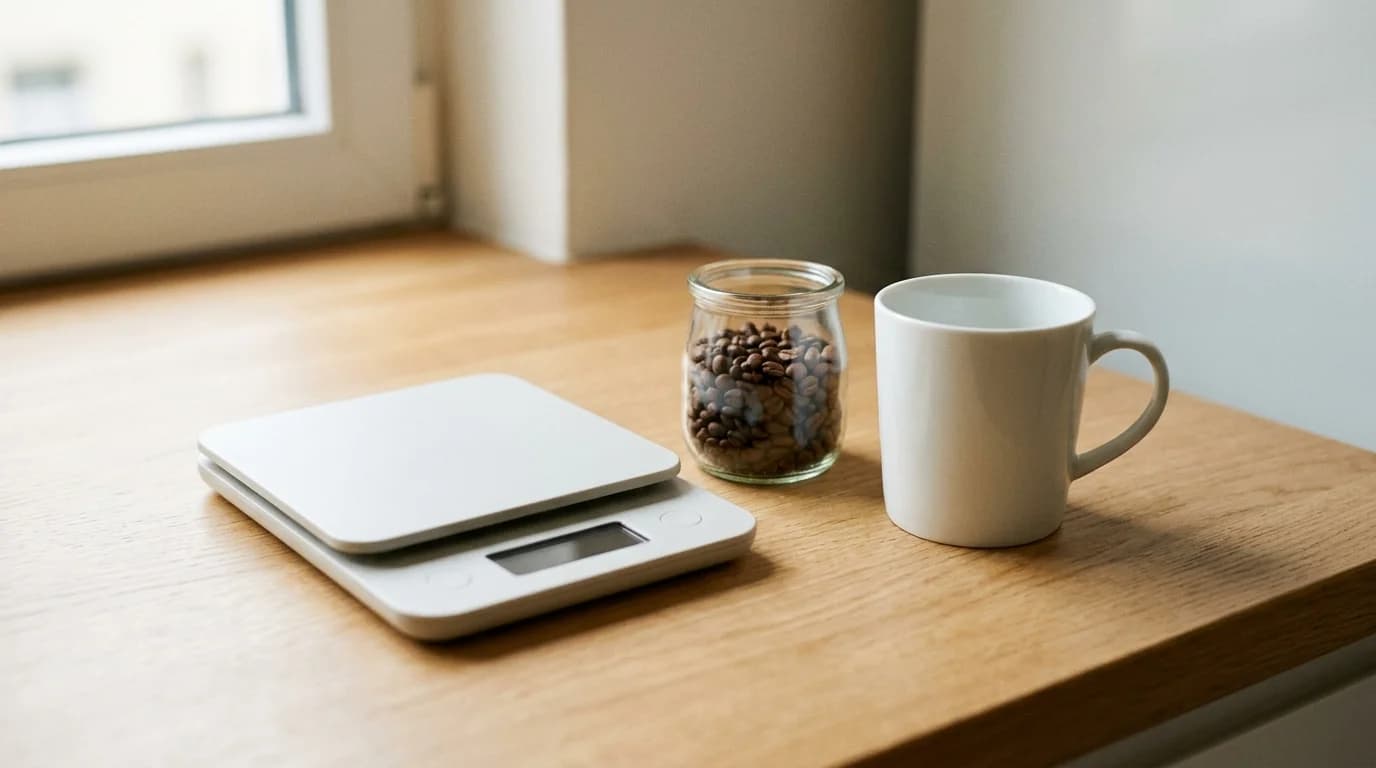
The coffee-to-water ratio is the single most important variable in brewing, and also the easiest to get right. It controls how strong your cup is — how many dissolved coffee solids are in a given volume of water. Everything else in the brewing process — grind size, temperature, technique — sits on top of the ratio you started with.
1:15–1:18
the standard reference range for coffee-to-water ratios in most drip and pour-over brewing[2]
1:16
a common default that lands in the middle of the range and works for most beans and methods[2]
Grams matter
a scale in grams is far more reliable than scoops or tablespoons — coffee density varies with roast and grind[1]
What the numbers mean
A "1:16 ratio" means one part coffee to sixteen parts water, by weight, both in grams. So:
- 15 g coffee + 240 g water = 1:16 ratio, ~8 oz cup
- 22 g coffee + 350 g water = 1:16 ratio, ~12 oz mug
- 30 g coffee + 475 g water = 1:16 ratio, ~16 oz large mug
Water weight is close to water volume for cold water (1 g ≈ 1 mL), so 240 g of water ≈ 240 mL ≈ 8 fl oz. Small differences at brewing temperature don't matter for typical home use.
Why not by volume? Coffee's density changes with roast (darker roasts are less dense — same scoop, less mass) and grind (fine grinds pack tighter than coarse). Two identical scoops of different coffees can differ in weight by 20% or more. A digital scale removes this variability[1].
The reference range and where different methods sit
Different brewing methods have slightly different sweet spots:
| Method | Typical ratio | Notes |
|---|---|---|
| Drip / auto-drip | 1:15 to 1:17 | 1:16 is a solid default |
| Pour-over (V60, Chemex) | 1:15 to 1:17 | 1:16 for most beans |
| French press | 1:14 to 1:17 | Heavier body tolerates a wider range |
| AeroPress | 1:12 to 1:17 | Wide range — depends on recipe |
| Cold brew concentrate | 1:5 to 1:8 | Diluted 1:1 with water or milk before serving |
| Cold brew ready-to-drink | 1:12 to 1:15 | Brewed at the ratio you'll drink |
| Espresso | ~1:2 | Different scale entirely — 18 g in, 36 g out |
Ratios drawn from Coffee Science Foundation brewing references[2]. Recipes vary; treat these as starting points.
Ratio ≠ extraction
The most useful concept in coffee brewing — and the one most home brewers miss — is that ratio and extraction are separate variables.
- Ratio controls brew strength (total dissolved solids, TDS). Adjust by adding more or less coffee.
- Grind size, water temperature, and time control extraction — what percentage of the coffee's soluble mass ends up in your cup.
A 2020 Journal of Food Science study explicitly quantified this: brew strength and extraction yield were varied independently, and both were shown to have measurable but distinct effects on the finished cup's flavour[1].
The practical implication: if your coffee tastes bitter, changing the ratio won't help — you're over-extracted, and need to grind coarser or reduce contact time. If it tastes weak but sweet and balanced, you're under-strength — increase the coffee at the same grind.
The "golden cup" numbers
The Specialty Coffee Association's classic "golden cup" guidelines put the target zone at:
- Brew strength (TDS): 1.15–1.35% — the range most drinkers find neither too weak nor too strong
- Extraction yield: 18–22% — the range where flavour is balanced rather than sour (under-extracted) or bitter (over-extracted)
Hitting the strength target is a ratio question (about 1:15–1:17 for most drip methods). Hitting the extraction target is a grind and time question[2].
You don't need a refractometer at home. The subjective test works fine: does this taste like coffee, is it strong enough, does the flavour finish clean or leave bitterness/astringency?
Figure
Brew strength (TDS) by coffee-to-water ratio
Practical rules that work
- Buy a scale. A basic kitchen scale accurate to 1 g is under $20 and is the single biggest coffee upgrade most home brewers can make. Scales that read 0.1 g are nicer but not necessary.
- Start at 1:16. For most beans and most brew methods, this is a reasonable middle point. Adjust from there.
- Change one variable at a time. If you push the ratio to 1:15 (stronger) and also grind finer, you've changed two things — you won't know which one moved the flavour.
- Weigh water, not volume. 240 g of water on a scale is more accurate than "one cup" on a measuring cup.
- Ratio is the same at any batch size. 15 g + 240 g works for one cup; 45 g + 720 g works for a whole pot at the same ratio.
Where the ratio breaks down
The 1:15–1:18 range assumes normal drip and pour-over brewing. Two exceptions matter:
- Espresso uses much less water — a "1:2 ratio" for a normal shot (18 g of coffee in, 36 g of espresso out) is standard. Ristretto is 1:1; lungo is 1:3+.
- Cold brew concentrate uses a 1:5 to 1:8 ratio — a much stronger extract — and is diluted before drinking. Ready-to-drink cold brew brewed at 1:12–1:15 lands close to iced coffee strength[2].
Different methods, different rules.
A ratio is only repeatable if the grind is, which is the argument for a burr grinder over a blade one — the tiers are compared in which grinder to buy.
The honest summary
Coffee-to-water ratio is the strength dial. 1:15 to 1:18 is where most brewed coffee sits, 1:16 is a safe starting point, and hitting your target requires a scale. If your coffee is inconsistent from day to day and you don't weigh it, that's the fix — before any grinder upgrade, before any beans change, before any technique tweak. Get the ratio right, then everything else can start to matter.
Frequently asked questions
- What is a good coffee-to-water ratio?
- 1:16 is a common starting point that works for most drip, pour-over, and French press methods. Stronger drinkers lean to 1:14–1:15; those who prefer lighter cups sit at 1:17–1:18. Espresso is a different scale entirely (around 1:2 for a normal shot).
- How many grams of coffee per cup of water?
- At 1:16, an 8 oz (240 g) cup takes 15 g of ground coffee. A 12 oz (355 g) mug takes 22 g. A 16 oz (475 g) cup takes 30 g. A digital kitchen scale in grams is the only way to hit these numbers reliably.
- Do I need a scale to brew good coffee?
- You don't need one, but you'll get more consistent results with one. Scoops and tablespoons vary substantially with roast, grind, and how you level the scoop. A cheap kitchen scale removes that variability for less than $20.
- What's the difference between ratio and grind size?
- Ratio controls how strong the coffee is — how many coffee solids per unit of water. Grind size controls how much of the coffee's solubles you extract. You can have a strong-but-under-extracted cup (correct ratio, wrong grind) or a weak-but-well-extracted cup. Both matter, independently.
References
Every factual claim in this article is drawn from the sources below. See the source library for how we grade evidence.
- [1]Effects of brew strength, brew yield, and roast on the sensory quality of drip brewed coffeeJournal of Food Science · 2020 · Controlled trial · Tier 2 · Moderate
- [2]Brewing FundamentalsCoffee Science Foundation · Reference work · Tier 2 · Moderate
- [3]Brewing temperature and the sensory profile of drip brew coffeePMC / NIH · 2020 · Controlled trial · Tier 2 · Moderate
Related reading
- Brewing ScienceCoffee Grind Size Guide: Which Grind for Which Method→
- Caffeine & HealthHow Much Caffeine Is in Coffee?→
- Brewing ScienceBest Water Temperature for Coffee→
- Brewing ScienceCoffee Extraction Explained: TDS, Solubles, and Yield→
- Coffee EquipmentHow Much to Spend on a Coffee Grinder→
- Brewing ScienceWater for Coffee: TDS, Minerals, and Why It Matters→