Coffee Strength vs Caffeine: They're Not the Same
By Coffee Studies Editorial·Published July 15, 2026·6 min read
Quick answer
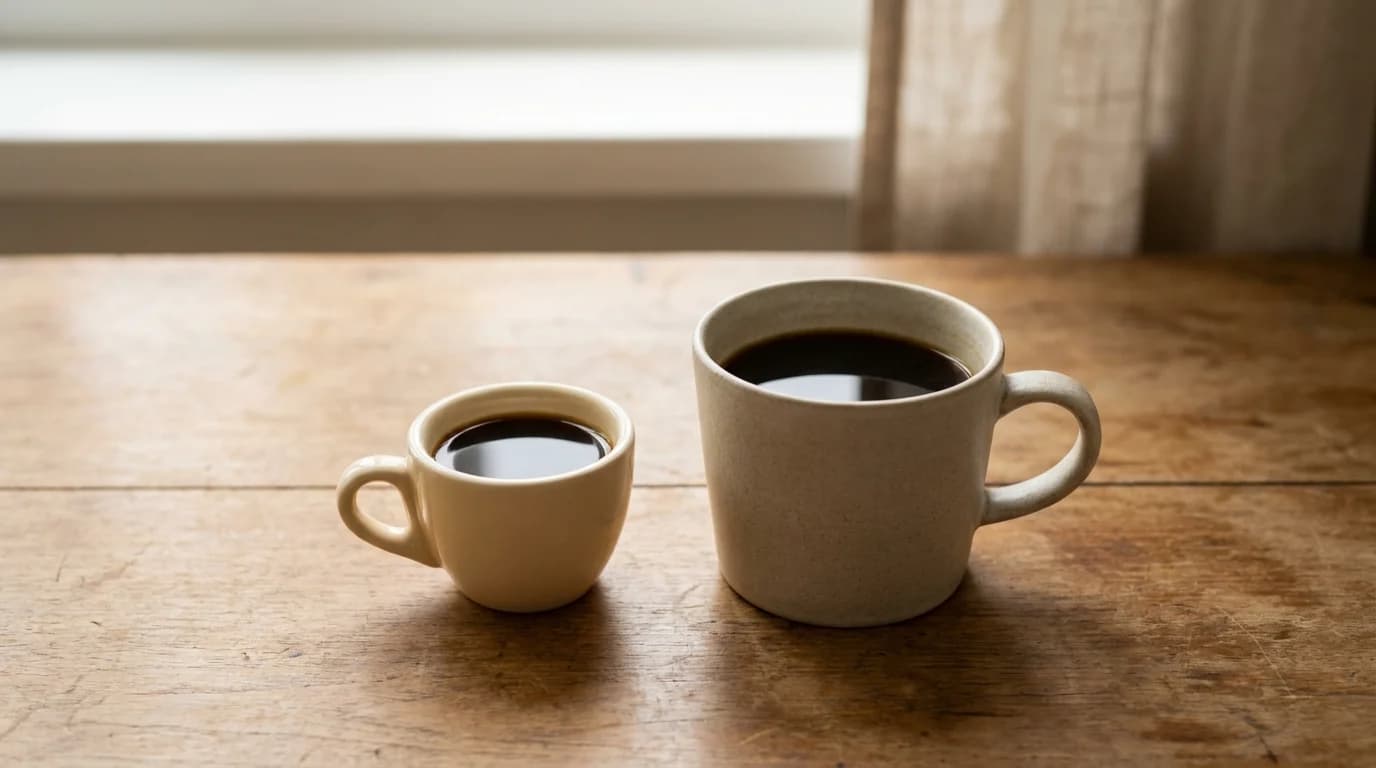
"Strong coffee" is one of the most casually-used phrases in coffee culture — and one of the most ambiguous. Depending on who's saying it, "strong" can mean high caffeine, high concentration, bold flavour, or dark roast. These often correlate, but they're independent variables — and confusing them leads to misunderstandings about what different coffees actually deliver.
TDS ≠ mg
strength (dissolved solids per volume) and caffeine (mg per serving) are separate variables[1]
1.2-1.4% drip
typical total dissolved solids (TDS) for drip coffee — versus 8-12% for espresso[2]
Serving matters
a small strong drink can have less caffeine than a large weak drink — total dose depends on volume too[3]
What "strength" actually measures
In coffee science, strength means the concentration of dissolved coffee solids in the drink — usually expressed as total dissolved solids (TDS) or brew strength percentage.
Roughly:
- Weak coffee: below 1.1% TDS — watery, thin
- Balanced coffee: 1.2-1.4% TDS — the classic "golden cup" range for drip
- Strong coffee: 1.5%+ TDS — noticeably concentrated
- Espresso: 8-12% TDS — extremely concentrated
- Cold brew concentrate: 2-3% TDS undiluted (but usually diluted before drinking)
A 2020 Journal of Food Science study explicitly examined how brew strength (TDS) and brew yield (extraction percentage) affect sensory quality — and treated these as separate variables because they can be adjusted independently[1].
The Specialty Coffee Association's "golden cup" framework defines strength targets and extraction targets as two distinct axes — a well-brewed coffee needs to hit both in range[2].
Strength is what your palate perceives
Perceived "strength" from your palate correlates with TDS but also with:
- Body and viscosity — thicker, oilier coffees feel stronger
- Bitterness — bitter cups often feel stronger even at the same TDS
- Roast level — dark-roasted coffees taste bolder, are often perceived as stronger
- Presentation — a small dark cup "feels" stronger than a large mild one at the same TDS
None of these are caffeine.
What caffeine actually is
Caffeine is a specific chemical compound (1,3,7-trimethylxanthine) measured in milligrams. Your coffee's caffeine content depends on:
- How much dry coffee was used (more coffee = more caffeine per cup)
- The bean species (robusta has ~2× the caffeine of arabica per gram)
- Brewing method extraction efficiency (hot vs cold, time, temperature)
- Serving size (obviously — a 16 oz cup at the same strength has more total caffeine than an 8 oz)
Reference points from USDA data[3]:
- 8 oz brewed drip coffee: 80-100 mg
- 8 oz instant coffee: ~60 mg
- 1 oz espresso shot: 60-65 mg
- 16 oz cold brew: 150-200 mg
Where strength and caffeine diverge
This is the useful part. Because strength and caffeine are independent, you get counterintuitive comparisons:
Espresso vs drip coffee:
- Espresso: 12% TDS, 60-65 mg caffeine per 1 oz shot
- Drip coffee: 1.3% TDS, 90 mg caffeine per 8 oz cup
Espresso is roughly 10× stronger by TDS. Drip has ~40% more total caffeine. Espresso "feels" more intense — smaller, more concentrated — but delivers less total caffeine dose than a full cup of drip.
Cold brew vs drip:
- Standard cold brew (ready-to-drink): 1.5% TDS, ~150 mg caffeine per 12 oz
- Drip: 1.3% TDS, ~90 mg caffeine per 8 oz
Cold brew is only slightly stronger by TDS but delivers substantially more caffeine per serving — because the recipe uses more coffee grounds and typically bigger servings.
Robusta vs arabica at the same TDS: Two cups brewed to the same 1.3% TDS from different species can have very different caffeine content — a robusta cup will have roughly twice the caffeine of an arabica cup at the same strength.
Decaf at the same TDS: An 8 oz cup of decaf brewed to normal drip strength (1.3% TDS) contains 2-15 mg of caffeine — not zero, but far below the 80-100 mg of regular. Same strength, dramatically different caffeine.
Figure
Caffeine density (mg per ounce) versus total per serving
Values in mg caffeine per fluid ounce
Why this matters practically
For managing caffeine intake:
- Don't judge caffeine by how "strong" a drink tastes
- A 16 oz iced coffee (mild-tasting, cold) can have 200+ mg caffeine
- A shot of ristretto (intense-tasting, concentrated) might have 40-50 mg
- Look at serving size and preparation method more than perceived strength
For flavour preference:
- If you want more concentrated flavour, adjust ratio (more coffee per unit water) — this raises TDS
- If you want more caffeine, either use more coffee, more volume, or a higher-caffeine bean/method
- These can be tuned independently
For sleep sensitivity:
- Your sleep response to caffeine depends on total caffeine dose, not perceived strength
- A mild but large late-afternoon cold brew can disrupt sleep more than a small strong espresso earlier in the day
The FDA's caffeine framework
The FDA's 400 mg per day guideline for healthy adults is a total caffeine dose figure — it doesn't care about strength, concentration, brewing method, or bean species. What matters is total milligrams[4]. This framing implicitly separates strength from caffeine — recognising that they're distinct variables that both matter but for different reasons.
How to think about both
A useful mental model:
- Ratio controls strength. More coffee per unit of water = higher TDS = "stronger" tasting. Adjustable by dose.
- Extraction (grind, time, temp) controls flavour balance. Sour vs bitter, developed vs under-developed. Adjustable by brewing variables.
- Total coffee mass controls total caffeine. More coffee in your brew = more caffeine in your cup. Adjustable by dose or serving size.
A "strong-tasting cup with less caffeine" is achievable by brewing a concentrated small serving (small volume, high TDS). A "mild-tasting cup with lots of caffeine" is achievable by brewing a large serving with plenty of coffee at normal strength (large volume, moderate TDS, high total dose).
Common misconceptions
- "Espresso has more caffeine than drip." Per ounce yes; per serving usually no. A double espresso and a full cup of drip are close in caffeine.
- "Strong-tasting coffee has more caffeine." Not necessarily. Perceived strength is about concentration and flavour intensity, not caffeine dose.
- "Cold brew is stronger." Per serving yes for caffeine — because larger servings and higher coffee-to-water ratios. Per unit volume, cold brew is often only slightly higher- TDS than drip.
- "Dark roast is stronger than light roast." In perceived flavour intensity, sometimes. In caffeine, essentially the same by weight of beans. In TDS at the same brewing ratio, similar.
Practical rules
- When you say "strong," specify what you mean. More concentrated? More caffeine? Bolder flavour? These aren't the same.
- To track caffeine intake, ignore "strength" claims and check the mg. USDA FoodData Central and product labels are your reference points.
- To adjust your cup's flavour without changing caffeine much, change extraction (grind, time, temperature) rather than dose.
- To adjust caffeine without changing flavour dramatically, change dose (more or less coffee) and let the ratio adjust proportionally.
The honest summary
"Strength" and "caffeine" are two different variables in coffee. Strength (TDS) is how concentrated the drink is per volume. Caffeine is total milligrams per serving. They're loosely correlated but independently controllable. Espresso is strong but low total caffeine; a mild large cold brew can be mild but high in caffeine. When you want a specific outcome, know which variable you're actually adjusting.
Frequently asked questions
- Does stronger coffee have more caffeine?
- Not necessarily. 'Strong' usually means high concentration of dissolved solids per volume. Caffeine is a separate variable — it depends on how much coffee was used, not how concentrated the drink is. Espresso is very concentrated but a single shot has less total caffeine than a full cup of drip coffee.
- Which has more caffeine, espresso or drip coffee?
- Per ounce, espresso has much more caffeine (about 60-65 mg per 1 oz shot vs 10-12 mg per ounce of drip). Per serving, a typical 8 oz drip cup (80-100 mg) has more total caffeine than a single espresso shot (60-65 mg). Serving size matters.
- How is coffee strength actually measured?
- Total dissolved solids (TDS) — the percentage of the drink that's dissolved coffee compounds by weight. Drip coffee is typically 1.2-1.4% TDS; espresso is 8-12% TDS. Coffee scientists measure this with a refractometer; home drinkers use their palate.
- Why does 'strong' feel confusing?
- Because the word gets used for multiple things: concentration (TDS), caffeine amount, bitterness, or bold flavour. All can vary independently. A cup can be strongly flavoured but low-caffeine (over-roasted decaf), or high-caffeine but not strongly flavoured (a large mild cold brew).
References
Every factual claim in this article is drawn from the sources below. See the source library for how we grade evidence.
- [1]Effects of brew strength, brew yield, and roast on the sensory quality of drip brewed coffeeJournal of Food Science · 2020 · Controlled trial · Tier 2 · Moderate
- [2]Brewing FundamentalsCoffee Science Foundation · Reference work · Tier 2 · Moderate
- [3]FoodData CentralU.S. Department of Agriculture · Official dataset · Tier 1 · Strong
- [4]Spilling the Beans: How Much Caffeine Is Too Much?U.S. Food and Drug Administration · 2024 · Agency guidance · Tier 1 · Strong
Related reading
- Caffeine & HealthHow Much Caffeine Is in Coffee?→
- Brewing ScienceCoffee-to-Water Ratio Explained→
- Brewing ScienceCoffee Extraction Explained: TDS, Solubles, and Yield→
- Brewing ScienceCoffee Cupping: How SCA Sensory Evaluation Works→
- Brewing ScienceCoffee pH Explained: What Acidity Means in the Cup→
- Brewing ScienceDoes Coffee Have Tannins? Yes, But Far Less Than Tea→