Coffee Cupping: How SCA Sensory Evaluation Works
By Coffee Studies Editorial·Published July 18, 2026·5 min read
Quick answer
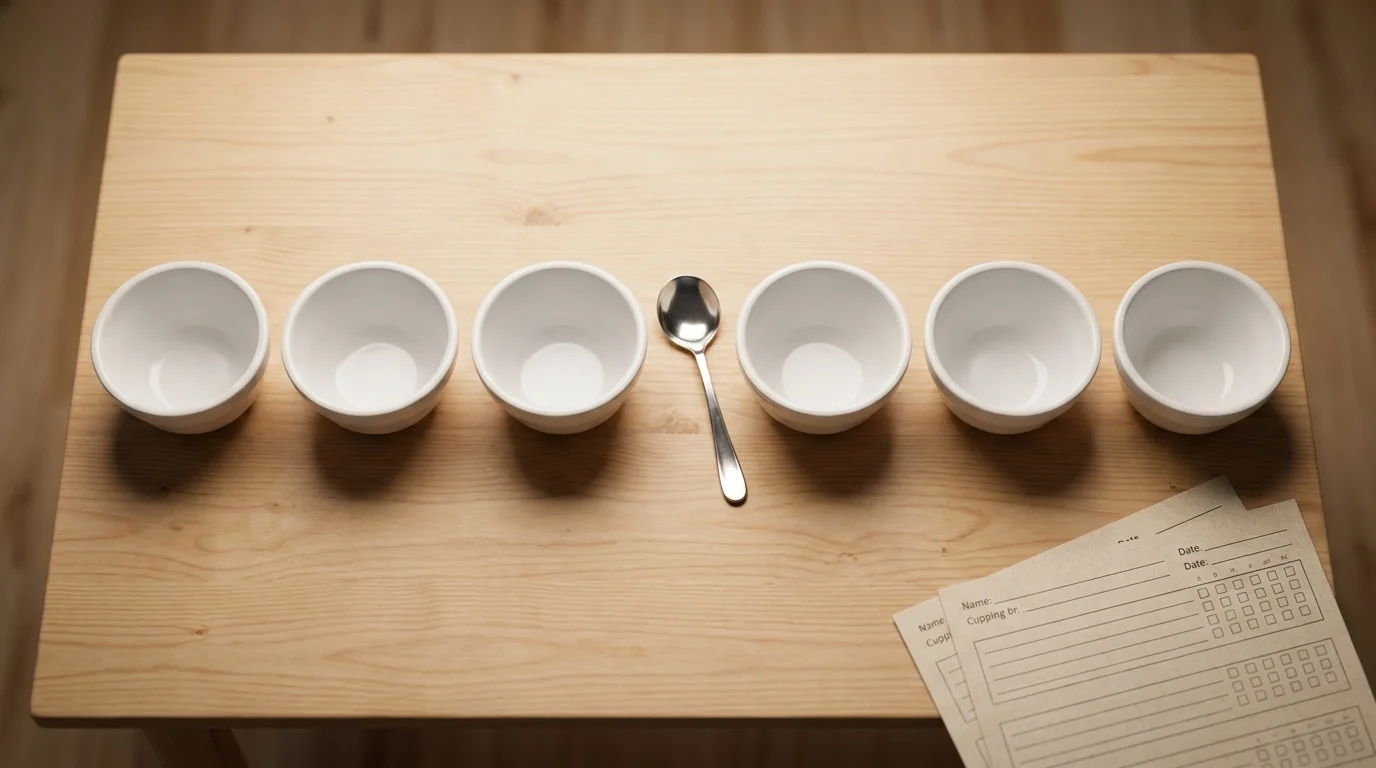
Every quality score attached to a specialty coffee — the "92 point" on a roaster's bag, the grades used to buy and sell green coffee at origin, the scores in barista competitions — comes from a standardised protocol called cupping. It is the coffee industry's scientific sensory evaluation method, and understanding how it works explains a lot about how coffee quality is defined and measured.
8.25 g per 150 mL
the SCA cupping protocol's fixed brew ratio — precise and consistent across all coffees being evaluated, eliminating ratio as a variable and ensuring that differences in the cup reflect differences in the coffee, not the brewer[1]
80 points = specialty grade
coffees scoring 80 or above on the SCA 100-point scale qualify as specialty-grade coffee; scores above 90 are considered exceptional; the majority of commercially traded coffee scores below 80 and is classified as commodity grade[1]
Over 1,000 volatile compounds evaluated
coffee contains more than 1,000 identified volatile aromatic compounds — cupping is designed to systematically assess the fragrance (dry grounds), aroma (wet grounds), and flavour (in the cup) that these compounds produce, using a standardised vocabulary anchored to the SCA Flavour Wheel[3]
Why cupping exists
Coffee is an agricultural product that varies dramatically by origin, variety, processing, and roast. A coffee buyer assessing 50 lots of Colombian green coffee needs a method that lets them compare all 50 on the same terms — not brewed as espresso through one machine and as pour-over through another, but evaluated through a controlled, reproducible protocol where the only variable is the coffee itself.
Cupping solves this. By fixing every parameter — ratio, grind, water temperature, timing, evaluation sequence — cupping removes the brewing method from the comparison. What you taste in the cup is as close as possible to an unfiltered signal from the coffee[1].
The SCA cupping protocol
The SCA protocol is the international standard. Its specifications:
Coffee weight: 8.25 g per 150 mL of water (approximately a 1:18 ratio). Multiple cups of each coffee are prepared (typically five per lot, to check for uniformity and detect defects).
Grind: medium-coarse, ground within 15 minutes of cupping. Grinding produces volatile release — if you grind and wait, the most aromatic compounds escape before you have a chance to assess them. For this reason, fragrance (dry grounds) is evaluated immediately after grinding.
Water: 93°C (±3°C), off boil. Poured directly onto the grounds to the 150 mL mark.
Infusion time: 4 minutes. The grounds sit on top of the water, forming a crust. The crust traps aromas.
Breaking the crust: After 4 minutes, the cupper uses a spoon to break through the crust with three strokes, then noses the released steam immediately. This "break" releases the most concentrated aromatic burst of the entire cupping — the primary aroma evaluation moment.
Skimming: After breaking, the foam and grounds floating on top are skimmed away. The liquid is then ready to taste.
Tasting: The cupper uses a deep spoon to aspirate the coffee loudly and sharply — the aspiration aerosolises the liquid across the entire palate, including the retro-nasal passage. Loud slurping is not uncouth at a cupping table; it is the correct technique for full flavour exposure.
Temperature windows: Coffee is evaluated hot (around 70°C for initial flavour), then warm (55°C for body and balance assessment), then cool (below 38°C for acidity and aftertaste, as some aromatic compounds and acids only reveal themselves at lower temperature)[2].
What is being evaluated
The SCA cupping form scores ten attributes:
Figure
SCA cupping attributes and their maximum point contribution
Values in points (out of 100 total)
The SCA Flavour Wheel
The Flavour Wheel is the vocabulary tool that makes cupping reproducible across tasters and locations. Without shared vocabulary, "fruity" means nothing — one taster means strawberry, another means dried fig. The wheel directs both toward specific reference points[3].
The wheel's structure moves from general categories at the centre to specific descriptors at the edge:
Fruity → Berry → Blackberry / Raspberry / Blueberry / Strawberry
Fruity → Citrus Fruit → Grapefruit / Orange / Lemon / Lime
Floral → Black Tea / Floral → Jasmine / Rose / Chamomile
Nutty / Cocoa → Nutty → Almond / Hazelnut / Peanut
Sweet → Brown Sugar / Vanilla / Caramelised → Honey / Maple
Roasted → Pipe Tobacco / Tobacco → Dark / Medium / Caramelised
The 2016 redesign (with World Coffee Research) anchored many descriptors to specific sensory reference standards — for example, "grapefruit" can be calibrated against actual grapefruit oil, so tasters in different countries are calibrating to the same physical reference.
What cupping reveals that brewing does not
Brewing methods introduce variables that mask or distort underlying coffee character:
- Espresso magnifies body and sweetness but suppresses acidity and some delicate aromatics due to pressure and concentration.
- Pour-over can emphasise acidity and clarity but is sensitive to filter type (paper absorbs oils, changing texture).
- French press includes oils and fine particles, producing heavier body and a different texture than filtered methods.
Cupping strips all of this away. The open-bowl infusion method produces a result that is less extreme than espresso, less filtered than pour-over, and controlled enough to compare across origins and processing methods[2].
A coffee that performs well in cupping tends to perform well across multiple brewing methods. A coffee that is highly optimised for one method (e.g., very high body and sweetness for espresso) may cup mediocre compared to its extracted performance.
Doing a home cupping
You do not need professional equipment. The protocol is straightforward at home:
- Grind 8–10 g per 150 mL of water to medium-coarse. Use the same grind for all coffees you are comparing.
- Prepare small identical cups or bowls (one per coffee). Weigh and dose each identically.
- Evaluate fragrance immediately after grinding.
- Add water at just-off-boil temperature to all cups.
- Wait 4 minutes.
- Break the crust and nose each cup immediately.
- Skim the grounds and foam.
- Taste using a spoon — slurp loudly to aerosolise the liquid across your palate. Evaluate hot, then warm, then cool.
- Compare the coffees against each other, not against an ideal. Notice what is different between them: one is brighter, one is heavier, one has a longer finish.
The value of home cupping is not achieving a certified score — it is developing the ability to notice specific attributes separately rather than experiencing coffee as an undifferentiated "good" or "bad."
Putting words to what you taste
 Structured tasting and cuppingThe Coffee Tasting Handbook: A Toolkit for Tasting Your CupA tasting framework rather than a brewing guide: what to look for, how to describe it, and how to run a comparison so the results mean something. Pairs with cupping at home, where the hard part is vocabulary rather than technique.amazon.com $21.25 USDamazon.ca $31.99 CADPrice and availability as of View on Amazon
 Origin-by-origin referenceThe World Atlas of Coffee 3rd edition: From beans to brewing – coffees explored, explained and enjoyedOrganised by producing country rather than by technique, which makes it the reference to reach for when a bag names a region you do not know. The brewing sections are brief by design; the maps and the origin profiles are the reason to own it.amazon.com $24.86 USDamazon.ca $31.65 CADPrice and availability as of View on Amazon
Product prices and availability are accurate as of the date/time indicated and are subject to change. Any price and availability information displayed on Amazon at the time of purchase will apply to the purchase of this product. Certain content that appears on this site comes from Amazon. This content is provided ‘as is’ and is subject to change or removal at any time.
The honest summary
Coffee cupping is the SCA-standardised sensory evaluation protocol used to assess coffee quality objectively. The method fixes all brewing variables — ratio (8.25 g per 150 mL), grind, water temperature (93°C), and timing (4 minutes) — so that the only variable is the coffee. Tasters evaluate ten attributes (fragrance, aroma, flavour, aftertaste, acidity, body, balance, uniformity, clean cup, sweetness) on a 100-point scale. Scores above 80 define specialty-grade coffee. The SCA Flavour Wheel provides standardised vocabulary for describing what tasters experience. Cupping is used to buy and sell green coffee, to quality-control roasted batches, and to calibrate tasters toward a shared sensory language.
Frequently asked questions
- What is coffee cupping?
- Coffee cupping is the standardised method used by specialty coffee professionals — roasters, buyers, Q Graders, and tasters — to evaluate and compare coffees objectively. The protocol controls variables: the same grind size, the same ratio of coffee to water, the same water temperature, the same timing. By eliminating brewing variables, cupping isolates the coffee itself — its origin character, variety, processing, and roast. Cupping is used by roasters to assess green coffee before buying, to quality-control roasted batches, and by competition judges to score entries.
- What is the SCA cupping protocol?
- The Specialty Coffee Association (SCA) cupping protocol specifies: a brew ratio of 8.25 g of coffee per 150 mL of water, coffee ground to a medium-coarse consistency, water temperature of 93°C (±3°C), an infusion time of 4 minutes before breaking the crust. Tasters evaluate eight attributes — fragrance/aroma, flavour, aftertaste, acidity, body, balance, uniformity, clean cup, sweetness, and overall — on a 100-point scale. Coffees scoring above 80 qualify as specialty grade; above 90 is considered exceptional.
- What is the coffee flavour wheel?
- The SCA Flavour Wheel (first published in 1995, redesigned in 2016 in collaboration with World Coffee Research) is a standardised vocabulary tool for describing coffee flavours. It organises flavour descriptors from broad categories in the centre (fruity, floral, nutty, roasted) to increasingly specific descriptors toward the outside (jasmine, bergamot, blackcurrant, cedar, dark chocolate). The wheel was developed from sensory science research to give tasters a shared vocabulary, reducing the subjectivity of terms like 'fruity' by directing attention to specific reference points.
- What does coffee cupping reveal that brewing doesn't?
- Cupping removes the brewing method as a variable. A coffee that tastes good as a pour-over might taste different as an espresso — method-dependent variables (pressure, filter type, temperature) affect what gets extracted. In cupping, coffee sits in contact with water in an open bowl, producing an infusion that exposes the coffee's fundamental character without the influence of any specific brewing equipment or technique. This makes comparison between coffees more reliable, which is why buyers and quality control professionals use it.
- What is a Q Grader?
- A Q Grader is a licensed coffee quality evaluator certified by the Coffee Quality Institute (CQI). The Q Grader certification involves a rigorous exam covering cupping skills, sensory calibration, coffee science, and green grading. Q Graders use the SCA cupping protocol to assign scores to coffees on the 100-point scale. A Q Grader's score is considered a standardised, reproducible assessment of coffee quality — used in green coffee purchasing contracts and specialty coffee certification.
References
Every factual claim in this article is drawn from the sources below. See the source library for how we grade evidence.
- [1]SCA Cupping ProtocolsSpecialty Coffee Association · 2023 · Reference work · Tier 3 · Contextual
- [2]Brewing FundamentalsCoffee Science Foundation · Reference work · Tier 2 · Moderate
- [3]Coffee volatile compounds and roast markersPMC / NIH · 2016 · Review · Tier 2 · Moderate
Related reading
- Brewing ScienceCoffee Extraction Explained: TDS, Solubles, and Yield→
- Brewing ScienceCoffee Acidity: pH, Sourness, and What Affects It→
- Brewing ScienceWhat Are Chlorogenic Acids? Coffee's Key Polyphenol→
- Beans, Roasts & OriginsWhat Is Specialty Coffee? The 80-Point Standard→
- Brewing ScienceWhat Is Coffee Bloom? CO₂, Degassing, and Why It Matters→
- Brewing ScienceCoffee Strength vs Caffeine: They're Not the Same→