What Is Coffee Bloom? CO₂, Degassing, and Why It Matters
By Coffee Studies Editorial·Published July 15, 2026·7 min read
Quick answer
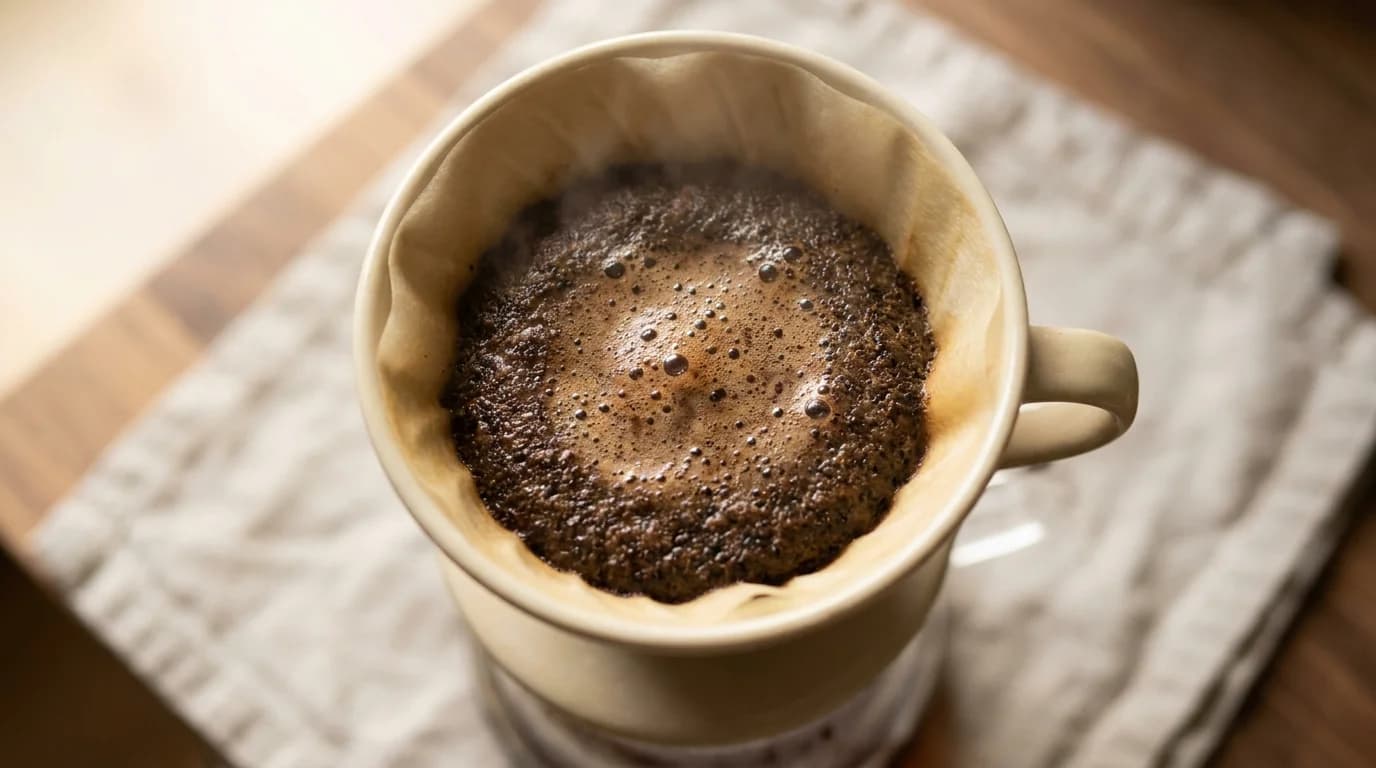
The coffee bloom is one of those small brewing details that looks decorative but is genuinely functional. When done right, it improves extraction and gives you real information about your beans. When skipped, you're leaving flavour on the table and probably brewing coffee that tastes less good than it should.
CO2 escape
the bloom is trapped carbon dioxide from roasting rushing out when water hits fresh coffee[2]
30-45 seconds
standard bloom time for pour-over and drip — long enough to release most CO2 before the main pour[4]
Freshness test
bloom size and duration are a rough freshness signal — fresh beans bloom vigorously, stale beans barely at all[1]
What the bloom actually is
Coffee roasting is a chemical process that produces carbon dioxide. As beans transform from green to roasted, hundreds of reactions generate CO2 gas — some escapes during roasting, but substantial amounts remain trapped inside the bean structure.
A 2000 Journal of Food Process Engineering paper on degassing kinetics documented what happens after roasting: CO2 continues to leave roasted coffee over days, weeks, and months, following predictable kinetic patterns. The rate depends on grind (ground coffee releases faster than whole beans), storage conditions, and initial roast level[2].
A 2005 Journal of Food Science paper on CO2 evolution during roasting mapped the chemistry — Strecker degradation and carbohydrate pyrolysis produce CO2 that becomes trapped in the porous roasted bean matrix[3].
When you pour hot water on freshly ground fresh coffee:
- The heat rapidly increases CO2's escape from the bean matrix
- The water absorbs some CO2 but can't hold all of it
- CO2 rushes out as visible bubbles
- The grounds swell as the internal gas expands
- You see the "bloom" — foaming, bubbling, rising grounds
Why the bloom matters for extraction
The bloom isn't just cosmetic. CO2 actively interferes with extraction:
1. CO2 creates a barrier. Gas trapped in the coffee bed prevents water from evenly contacting all the grounds. Water finds paths around the CO2-rich areas — a form of channelling that produces uneven extraction.
2. CO2 pushes water away. Escaping CO2 physically resists water flow through the coffee. This can cause pour-over to run faster than expected and drip machines to under-extract.
3. CO2 affects flavour. Some dissolved CO2 in the finished cup contributes to a specific sharp, sparkling character that many drinkers find harsh or acid-forward.
4. Fresh coffee floats. Very fresh, un-bloomed grounds can float on top of the water rather than settling and extracting evenly.
By pouring a small amount of water first and waiting 30-45 seconds, you let most of the CO2 escape before the main pour. The remaining brew then extracts evenly, tastes cleaner, and produces a better cup.
How to bloom (the standard technique)
For pour-over or drip:
- Grind your coffee and add it to the filter.
- Zero your scale.
- Pour hot water in a slow circle, wetting all the grounds uniformly. Amount: about twice the weight of the coffee (44 g water for 22 g coffee).
- Watch the bloom — grounds swell and bubble.
- Wait 30-45 seconds — the bloom starts vigorous, gradually settles.
- Continue with the main pour for the remaining water, following your normal recipe.
For French press:
Some recipes call for a similar bloom step — pour twice the coffee weight of water, stir gently, wait 30 seconds, then add the remaining water and continue with the standard steep. Not required for French press but produces a cleaner cup.
For espresso:
Modern espresso machines don't allow a manual bloom before the main shot — the pump fires continuously. Some machines have a "pre-infusion" feature that acts similarly, wetting the puck at low pressure before the full 9-bar extraction begins. This achieves the same goal.
For AeroPress:
Depending on recipe, you can bloom or skip it. Some AeroPress recipes pour and stir immediately; others include a 15-30 second bloom similar to pour-over.
For cold brew:
Not applicable — cold water at room temperature doesn't drive CO2 out the same way hot water does. Cold brew extracts slowly enough that trapped CO2 doesn't disrupt the process meaningfully.
Blooming well is a weight and a controlled pour, so it is one of the few techniques where the tools genuinely change what you can do rather than just making it tidier.
 Scale with a timer, 0.1gMaestri House S2 Espresso Coffee Scale with Timer 0.1g Precision Shot Scale | USB-C Rechargeable, Dual Timing Modes, 2kg/0.1g Digital Scale with Borosilicate Glass Top for Espresso and Pour-Over BrewingDose and ratio are the two variables you can fix for free, and neither is fixable by eye: a scoop of beans varies by several grams depending on bean size and how it was filled. A timer on the same device means you are reading one instrument instead of two.amazon.com $30.39 USDamazon.ca $34.19 CADPrice and availability as of View on Amazon
 Variable-temperature gooseneckCosori Gooseneck Electric Kettle with Temperature Control, 0.8L, Black | No Plastic Contact with Water, 5 Presets, 60-Min Keep Warm, Pour Over Coffee & Tea, Stainless Steel Interior, 1200WThe spout gives you a slow, placeable stream, which is most of pour-over technique. Temperature control matters less than people assume at fixed extraction, but it removes a variable while you are learning, and it is the difference between guessing and knowing what went into the cup.amazon.com $62.99 USDamazon.ca $85.49 CADPrice and availability as of View on Amazon
Product prices and availability are accurate as of the date/time indicated and are subject to change. Any price and availability information displayed on Amazon at the time of purchase will apply to the purchase of this product. Certain content that appears on this site comes from Amazon. This content is provided ‘as is’ and is subject to change or removal at any time.
What bloom size tells you about freshness
The bloom is a fast, free freshness test. A rough guide:
Vigorous bloom, big rising dome, obvious bubbling:
- Coffee is very fresh (0-14 days from roast date)
- Beans still contain substantial trapped CO2
- Bloom duration may need extending slightly to 60 seconds
Moderate bloom, visible bubbling, some doming:
- Coffee is fresh (2-4 weeks from roast)
- Standard 30-45 second bloom works well
Weak bloom, minimal bubbling, no doming:
- Coffee is aging (4-6 weeks from roast)
- Cup will taste weaker or flatter than fresh coffee
- Bloom can be shortened to 20-30 seconds
Essentially no bloom, grounds just get wet:
- Coffee is stale (6+ weeks from roast)
- Cup will taste dull and flat
- Consider fresher beans
Whole beans stay fresh longer than ground coffee — CO2 escapes much faster from ground coffee due to increased surface area[2]. This is why the common advice is to grind just before brewing.
Storage affects bloom too
Even fresh beans lose their bloom potential to poor storage:
- Air exposure — oxygen accelerates CO2 loss along with flavour degradation
- Heat — heat drives CO2 out faster
- Moisture — humidity encourages other degradation reactions
Good storage means whole beans, sealed container, cool dark place. This preserves the CO2 (and the flavour) longer.
A 2017 Journal of Agricultural and Food Chemistry paper used time-resolved gravimetric methods to precisely measure coffee degassing — quantifying how CO2 loss varies with storage conditions, grind, and roast level. The data supports the practical guidance: fresh, well-stored, whole beans bloom the best[1].
Roast level affects the bloom
Light roasts:
- Less CO2 produced during roasting (shorter roast, lower final temperature)
- Bloom is present but often smaller than dark roasts at the same age
- Retain CO2 slightly longer in some cases
Medium roasts:
- Balanced CO2 content
- Standard bloom behaviour
- The default reference
Dark roasts:
- Most CO2 produced (longer, hotter roasting)
- Vigorous initial bloom
- CO2 also escapes faster from the porous dark-roast structure
- Can be past optimal bloom-worthiness sooner than lighter roasts
Regardless of roast level, the same principle applies: fresher = more bloom.
When to bloom longer vs shorter
Longer bloom (60 seconds) when:
- Coffee is very fresh (roasted in the last 3-7 days)
- Bloom is unusually vigorous
- You want to reduce CO2's flavour contribution
Shorter bloom (20-30 seconds) when:
- Coffee is older
- Bloom is weak (indicates less CO2 to escape)
- You want more of the fresh, sharp character in your cup
Skip the bloom (start pouring immediately) when:
- Coffee is very stale (no bloom happens anyway)
- Cold-brewing (no bloom occurs at cold temperatures)
- Using very old commodity coffee where the CO2 is long gone
Common misconceptions
- "Bloom is just decorative." It's a functional extraction improvement, not just visual.
- "You should stir during the bloom." Some recipes call for stirring; others say don't. Both work. Stirring wets grounds more evenly; not stirring lets the CO2 escape more naturally.
- "All coffee should bloom vigorously." Only fresh coffee will. Weak bloom means old coffee — informative, not a problem with your technique.
- "The bloom means the coffee is releasing flavour." It's releasing CO2 that was trapped from roasting, not flavour. Flavour extraction happens continuously through the brew.
Practical rules
- Always bloom for pour-over, drip, and Chemex brewing
- Twice the coffee weight in water for the bloom pour
- 30-45 seconds is the standard wait
- Adjust based on freshness — longer for very fresh, shorter for older beans
- Use the bloom as a freshness signal — over time you'll learn what your usual coffee's bloom looks like, and any drop-off tells you the bag is getting old
How much the bloom matters depends partly on the brewer, since a flat-bottom bed degasses differently from a cone — see pour-over brewers.
The honest summary
The coffee bloom is trapped CO2 from roasting escaping when hot water hits fresh coffee. Blooming your coffee (pouring a small amount, waiting 30-45 seconds) releases most of this CO2 before the main pour so extraction goes more evenly. Bloom size is a useful freshness test — vigorous means fresh, weak means stale. Not required for cold brew or espresso (the mechanics don't apply), but essential for good pour-over and drip. A 30-second detail that meaningfully improves your cup.
Frequently asked questions
- What is the coffee bloom?
- The visible foaming, bubbling, and expansion of ground coffee when hot water first touches it. Fresh coffee contains CO2 gas trapped from roasting; when water hits, that CO2 rushes out, creating bubbles that make the grounds swell and foam. Blooming is both the phenomenon and the deliberate technique of letting it happen before the main pour.
- How long should you bloom coffee?
- 30-45 seconds is standard for pour-over and drip. Very fresh beans (within a few days of roasting) may need slightly longer (up to 60 seconds) because they release more CO2. Older beans need less time because they've lost more CO2 already.
- How much water do you use for a bloom?
- About twice the weight of the coffee. For 22 g of coffee, pour ~44 g of water for the bloom. Enough to fully saturate all the grounds without pooling excessively.
- Why does bloom size vary?
- Freshness. Freshly roasted beans (0-14 days after roast) bloom vigorously — the grounds swell dramatically, foam builds visibly. Beans past 4-6 weeks bloom weakly or not at all — they've lost most of their CO2 to atmospheric degassing. Bloom size is a fast, free freshness test.
References
Every factual claim in this article is drawn from the sources below. See the source library for how we grade evidence.
- [1]Time-Resolved Gravimetric Method To Assess Degassing of Roasted CoffeeJournal of Agricultural and Food Chemistry · 2017 · Controlled trial · Tier 2 · Moderate
- [2]Degassing Kinetics and Sorption Equilibrium of Carbon Dioxide in Fresh Roasted and Ground CoffeeJournal of Food Process Engineering · 2000 · Controlled trial · Tier 2 · Moderate
- [3]Carbon Dioxide Evolution and Moisture Evaporation During Roasting of Coffee BeansJournal of Food Science · 2005 · Observational study · Tier 2 · Moderate
- [4]Brewing FundamentalsCoffee Science Foundation · Reference work · Tier 2 · Moderate
Related reading
- Brew MethodsPour-Over Coffee Guide: Ratios, Bloom, and Technique→
- Brewing ScienceCoffee Extraction Explained: TDS, Solubles, and Yield→
- Brewing ScienceHow Long Does Coffee Last? Freshness and Shelf Life→
- Coffee EquipmentPour-Over Coffee Makers: Cone, Flat Bottom, or Chemex→
- Brewing ScienceSalt in Coffee: Does It Actually Reduce Bitterness?→
- Brewing ScienceUnder-Extracted vs Over-Extracted Coffee→