Chemex Brew Guide: Ratios, Grind, and Technique
By Coffee Studies Editorial·Published July 15, 2026·8 min read
Quick answer
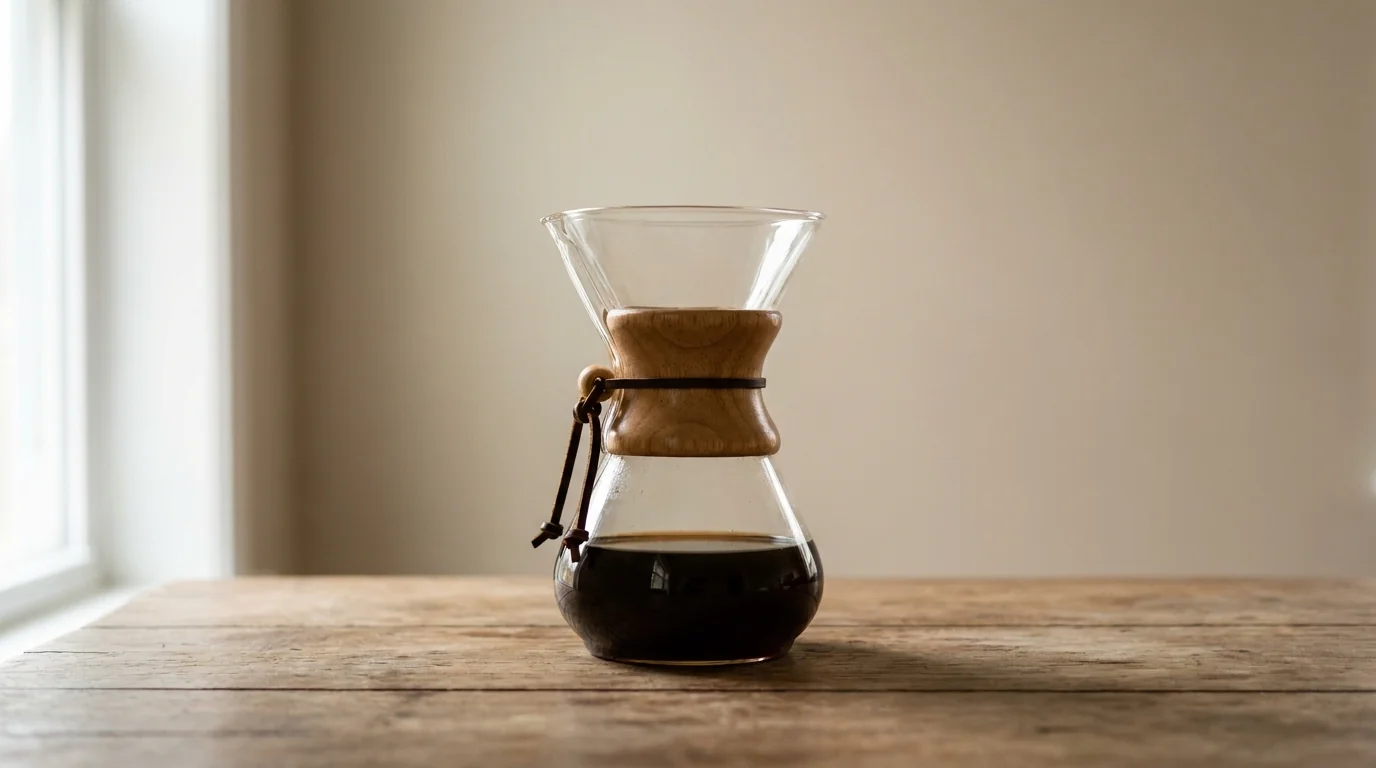
Chemex is one of the few coffee brewers that qualifies as industrial design famous outside coffee circles — the hourglass carafe with its wooden collar and leather tie has been in the Museum of Modern Art's permanent collection since 1943 and has been continuously produced without meaningful design change since 1941. But the reason coffee people care about the Chemex isn't the design — it's the filter. The distinctively thick bonded paper filter produces a cup unlike anything else.
1941
year Peter Schlumbohm patented the Chemex design — continuously produced since[1]
20-30% thicker
Chemex filters weigh substantially more than standard cone filters — trapping more oils and sediment[2]
Cleanest cup
filtered by the thickest paper in coffee, the Chemex brew has the least body and clearest flavour separation of any pour-over[3]
What Chemex actually is
Chemex was invented by Peter Schlumbohm, a German-American chemist working in New York, and patented in 1941. Schlumbohm was frustrated with the messy, inconsistent coffee brewers of the era and applied laboratory glassware design principles to build a better one. The result:
- A hourglass-shaped borosilicate glass carafe — the same glass used in laboratory beakers, chosen for chemical neutrality and heat tolerance.
- A wooden collar wrapped around the narrow middle, functioning as insulation so you can hold the vessel while brewing.
- A leather tie wrapped around the collar — decorative but also functional in the original design (allowed the collar to be untied for cleaning).
- A distinctive bonded paper filter — thicker than standard cone filters, folded into a specific cone shape that fits the Chemex neck.
- An air channel — a small runnel along one side of the neck that allows air to escape as coffee brews (a feature many pour-over drippers now include, adapted from Chemex)[1].
Sizes: 3-cup (typically for one strong drinker), 6-cup (for two to four servings), 8-cup (for a small dinner party), and 10-cup (large batch).
Why the filter matters so much
Every pour-over uses a paper filter, but Chemex uses a much heavier one than any other design. Two consequences:
Oil retention. Coffee's non-caffeine oils — including cafestol and kahweol (the diterpenes that raise LDL cholesterol, see Coffee and Cholesterol) — are substantially retained by paper filters. The heavier Chemex filter is particularly effective at this. The brew comes through with almost no visible oil sheen[5].
Fine particle removal. Paper filters also trap small particles of coffee that pass through the grind. A thicker filter traps more fines. Chemex-brewed coffee has the least sediment of any pour-over method — you can hold the finished brew up to light and see through it clearly.
Slower flow rate. The thick filter is more restrictive. Chemex brewing is slower than V60 or Kalita for the same grind size, meaning grinds need to be coarser to hit the same total time.
The result is a distinctively clean, tea-like cup. Body is minimal; acidity is bright and articulated; flavour notes are very clearly separated rather than blended. Fans love this; critics say it lacks weight.
The classic recipe (6-cup Chemex)
Equipment:
- Chemex 6-cup brewer
- Chemex bonded filter (the correct fold for a 6-cup brewer)
- Gooseneck kettle
- Scale
- Grinder capable of medium-coarse (a burr grinder — blade grinders don't produce even-enough particles for pour-over)
- Timer
Beans:
- 42 g of medium-roast whole beans, freshly ground medium- coarse.
Water:
- 700 g total, temperature 195-205°F (90-96°C).
Process:
- Rinse the filter — place the filter in the Chemex with the triple-folded side against the spout. Pour hot water through the filter to wet it, warm the vessel, and rinse any papery taste. Discard the rinse water.
- Add coffee — 42 g of grounds into the wetted filter. Give the Chemex a gentle shake to level the coffee bed.
- Bloom — pour 84 g of water (double the coffee weight) over the grounds. Start the timer. Wait 45 seconds. The coffee should visibly rise as CO₂ is released.
- First main pour — after 45 seconds, pour slowly in concentric circles until you reach 350 g total water (including the bloom). Aim to complete this pour by about 1:30 on the timer.
- Second main pour — pour to 550 g by about 2:30.
- Final pour — pour to 700 g by about 3:30.
- Drawdown — let the water finish draining through. Total brew time should be roughly 4:30-5:30.
- Remove the filter, swirl the brew, pour, and serve.
Grind troubleshooting
- If total brew time is under 4 minutes: grind is too coarse or the filter is drawing too fast. Grind slightly finer next time.
- If total brew time is over 6 minutes: grind is too fine or the pour rate was too aggressive. Grind coarser.
- If the coffee tastes sour and thin: under-extracted — grind finer, use slightly hotter water, or lengthen the brew.
- If the coffee tastes bitter and dry: over-extracted — grind coarser, use slightly cooler water, or shorten the brew.
Chemex is particularly sensitive to grind evenness. A grinder that produces lots of fines (blade grinder or a poor- quality burr grinder) will clog the filter and give inconsistent extraction. See Burr vs Blade Grinder for the foundational grinder story.
Chemex vs V60 vs Kalita Wave
The three most-loved pour-over brewers each produce different results.
Chemex:
- Thickest filter → cleanest, most transparent cup.
- Slowest flow → needs coarser grind.
- Best for: bright, acidic origins (Ethiopian, Kenyan) where you want the acidity clearly articulated. Also best for cholesterol-conscious brewing.
- Not ideal for: dark roasts (may taste hollow), lower- quality beans (nothing to hide flaws behind).
V60 (Hario):
- Thinner filter, single spiral rib pattern, single large hole.
- Faster flow → needs finer grind.
- Produces more body than Chemex, faster brew, more sensitive to pour technique.
- Best for: single-origin light-medium roasts where you want balance of clarity and body.
Kalita Wave:
- Flat bottom (not conical), three small holes.
- Wavy paper filter with pleats.
- More forgiving of pour technique than V60 — the flat bottom and small holes regulate flow rate more consistently.
- Best for: consistent daily brewing where technique varies.
For a full V60 walk-through see V60 Pour-Over Guide.
What to look for in a good Chemex brew
- Colour — a clean, medium amber. Chemex brew is distinctively lighter-coloured than V60 or drip machine coffee.
- Clarity — hold it up to a light. You should be able to see through the brew almost like tea. Very little sediment.
- Aroma — floral, fruity, tea-like for lighter roasts. Chemex doesn't emphasise the heavier chocolate/nut notes of dark roasts as much as other methods.
- Body — light and clean, almost delicate. If you want heavy body, Chemex isn't the right method.
- Aftertaste — often very persistent and articulated; specific flavour notes linger clearly rather than blending into a general "coffee" impression.
Filter notes
Chemex sells two filter varieties:
- Bonded filters — the standard. Thick, distinctive four- layer cone. These are what produce the classic Chemex cup.
- Bleached (white) vs unbleached (brown) — the bleached filters are oxygen-bleached (not chlorine- bleached in modern production). Unbleached filters may add a subtle papery flavour if not rinsed thoroughly. Bleached filters typically have less papery character.
Never use standard cone filters (like a Melitta filter) in a Chemex — they don't fit the neck correctly and won't produce the Chemex characteristic. The bonded filter is specifically designed for this brewer.
Cleaning and care
- Rinse with warm water after each use.
- Clean interior thoroughly weekly with mild soap; the wooden collar and leather tie can be unclipped for cleaning access.
- Avoid abrasive scrubbing pads on the glass.
- The wooden collar should be kept dry when possible — brief water exposure is fine, extended soaking will damage the wood finish.
- If you get coffee oil buildup on the interior over time, soak with a coffee-equipment cleaning solution (Cafiza or similar).
Common misconceptions
- "Chemex is just a fancy pour-over." The filter is the functional difference, not just the design. Substituting a regular cone filter or a different filter type substantially changes the brew.
- "Chemex is only for light roasts." Best-suited but not exclusive. Medium roasts work well; dark roasts work but produce a more hollow cup than they would in a French press or drip machine.
- "The bloom doesn't matter for Chemex." It does — CO₂ release during bloom is universal to all pour-over methods.
- "Chemex needs specific water." All pour-over methods benefit from decent brewing water (moderate mineral content, not distilled, not super-hard). Chemex isn't more water-sensitive than V60.
The honest summary
Chemex is a specific pour-over answer to the question of how to produce the cleanest possible cup of coffee. The thick bonded filter traps oils and fine sediment more thoroughly than any other paper filter, producing a distinctive transparent, bright, tea-like brew. It excels with light-to- medium single-origin coffees where you want acidity clearly articulated; it's less suited to dark roasts or lower-quality beans that need some body to hide behind. If you like your coffee clean and bright, and you enjoy the ritual of a slow brew method, Chemex is one of the most rewarding brewers you can own — and one of the oldest continuously-produced pieces of American industrial design.
Frequently asked questions
- What is Chemex?
- Chemex is a manual pour-over coffee brewer designed by chemist Peter Schlumbohm in 1941. It consists of an hourglass-shaped glass carafe with a wooden collar and leather tie, used with distinctively thick bonded paper filters. The design has been continuously produced since 1941 and is in the permanent collection of the Museum of Modern Art.
- What makes Chemex different from other pour-overs?
- The thick bonded filter. A Chemex filter is roughly 20-30% heavier than a standard cone filter — it traps more oils and fine sediment than any other paper filter. This produces the cleanest, most transparent cup of any pour-over method: bright acidity, almost no body, and very clear flavour separation. The trade-off is that the brew process is slower and the cup has less body than a V60 or Kalita.
- What's the ratio for Chemex?
- The Chemex-recommended ratio is 1:15 (heavier) to 1:17 (lighter). A middle default is about 1:16.7 — 42 g coffee to 700 g water for a full 6-cup carafe. For a 3-cup brew, halve everything: 21 g coffee, 350 g water. Coarser grind is critical — Chemex ratios don't compensate for over-fine grind.
- How coarse should the grind be for Chemex?
- Medium-coarse, coarser than a V60 or Kalita and closer to French press. If it's too fine, the thick filter clogs and drip time balloons past 6 minutes, producing over-extraction. Aim for about 5-6 minute total brew time; if it's slower, grind coarser next time.
- Does Chemex remove cafestol like other paper-filter methods?
- Yes — Chemex's paper filter traps cafestol and kahweol (the coffee oils that raise LDL cholesterol) as effectively as, and probably more effectively than, standard paper filters. If you're managing cholesterol, Chemex is one of the cleanest brewing choices you can make.
References
Every factual claim in this article is drawn from the sources below. See the source library for how we grade evidence.
- [1]Brewing FundamentalsCoffee Science Foundation · Reference work · Tier 2 · Moderate
- [2]Coffee extraction kinetics in a well mixed systemJournal of Mathematics in Industry · 2016 · Review · Tier 2 · Moderate
- [3]Effects of brew strength, brew yield, and roast on the sensory quality of drip brewed coffeeJournal of Food Science · 2020 · Controlled trial · Tier 2 · Moderate
- [4]Comparison of nine common coffee extraction methods: instrumental and sensory analysisEuropean Food Research and Technology · 2013 · Controlled trial · Tier 2 · Moderate
- [5]The cholesterol-raising factor from coffee beansAnnual Review of Nutrition · 1997 · Review · Tier 1 · Strong
Related reading
- Brew MethodsPour-Over Coffee Guide: Ratios, Bloom, and Technique→
- Caffeine & HealthCoffee and Cholesterol: Cafestol, Diterpenes, and Risk→
- Brewing ScienceCoffee Extraction Explained: TDS, Solubles, and Yield→
- Brew MethodsPhin Coffee: How Vietnam's Single-Cup Filter Works→
- Brew MethodsChemex vs V60: Which Pour-Over Makes Better Coffee?→
- Brew MethodsCold Drip Coffee: How Slow Drip Differs from Cold Brew→