V60 Pour-Over Guide: Ratios, Technique, Step by Step
By Coffee Studies Editorial·Published July 15, 2026·8 min read
Quick answer
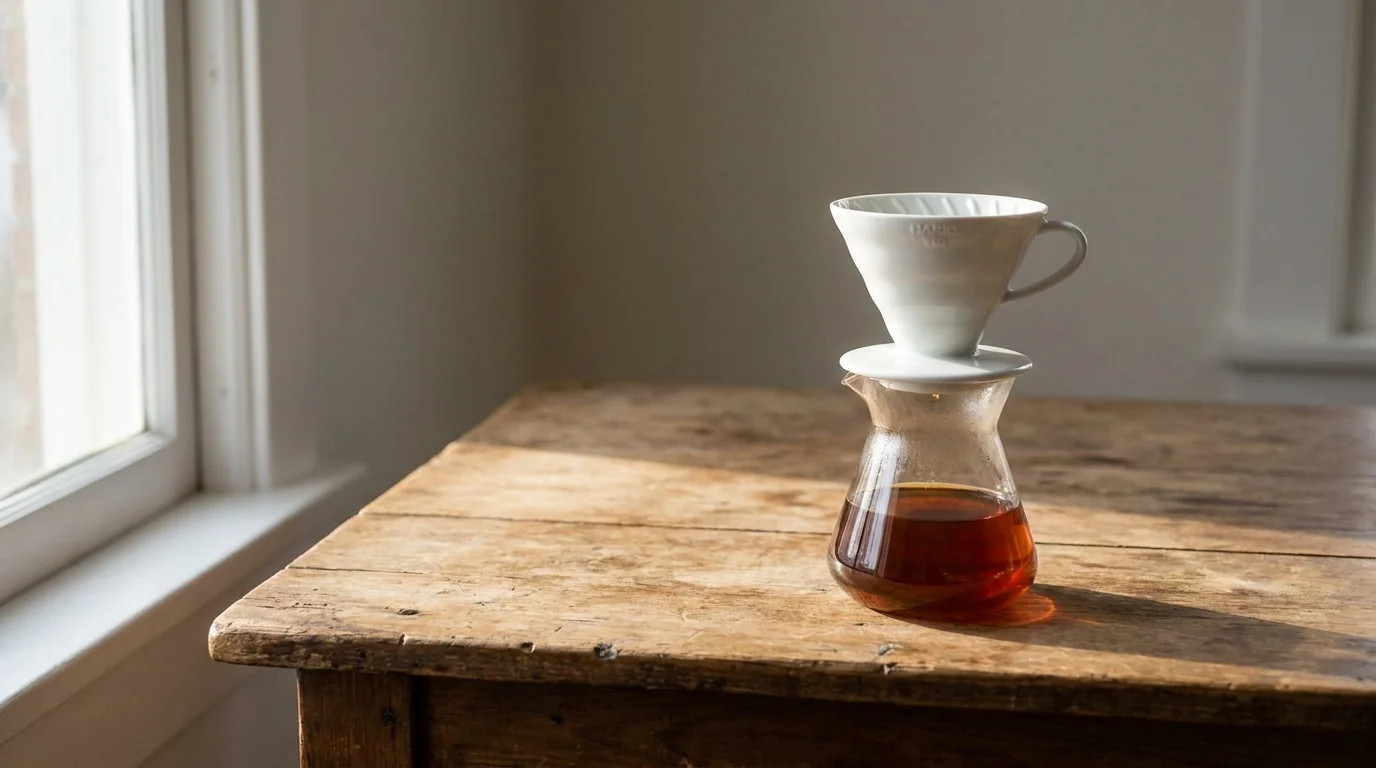
The Hario V60 is arguably the single most important piece of specialty coffee equipment of the 21st century. Since its 2004 introduction, it has become the default pour-over dripper in independent cafés around the world, the reference brewer in countless barista competitions, and the pour-over that most home enthusiasts start with. It's cheap (basic ceramic and plastic versions start under $25), durable, and produces excellent coffee — but only if you actually control the variables it exposes.
60-degree cone
the geometric feature that gives the V60 its name — steeper than most drippers[1]
Single large hole
unlike Kalita's three small holes, the V60's single drain lets grind and pour rate control flow directly[2]
Spiral ribs
the inner surface ribbing lifts the filter away from the walls, allowing air to escape during brewing[1]
Anatomy of the V60
The V60 looks simple, but each design element serves a specific brewing purpose.
60-degree cone walls. The steep cone shape concentrates the coffee bed into a narrow column, so water flows through more coffee per unit of vertical distance than in a shallower cone. This produces a slightly higher-extraction cup for a given amount of coffee and water.
Single large drain hole. Most other conical drippers use multiple small holes or a restricted opening. The V60's single ~20 mm hole doesn't restrict flow — the flow rate is determined by how quickly water passes through the coffee bed and filter, not by the geometry of the dripper. This means your grind and pour rate directly control extraction.
Spiral rib pattern. Inside the cone, the walls have raised spiral ribs. These lift the paper filter slightly away from the dripper wall, creating air channels. The channels allow displaced air to escape during brewing (rather than forming a suction that resists water flow) and promote more uniform extraction across the bed[1].
Materials. V60s come in ceramic, glass, plastic (AS- resin), and metal. Ceramic retains heat best but requires pre-warming. Plastic is lightweight, cheap, and doesn't need pre-warming as aggressively. Metal (copper or stainless) is durable but loses heat quickly. For most home brewers, ceramic (with pre-warming) or plastic are the practical choices.
Sizes. 01 (small, single cup), 02 (medium, 1-4 cups — the most common), and 03 (large, batch brewing).
The classic V60 recipe (single cup)
Equipment:
- V60 dripper (02 size for most single-cup brewing)
- Hario V60 filter (size 02, tabbed or standard)
- Gooseneck kettle
- Scale
- Burr grinder
- Timer
- Glass carafe or mug that fits under the dripper
Beans:
- 22 g whole medium-roast coffee, freshly ground medium.
Water:
- 350 g total, temperature 195-205°F (90-96°C — see Best Water Temperature for Coffee).
Process:
- Rinse the filter — insert filter into V60, pour hot water through to wet, warm the vessel below, and rinse any papery taste. Discard rinse water.
- Add coffee — 22 g grounds into wetted filter. Gentle shake to level the bed.
- Bloom — pour 44-50 g of water (roughly 2× coffee weight) in slow spiral. Start timer. Wait 30-45 seconds. The bed should visibly rise and bubble as CO₂ escapes.
- First main pour — from 45 seconds, pour in a slow spiral outward from the centre, aiming to hit 175 g (about halfway) by 1:15.
- Second main pour — continue pouring in slow spirals to reach 350 g total by 2:15-2:30.
- Drawdown — let the water finish passing through. Total time should be 2:45-3:30.
- Remove dripper, swirl brew gently, serve.
 Cone dripper, 60-degreeHARIO V60 Ceramic Coffee Dripper, Size 02, White | Handmade Porcelain Coffee Maker with Conical Shape and Spiral Ridges for Heavier FlavorThe reference cone: steep walls, one large hole, and spiral ribs that keep the paper off the wall so air can escape. All three features hand flow control to the person pouring, which is why the V60 rewards technique and punishes inattention.amazon.com $25.00 USDamazon.ca $32.00 CADPrice and availability as of View on Amazon
 Variable-temperature gooseneckCosori Gooseneck Electric Kettle with Temperature Control, 0.8L, Black | No Plastic Contact with Water, 5 Presets, 60-Min Keep Warm, Pour Over Coffee & Tea, Stainless Steel Interior, 1200WThe spout gives you a slow, placeable stream, which is most of pour-over technique. Temperature control matters less than people assume at fixed extraction, but it removes a variable while you are learning, and it is the difference between guessing and knowing what went into the cup.amazon.com $62.99 USDamazon.ca $85.49 CADPrice and availability as of View on Amazon
 Scale with a timer, 0.1gMaestri House S2 Espresso Coffee Scale with Timer 0.1g Precision Shot Scale | USB-C Rechargeable, Dual Timing Modes, 2kg/0.1g Digital Scale with Borosilicate Glass Top for Espresso and Pour-Over BrewingDose and ratio are the two variables you can fix for free, and neither is fixable by eye: a scoop of beans varies by several grams depending on bean size and how it was filled. A timer on the same device means you are reading one instrument instead of two.amazon.com $30.39 USDamazon.ca $34.19 CADPrice and availability as of View on Amazon
Product prices and availability are accurate as of the date/time indicated and are subject to change. Any price and availability information displayed on Amazon at the time of purchase will apply to the purchase of this product. Certain content that appears on this site comes from Amazon. This content is provided ‘as is’ and is subject to change or removal at any time.
Reading your brew
The V60 gives visible feedback on how the brew is going. Things to watch:
During the bloom:
- The bed should rise noticeably (2-5 mm) and bubble actively. If it doesn't, your beans may be stale or your water is too cool.
- Any dry spots visible on top mean you didn't pour evenly — try a slower, more thorough pour next time.
During main pours:
- Grounds swirling gently: good agitation.
- Grounds sitting still: pour too gentle; may need to raise kettle height for a bit more agitation.
- Grounds violently sloshing: pour too aggressive; slow down and pour lower to the bed.
- A flat, even bed at the end of pours: good technique.
- Coffee "walls" up the sides of the filter: uneven pour; do a final "rinse pour" around the edges.
During drawdown:
- Bed drains flat: even extraction.
- Bed drains with a crater in the middle: channelling — water finding a preferred path rather than extracting the whole bed. Grind more consistently, tap the dripper after adding coffee to level the bed.
Grind sensitivity and troubleshooting
The V60 is one of the most grind-sensitive pour-over methods because the flow isn't restricted by the dripper geometry.
If total brew time is under 2:30: grind is too coarse or filter/pour was rushed. Grind finer.
If total brew time is over 3:30: grind is too fine or too many fines in the grind (blade grinder culprit). Grind coarser or upgrade your grinder[2].
If the coffee tastes thin and sour: under-extracted. Grind finer, use slightly hotter water, or slow the pour down.
If the coffee tastes bitter and dry: over-extracted. Grind coarser, use slightly cooler water, or pour more quickly.
If different pours from the same beans taste inconsistent: likely a grinder issue. Blade grinders in particular produce inconsistent particle sizes; even mid-range burr grinders help significantly. See Burr vs Blade Grinder.
Pouring technique matters
Unlike a Kalita Wave (which forgives sloppy pouring due to flow-restricting holes) or a Chemex (whose thick filter slows everything down), the V60 shows pouring technique clearly in the cup.
Key elements of good V60 pouring:
Slow and controlled. A gooseneck kettle is essentially mandatory. The narrow spout lets you regulate pour rate precisely.
Concentric circles. Start pouring from the centre, spiral outward slowly, then spiral back inward. Try to avoid pouring directly on the filter wall (this bypasses the coffee bed).
Consistent height. Pour with the kettle spout close to the coffee bed — a few centimetres above the surface. Higher pouring introduces too much agitation and can create channelling.
Continuous or pulse. Two styles: continuous (single long pour after bloom, gradually filling the dripper to capacity), or pulse (several discrete pours with pauses in between). Continuous is smoother; pulse gives more control over total contact time. Most V60 competition recipes use 2-4 pulses.
V60 vs Chemex vs Kalita (quick comparison)
- V60: most control, most body, fast flow, needs precise grind and pour. Best for practiced brewers who want a responsive method.
- Chemex: cleanest cup, thickest filter, slowest flow, needs coarser grind. Best for bright light-roast coffees where clarity matters — see Chemex Coffee Guide.
- Kalita Wave: most forgiving, three small holes regulate flow, medium body, less technique-dependent. Best for consistent daily brewing.
Most enthusiasts eventually own multiple pour-over methods. They're cheap enough that you don't need to commit.
Filter notes
V60 filters come in several types:
Standard Hario cone filters. The default. Bleached (white) or unbleached (brown). Bleached filters have less papery character if not thoroughly rinsed; unbleached filters need more rinsing but are marketed as more natural.
Cafec Abaca+ filters. Third-party filters made from manila hemp (abaca) and wood pulp, thicker and slightly faster-flowing than Hario's standard filters. Popular for higher-extraction brewing recipes.
Cafec Trinity filters. Cafec's premium filter, thicker still. Approaches Chemex flow rate.
Sibarist / Cafec Traveler and other "fast" filters. Designed to allow much higher flow rates for higher-extraction recipes with finer grinds.
For beginners, standard Hario filters are the reference; try alternatives once you have consistent technique.
Why the V60 became the default
The V60 is now the most-used specialty pour-over dripper because of several converging factors:
- Timing — arrived in 2004 as the specialty coffee third wave was accelerating. Cafés looking for a distinctive brewing method adopted it early.
- Availability — Hario is a mass-market Japanese producer; V60s are cheap and widely available.
- Barista competition results — V60s have been used in many World Brewers Cup winning recipes, which drove broader adoption.
- The right level of complexity — enough control to reward technique, not so much that it's intimidating.
- Café use — many independent third-wave cafés use V60 as their default pour-over, which meant customers wanted to buy them for home use.
The result is the closest thing coffee has to a "standard" pour-over dripper.
Common misconceptions
- "V60 is objectively the best pour-over." It's the most-used and most-loved by many. Whether it's "best" depends on what you want — Chemex is better for clean bright light roasts; Kalita is better for consistency without effort.
- "Ceramic is better than plastic." Ceramic retains heat better if warmed; plastic works fine and is more travel- friendly. Neither is inherently better-brewing.
- "You need Hario-branded filters." Hario filters are designed for the V60 and are the reference. Third-party filters designed specifically for V60 shape (Cafec, Sibarist) also work well. Random cone filters may not fit correctly.
- "Cold water is fine for pour-over." No — brewing temperature matters substantially. See Best Water Temperature for Coffee.
The honest summary
The Hario V60 is the reference pour-over dripper of the specialty coffee era — a 60-degree conical brewer with a single large drain hole and spiral internal ribs that give it distinctive flow characteristics. It rewards technique more than any other pour-over: consistent grind, controlled pouring, and correct water temperature produce excellent coffee; sloppy execution produces uneven, unpredictable results. Not the most forgiving brewer, but arguably the most educational — brewing with a V60 for a few weeks will teach you more about coffee extraction than any other manual method.
Frequently asked questions
- What is a Hario V60?
- The Hario V60 is a conical pour-over coffee dripper made by the Japanese glassware company Hario. It has 60-degree cone walls (the source of the '60' in the name), a single large drain hole at the bottom, and spiral ribs on the inner surface that lift the filter away from the wall. It was designed in 2004 and has become the world's most-used specialty pour-over dripper.
- Why do people prefer the V60?
- Three reasons: (1) the conical shape and single large hole allow flow rate to respond directly to grind and pour technique, giving experienced brewers precise control; (2) the spiral ribs create even air channels that promote uniform extraction; (3) it's cheap, durable, and widely available. The trade-off is that the V60 is unforgiving — technique errors show up clearly in the cup.
- What's the ratio for V60?
- 1:15 to 1:17 covers the useful range, with 1:16 as a middle default. For a single 12 oz cup: 22 g coffee to 350 g water. For lighter roasts and single-origin brewing, 1:16 to 1:17 is common. For heavier drinkers or espresso-style single-origin brews, 1:15 works. Beyond 1:14 the coffee becomes very heavy; beyond 1:18 it tends to feel thin.
- What grind for V60?
- Medium — coarser than espresso, finer than Chemex or French press, roughly the texture of table salt or slightly coarser. If your total brew time is under 2:30, grind finer. If over 3:30, grind coarser. Consistent grind is more important than exact size — a good burr grinder is the biggest single equipment upgrade for pour-over.
- V60 vs Chemex — which should I choose?
- V60 for control and body, Chemex for cleanliness and clarity. V60 filters are thinner, so more oils and fines pass through — producing more body but less clarity. V60 responds directly to pour technique; Chemex is more forgiving but has a slower learning curve for optimal results. Many enthusiasts own both.
References
Every factual claim in this article is drawn from the sources below. See the source library for how we grade evidence.
- [1]Brewing FundamentalsCoffee Science Foundation · Reference work · Tier 2 · Moderate
- [2]Coffee extraction kinetics in a well mixed systemJournal of Mathematics in Industry · 2016 · Review · Tier 2 · Moderate
- [3]Effects of brew strength, brew yield, and roast on the sensory quality of drip brewed coffeeJournal of Food Science · 2020 · Controlled trial · Tier 2 · Moderate
- [4]Comparison of nine common coffee extraction methods: instrumental and sensory analysisEuropean Food Research and Technology · 2013 · Controlled trial · Tier 2 · Moderate
- [5]Brewing temperature and the sensory profile of drip brew coffeePMC / NIH · 2020 · Controlled trial · Tier 2 · Moderate
Related reading
- Brew MethodsPour-Over Coffee Guide: Ratios, Bloom, and Technique→
- Brew MethodsChemex Brew Guide: Ratios, Grind, and Technique→
- Brewing ScienceCoffee Grind Size Guide: Which Grind for Which Method→
- Brew MethodsChemex vs V60: Which Pour-Over Makes Better Coffee?→
- Brew MethodsHow to Make Turkish Coffee: Cezve, Grind, and Serving→
- Brew MethodsSiphon Coffee: How Vacuum Brewing Works and Tastes→