Vietnamese Coffee Guide: Phin, Cà Phê Sữa, Robusta
By Coffee Studies Editorial·Published July 15, 2026·9 min read
Quick answer
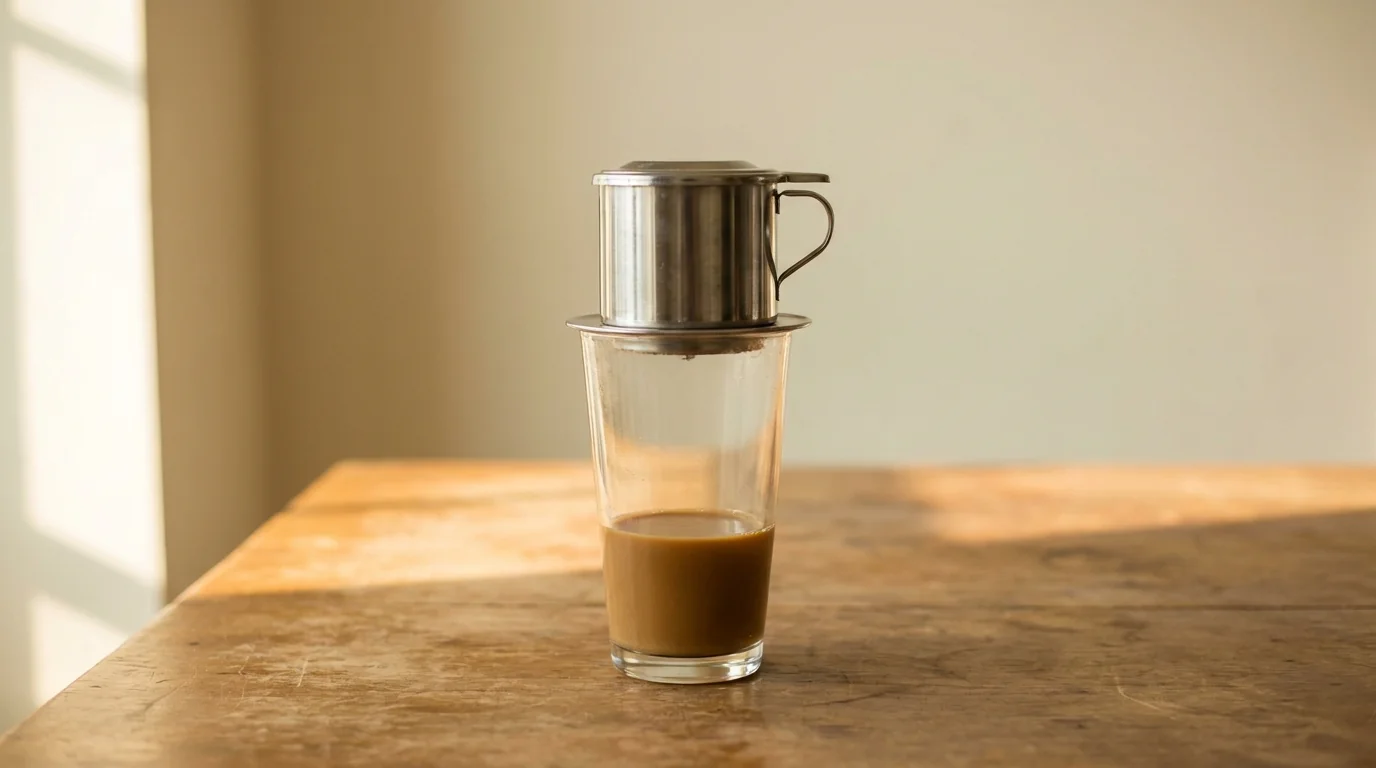
Vietnamese coffee is one of the world's most distinctive coffee traditions — a specific brewing device, a specific bean choice, and a specific serving format that together produce a drink unlike any other national coffee style. It has almost nothing in common with Italian espresso or French café au lait, and it answers a different question about what coffee should be: not "how do I extract the most nuanced flavour from this bean?" but "how do I make something intensely strong and bittersweet that holds up beautifully against ice and sweetened milk?"
Phin filter
small stainless-steel drip filter that gives Vietnamese coffee its signature slow-brew character[1]
Robusta base
Vietnam is the world's largest robusta producer — the coffee tradition developed around this species, not arabica[3]
~2× caffeine
robusta contains roughly twice the caffeine of arabica by weight, contributing to Vietnamese coffee's intensity[5]
What Vietnamese coffee is and isn't
Vietnamese coffee didn't develop in isolation — coffee arrived in Vietnam via French colonial planters in the 19th century, and the coffee industry has its roots in that colonial period. But what emerged as Vietnamese coffee culture is genuinely distinctive.
The defining features:
- Robusta, not arabica. Vietnam is the world's largest robusta producer (about 40% of global robusta supply) and the tradition uses it heavily. Compared to arabica, robusta has higher caffeine (~2.2% vs ~1.2%), higher chlorogenic acid, less sugar, and a distinctive bitter-and-earthy profile.
- Dark roasts, often with butter or sugar in the roast. Vietnamese coffee roasters traditionally roast to a very dark level, and often add a small amount of butter, sugar, or fat during roasting — a technique that adds body, sweetness, and a slightly smoky quality.
- Slow drip brewing. The phin filter drips slowly, giving water long contact time with coffee — pulling out heavier compounds and creating a very concentrated, bitter-strong cup.
- Sweetened condensed milk. The base preparation almost always includes sweetened condensed milk (introduced under French colonial rule when fresh milk was hard to keep in the tropical climate). The combination of intensely bitter coffee and intensely sweet milk is the foundation of the taste profile.
- Iced or hot. Both are traditional, though iced (ca phe sua da) is the more famous internationally[4].
Vietnamese coffee is essentially an antidote to weak coffee — it's designed to be strong enough that adding significant amounts of sweetened milk and ice still leaves you with a distinctly coffee-tasting drink.
The phin filter — how it works
The phin is one of the world's simplest brewing devices. Four parts:
- Base plate — a circular disc with a raised rim, sitting on top of your cup or glass. This catches drips and stabilises the filter.
- Chamber — a small cylindrical body, typically 100-150 mL, with small holes drilled in the bottom. Coffee grounds go here.
- Insert (press or screw) — a smaller disc that sits on top of the grounds. In traditional phins, this is a gravity-press design with a small handle; some newer phins use a screw-down design.
- Lid — a small cap that keeps heat in during brewing.
How the brew works:
- Ground coffee goes in the chamber.
- The press insert is placed on top, gently patting the grounds down (not tamping — light pressure only).
- Near-boiling water is poured over the top, filling the chamber.
- Water percolates through the coffee bed and drips through the base plate holes into the cup below.
- Total brew time: 4-5 minutes typical, sometimes longer for very fine grinds or tightly pressed setups.
The result is a small, extremely concentrated coffee — usually around 60-100 mL per brew, roughly the volume of a large espresso shot but taking many times longer to produce[2].
 Vietnamese phin filterVietnamese Coffee Filter Phin 11 Ounce (Large), Gravity Insert, One CupThe whole apparatus: a perforated chamber, a gravity insert that sits on the grounds, and a lid. There is no pump and no paper, so the brew rate is set by grind and by how hard the insert presses, which is why the same phin produces a very different cup in two different hands.amazon.com $11.95 USDamazon.ca $15.99 CADPrice and availability as of View on Amazon
Product prices and availability are accurate as of the date/time indicated and are subject to change. Any price and availability information displayed on Amazon at the time of purchase will apply to the purchase of this product. Certain content that appears on this site comes from Amazon. This content is provided ‘as is’ and is subject to change or removal at any time.
Grind and dose
Vietnamese coffee grind is coarser than espresso but finer than drip — around medium-coarse on most grinders. Too fine and the phin will clog and drip too slowly (or not at all). Too coarse and the water rushes through and the coffee is weak.
Rough dosing:
- Small phin (100 mL capacity): 15-20 g of ground coffee → 80-100 mL of finished coffee.
- Medium phin (150 mL capacity): 22-25 g coffee → 120-150 mL finished coffee.
The finished coffee is highly concentrated — think of it as Vietnamese espresso rather than as brewed drip coffee. When combined with ice and condensed milk, the final drink is roughly 16-20 oz total.
The classic recipes
Ca phe sua nong
Ca phe sua nong (hot coffee with milk):
- 2-3 tablespoons sweetened condensed milk at the bottom of a small heat-safe cup or glass.
- Assemble phin on top: dose 20 g coarse-medium coffee, gently press, pour a small pre-wet of hot water (bloom), then fill the chamber with hot (~92-95°C) water.
- Let it drip 4-5 minutes.
- Stir vigorously to combine the coffee and condensed milk.
- Serve.
Ca phe sua da
Ca phe sua da (iced coffee with milk):
- Make ca phe sua nong as above but in a smaller cup, then pour over a tall glass of ice.
- The dilution from melting ice is expected and calculated — the coffee starts intense specifically because it will be diluted.
Ca phe den
Ca phe den (black coffee):
- No condensed milk. Sometimes served with a small amount of sugar, sometimes plain.
- Even more intensely bitter — for people who want the robusta character without the sweetness.
Ca phe trung
Ca phe trung (egg coffee):
- A Hanoi specialty. Yolk and sweetened condensed milk are whipped together into a thick foam, then poured on top of a small cup of hot phin coffee.
- The result resembles a tiramisu in liquid form — dessert- adjacent and distinctive.
Ca phe dua
Ca phe dua (coconut coffee):
- Blended with coconut cream, condensed milk, and ice into an almost-slushie consistency.
- More modern and Instagram-friendly than traditional; popular in tourist-facing Vietnamese cafés.
Why the flavour is so distinctive
Several factors combine to produce the Vietnamese coffee taste:
Robusta chemistry
Robusta chemistry. Robusta beans contain roughly twice the chlorogenic acid of arabica, more caffeine, and less lipid content. This produces a stronger and more bitter cup at any brew method — and the slow drip of the phin exaggerates the extraction of bitter compounds[3].
Dark roast and slow drip
Dark roast + slow drip. Dark roasts have less acidity, more Maillard-reaction browning notes, and a smokier profile. The long contact time in the phin extracts these thoroughly.
Condensed milk contrast
Condensed milk contrast. The sweetened condensed milk isn't just sweetener — its concentrated dairy sugars and proteins create a specific creaminess and sweetness that doesn't translate to using fresh milk plus sugar.
Ice dilution
Ice dilution engineered in. Ca phe sua da is designed to be diluted by melting ice. The starting concentration is extreme; the finished drink is what the maker was targeting.
Compared to Italian espresso culture, Vietnamese coffee prizes strength and sweetness balance over aromatic nuance. Different answer to the same question of what coffee should be.
Beans to buy for Vietnamese coffee
Traditional Vietnamese coffee blends:
- Trung Nguyen — Vietnam's largest coffee brand; widely exported. Their G7 line is instant-coffee based; their ground blends (Creative series) are more traditional.
- Highland Coffee — another major Vietnamese brand, varying availability outside Vietnam.
- Cafe du Monde — technically New Orleans, not Vietnamese, but the chicory-coffee blend is very close in taste profile to traditional Vietnamese coffee and is widely available in North America. Chicory adds some of the same bitter-earthy quality as Vietnamese-style dark robusta.
- Copper Cow, Nguyen Coffee Supply, and specialty Vietnamese- American roasters — a newer generation of Vietnamese- origin roasters producing higher-quality single-origin Vietnamese robusta and arabica in Western markets.
- Any dark-roasted robusta will approximate the effect, though may lack the buttered-roast character of traditional Vietnamese preparation.
The condensed milk detail
Sweetened condensed milk is a specific product — evaporated milk with sugar added, roughly 40-45% sugar by weight, very thick and pourable but viscous. It's not the same as evaporated milk, and it's not the same as sweetened concentrated milk.
For Vietnamese coffee:
- Longevity — one can of sweetened condensed milk covers a lot of coffee servings; a couple of tablespoons per drink.
- Refrigeration — keeps in the fridge for weeks after opening.
- Common brands — Longevity, Old Man Que Huong, and various Vietnamese import brands are traditional; Eagle Brand and other Western brands work fine.
Substitutions (sweetened cream, coconut condensed milk, oat- based sweetened condensed alternatives) all work but produce a distinctly different drink.
Practical rules
For your first attempt:
- Get a proper phin filter (widely available online for $10-20).
- Start with a Vietnamese-labeled robusta blend or Cafe du Monde.
- Grind medium-coarse (if using a grinder — for pre-ground, use as-is).
- 20 g coffee, 100 mL near-boiling water, 4-5 minute drip.
- 2 tablespoons sweetened condensed milk in the bottom of the glass.
- Stir and drink hot, or pour over ice.
Adjustments if it's not right:
- Dripping too fast (under 3 minutes): grind finer or press the insert down more firmly.
- Dripping too slow (over 6 minutes or clogged): grind coarser, use less coffee, or don't press the insert as hard.
- Too weak: use more coffee, or make sure it's actually robusta.
- Too bitter without milk: this is normal — Vietnamese coffee is designed to combine with the sweetened milk. If drinking black, use less coffee or a lighter grind.
Common misconceptions
- "Vietnamese coffee is just coffee with condensed milk." The bean choice (robusta), roast style (dark, sometimes buttered), brewing device (phin), and serving format all matter. Substituting any single element gives you something meaningfully different.
- "Robusta is bad coffee." Robusta has a reputation problem in specialty coffee circles that isn't entirely fair. It has different flavour characteristics than arabica — better for some purposes (strong bitter drinks, espresso blends for crema and body) and worse for others (nuanced single-origin brewing). Vietnamese coffee makes good use of robusta's strengths.
- "Vietnamese coffee is the same as Thai iced coffee." Similar family but distinct. Thai iced coffee typically uses cardamom or other spices and different milk products, and the coffee itself is often a different roast profile.
The honest summary
Vietnamese coffee is a distinctive brewing tradition built around the phin filter, robusta beans, dark roast, and sweetened condensed milk. It answers the question of "how do I make something intensely strong and bittersweet that holds up to ice and milk" differently than any other national coffee tradition. The equipment is cheap and simple; the technique is forgiving; the flavour result is unlike anything achievable with an espresso machine or pour-over. Worth trying if you've only ever had Italian or American-style coffee — it's a different answer to the same question, and one of the most compelling ways coffee has evolved outside its European commercialisation.
Frequently asked questions
- What is Vietnamese coffee?
- Vietnamese coffee is the coffee tradition of Vietnam — dark-roasted robusta coffee brewed through a small stainless-steel drip filter called a phin, typically served with sweetened condensed milk either hot (ca phe sua nong) or over ice (ca phe sua da). The taste profile is intensely strong, bitter-sweet, and heavier-bodied than most espresso-based drinks.
- What is a phin?
- A phin is a small stainless-steel drip filter used to brew Vietnamese coffee. It has four parts: a base plate that sits on top of a cup, a chamber that holds the ground coffee, a gravity-press or screw-down disc that sits on top of the grounds, and a lid. Hot water is poured in, and the coffee slowly drips into the cup below.
- Why does Vietnamese coffee use robusta?
- Vietnam is the world's largest producer of Coffea canephora (robusta), and Vietnamese coffee culture developed around robusta rather than arabica. Robusta has about twice the caffeine of arabica, a stronger and more bitter profile, and holds up better against the sweetened condensed milk that defines Vietnamese coffee drinks.
- What is ca phe sua da?
- Ca phe sua da is Vietnamese iced coffee — literally 'coffee milk ice.' It's made by dripping strong phin-brewed coffee onto a layer of sweetened condensed milk at the bottom of a glass, stirring to combine, then pouring over a tall glass of ice. It's one of the world's most distinctive iced coffee traditions.
- Can I make Vietnamese coffee with arabica beans?
- You can, but it won't taste traditional. Arabica is lighter, more acidic, and doesn't produce the intense, bitter-strong flavour that stands up to sweetened condensed milk. If you want the classic taste, look for a Vietnamese-style robusta blend — Trung Nguyen, Cafe du Monde (chicory-blend), and various specialty roasters produce them.
References
Every factual claim in this article is drawn from the sources below. See the source library for how we grade evidence.
- [1]Brewing FundamentalsCoffee Science Foundation · Reference work · Tier 2 · Moderate
- [2]Coffee extraction kinetics in a well mixed systemJournal of Mathematics in Industry · 2016 · Review · Tier 2 · Moderate
- [3]Caffeine and related purine alkaloids: biosynthesis, catabolism, function and genetic engineeringPhytochemistry · 2008 · Review · Tier 2 · Moderate
- [4]Uncommon Grounds: The History of Coffee and How It Transformed Our World (revised edition)Basic Books (Mark Pendergrast) · 2010 · Reference work · Tier 2 · Moderate
- [5]International Coffee OrganizationInternational Coffee Organization · Official dataset · Tier 1 · Strong
- [6]CoffeeEncyclopaedia Britannica · Reference work · Tier 3 · Contextual
Related reading
- Brew MethodsPour-Over Coffee Guide: Ratios, Bloom, and Technique→
- Brew MethodsCold Brew vs Iced Coffee: The Real Difference→
- Beans, Roasts & OriginsArabica vs Robusta: Taste, Caffeine, and Differences→
- Brew MethodsPhin Coffee: How Vietnam's Single-Cup Filter Works→
- Brew MethodsCold Drip Coffee: How Slow Drip Differs from Cold Brew→
- Brew MethodsBica: Portugal's Espresso, and the Acronym That Isn't True→