Espresso Machine Buying Guide: Choosing the Right Type
By Coffee Studies Editorial·Published July 16, 2026·11 min read
Quick answer
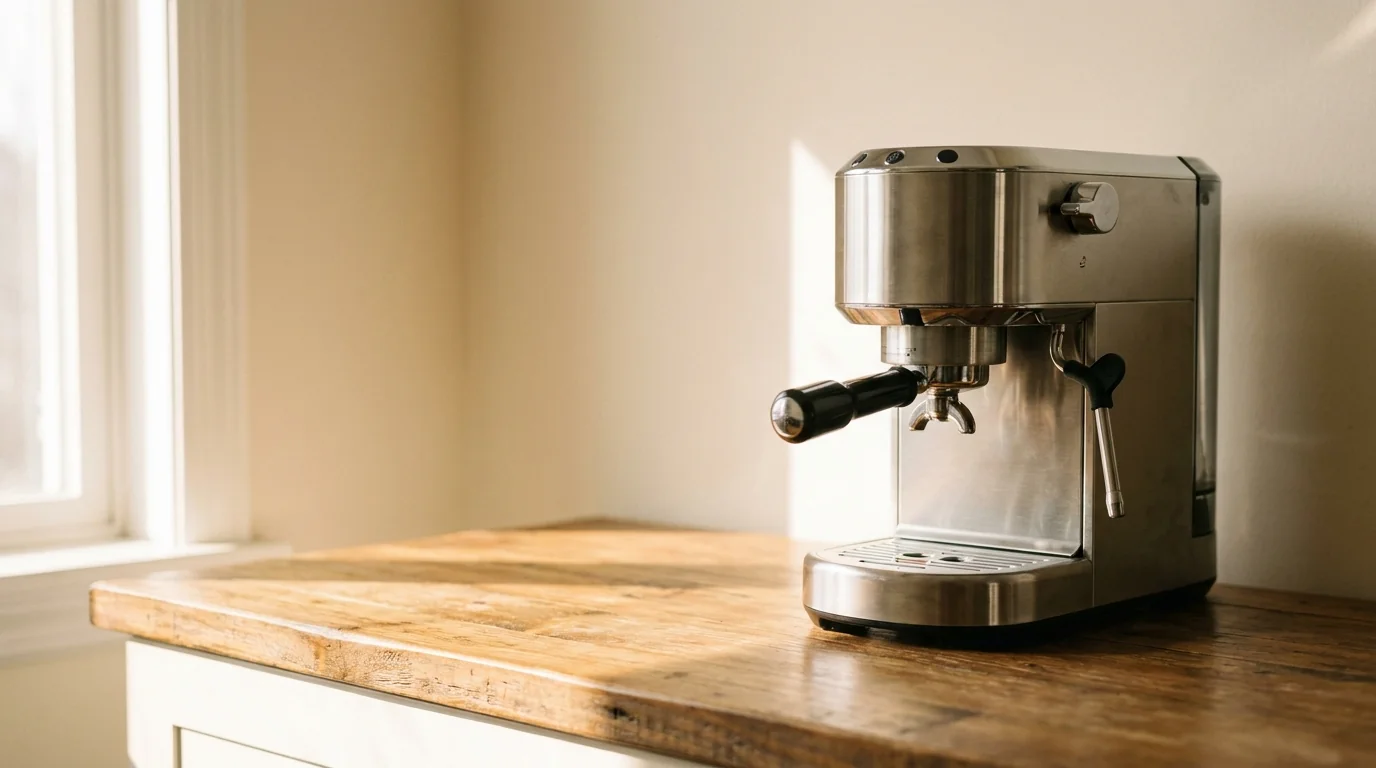
Buying an espresso machine is one of the more expensive coffee equipment decisions most people make, and one of the most confusing. The options span from $50 capsule machines to $10,000+ commercial-grade home units, with dramatically different quality potential, convenience levels, and learning curves. This guide helps you navigate the categories, understand what actually matters for espresso quality, and identify where you sit on the buying-decision spectrum.
Five categories
manual lever, semi-automatic, automatic, super-automatic, and capsule machines — each with distinct trade-offs[1]
~9 bar pressure
proper espresso extraction requires consistent 8-9 bar pressure at the coffee puck[2]
Grinder ≥ machine
grinder quality matters at least as much as machine quality — don't spend $1500 on a machine and $100 on a grinder[4]
The five categories
Manual lever machines
1. Manual lever machines
Manual lever machines have no electric pump — you pull a lever to build pressure through a spring-loaded piston. The barista provides the pressure directly (or via a spring mechanism).
- Examples: La Pavoni Europiccola, La Pavoni Professional, Elektra Micro Casa a Leva, Cafelat Robot (a modern hand-operated design without electricity), Flair Espresso.
- Price range: $150-2500+.
- Advantages: distinctive shot profile (pressure decays during extraction), no electric pump maintenance, often visually beautiful, can produce excellent shots.
- Disadvantages: steep learning curve, physically demanding, difficult to make consistent shots, requires a separate grinder.
- Best for: enthusiasts who enjoy hands-on brewing ritual and want a distinctive shot character.
Semi-automatic machines
2. Semi-automatic machines
The dominant category for quality-focused home espresso. An electric pump provides consistent pressure; the barista controls dosing, tamping, and shot timing (starting/ stopping the extraction).
- Examples entry-level ($400-700): Breville Bambino, Breville Barista Pro (integrated grinder), Rancilio Silvia, Gaggia Classic Pro.
- Examples mid-range ($700-1500): Rocket Appartamento, ECM Casa, Profitec Pro 300, Lelit MaraX.
- Examples high-end ($1500-4000+): Rocket R58, ECM Synchronika, Profitec Pro 700, Lelit Bianca, La Marzocco Linea Mini.
- Advantages: best balance of quality potential and ease of use, wide brand/model selection at every price tier, upgradability, standard portafilter allows aftermarket accessories.
- Disadvantages: requires a separate grinder, learning curve for consistent shots.
- Best for: most home espresso enthusiasts. The standard recommendation for anyone who wants real espresso at home.
Automatic machines
3. Automatic machines
Automatic machines add programmed shot timing to semi- automatic capability — you program shot volume, and the machine handles start/stop.
- Examples: Various Breville models, some Rancilio and ECM models offer volumetric control, most commercial-style machines.
- Advantages: more consistent shot volumes without manual timing, useful for high-volume households.
- Disadvantages: slight loss of shot-to-shot adjustability, added complexity, similar or higher price than equivalent semi-automatic.
- Best for: users who want less manual involvement while retaining shot quality potential.
Super-automatic machines
4. Super-automatic machines
Super-automatics handle everything: grinding, dosing, tamping, brewing, and often milk frothing — all with the push of a button.
- Examples entry-level ($500-1200): Various DeLonghi models (Magnifica, Dinamica), Philips 3200.
- Examples mid-range ($1500-3000): DeLonghi Eletta, Jura E8 or ENA models, Philips 5400.
- Examples high-end ($3000-6000+): Jura Z10, Miele CM7, DeLonghi Maestosa.
- Advantages: maximum convenience, minimal learning curve, integrated milk frothing (many models), consistent output shot-to-shot.
- Disadvantages: limited ability to control extraction variables, generally lower shot quality potential than equivalent-price semi-automatic + separate grinder, built-in grinders often lower quality than dedicated grinders, harder to service.
- Best for: users who prioritise convenience over peak quality, office environments, users who don't want to learn barista skills.
Capsule / pod machines
5. Capsule / pod machines
Pre-portioned coffee capsules — you insert the capsule, press a button, machine extracts through it.
- Examples: Nespresso Original line (aluminum capsules), Nespresso Vertuo (larger capsules with centrifugal extraction), Keurig K-Cafe (pod-based espresso attempt), Illy X series.
- Price range: $80-500 for machines; capsule cost $0.60-1.50+ per shot.
- Advantages: maximum convenience, extremely consistent, no grinding or cleaning of grounds, wide compatible capsule selection (especially for Nespresso Original), attractive design.
- Disadvantages: ongoing per-shot cost, environmental impact (though many capsules now recyclable or compostable), genuinely different espresso quality (less crema depth, less freshness, less complex extraction), limited flavour variety compared to freshly-ground coffee.
- Best for: convenience-first users, occasional espresso drinkers, offices, secondary machines, people prioritising space and ease.
What actually matters for espresso quality
If quality is your priority, these variables matter most (in rough order of importance):
Grinder
1. Grinder. Cannot be overstated. An excellent espresso machine paired with a poor grinder produces poor espresso. A mediocre espresso machine paired with an excellent grinder produces reasonable espresso. Espresso requires very fine, very consistent grind — bad grinders can't produce this. See Burr vs Blade Grinder.
Espresso-capable grinder budgets:
- Entry-level: $400-700 (Baratza Sette, DF64, Eureka Mignon Filtro).
- Mid-range: $700-1500 (Eureka Atom, Niche Zero, Bezzera BB005).
- High-end: $1500-3500+ (Mahlkönig E80, various Mazzers).
Pressure consistency
2. Pressure consistency. Espresso requires ~9 bar pressure at the coffee puck consistently through the shot. Cheap pumps struggle to maintain this; better machines do it easily. Pressure profiling (varying pressure through the shot) is an advanced feature that premium machines offer.
Water temperature stability
3. Water temperature stability. Espresso is temperature-sensitive — a few degrees changes flavour substantially. Better machines have PID (proportional- integral-derivative) temperature control that maintains target temperature precisely. Cheaper machines drift more.
Boiler system
4. Boiler system.
- Single boiler: cheapest; can't brew and steam simultaneously.
- Dual boiler (dual thermoblock or heat exchange): can brew and steam simultaneously; better temperature control; more expensive.
- Heat exchange (HX): intermediate approach; brews and steams simultaneously via cleverer plumbing.
The trade-offs between these, and the thermoblock design most spec sheets skip, are worked through in dual boiler vs heat exchanger.
5. Portafilter and basket quality. The basket holding your coffee puck substantially affects extraction. Aftermarket precision baskets (VST, IMS) improve results with any machine.
6. Freshness of beans and coffee quality. No machine compensates for stale or bad coffee. Fresh specialty beans within 3-4 weeks of roast date.
7. Barista technique. Dose (grams of coffee), distribution (even coffee bed), tamping (even pressure) all matter substantially. Even the best machines require technique.
The espresso machine + grinder budget matrix
~$500 total budget:
- Nespresso capsule machine ($150-300) + no grinder needed.
- Not proper espresso, but the best you can do at this budget.
~$1000 total budget:
- Entry semi-automatic ($400-500) + entry burr grinder ($400-500) — e.g., Gaggia Classic Pro + Baratza Sette.
- Produces real espresso with meaningful compromises.
- Or: Breville Barista Pro/Express (all-in-one with built-in grinder) — decent starter setup.
~$1500-2000 total budget:
- Mid-range semi-automatic ($800-1200) + mid-range grinder ($400-700) — e.g., Rocket Appartamento + Baratza Sette or Bezzera BB005 + Eureka Mignon Filtro.
- The specialty coffee sweet spot for home espresso.
- Produces consistently good shots with reasonable effort.
~$3000 total budget:
- Higher-end semi-automatic ($1500-2000) + good grinder ($700-1000) — e.g., ECM Synchronika + Eureka Atom 60mm.
- Excellent quality potential; enthusiast territory.
~$5000+ total budget:
- Premium semi-automatic or entry commercial machine ($2500-4000) + premium grinder ($1000-2000) — e.g., La Marzocco Linea Mini + Mahlkönig E80.
- Commercial-grade home setup; approaches café quality.
The key trade-off at every budget level: you'll be tempted to spend more on the machine and less on the grinder. Resist. The grinder is at least as important as the machine for espresso quality[4].
What espresso machines don't fix
Common mistakes about what machines can do:
Won't fix stale beans. Fresh coffee (within 3-4 weeks of roasting, degassed 5-14 days) is essential regardless of machine quality.
Won't fix bad grinder. Even the best espresso machine produces poor shots with inconsistent grind.
Won't teach technique. Dosing consistency, puck preparation, distribution, and tamping all take practice. Great machines require competent baristas.
Won't produce good milk drinks alone. Milk texturing technique (proper microfoam) matters as much as the steam wand quality for milk-based drinks.
Won't reduce the learning curve. Semi-automatic espresso takes weeks to months of practice to master. Super-automatics reduce this but at the cost of quality control.
Machine features to actually care about
Worth spending on:
- Proper 9-bar consistent pressure (any legitimate machine).
- PID temperature control (a real quality improvement).
- Dual boiler or good heat exchange (allows simultaneous brewing and steaming).
- Good steam wand (for milk drinks — 3-4 hole tip, good pressure).
- 58mm portafilter (industry standard; wide aftermarket accessory compatibility).
- Removable water tank (easier cleaning).
- Cup warmer (matters more than expected — cold cups ruin shots).
Nice but not essential:
- Pressure profiling (advanced; interesting for enthusiasts).
- Flow control paddle (advanced control lever).
- Steam boiler pressure gauge.
- Built-in grinder (integrated machines like Breville Barista Pro; convenient but limits upgrade path).
Marketing that doesn't matter as much:
- 15+ bar pump (specification means max pressure, not useful pressure — you only want 9 bar at the puck; the extra is regulated down).
- Fancy interfaces (touchscreens etc; doesn't improve espresso).
- Programmed shot options (if you're timing shots by volume, you're missing the actual craft anyway — use by mass instead).
- Colour choice / cosmetics (matter for aesthetics not performance).
Common misconceptions
- "More expensive = better espresso." Only up to a point. Above ~$2000 for the machine, additional cost buys refinement (build quality, temperature stability, pressure profiling) rather than fundamentally different espresso. And grinder matters at least as much as machine.
- "Capsule machines make real espresso." Similar- looking output, but the extraction dynamics, freshness, and complexity are meaningfully different from freshly- ground and freshly-pulled espresso.
- "Super-automatics are just as good as semi- automatics." Not for quality-focused espresso. Super-automatics prioritise convenience over extraction control.
- "You need commercial machine for good espresso." No — good home semi-automatics can rival café espresso when paired with proper grinder and technique.
- "Pressure is the most important variable." Grinder matters more. Consistency of pressure matters more than peak pressure.
Practical decision framework
Answer these questions to narrow options:
1. What's your total budget (machine + grinder)?
- Under $500: Nespresso; can't do proper espresso at this budget.
- $500-1000: entry semi-automatic + entry grinder, or all-in-one like Breville Barista Pro.
- $1000-2000: mid-range semi-automatic + mid-range grinder.
- $2000-5000: higher-end setup.
- $5000+: premium enthusiast/commercial territory.
2. How much do you value convenience vs quality?
- Maximum convenience: super-automatic or capsule.
- Balanced: semi-automatic + separate grinder.
- Quality first: semi-automatic + high-end grinder.
3. Will you make milk drinks?
- Yes, regularly: prioritise dual boiler or good HX machine + practice milk texturing.
- Occasionally: any semi-automatic works.
- No: focus budget on brew quality; simpler steam system is fine.
4. How much space do you have?
- Small counter: compact semi-automatic (Breville Bambino, Gaggia Classic).
- Standard counter: most machines fit.
- Dedicated coffee bar: any size works.
5. Are you willing to learn barista skills?
- Yes: semi-automatic gives most flexibility.
- No: super-automatic or capsule.
6. Do you already own a good grinder?
- Yes: budget the whole allowance for machine.
- No: allocate 30-50% of budget to grinder.
Common home espresso setups by profile
Casual daily espresso drinker, convenience focused:
- Nespresso Vertuo Plus ($150) or Breville Bambino (and if counter space is the constraint, the compact espresso machines guide) ($300, requires separate grinder).
Serious home barista, budget-conscious:
- Breville Barista Express (all-in-one) or Gaggia Classic Pro or Rancilio Silvia ($500-1000) + Baratza Sette 270 ($430).
Established home barista, quality-focused:
- Rocket Appartamento + Eureka Mignon Filtro ($550) or similar.
The machines in this band are what the trade calls prosumer, and what that word actually means is in prosumer espresso machine.
Enthusiast, quality-maximised:
- ECM Synchronika ($3500) + Eureka Atom 60mm ($1000).
Household with two espresso drinkers:
- Higher-capacity dual boiler like Rocket R58 or ECM Synchronika + prosumer grinder.
Office / small business:
- Super-automatic (Jura E8 or DeLonghi Eletta) for minimal maintenance and consistent output.
Breville dominates the semi-automatic category at home, and its model names do not say what separates them. Which one takes which job off you is in Breville espresso machines compared.
Where each category starts
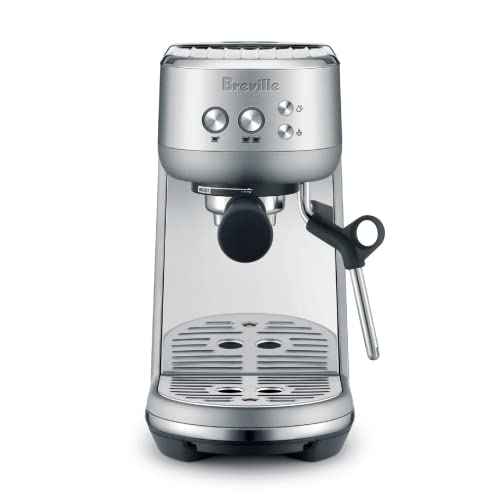 No grinder, manual steam wandBreville BES450BSS Bambino Espresso Machine, Brushed Stainless Steel | Make café-quality espresso, lattes and cappuccinos at home with this compact, manual coffee maker | Beginner-friendlyThe entry point, and the one that assumes you already own a grinder. Heats in a few seconds rather than minutes because it heats water on demand instead of keeping a boiler hot. You texture the milk yourself.amazon.com $299.95 USDamazon.ca $449.99 CADPrice and availability as of View on Amazon
 Built-in grinder, you tamp, you textureBreville BES870XL Barista Express Espresso Machine, Brushed Stainless Steel | Craft café-quality espresso shots, lattes and cappuccinos at home with this manual coffee maker with built-in grinderThe one most people mean by "a Breville". Grinder, dose and tamp in one footprint, with both the tamping and the milk left to you, which is the reason it is both the cheapest way into a complete setup and the one with the steepest learning curve.amazon.com $699.95 USDamazon.ca $749.98 CADPrice and availability as of View on Amazon
 Two boilers, no grinderBreville BES920XL Dual Boiler Espresso Machine, Brushed Stainless Steel | Pull barista-quality espresso shots, lattes and cappuccinos at home with this manual coffee maker with LCD displayThe structural change rather than a feature one: two separate boilers, so it brews and steams at the same time instead of switching between them. That matters when you are making several drinks in a row and not much otherwise. No grinder.amazon.com $1,599.95 USDamazon.ca $2,399.99 CADPrice and availability as of View on Amazon
Product prices and availability are accurate as of the date/time indicated and are subject to change. Any price and availability information displayed on Amazon at the time of purchase will apply to the purchase of this product. Certain content that appears on this site comes from Amazon. This content is provided ‘as is’ and is subject to change or removal at any time.
Whatever you buy, the maintenance is the part that decides how long it lasts: see cleaning an espresso machine.
If this is your first machine, the budget split that matters more than the model is in your first espresso machine.
When to upgrade
Signs your current espresso setup needs an upgrade:
- Consistent shot problems you can't solve — usually points to grinder inadequacy.
- Wanting milk drinks with a machine that lacks simultaneous steam.
- Interest in learning more with a machine that doesn't allow control (super-automatic → semi- automatic upgrade).
- Volume needs exceeding a small single-boiler machine.
Don't upgrade for:
- Cosmetic improvements alone.
- Marketing appeal.
- Trend-following (many "pressure profiling" upgrades don't fundamentally change espresso quality).
The honest summary
Espresso machines fall into five main categories: manual lever, semi-automatic, automatic, super-automatic, and capsule/pod. For quality-focused home espresso, semi- automatic machines in the $800-1500 range paired with a matching burr grinder ($400-800) are the specialty coffee sweet spot. Below $500 for the machine typically means either capsule machines (convenient but not proper espresso) or entry-level semi-automatics with substantial compromises. Above $2000, additional cost buys refinement rather than fundamentally different espresso. The grinder matters at least as much as the machine — don't spend $1500 on a machine and $100 on a grinder. Capsule machines offer convenience but genuinely different espresso quality; super-automatics prioritise convenience over control. Whatever machine you choose, fresh coffee and good technique matter as much as the equipment.
Frequently asked questions
- What are the different types of espresso machines?
- Five main categories: (1) Manual lever — you pull a lever to build pressure; all technique-driven. (2) Semi-automatic — machine provides pressure via pump; you control shot start/stop and grind/dose/tamp. (3) Automatic — machine handles shot timing based on programmed volume. (4) Super-automatic — machine handles everything from grinding through milk frothing to cleaning. (5) Capsule/pod — Nespresso, Keurig-style; pre-portioned coffee capsules. Each has different price ranges, learning curves, quality potential, and convenience trade-offs.
- How much should I spend on an espresso machine?
- For meaningful espresso quality at home, budget $500-2000+ for the machine plus $300-800 for a proper grinder. Below $500 for the machine, you're mostly getting capsule machines or low-end semi-automatics with substantial compromises. The $800-1500 range is the specialty home sweet spot for semi-automatic machines. Above $2000 buys refinements (dual boilers, PID temperature control, better build quality) rather than fundamentally different espresso. The grinder is at least as important as the machine — don't skimp there.
- What actually matters for espresso quality?
- In rough order of importance: (1) grinder quality — proper burr grinder producing consistent particle size for espresso-fine grind. (2) Water pressure — needs to reach 9 bar consistently during extraction. (3) Water temperature — 90-96°C, stable throughout the shot. (4) Fresh coffee beans — roasted within a few weeks. (5) Portafilter and basket quality — proper basket geometry supports consistent extraction. (6) Barista technique — dose, distribution, tamp. Interface complexity (PID displays, pressure profiling, etc.) matters less than these fundamentals.
- Should I get a capsule machine or a real espresso machine?
- Capsule machines (Nespresso, Keurig) offer massive convenience and consistency but produce genuinely different espresso than a real semi-automatic machine. Capsule espresso lacks the crema depth, extraction complexity, and freshness of a well-pulled shot. If convenience is the top priority and you're comparing capsule espresso to no espresso at home, capsule is a reasonable choice. If you actually want proper espresso, capsule machines won't get you there — invest in a real semi-automatic + grinder setup.
- What are the best espresso machine brands?
- Reputable brands by segment: Entry-level semi-automatic — Breville (Bambino, Barista Pro), Rancilio Silvia, Gaggia Classic Pro. Mid-range prosumer — Rocket Espresso, ECM, Profitec, Lelit. High-end prosumer — La Marzocco (Linea Mini), Slayer, Modbar. Commercial — La Marzocco, Nuova Simonelli, Slayer. Capsule — Nespresso (Vertuo or Original) dominates. Super-automatic — Jura, DeLonghi Eletta, Breville Oracle. Different price tiers and philosophies; specific model choice depends on your specific priorities and budget.
References
Every factual claim in this article is drawn from the sources below. See the source library for how we grade evidence.
- [1]Brewing FundamentalsCoffee Science Foundation · Reference work · Tier 2 · Moderate
- [2]Influence of Water Pressure on the Final Quality of Arabica Espresso CoffeeJournal of Agricultural and Food Chemistry · 2002 · Controlled trial · Tier 2 · Moderate
- [3]Influence of extraction temperature on the final quality of espresso coffeeJournal of the Science of Food and Agriculture · 2003 · Controlled trial · Tier 2 · Moderate
- [4]How the variance of some extraction variables may affect the quality of espresso coffees served in coffee shopsJournal of the Science of Food and Agriculture · 2015 · Observational study · Tier 2 · Moderate
- [5]CoffeeEncyclopaedia Britannica · Reference work · Tier 3 · Contextual
Related reading
- Espresso & Coffee DrinksThe Origin of Espresso: How Italy Invented the Shot→
- Brewing ScienceBurr vs Blade Grinder: Which Makes Better Coffee?→
- Espresso & Coffee DrinksWhat Is Espresso? Pressure, Extraction, the Shot→
- Coffee EquipmentHow to Clean an Espresso Machine: The Full Guide→
- Brewing ScienceWhy Is Coffee Bitter? The Chemistry of Coffee Bitterness→
- Brewing ScienceCoffee Cupping: How SCA Sensory Evaluation Works→