Dual Boiler vs Heat Exchanger: Which Espresso Machine Design Fits You
By Coffee Studies Editorial·Published October 17, 2026·9 min read
Quick answer
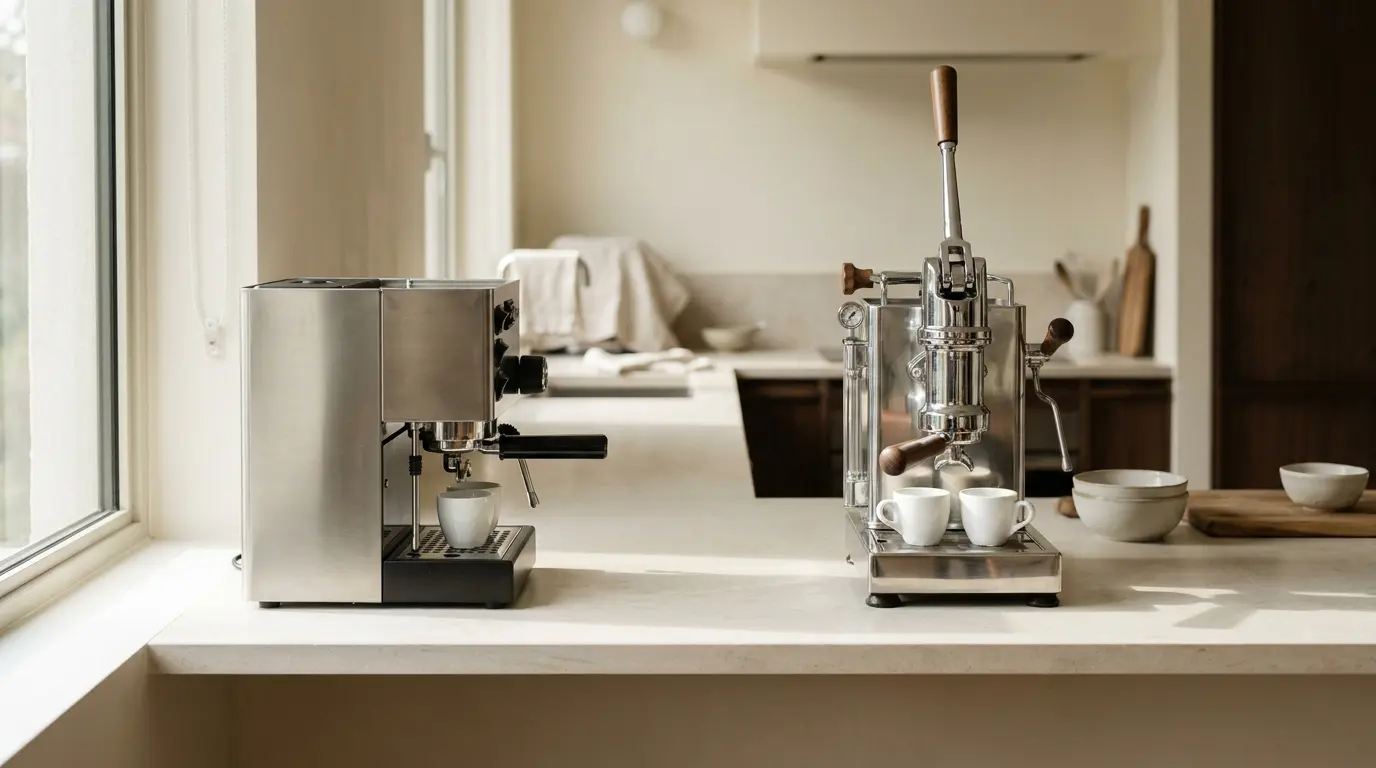
Every espresso machine has to do two things that want different temperatures. The shot wants water somewhere around 93 C, held there for the twenty to thirty seconds it takes to pull. Milk wants dry steam, which means a boiler sitting well above 100 C and under pressure. The whole business of boiler design is how a machine holds those two temperatures at once, and whether it makes you wait between them.
There are four answers on the market. They are not better and worse so much as suited to different mornings.
Single boiler: one job at a time
The simplest design is one small boiler, usually a few hundred millilitres, with a heating element and a thermostat. Set it to brew temperature and pull a shot. Flip a switch to steam mode and the same boiler climbs past boiling to make pressure; steam your milk; then wait for it to cool back to brew range before the next shot, or run water through to hurry it.
This is the design in the Gaggia Classic, the Rancilio Silvia and most machines under about a thousand dollars. It can pull an excellent shot. Pressure at the puck, which is what governs extraction more than any other machine variable[1], comes from the pump, not the boiler, and a single boiler machine has the same pump as a dual boiler one.
What it cannot do is two things at once, and what it does badly without help is tell you where the temperature is. A plain thermostat cycles the element on and off across a band of several degrees, so the shot you pull just after the light comes on is hotter than the one you pull just before it. Home baristas learned to "temperature surf", pulling the shot at a chosen point in the cycle. A PID controller, which many of these machines now include or can be fitted with, replaces the thermostat with a feedback loop that holds a set temperature within a degree. On a single boiler, PID is the upgrade that matters; it is the difference between a machine you fight and one you trust.
If you drink espresso, or one milk drink a day, a single boiler with PID is as much machine as you need. The waiting only bites when the drinks stack up.
Heat exchanger: one boiler doing both jobs
A heat exchanger machine, usually written HX, has one large boiler, a litre and a half or more, held permanently at steam temperature and pressure. Running through the middle of that boiler is a narrow pipe. When you pull a shot, fresh cold water from the tank is pumped through that pipe, picks up heat from the surrounding boiler in the second or two it takes to pass, and arrives at the group at brew temperature.
The elegance is that you get steam and brew water from one heating element, at the same time, with no mode switch. Pull the shot, steam the milk while it runs, pull the next one. That is why this design has run cafes for sixty years and why the Rocket Appartamento, the Rocket Mozzafiato and most prosumer machines around two to three thousand dollars use it.
The catch is the water sitting in the pipe while the machine idles. It has been soaking in a boiler at well over 100 C, so it is too hot for coffee. The first water out of the group after a rest will be several degrees over, and over-hot water pulls bitterness forward[3]. The fix is the cooling flush: run the group for a few seconds before locking in the portafilter, until the water stops hissing and spitting and runs clear and smooth. Then the pipe holds fresh water and the shot lands in range. Pull a second shot inside a minute or two and you skip it. It is a five-second habit that takes a week to stop thinking about.
What a PID is, and what it does and does not control on each design, is set out in E61, PID and pumps.
Some HX machines add a PID. It does not control the brew water directly, because nothing holds that water; it controls the steam boiler more precisely, which makes the flush more predictable. A few also add a dial to shift the whole system up or down a little. Either is a refinement of the same design, not a change to it.
Dual boiler: two temperatures, held separately
A dual boiler machine has exactly what the name says: one boiler for brew water, held at brew temperature, and a second boiler for steam, held at steam temperature. Each has its own heating element, and the brew boiler almost always has a PID controller.
This is the only design that holds brew temperature steady without any ritual from you. No mode switch, no surfing, no flush. Set 93 C and the next shot is at 93 C whether the machine has been idle for an hour or has just pulled three. You can steam while the shot runs, because the two boilers are independent.
What you pay for is the second boiler, the second element, the second controller, and the current to run both. Dual boiler machines are heavier, draw more power, take longer from cold, and in a home machine start around two thousand dollars for a small one and run well past three thousand. Breville's Dual Boiler is the inexpensive outlier because it uses small boilers in a plastic body; the Rancilio Silvia Pro X and Diletta Alto are the stainless prosumer versions of the same idea.
The honest question is whether you need the ritual removed. If you pull a shot and go, a heat exchanger with a flush habit gives you the same cup. If you make four flat whites for a household every morning, the dual boiler is the machine that stops feeling like work.
Thermoblock and thermojet: heat on the way through
The fourth design holds no hot water at all. A thermoblock is a metal block with a heating element and a channel through it; water is heated as it passes, like a tankless water heater. Breville's thermocoil and thermojet are variants of the same idea with a coil or a faster heater.
The advantages are real. There is nothing to warm up, so the machine is ready in seconds rather than the ten to twenty minutes a boiler takes. There is no boiler to descale. It fits in a small body and costs little, which is why nearly every machine under six hundred dollars uses one, and why the Breville Oracle Jet uses one at two thousand to get rid of the warm-up.
The trade is that water heated in transit is harder to hold at a steady temperature across a shot than water sitting in a thermostatically controlled tank, and the steam from a thermoblock is generally weaker and wetter than from a boiler under pressure. Good control software has narrowed the first problem a great deal in recent designs. The second is still why a thermoblock machine textures milk more slowly than a boiler machine at the same price.
What the design does not change
It is worth being clear about the limits of this choice. The boiler design governs temperature stability and whether you can do two things at once. It does not govern pressure, which is the pump; it does not govern the grind, which the research puts ahead of every machine variable for what ends up in the cup[2]; and it does not govern the coffee. A single boiler with a good grinder and fresh beans beats a dual boiler with a built-in grinder set badly, every time.
So the sequence is: grinder first, then the design that matches how many drinks you make in a row, then the specific machine inside that design.
Which design, by how you drink
Espresso, or one milk drink, most days. Single boiler with PID. Gaggia Classic Evo Pro or Rancilio Silvia, with a PID added to the Silvia if you can. Spend the saved money on the grinder.
Two or three milk drinks, most days. Heat exchanger. The Rocket Appartamento is the entry point to the design; the Mozzafiato adds PID and a shot timer. Learn the flush and you have a cafe's workflow at home.
A household of milk drinkers, or you hate ritual. Dual boiler. The Rancilio Silvia Pro X is the smallest serious one; the Diletta Alto is the larger E61 version. Breville's Dual Boiler is the budget route to the same architecture.
Counter space, impatience, or a kitchen that is not yours. Thermoblock. The Breville Oracle Jet is the top of that design; the Bambino is the bottom of it.
One machine from each design
 Single boiler, 58 mm, stainless boilerGaggia RI9380/51 Classic Evo Pro Espresso Machine, Industrial Grey, SmallA small commercial machine at a consumer price: a 58 mm group, a three-way solenoid and a real steam wand on a boiler. The Evo Pro ships at nine bar with a stainless boiler. No temperature control, so plan on timing the shot or adding a PID, and budget for a grinder.amazon.com $529.99 USDamazon.ca $733.15 CADPrice and availability as of View on Amazon
 Heat exchanger, E61 groupRocket Espresso Appartamento 2.0 Espresso Machine | Heat Exchanger | 1.8L | (White)The entry to the E61 heat exchanger: one copper boiler, brew and steam together, commercial fittings, a vibratory pump. No display and no PID; the brew temperature is set through the boiler and a short cooling flush before shots after idle is the one habit it asks.amazon.com $2,150.00 USDnot sold on amazon.caPrice and availability as of View on Amazon
 Dual boiler with PID, compactRancilio Silvia Pro X Espresso Machine, 1 liters, Stainless SteelTwo boilers on two controllers in a body only a little wider than the Silvia. Set temperature holds, steam is always ready, milk textures while the shot runs, and nothing needs adding. The smallest serious dual boiler made.amazon.com $2,195.00 USDamazon.ca $3,850.00 CADPrice and availability as of View on Amazon
 Automated, on-demand heating, cold modesBreville BES985BSS Oracle Jet Espresso Machine, Brushed Stainless Steel | Automatically brew barista-quality lattes, cappuccinos and cold brew at home with this coffee maker with built-in grinderGrinds, doses, tamps and textures milk from a touchscreen, and is ready in seconds because it heats on demand rather than holding a boiler. The trade is steaming after the shot with a little less power. The only Breville with cold extraction modes.amazon.com $1,979.99 USDamazon.ca $2,999.99 CADPrice and availability as of View on Amazon
Product prices and availability are accurate as of the date/time indicated and are subject to change. Any price and availability information displayed on Amazon at the time of purchase will apply to the purchase of this product. Certain content that appears on this site comes from Amazon. This content is provided ‘as is’ and is subject to change or removal at any time.
Common misconceptions
"Dual boiler makes better espresso." It makes more consistent espresso with less ritual. The ceiling is the same.
"A heat exchanger wastes water." The cooling flush is a few seconds and perhaps fifty millilitres. It is not nothing, but it is not the reason to avoid the design.
"Thermoblock machines are toys." They were, twenty years ago. The control electronics in current designs are good enough that the limitation is steam power rather than shot temperature.
"You need a dual boiler to steam milk well." You need dry steam at pressure, which a heat exchanger provides from the same boiler and a single boiler provides after its mode switch. What the dual boiler provides is steaming during the shot.
What we have and have not checked
The design descriptions here are mechanical and apply to every machine of each type. The temperature behaviour, the need for a cooling flush on a heat exchanger, and the drift on a plain thermostat are documented widely and are not in dispute. The specific machines named are placed by their published boiler type; we have not measured any of them on a bench, and the price bands are approximate ranges, not quotes. The product cards show live prices.
The honest summary
Four designs, one problem. A single boiler does one job at a time and wants a PID. A heat exchanger does both at once and wants a flush. A dual boiler does both at once with no ritual and wants your money. A thermoblock does it in seconds and a small box and wants a little patience with the milk. Match the design to how many drinks you make in a row, buy the grinder first, and the machine inside that design is a much smaller decision than it looks.
Frequently asked questions
- Is a dual boiler espresso machine worth it?
- Only if you have the problem it solves. A dual boiler holds the brew boiler at a set temperature on its own controller while a second boiler sits at steam pressure, so the shot temperature does not drift and you can steam milk while the shot runs. If you make one or two drinks a morning, a single boiler or heat exchanger gives you the same espresso for less money and a little waiting. If you make three or four milk drinks back to back, the second boiler is the thing you will notice every single day.
- What is the difference between a heat exchanger and a dual boiler?
- A heat exchanger has one large boiler held at steam temperature, with a narrow pipe running through it; fresh water passes through that pipe on the way to the group and picks up heat in transit. A dual boiler has two boilers, one for brew water and one for steam, each at its own temperature. The heat exchanger is cheaper and brews and steams at once, but the water in the pipe overheats while the machine idles, so you flush a few seconds before each shot. The dual boiler needs no flush and holds a set temperature.
- Do you need to flush a heat exchanger machine before every shot?
- After the machine has sat idle, yes. The water sitting in the exchanger pipe climbs toward the steam boiler's temperature, so the first water out of the group is too hot for coffee. A short flush, a few seconds until the water stops spitting and runs smooth, brings it back into range. If you pull a second shot within a minute or two, the pipe has fresh water in it and you skip the flush. It takes a week to make the habit automatic.
- Is a single boiler espresso machine good enough?
- For espresso alone, a well-made single boiler can pull a shot as good as anything on this page; the design does not limit the coffee, it limits the sequence. You brew, then switch to steam mode and wait for the boiler to climb, then steam, then wait for it to come back down before the next shot. That is a few minutes per milk drink. A single boiler with a PID controller removes the guessing about where the temperature is, which is the upgrade that matters most on this design.
- What is a thermoblock espresso machine?
- A thermoblock, or thermocoil, or thermojet in Breville's naming, heats water as it passes through a heated metal block rather than holding a tank of hot water. It is ready in seconds, takes little space and costs less, which is why most machines under about six hundred dollars use one. The trade is stability: the water temperature can wander during a shot more than it does from a true boiler, and steam power is usually weaker. Newer designs have narrowed that gap considerably.
- Which design makes the best espresso?
- None of them, by itself. Shot quality is governed by pressure at the puck, grind, dose and the coffee, and all four designs can deliver the pressure and temperature a good shot needs when they are set up well. What the design changes is how consistently the machine delivers that temperature and how much ritual it takes from you. A dual boiler is the most consistent and the least ritual; a heat exchanger is nearly as consistent with one habit added; a single boiler asks the most of you.
References
Every factual claim in this article is drawn from the sources below. See the source library for how we grade evidence.
- [1]Influence of Water Pressure on the Final Quality of Arabica Espresso CoffeeJournal of Agricultural and Food Chemistry · 2002 · Controlled trial · Tier 2 · Moderate
- [2]Brewing FundamentalsCoffee Science Foundation · Reference work · Tier 2 · Moderate
- [3]Effects of brew strength, brew yield, and roast on the sensory quality of drip brewed coffeeJournal of Food Science · 2020 · Controlled trial · Tier 2 · Moderate
Related reading
- Brewing ScienceEspresso Machine Buying Guide: Choosing the Right Type→
- Coffee EquipmentRocket Appartamento: The Heat Exchanger Most People Start With→
- Coffee EquipmentRancilio Silvia vs Silvia Pro X: One Name, Two Different Machines→
- Coffee EquipmentBreville Oracle Jet vs Oracle Touch: Fast Heater or Two Boilers→
- Coffee EquipmentBreville Espresso Machines Compared: What Actually Differs→
- Coffee EquipmentFellow Espresso Series 1: Pressure Profiling at a New Price→