Diletta Espresso Machines: Bello, Bello Plus and Alto Compared
By Coffee Studies Editorial·Published October 17, 2026·6 min read
Quick answer
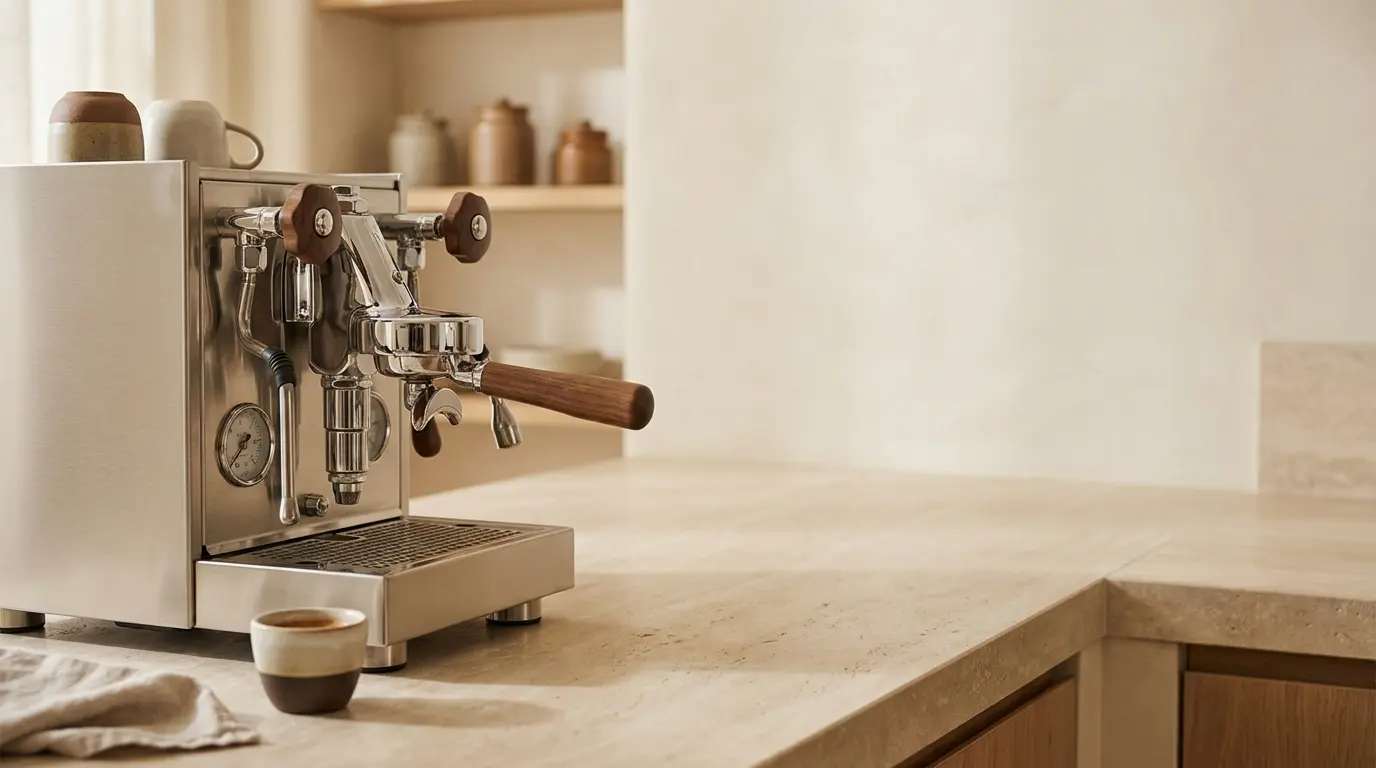
Diletta is not one of the names people recite when they talk about E61 machines, which is most of why it is worth writing about. The range is three machines covering the same three tiers the Italian makers cover, built around the same group and the same two boiler architectures, generally at a lower price.
Here is what separates the three, and where each lands against the obvious alternative.
The shared platform
All three take an E61 group: a heavy chromed casting with a thermosiphon loop that keeps it at working temperature, a lever that opens the shot, and a standard 58 mm portafilter so every commercial basket and tamper fits. What that group does, and why so many machines share it, is covered in E61, PID and pumps.
None of the three has a grinder. All three are tank machines with vibratory pumps in their standard forms. All three deliver the nine bar at the puck that governs extraction[1], which is to say the shot ceiling is the same across the range and what changes is temperature control and workflow.
Bello: the heat exchanger
The entry machine. One boiler held at steam temperature with brew water drawn through a pipe running inside it, which means you brew and steam at the same time from a single heating element. The boiler is governed by a pressurestat, a mechanical pressure switch, so brew temperature is set indirectly by boiler pressure rather than by a number you dial in.
This is the classic prosumer arrangement and it carries the classic habit: a short cooling flush before a shot when the machine has been idling, because the water sitting in that pipe has been soaking in a boiler well above brewing temperature, and over-hot water pushes the shot bitter[2]. Pull a second shot within a minute or two and you skip it.
It is the same design as the Rocket Appartamento, typically at a lower price.
Bello Plus: the same machine, controlled
The Bello Plus keeps the heat exchanger and adds a PID governing the boiler, a shot timer and a programmable display.
The important nuance is what the PID is controlling. A heat exchanger holds no brew water, so the PID is not setting your shot temperature directly; it is holding the steam boiler far more precisely than a mechanical pressurestat can. The effect is that the machine behaves the same way every morning and the cooling flush becomes a repeatable routine rather than a judgement call.
If you like the heat-exchanger design but want the machine to be predictable, this is the version to buy. In Rocket's range the equivalent step is the Mozzafiato.
Alto: the dual boiler
The Alto changes the architecture rather than the controls. Separate brew and steam boilers, each with its own controller, which means the brew temperature is simply set and held, steam is independently available, and there is no cooling flush at all.
That is the same promise as the Rancilio Silvia Pro X, reached in a full-size E61 body rather than a compact one. The choice between them is mostly footprint and whether you want the traditional group. The trade-offs between the two architectures are worked through in dual boiler vs heat exchanger.
The three tiers
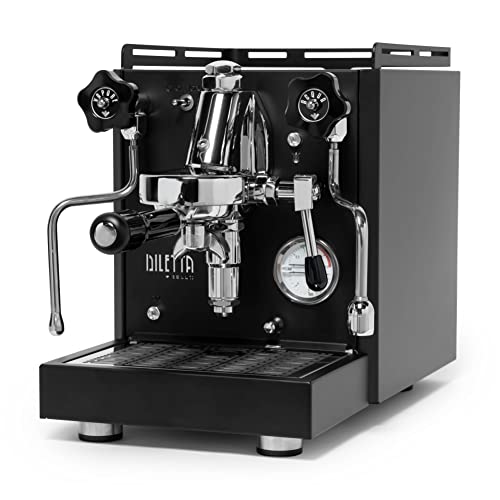 Heat exchanger, E61, pressurestatDiletta Bello Espresso Machine (Black)The entry to the range: an E61 heat exchanger governed by a mechanical pressurestat rather than a PID, so brew temperature is set through boiler pressure and read off the gauge. Brews and steams together; the cooling flush before a shot after idling is part of the design.amazon.com $1,899.00 USDnot sold on amazon.caPrice and availability as of View on Amazon
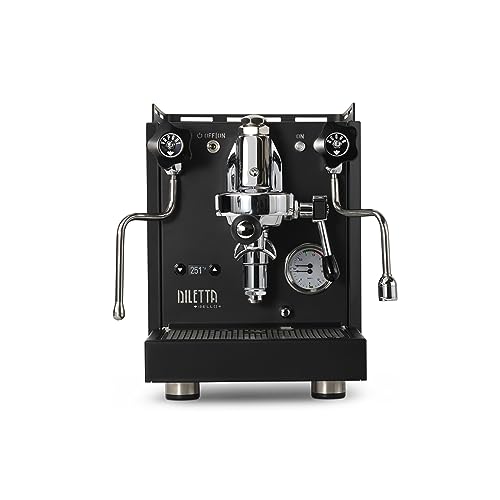 Heat exchanger, E61, PIDDiletta Bello+ Espresso Machine | E61 | PID Temperature Control | Shot Timer | Programmable Preinfusion | Handmade In Italy (Black)An E61 heat exchanger with a PID governing the boiler, which is the same arrangement as the Rocket Mozzafiato at a lower price. Brews and steams together; the cooling flush habit applies.amazon.com $2,149.00 USDnot sold on amazon.caPrice and availability as of View on Amazon
 Dual boiler, E61, PIDDiletta Alto Espresso Machine | Dual Boiler | PID | Shot Timer | Adjustable OPV | (Black)The full-size E61 dual boiler: separate brew and steam boilers on PID, a shot timer, no cooling flush. Where the Silvia Pro X is the compact answer to the same design, this is the traditional one.amazon.com $2,799.00 USDnot sold on amazon.caPrice and availability as of View on Amazon
Product prices and availability are accurate as of the date/time indicated and are subject to change. Any price and availability information displayed on Amazon at the time of purchase will apply to the purchase of this product. Certain content that appears on this site comes from Amazon. This content is provided ‘as is’ and is subject to change or removal at any time.
Which one
Bello if you want the E61 heat-exchanger experience at the lowest price and do not mind judging the machine by its pressure gauge and your flush habit.
Bello Plus if you want that same design to behave identically every day. For most buyers in this range, the PID and the shot timer are worth the step and this is the sensible middle.
Alto if the flush is the thing you want gone, or if several people use the machine and a set temperature matters more than a ritual somebody will forget.
Something else if you want a compact machine, because all three are full-size E61 machines with the depth that implies. The compact alternatives, including the Ascaso Steel Duo and the Silvia Pro X, are in compact espresso machines.
Buying notes
Variants. Diletta lists these machines in several finishes and occasionally with flow control, as separate listings at different prices. Read the listing you are opening rather than assuming the cheapest result is the model described here.
Canada. The Diletta machines are thin on the Canadian storefront; searches there return mostly accessories and third-party items. The product cards on this page show a tagged search for Canadian readers rather than pointing at a listing that is not the machine.
The grinder. As with everything in this band, a machine of this standard behind a weak grinder exposes the grinder. Grind consistency governs extraction ahead of the brew side[3], so budget for it in the same purchase.
Common misconceptions
"PID means it controls brew temperature." On the Bello Plus it controls the steam boiler. That is useful and it is not the same thing.
"The Alto is the Bello Plus with more features." It is a different boiler architecture. That is a bigger change than a feature list suggests.
"A lesser-known brand means lesser engineering." The group, the boiler arrangement and the pump are the same proven components the category shares. What a bigger name buys is service network and resale.
"E61 machines are all the same." The group is. The boiler design behind it is the decision that changes your mornings.
What we have and have not checked
Model configurations, boiler arrangements and the presence of PID, shot timer and programmable controls come from the maker's published specifications and the live listings. Heat-exchanger and dual-boiler behaviour, including the cooling flush, is intrinsic to those designs. We have not bench-tested any Diletta machine and make no comparative claim about build quality against other brands. Canadian availability was checked on the Amazon storefront at the time of writing and may change. The product cards show live prices.
The honest summary
Three machines, two architectures, one group. The Bello is an E61 heat exchanger with a pressurestat and a flush habit. The Bello Plus adds a PID and a timer so that habit becomes predictable, and is the one most people should buy. The Alto is a dual boiler and removes the flush entirely. They do what the better-known Italian machines do at each tier, usually for less, and like all of them they are only as good as the grinder you put beside them.
Frequently asked questions
- What is the difference between the Diletta Bello and the Bello Plus?
- Control, not architecture. Both are E61 heat-exchanger machines with the same boiler arrangement, so both brew and steam at the same time and both want a cooling flush before a shot after idling. The Bello Plus adds a PID governing the boiler, a shot timer and a programmable display. The PID does not control brew water directly, because a heat exchanger holds none, but it governs the boiler far more precisely than a pressurestat, which makes the flush consistent and the machine predictable.
- Is the Diletta Alto a dual boiler?
- Yes. The Alto has separate brew and steam boilers, each with its own controller, which is the design change rather than a feature addition. It holds a set brew temperature without any timing or flushing from you, and steam is independently available, so milk and shot never compete. That is the practical difference from the Bello and Bello Plus, both of which are heat exchangers that heat brew water in transit through the steam boiler.
- How does Diletta compare with Rocket?
- They compete directly at each tier and the architecture is broadly equivalent: E61 groups, heat exchangers at the lower end, dual boilers above. Rocket is the older and better-known Italian name with a wider service network and stronger resale. Diletta generally undercuts it. If a service relationship and the badge matter to you, that is what the premium buys; if the engineering is what you are buying, the Diletta tier is the cheaper route to the same capability.
- Do Diletta machines need a cooling flush?
- The Bello and Bello Plus do, because they are heat exchangers: brew water passes through a pipe inside a boiler held at steam temperature, so water that has been sitting in that pipe while the machine idles is too hot for coffee. A few seconds of flushing before locking in the portafilter clears it. The Alto does not, because it is a dual boiler and its brew water is held at brew temperature in its own vessel.
- Does a Diletta come with a grinder?
- No, and none of these machines should be bought without budgeting for one. They take the 58 mm commercial portafilter, so cafe baskets and tampers fit, and they expect a dedicated espresso grinder beside them. Grind consistency drives extraction more than anything in the machine, so a Diletta behind a weak grinder will expose the grinder rather than compensate for it.
- Are Diletta machines available in Canada?
- On Amazon, generally not. The Diletta listings that appear on the Canadian storefront are overwhelmingly accessories and third-party items rather than the machines themselves, so Canadian readers looking at this range will usually be buying through a specialist dealer rather than through Amazon. The product cards on this page reflect that, and show a tagged search for Canada rather than a listing that does not exist.
References
Every factual claim in this article is drawn from the sources below. See the source library for how we grade evidence.
- [1]Influence of Water Pressure on the Final Quality of Arabica Espresso CoffeeJournal of Agricultural and Food Chemistry · 2002 · Controlled trial · Tier 2 · Moderate
- [2]Effects of brew strength, brew yield, and roast on the sensory quality of drip brewed coffeeJournal of Food Science · 2020 · Controlled trial · Tier 2 · Moderate
- [3]Brewing FundamentalsCoffee Science Foundation · Reference work · Tier 2 · Moderate
Related reading
- Coffee EquipmentDual Boiler vs Heat Exchanger: Which Espresso Machine Design Fits You→
- Coffee EquipmentE61, PID and Pumps: Reading an Espresso Machine Spec Sheet→
- Coffee EquipmentRocket Appartamento: The Heat Exchanger Most People Start With→
- Coffee EquipmentProsumer Espresso Machine: What the Word Means and Where It Starts→
- Coffee EquipmentRancilio Silvia vs Silvia Pro X: One Name, Two Different Machines→
- Coffee EquipmentAscaso Steel Duo: Two Thermoblocks Instead of Two Boilers→