Rocket Appartamento: The Heat Exchanger Most People Start With
By Coffee Studies Editorial·Published October 17, 2026·7 min read
Quick answer
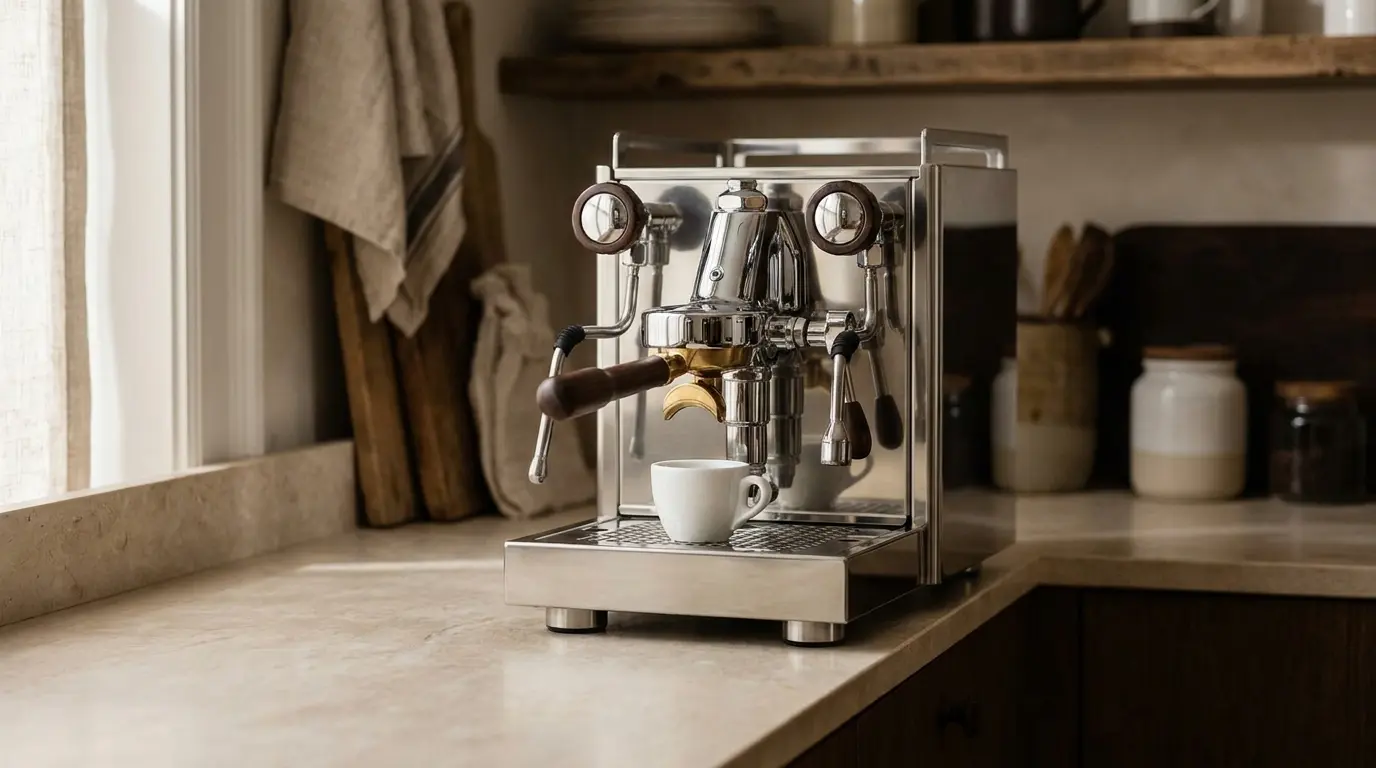
Every maker of prosumer espresso machines has an entry model, and for Rocket that is the Appartamento. It is the machine people buy when they have outgrown a Gaggia or a Breville and want the thing they saw on the cafe counter, scaled to a kitchen. Understanding it is mostly understanding the design it belongs to.
What it is
The Appartamento is a heat-exchanger machine with an E61 group. Those two phrases carry most of the specification.
Heat exchanger. One boiler, 1.8 litres of copper, held permanently at steam temperature and pressure. A narrow pipe runs through it, and when you pull a shot, cold water from the 2.5 litre tank is pumped through that pipe, picks up heat in the second or two it takes to pass, and arrives at the group at brew temperature. Steam is drawn from the same boiler. The result is a machine that brews and steams at once from a single heating element, which is how cafe machines have worked for sixty years.
E61 group. A heavy chrome brew group, named for the 1961 Faema design it descends from, with a lever that opens the shot. The mass of the group acts as a thermal buffer that steadies the water temperature on the way to the puck, and a thermosiphon loop keeps it hot between shots. It takes a standard 58 mm portafilter, so every basket and tamper made for commercial machines fits.
Vibratory pump. The same type as in machines a third the price, and it delivers the nine bar that governs extraction[1] without difficulty. It is louder than the rotary pump in Rocket's larger machines and cannot be plumbed to a water line.
Build. Stainless panels on a steel frame, commercial fittings, nothing proprietary. The parts that wear are gaskets, the pump and the element, all standard, all replaceable for as long as you own it.
What it does not have is a display, a timer, a PID, or any way to see the brew temperature. That is the trade the Appartamento makes, and it is worth understanding before buying.
The one habit: the cooling flush
Because the brew water sits in a pipe inside a boiler at well over 100 C, the first water out of the group after the machine has idled is too hot for coffee, and over-hot water pulls bitterness forward[2]. The fix is to run the group for a few seconds before locking in the portafilter, until the water stops hissing and spitting and runs clear. That clears the overheated water; the next water through the pipe has had only its transit time to heat and lands in range.
The flush is a few seconds and a splash of water. Pull a second shot within a minute or two and the pipe already holds fresh water, so you skip it. Within a week it is as automatic as locking in the portafilter, and it is the price of a design that lets you steam while you brew.
Setting temperature without a display
The brew temperature on a standard Appartamento is set by the steam boiler's pressure, which is governed by a pressurestat. Raise the boiler pressure and the water in the exchanger pipe arrives hotter; lower it and it arrives cooler. The factory setting lands most coffees in a good range, and the flush gives you a little control on top: a longer flush drops the shot a degree or two, a shorter one leaves it higher.
If you want to move the whole range, the standard machine requires adjusting the pressurestat, which is a tool-and-screwdriver job. The TCA version, for Temperature Control Adjustment, adds a control that shifts the brew temperature without tools. It is not a PID and there is still no display; it is adjustability added to the same design, and it is worth the modest premium if you roast your own or switch between light and dark coffees often.
Appartamento, Mozzafiato, R58
Rocket's home line is best read as three steps on two designs.
Appartamento. Heat exchanger, E61, vibratory pump, no display. The smallest footprint and the lowest price. The TCA adds temperature adjustment.
Mozzafiato. The same heat-exchanger architecture with a PID controller on the boiler and a shot timer in a display, in a larger body with more polish. The PID does not hold brew water directly, because a heat exchanger holds none, but it governs the boiler far more precisely than a pressurestat, so the flush becomes predictable and the temperature stays put. The vibratory-pump version is the direct upgrade from the Appartamento; the rotary-pump version is quieter and can be plumbed in. The Giotto is the same machine in a different cabinet.
R58. A dual boiler: separate brew and steam boilers, each on PID, no flush, a rotary pump, plumb-in capability, and a detachable controller. It is the design change rather than the feature change, and it costs and weighs accordingly. The Rancilio Silvia Pro X is the compact alternative in that category; the R58 is the full-size one.
Most people who buy an Appartamento keep it. The ones who move on usually want the display and the predictability, which is the Mozzafiato, or want to stop flushing altogether, which is a dual boiler.
What it will not do
Three things, honestly.
It will not fix a poor grinder. Grind governs extraction ahead of any machine variable[3], and an E61 machine fed by a grinder that cannot hold a fine, even setting will pull fast, sour shots no matter what the boiler does. There is no grinder in the Appartamento; budget for a real one.
It will not be quiet. The vibratory pump is the same type as in far cheaper machines and sounds like it. If the noise matters, the rotary Mozzafiato or the R58 is the answer.
It will not tell you its temperature. If you are the kind of person who wants to see a number, the Mozzafiato is the same design with that number added.
Who it is for
Buy it if you want the cafe's workflow at home, brewing and steaming together, from a machine built to be repaired, and you are happy to learn one habit. It is the least expensive way into an E61 heat exchanger from a maker with a service network, and it fits counters that larger prosumer machines do not.
Choose the TCA if you change coffees often or want to tune temperature without tools.
Go to the Mozzafiato if you want a display and a PID on the same design.
Go to a dual boiler if the flush annoys you before you have even bought it. That is a sign the Silvia Pro X or the R58 is your machine.
The Appartamento and its two upgrade paths
 Heat exchanger, E61 groupRocket Espresso Appartamento 2.0 Espresso Machine | Heat Exchanger | 1.8L | (White)The entry to the E61 heat exchanger: one copper boiler, brew and steam together, commercial fittings, a vibratory pump. No display and no PID; the brew temperature is set through the boiler and a short cooling flush before shots after idle is the one habit it asks.amazon.com $2,150.00 USDnot sold on amazon.caPrice and availability as of View on Amazon
 Heat exchanger with PID and shot timerRocket Espresso Mozzafiato FAST V Espresso Machine | Vibratory Pump | Heat Exchanger | PID Temperature Control | (Black)The same E61 heat-exchanger architecture as the Appartamento with a PID governing the boiler and a shot timer in the display, so the flush becomes predictable and the temperature stays put. The direct upgrade inside the same design.amazon.com $2,749.00 USDnot sold on amazon.caPrice and availability as of View on Amazon
 Dual boiler with PID, compactRancilio Silvia Pro X Espresso Machine, 1 liters, Stainless SteelTwo boilers on two controllers in a body only a little wider than the Silvia. Set temperature holds, steam is always ready, milk textures while the shot runs, and nothing needs adding. The smallest serious dual boiler made.amazon.com $2,195.00 USDamazon.ca $3,850.00 CADPrice and availability as of View on Amazon
Product prices and availability are accurate as of the date/time indicated and are subject to change. Any price and availability information displayed on Amazon at the time of purchase will apply to the purchase of this product. Certain content that appears on this site comes from Amazon. This content is provided ‘as is’ and is subject to change or removal at any time.
Common misconceptions
"Heat exchangers are old technology." They are proven technology. Most of the world's cafe espresso is pulled on one.
"No PID means inconsistent shots." The E61 group's thermal mass and a consistent flush habit give repeatable shots. The PID on the Mozzafiato makes that easier to get, not possible to get.
"The Appartamento is a small machine." It is small for an E61 machine. It is still heavier and deeper than anything from Breville or Gaggia, and the group sticks out at the front. Measure the counter.
"You can plumb it in." Not the vibratory-pump version. Plumb-in needs the rotary Mozzafiato or the R58.
What we have and have not checked
The design, boiler capacity, group type and pump type are taken from the maker's published specifications, and the behaviour of a heat exchanger, including the cooling flush, is intrinsic to the design. The current revision is sold as the Appartamento 2.0; we have described the architecture, which the revision shares, and have not itemised the revision's detail changes. We have not bench-tested the machine. Price bands in the text are the usual market range and the product cards show live prices.
The honest summary
The Rocket Appartamento is an E61 heat exchanger sized for a kitchen: one copper boiler, brew and steam together, commercial parts, and one habit to learn. It has no display and no PID, and it sets temperature through the boiler rather than a number; the TCA adds a dial for that, the Mozzafiato adds the number, and the R58 changes the design entirely. For most people stepping up from an appliance, the Appartamento is the right amount of machine, and the grinder beside it matters more than which Rocket it is.
Frequently asked questions
- Is the Rocket Appartamento a good first prosumer machine?
- It is the one most people choose for that role, and for good reasons: it is the smallest and least expensive way into an E61 heat-exchanger machine from a maker with a service network, it brews and steams at once, and it is built from parts that are repaired rather than replaced. The learning curve is one habit, the cooling flush, and the one real limitation is that it has no temperature display, so you set the brew temperature indirectly through the boiler pressure.
- What is the cooling flush on a heat exchanger?
- The Appartamento heats brew water by passing it through a pipe inside the steam boiler. When the machine sits idle, the water in that pipe climbs toward the boiler's temperature and becomes too hot for coffee. Before locking in the portafilter, you run the group for a few seconds until the water stops spitting and runs smoothly; that clears the overheated water and the shot lands in range. Pull a second shot within a minute or two and you skip it. It becomes automatic within a week.
- What does TCA mean on the Rocket Appartamento?
- Temperature Control Adjustment. On the standard Appartamento, brew temperature is set indirectly by the pressurestat that governs the steam boiler, and changing it means adjusting that component. The TCA version adds an accessible control that shifts the brew temperature up or down within a useful range without tools. It does not add a PID or a display; it adds adjustability to the same heat-exchanger design.
- Rocket Appartamento vs Mozzafiato: what is the difference?
- Same E61 heat-exchanger architecture, same boiler size and pump type on the vibratory version. The Mozzafiato adds a PID controller on the boiler and a shot timer in a display, which makes the temperature behaviour more predictable and the flush more consistent, in a larger and more expensive body. The rotary-pump Mozzafiato can also be plumbed in. If the Appartamento's lack of a display bothers you, the Mozzafiato is the answer inside the same design.
- Should I get the Appartamento or the R58?
- They are different designs. The Appartamento is a heat exchanger: one boiler, a cooling flush, temperature set indirectly. The R58 is a dual boiler with a rotary pump and plumb-in capability: two boilers on PID, no flush, quieter, and considerably more money and counter space. If you make a few drinks a day and want the classic E61 workflow, the Appartamento. If you want set-and-forget temperature and a machine that can run all morning, the R58.
- Does the Rocket Appartamento need a grinder?
- Yes, and a serious one. No Rocket has a built-in grinder, and an E61 machine at nine bar needs a grinder fine and consistent enough to resist that pressure for twenty-five seconds. Budget for a dedicated espresso grinder as part of the purchase; it is where most of the shot quality is decided, and a machine of this standard fed by a poor grinder will disappoint.
References
Every factual claim in this article is drawn from the sources below. See the source library for how we grade evidence.
- [1]Influence of Water Pressure on the Final Quality of Arabica Espresso CoffeeJournal of Agricultural and Food Chemistry · 2002 · Controlled trial · Tier 2 · Moderate
- [2]Effects of brew strength, brew yield, and roast on the sensory quality of drip brewed coffeeJournal of Food Science · 2020 · Controlled trial · Tier 2 · Moderate
- [3]Brewing FundamentalsCoffee Science Foundation · Reference work · Tier 2 · Moderate
Related reading
- Coffee EquipmentDual Boiler vs Heat Exchanger: Which Espresso Machine Design Fits You→
- Coffee EquipmentRancilio Silvia vs Silvia Pro X: One Name, Two Different Machines→
- Brewing ScienceEspresso Machine Buying Guide: Choosing the Right Type→
- Coffee EquipmentCompact Espresso Machines: What Fits, and What You Give Up→
- Coffee EquipmentHow to Clean an Espresso Machine: The Full Guide→
- Coffee EquipmentHow Much to Spend on a Coffee Grinder→