How to Clean an Espresso Machine: The Full Guide
By Coffee Studies Editorial·Published July 18, 2026·6 min read
Quick answer
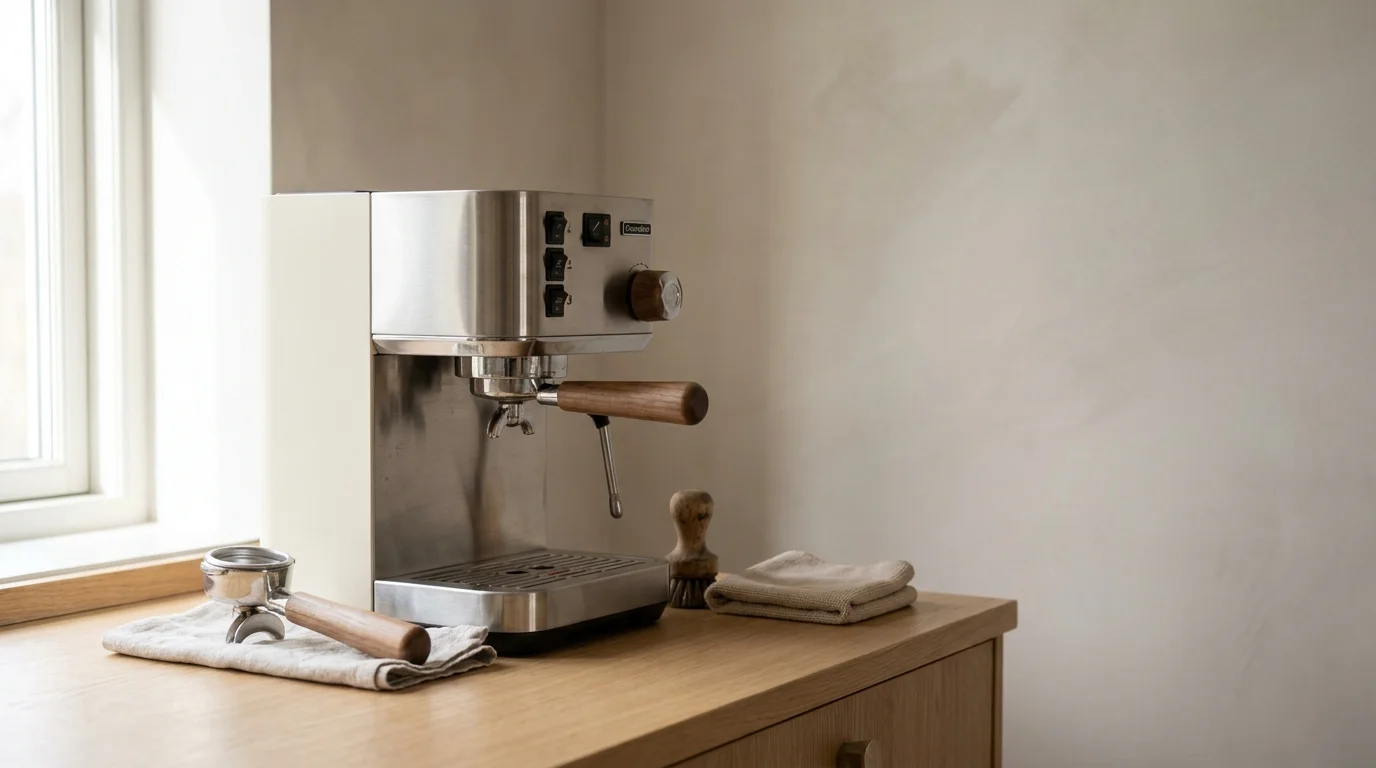
Most faults that look like a dying machine are a cleaning problem wearing a disguise; the five that actually occur are set out in Breville espresso machine problems.
A neglected espresso machine is one of the most common causes of bad espresso at home — and the most easily fixed. Coffee oils accumulate in the group head, portafilter, and basket between sessions, turning rancid and adding bitter, stale flavour to every shot. Mineral scale builds up in the boiler, reducing temperature accuracy and ultimately degrading extraction.
Cleaning an espresso machine is not one task — it is a schedule of tasks at different intervals. The daily tasks take two minutes. The weekly cycle takes ten. Monthly descaling takes thirty.
Daily purge prevents 90% of taste problems
flushing water through the group head before and after each session removes old coffee oils before they go rancid — the single most impactful daily habit for espresso quality[2]
Weekly backflush for machines with solenoid valves
backflushing with cleaning powder (Cafiza, Puly Caff, or Breville tablets) flushes coffee oils from the group head and three-way valve — only possible on machines with a solenoid valve, which includes most home semi-autos[1]
Scale drops water temperature below target
calcium deposits on the boiler insulate the heating element from the water, causing the machine to deliver espresso at lower than optimal temperature — under-extraction, flat and sour shots, even with perfectly dialled-in grind and dose[3]
The cleaning schedule
Daily tasks (2 minutes)
Before the first shot: Flush water through the group head for 5–10 seconds (press the brew button without a portafilter installed). This clears old water from the boiler and warms the group head[2].
After each shot: Remove the portafilter, knock the spent puck into the knock box, and immediately wipe the basket and portafilter with a dry cloth. Old coffee grounds begin to oxidise and go rancid within minutes if left in a hot portafilter. Flush water through the group head once more to clear the shower screen.
After using the steam wand: The steam wand must be purged and wiped immediately after each use. Milk left on or in the steam wand dries into a protein crust within minutes. To clean: turn the steam on briefly to purge any milk from inside the wand, then wipe the exterior immediately with a damp cloth. If milk has dried on the wand, soak a cloth in hot water and wrap it around the wand for a few minutes to soften the deposit before wiping.
At end of session: Empty the drip tray and wipe it dry.
Weekly tasks (10 minutes)
Backflush with cleaning powder: Backflushing forces water backwards through the group head and solenoid valve, removing accumulated coffee oils. Requires a blank (blind) basket — a portafilter basket with no holes, usually included with semi-automatic machines.
- Insert the blind basket into the portafilter.
- Add a small amount of espresso machine cleaning powder (Cafiza, Puly Caff, or the manufacturer's branded cleaning tablet — about ¼–½ teaspoon or one tablet).
- Lock the portafilter into the group head.
- Press the brew button for 10 seconds, then release.
- Repeat 4–5 times. You will see dark, oily water drain from the machine each cycle.
- Remove the powder, rinse the blind basket, and repeat 4–5 times with the blind basket and no powder (water-only flush).
- Remove the portafilter, reinstall your normal basket, and pull one or two shots to flush any residual cleaning agent[1].
Wipe the group head gasket: The rubber gasket seals the portafilter to the group head. It accumulates coffee residue that can cause the portafilter to stick or leak. Use a small brush (a dedicated group head brush or old toothbrush) and warm water to scrub the gasket and the groove it sits in.
Monthly tasks (30 minutes)
Descaling: Scale builds up in the boiler over time from mineral-bearing water. Most home espresso machines display an indicator when descaling is due.
Use a citric acid solution (1–2 tablespoons of citric acid powder dissolved in 1 litre of water) or the machine manufacturer's recommended descaling product. Do not use vinegar in espresso machines — it can damage seals and leave difficult-to-rinse residue.
Figure
Espresso machine cleaning: tasks by frequency
Values in times per year (approximate)
Breville-specific cleaning
Breville semi-automatic machines (Barista Express, Barista Pro, Barista Touch, Oracle, Infuser, and others) have two separate indicator lights:
"Clean Me" light: Indicates the brew head cleaning cycle is due. Use the cleaning disc (an orange silicone disc that acts as a blind basket, included with most Breville machines) and a Breville cleaning tablet or compatible cleaning powder. Insert the disc into the portafilter, add the tablet or ¼ teaspoon of powder, lock in, and follow the cleaning cycle described in your manual — on most models, this is a button-press sequence that runs an automated backflush cycle.
"Descale" light: Indicates mineral scale removal is needed. Use Breville's descaling sachets or a citric acid solution. Most Breville machines have a dedicated descale mode accessed through the settings or a button combination. Follow the machine manual for the exact entry sequence and cycle steps[3].
Do not ignore either light. Running an Breville with an active "Clean Me" light allows coffee oils to accumulate to a point where they affect solenoid valve function; running with an active "Descale" light can eventually cause scale to break free and block water paths.
Cleaning the portafilter and basket
Daily: Wipe with a dry cloth immediately after knocking out the puck. Do not leave the portafilter in the group head between sessions — the heat accelerates rancidification of residual oils.
Weekly: Soak the portafilter and basket in hot water with a small amount of cleaning powder for 20 minutes. Scrub with a brush, rinse thoroughly. The basket's small holes clog with fine coffee oil residue over time — a soak removes this more effectively than wiping alone.
Steam pitcher: After milk sessions, rinse the pitcher immediately with cold water (hot water sets milk protein). Wash with warm soapy water. A clean steam pitcher is essential for consistent microfoam.
What the routine needs
Nothing here is exotic: a basket with no holes, a detergent that dissolves coffee oil, and a descaler that is pre-measured so you cannot over-concentrate the acid against boiler seals. Match the backflush insert's diameter to your group head — 54mm on most Breville models, 58mm on commercial-size machines. What is actually in a descaler, and how often your water really needs one, is in coffee machine descaler.
 Backflush insertGLOGLOW 54mm Metal Backflush Insert Stainless Steel Blind Filter | Backflush Filter Basket Espresso, Coffee Machine Accessories for Sage8 SeriesA portafilter basket with no holes. Backflushing only works if the water has nowhere to go but back through the three-way solenoid valve, so this is the part that makes the weekly clean possible at all. Match the diameter to your machine — 54mm on most Breville models, 58mm on commercial-size group heads.amazon.com $6.38 USDamazon.ca $11.90 CADPrice and availability as of View on Amazon
 Cleaning tablets for the weekly backflushBreville BEC250 Espresso Machine Cleaning Tablets, 8 Pack | Safely and thoroughly remove coffee oils and residue with the cleaner designed for use with Breville modelsThe tablet the Breville cleaning cycle is designed around. Any espresso cleaning tablet dissolves coffee oils out of the group head and solenoid; this one is sized for Breville's own cycle, which is why the manual calls for it.amazon.com $11.98 USDamazon.ca $14.98 CADPrice and availability as of View on Amazon
 Bulk cleaning powderUrnex Espresso Machine Cleaning Powder - 566 grams - Cafiza Professional Espresso Machine CleanerThe same detergent commercial bars backflush with, in a quantity that lasts a home machine years. Cheaper per clean than tablets if you are backflushing weekly, and it is the powder most machine manuals name as an accepted alternative.amazon.com $19.59 USDamazon.ca $47.52 CADPrice and availability as of View on Amazon
 Descaling sachetsBreville BCC102 Espresso Machine Descaler, 12 pack | Prevent buildup with the descaler designed for use with Breville modelsDescaling is the one job on the maintenance list that is about temperature rather than taste residue: scale insulates the boiler, the water arrives cooler than the set point, and the shot under-extracts. Manufacturer sachets are pre-measured, which matters because over-concentrated acid attacks boiler seals.amazon.com $34.95 USDamazon.ca $44.99 CADPrice and availability as of View on Amazon
Product prices and availability are accurate as of the date/time indicated and are subject to change. Any price and availability information displayed on Amazon at the time of purchase will apply to the purchase of this product. Certain content that appears on this site comes from Amazon. This content is provided ‘as is’ and is subject to change or removal at any time.
If you are still choosing which Breville to buy rather than maintaining one, the models are mapped in Breville espresso machines compared.
The honest summary
Espresso machine cleaning has three levels: daily (flush the group head, wipe the portafilter, clean the steam wand immediately after use), weekly (backflush with cleaning powder using a blind basket), and monthly (descale the boiler with citric acid or manufacturer solution). On Breville machines, the "Clean Me" and "Descale" indicator lights signal when these tasks are due — treat them as minimums, not reminders to delay. Rancid coffee oils in the group head and mineral scale in the boiler are the two most common causes of espresso that tastes worse over time despite correct grind, dose, and extraction parameters.
Frequently asked questions
- How often should I clean my espresso machine?
- Daily: purge the group head, wipe the portafilter and basket, clean the steam wand after every use. Weekly: backflush with cleaning powder (if your machine supports it), wipe the group head gasket, empty and clean the drip tray. Monthly: full descale of the boiler and water system. Breville machines use indicator lights ('Clean Me' and 'Descale') to signal when these tasks are overdue — trust the lights as minimums, not targets.
- What is backflushing and how do I do it?
- Backflushing uses a blind basket (a portafilter basket with no holes) and cleaning powder (such as Cafiza or Puly Caff) to force water back through the group head and solenoid valve, flushing out coffee oils. It only works on machines with a three-way solenoid valve — most semi-automatic home espresso machines have one (including all Breville espresso machines). Insert the blind basket, add a small amount of cleaning powder (typically half a teaspoon), lock the portafilter into the group head, press the brew button for 10 seconds, release, and repeat 5 times. Finish with several flush cycles using the blind basket and water only.
- How do I clean the Breville espresso machine?
- Breville espresso machines have two cleaning indicators. The 'Clean Me' light indicates the brew head cleaning cycle is due — this is the backflush cycle performed with a cleaning disc (included with the machine) and cleaning tablet. Insert the cleaning disc into the portafilter, add one cleaning tablet, lock in, and follow the automated cleaning cycle (usually button-press sequence in the manual). The 'Descale' light indicates mineral scale removal is needed — use Breville's descaling sachets or a citric acid solution through the descale cycle in the settings menu.
- Can I use Cafiza to clean my Breville?
- Yes. Cafiza and Puly Caff are the two most widely used espresso machine cleaning powders and are compatible with Breville semi-automatic machines. For the weekly cleaning cycle, use the cleaning disc (blind basket) that came with your Breville, add a quarter to half teaspoon of Cafiza or the Breville cleaning tablet, and run the cleaning cycle. Cafiza is often more economical than Breville's branded tablets for weekly use.
- Does descaling really make a difference to espresso taste?
- Yes. Scale on the boiler walls reduces thermal efficiency, causing the machine to produce water that is cooler than the target temperature. Espresso brewed at below-optimal temperature (below approximately 90°C) is under-extracted — flat, sour, and lacking sweetness. Descaling restores accurate temperature control, which directly affects extraction quality. Most people notice improved taste within the first few shots after descaling a heavily scaled machine.
References
Every factual claim in this article is drawn from the sources below. See the source library for how we grade evidence.
- [1]Brewing FundamentalsCoffee Science Foundation · Reference work · Tier 2 · Moderate
- [2]SCA Cupping ProtocolsSpecialty Coffee Association · 2023 · Reference work · Tier 3 · Contextual
- [3]Brewing temperature and the sensory profile of drip brew coffeePMC / NIH · 2020 · Controlled trial · Tier 2 · Moderate
Related reading
- Barista SkillsDialing In Espresso: How to Adjust Your Shot→
- Barista SkillsHow to Steam and Froth Milk for Coffee→
- Brewing ScienceEspresso Machine Buying Guide: Choosing the Right Type→
- Brew MethodsMoka Pot Guide: How to Brew Stovetop Espresso at Home→
- Coffee EquipmentBreville Espresso Machine Problems: What Actually Goes Wrong→
- Coffee EquipmentFellow Espresso Series 1: Pressure Profiling at a New Price→