Breville Espresso Machine Problems: What Actually Goes Wrong
By Coffee Studies Editorial·Published October 17, 2026·6 min read
Quick answer
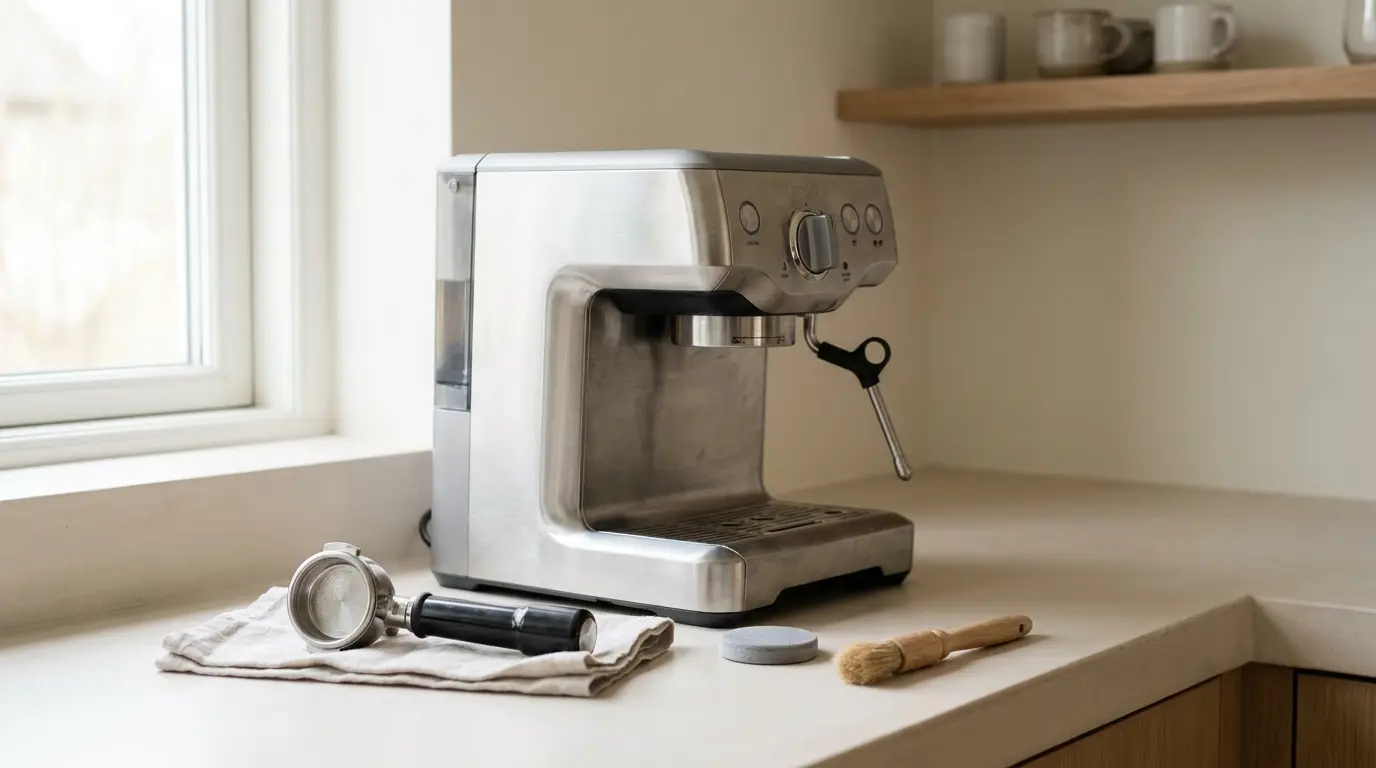
Breville machines fail in predictable ways, and most of the panic that sends people searching is caused by something that takes ten minutes and no tools. The machine being genuinely broken is further down the list than it feels at the time.
Here are the five faults that account for most of it, what causes each one, and the point where repair stops making sense.
1. No water, or weak flow
The most common fault and the most commonly misdiagnosed. The order to check is almost always the same.
Scale. Minerals from your water build up inside the heater and the narrow passages, and flow drops long before the machine stops. If you have not descaled on schedule, this is the answer, and the schedule depends on your water rather than on the calendar. The descaling process and what it actually removes is covered in coffee machine descaler.
A clogged shower screen. Coffee oils polymerise onto the screen above the puck and restrict the holes. It unscrews, soaks in cleaner and goes back. This is part of routine cleaning rather than a repair, and the full routine is in how to clean an espresso machine.
A tank that is not seated. There is a valve in the base of the water tank that only opens when it is pushed home. A tank sitting a few millimetres proud gives you exactly the symptoms of a dead pump.
A pump that has lost prime after running dry. Some models recover if you run the hot water function with a full tank; some need a technician.
Work the list in that order. People replace pumps that were never the problem.
2. The grinder spins but nothing comes out
On the models with a built-in grinder, this is the second most common complaint, and it is usually a feeding problem rather than a grinding one.
Dark, oily beans bridge across the opening at the bottom of the hopper. The motor runs, the burrs turn, and no coffee arrives because nothing is falling into them. Empty the hopper, clear the chute, and check the burrs for a compacted ring of old grounds. Grinder cleaning tablets will clear the oils that a brush cannot.
If the motor hums without turning, stop. That is a jam or a failed motor, and forcing it makes the repair worse.
One honest note about built-in grinders: they are sized to fit inside the machine rather than to perform, which is why a separate grinder at the same money grinds better and why, when either half fails, you lose both. That trade is discussed in how much to spend on a coffee grinder.
3. Water where it should not be
Identify the water before worrying about it.
Under the front is nearly always the drip tray being full, or the automatic purge after steaming putting water into a tray you have not emptied.
From the sides of the portafilter during the shot is a perished group gasket. It is a rubber ring, it is cheap, it is a consumable, and it is replaced rather than repaired. A gasket that has gone hard also makes the portafilter progressively harder to lock in, which is often the first sign.
Inside the body, or from the back is the only pattern worth treating as serious.
4. It will not heat
Most no-heat faults are a thermal cut-out doing exactly what it was fitted to do. Scale reduces flow through the heater, the heater runs hotter than it should, and the cut-out trips.
Descale, let the machine cool completely, and try again. If it trips repeatedly, the restriction that caused it has not been cleared. If the machine shows a specific error code, look that code up for your model before anything comes apart, because the codes are model-specific and some of them mean something innocuous.
5. The shots changed, so the machine must be broken
This one is almost never the machine.
A shot that ran well last week and gushes this week has changed because the coffee changed. Beans lose gas and moisture as they age, so the same grind setting runs faster on older coffee. Grind consistency governs extraction ahead of anything the machine contributes[2], and the machine's pressure is set by a valve that does not drift on its own[1].
Check in this order: grind finer, weigh the dose rather than eyeballing it, check the roast date, and look at the puck. A soupy puck means too little coffee for the basket, not a faulty machine. If the shot tastes wrong rather than running wrong, that is an extraction problem and the diagnosis lives in dialling in espresso, because temperature and extraction drive taste more than hardware does[3].
What the routine maintenance actually needs
 Cleaning tablets for the weekly backflushBreville BEC250 Espresso Machine Cleaning Tablets, 8 Pack | Safely and thoroughly remove coffee oils and residue with the cleaner designed for use with Breville modelsThe tablet the Breville cleaning cycle is designed around. Any espresso cleaning tablet dissolves coffee oils out of the group head and solenoid; this one is sized for Breville's own cycle, which is why the manual calls for it.amazon.com $11.98 USDamazon.ca $14.98 CADPrice and availability as of View on Amazon
 Descaling sachetsBreville BCC102 Espresso Machine Descaler, 12 pack | Prevent buildup with the descaler designed for use with Breville modelsDescaling is the one job on the maintenance list that is about temperature rather than taste residue: scale insulates the boiler, the water arrives cooler than the set point, and the shot under-extracts. Manufacturer sachets are pre-measured, which matters because over-concentrated acid attacks boiler seals.amazon.com $34.95 USDamazon.ca $44.99 CADPrice and availability as of View on Amazon
 Backflush insertGLOGLOW 54mm Metal Backflush Insert Stainless Steel Blind Filter | Backflush Filter Basket Espresso, Coffee Machine Accessories for Sage8 SeriesA portafilter basket with no holes. Backflushing only works if the water has nowhere to go but back through the three-way solenoid valve, so this is the part that makes the weekly clean possible at all. Match the diameter to your machine — 54mm on most Breville models, 58mm on commercial-size group heads.amazon.com $7.33 USDamazon.ca $11.90 CADPrice and availability as of View on Amazon
Product prices and availability are accurate as of the date/time indicated and are subject to change. Any price and availability information displayed on Amazon at the time of purchase will apply to the purchase of this product. Certain content that appears on this site comes from Amazon. This content is provided ‘as is’ and is subject to change or removal at any time.
When to stop repairing
Breville machines are appliances. They are well made appliances, but they are assembled rather than built from serviceable commercial parts, which is the real structural difference between them and a Gaggia Classic or a Rancilio Silvia, where gaskets, solenoids, elements and pumps are standard items a technician stocks.
Stop repairing when any of these is true:
- The quote approaches half the price of a new machine.
- The fault is inside a sealed thermoblock or pump assembly on a machine several years old.
- The grinder and the brew side have both begun to fail.
- You have descaled, cleaned the screen and replaced the gasket, and the symptom came back within months.
At that point the useful comparison is not repair against replacement with the same machine. It is repair against a machine whose parts can be replaced for a decade, which is the argument for stepping into a single boiler with commercial fittings, or into a heat exchanger if you have outgrown waiting between shot and steam.
Common misconceptions
"Descaling is optional if the water tastes fine." Scale is invisible until flow drops. Taste is not the indicator.
"The pump is dead." It is the least likely of the four causes of no flow and the most frequently blamed.
"A leak means the boiler is cracked." Nearly every leak on these machines is a tray or a gasket.
"The machine is inconsistent." The machine holds one pressure. The coffee and the grind are what changed.
What we have and have not checked
This page describes failure patterns common to Breville's espresso range and to thermoblock machines generally. It is deliberately not model-specific: error codes, part numbers, reset procedures and descaling intervals differ between models and between regions, and the manual for your exact model is the authority on all four. Nothing here should be treated as a repair instruction for a machine still under warranty, where opening it may void cover. The product cards show live prices for the consumables named.
The honest summary
Five faults cover most of it, and three of the five are maintenance rather than failure. Descale before suspecting the pump, clear the hopper before suspecting the grinder motor, and check the coffee before suspecting anything at all. When a real repair does arrive, judge it against the machine's design: an appliance with a sealed assembly at half the price of a new one is telling you to move to something built to be opened.
Frequently asked questions
- Why is no water coming out of my Breville espresso machine?
- In order of likelihood: scale restricting the water path, a shower screen clogged with old coffee oils, a tank that is not seated properly so the valve at its base stays shut, or a pump that has lost its prime after running dry. Work through them in that order. Descale first, then remove and clean the shower screen, then reseat the tank. A pump that is genuinely failing is the least common of the four and the only one that needs a technician.
- Why is my Breville grinder not grinding?
- Usually the beans are not reaching the burrs rather than the burrs failing. Oily dark-roast beans bridge over the opening and sit there while the motor runs, so you hear grinding and get nothing. Empty the hopper, clear the chute with the supplied brush or a chopstick, and check the burrs for a compacted layer of grounds. If it still will not feed, run a handful of grinder cleaning tablets through. A motor that hums without turning is a different and more serious fault.
- Why is my Breville espresso machine leaking water?
- Check what is actually wet before worrying. Water pooling under the front is almost always a full drip tray or condensation from the steam wand purge. Water escaping from the sides of the portafilter while the shot runs is a perished group gasket, which is a cheap part and a routine replacement. Water inside the machine body or under the rear is the only pattern that suggests something structural, and that is the one to take to a technician.
- Why does my Breville not heat up?
- Most no-heat faults are a thermal cut-out that has tripped to protect the machine, frequently after scale has reduced flow through the heater and let it run hot. Descaling the machine and letting it cool fully before switching on again resolves a good share of these. If it trips repeatedly, the underlying restriction has not been cleared. A machine that shows an error code should be checked against the manual for that model before anything is dismantled.
- My shots suddenly run too fast. Is the machine broken?
- Almost never. A shot that changes speed overnight is the grind, the dose or the coffee, in that order. Beans lose moisture and gas as they age, so the same grind setting runs faster on three-week-old coffee than on fresh. Grind finer, check your dose by weight rather than by eye, and see whether the puck looks soupy when you knock it out. Only if those are steady and the shot is still wrong should you look at the machine.
- When is a Breville not worth repairing?
- When the repair quote approaches half the price of the machine, when the fault is inside a sealed thermoblock or pump assembly on a machine that is several years old, or when the grinder and the brew side have both started failing. These machines are built as appliances rather than from serviceable commercial parts, which is the real difference between them and a Gaggia or a Rancilio. At that point the honest comparison is repair cost against a machine with replaceable parts.
References
Every factual claim in this article is drawn from the sources below. See the source library for how we grade evidence.
- [1]Influence of Water Pressure on the Final Quality of Arabica Espresso CoffeeJournal of Agricultural and Food Chemistry · 2002 · Controlled trial · Tier 2 · Moderate
- [2]Brewing FundamentalsCoffee Science Foundation · Reference work · Tier 2 · Moderate
- [3]Effects of brew strength, brew yield, and roast on the sensory quality of drip brewed coffeeJournal of Food Science · 2020 · Controlled trial · Tier 2 · Moderate
Related reading
- Coffee EquipmentHow to Clean an Espresso Machine: The Full Guide→
- Coffee EquipmentCoffee Machine Descaler: What It Is and What It Fixes→
- Coffee EquipmentBreville Espresso Machines Compared: What Actually Differs→
- Coffee EquipmentBreville Oracle Jet vs Oracle Touch: Fast Heater or Two Boilers→
- Coffee EquipmentDual Boiler vs Heat Exchanger: Which Espresso Machine Design Fits You→
- Coffee EquipmentHow Much to Spend on a Coffee Grinder→