Breville Oracle Jet vs Oracle Touch: Fast Heater or Two Boilers
By Coffee Studies Editorial·Published October 17, 2026·6 min read
Quick answer
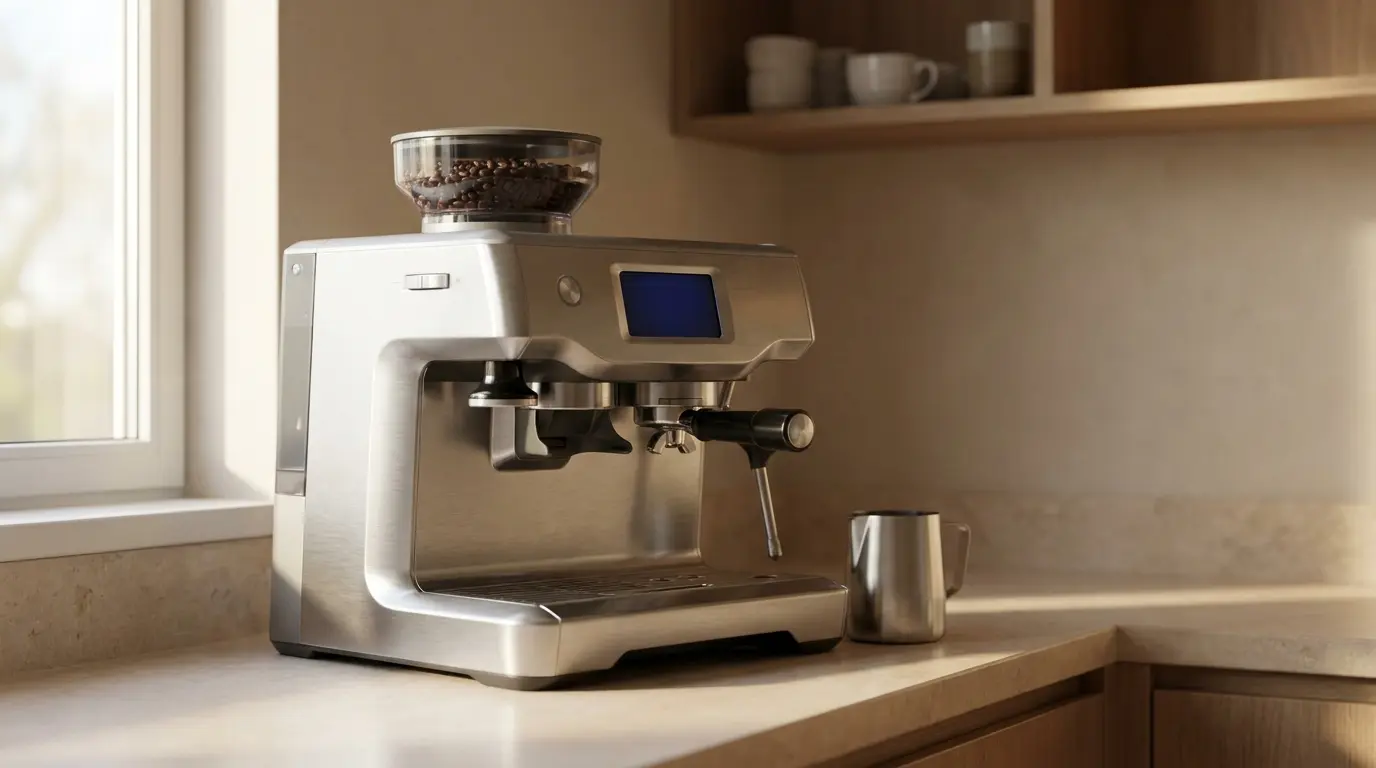
Breville sells two machines above the Barista line, and they are easy to confuse because they look alike, automate the same jobs and share a name. The Oracle Jet and the Oracle Touch both grind the beans, dose and tamp the puck, texture the milk and run it all from a touchscreen. What separates them is a single engineering decision, and it is the same decision that separates every espresso machine from every other: how to make hot water.
What both Oracles do
Start with what is shared, because it is most of the machine.
Integrated grinding and dosing. A conical burr grinder in the machine grinds directly into the portafilter and doses by weight or time to a target, so the amount of coffee in the basket is decided by the machine rather than by eye.
Automatic tamping. The machine tamps the puck with a set force. On a manual machine, inconsistent tamping is the most common reason a home shot runs fast and sour; both Oracles remove the variable.
Automatic milk. The steam wand textures milk to a selected temperature and texture and stops on its own, then purges. You can also steam manually if you want to learn.
A touchscreen that carries presets for the usual drinks and lets you adjust dose, temperature, and milk per drink.
A 54 mm portafilter. Smaller than the commercial 58 mm standard, which matters only if you want to use accessories made for cafe machines.
Everything above is the reason to buy an Oracle at all. If you do not want the machine to grind, tamp and texture for you, a simpler machine with a separate grinder will give you the same shot for less, because pressure at the puck and the grind govern extraction[1] and both Oracles aim at the same target there.
Oracle Touch: two boilers
The Touch is a dual boiler. One boiler holds brew water at brew temperature; a second holds steam at steam temperature. That is the architecture of a prosumer machine, and it brings the prosumer machine's two advantages: the brew temperature is held steady by its own controller, and the steam is always ready, so you can texture milk while the shot runs.
It also brings the prosumer machine's costs. Two boilers take several minutes to heat from cold, so the Touch is a machine you switch on before you need it or leave on a timer. It is heavier and dearer. And it has the long-standing limitation of any boiler machine: every drop of water passes through hot water, so it cannot brew cold.
Oracle Jet: heat on the way through
The Jet replaces both boilers with a fast on-demand heater, which heats water as it flows rather than holding a tank of it. Breville calls the system a thermojet; in general terms it is an evolved thermoblock.
The first consequence is the one you notice every morning: the Jet is ready in a few seconds from cold. There is no warm-up, no timer, no switching it on before the shower. The second is weight and cost; with no boilers, the machine is lighter and several hundred dollars cheaper than the Touch. The third is cold extraction. Because the heater can simply not heat, the Jet offers modes that pull shots and brew cups with cool water over a longer time, for iced espresso and cold brew styles, which a boiler machine cannot do.
The consequences in the other direction are the ones a dual boiler was invented to avoid. An on-demand heater steams milk from the same water path it brews with, so it textures after the shot rather than during it, and a little more slowly than steam drawn from a pressurised boiler. And water heated in transit is harder to hold at a perfectly steady temperature across a shot than water sitting in a controlled tank. Breville's control electronics narrow that gap a great deal, and for a single shot into a milk drink the difference is not something most people taste. It is a real difference in design nonetheless.
Which trade is yours
The decision is not about espresso quality. Both machines grind, dose and tamp to the same target and both deliver the pressure a shot needs; the grinder and the coffee decide more of the cup than either boiler system[2]. The decision is about your mornings.
You want it ready when you walk in. Jet. Seconds against minutes, every day, is the single biggest difference in living with these two machines.
You make one or two drinks. Jet. The sequence of shot then milk costs you half a minute and the machine cost you less.
You make three or four milk drinks in a row. Touch. Steaming while the next shot runs, with steam that never runs short, is what the second boiler is for.
You want iced drinks from the same machine. Jet. The cold modes are not available on a boiler machine.
You want the architecture of a prosumer machine with the automation of a Breville. Touch. It is the only Breville that is a true dual boiler with a grinder built in.
The Jet, and the dual-boiler Breville it replaces for most people
 Automated, on-demand heating, cold modesBreville BES985BSS Oracle Jet Espresso Machine, Brushed Stainless Steel | Automatically brew barista-quality lattes, cappuccinos and cold brew at home with this coffee maker with built-in grinderGrinds, doses, tamps and textures milk from a touchscreen, and is ready in seconds because it heats on demand rather than holding a boiler. The trade is steaming after the shot with a little less power. The only Breville with cold extraction modes.amazon.com $1,979.99 USDamazon.ca $2,999.99 CADPrice and availability as of View on Amazon
 Two boilers, no grinderBreville BES920XL Dual Boiler Espresso Machine, Brushed Stainless Steel | Pull barista-quality espresso shots, lattes and cappuccinos at home with this manual coffee maker with LCD displayThe structural change rather than a feature one: two separate boilers, so it brews and steams at the same time instead of switching between them. That matters when you are making several drinks in a row and not much otherwise. No grinder.amazon.com $1,599.95 USDamazon.ca $2,399.99 CADPrice and availability as of View on Amazon
Product prices and availability are accurate as of the date/time indicated and are subject to change. Any price and availability information displayed on Amazon at the time of purchase will apply to the purchase of this product. Certain content that appears on this site comes from Amazon. This content is provided ‘as is’ and is subject to change or removal at any time.
Where the Oracles sit in Breville's line
Breville's range is one machine with switches added. The Bambino has no grinder and manual milk; the Barista Express adds a grinder; the Impress assists the tamp; the Barista Pro swaps the warm-up for fast heating; the Barista Touch automates the milk. The Oracles switch everything to "the machine does it" and add automatic tamping and a better interface. The Jet is the fast-heating Oracle, the way the Barista Pro is the fast-heating Barista; the Touch is the dual-boiler Oracle. If you are weighing the Oracles against the rest of the line, the model-by-model comparison is in Breville espresso machines compared.
Common misconceptions
"The Jet is the newer Touch." It is a different design at a lower price, not a replacement. Breville sells both.
"On-demand heating is a downgrade." It is a trade. You give up steaming during the shot and a little steam power; you get seconds instead of minutes and cold modes.
"The Oracles make better espresso than the Barista machines." They automate more of the job and heat faster. The shot ceiling is set by grind and coffee on all of them.
"54 mm is a problem." Only if you want to use cafe accessories. For the machine's own baskets it is irrelevant.
What we have and have not checked
The heating systems, the automation features and the portafilter size are from the maker's published specifications. The behaviour of a dual boiler and of an on-demand heater is intrinsic to those designs and is set out in more detail in the boiler-design guide linked above. We have not bench-tested either machine, and statements about speed and steam power are the known characteristics of the designs rather than our own measurements. The product cards show live prices.
The honest summary
Two Oracles, one decision. Both grind, dose, tamp and texture for you. The Touch holds two boilers and gives you the prosumer workflow, steam during the shot and a steady temperature, after a warm-up and for more money. The Jet heats on demand and gives you a machine that is ready in seconds, costs less, and brews cold, in exchange for steaming after the shot. Count the drinks you make in a row and how long you are willing to wait for the first one; that answers it.
Frequently asked questions
- What is the difference between the Breville Oracle Jet and the Oracle Touch?
- The heating system, and what follows from it. The Oracle Touch has two boilers, one for brew water and one for steam, so it holds a set temperature and steams while the shot runs, but it takes several minutes to warm up and costs more. The Oracle Jet uses a fast on-demand heater instead, so it is ready in a few seconds, is lighter and cheaper, and adds cold extraction modes, but it steams after the shot rather than during it and with a little less power. Both grind, dose, tamp and texture milk automatically through a touchscreen.
- Is the Breville Oracle Jet a dual boiler?
- No. The Jet uses Breville's fast on-demand heating, which heats water as it passes rather than holding it in a boiler. That is why it is ready in seconds where the dual-boiler Oracle Touch needs minutes. The trade is that an on-demand heater steams milk a little more slowly and cannot steam during the shot. If a true dual boiler is the requirement, the Oracle Touch is the Breville that has one.
- Is the Oracle Jet worth it?
- For the person it is built for, yes: someone who wants a cafe-style milk drink with the grinding, tamping and milk handled by the machine, who wants it ready the moment they walk into the kitchen, and who is not making four drinks in a row. That person pays for automation and speed and gets both. Someone who drinks straight espresso and owns a grinder is paying for automation they will not use and would do better with a simpler machine and a better grinder.
- Does the Oracle Jet make better espresso than the Barista Touch?
- Not in a way the brew group explains. Shot quality is set by pressure at the puck, grind, dose and the coffee, and the automated grinding and tamping on both machines aim at the same target. What the Jet adds over the Barista line is faster heating, a larger and more capable interface, cold extraction modes, and more refined automation of dose and milk. You are paying for the machine doing more of the job, and doing it faster, rather than for a higher ceiling.
- What is cold extraction on the Oracle Jet?
- Modes that pull a shot, or brew a cup, with cold or unheated water over a longer time, for iced drinks and cold brew styles. A machine that holds a boiler at temperature cannot easily do this, because every drop passes through hot water; a machine that heats on demand can simply not heat. It is a genuine capability the on-demand design makes possible, and one the dual-boiler Oracle Touch does not offer.
- Which Breville Oracle should I buy?
- Count your mornings. One or two drinks, and you want them fast: the Oracle Jet, which is also the cheaper of the two and the one with cold modes. Several milk drinks back to back, or you want the temperature stability of a true dual boiler and do not mind a warm-up: the Oracle Touch. The espresso is the same class on both; the difference is in the waiting and the sequence.
References
Every factual claim in this article is drawn from the sources below. See the source library for how we grade evidence.
- [1]Influence of Water Pressure on the Final Quality of Arabica Espresso CoffeeJournal of Agricultural and Food Chemistry · 2002 · Controlled trial · Tier 2 · Moderate
- [2]Brewing FundamentalsCoffee Science Foundation · Reference work · Tier 2 · Moderate
Related reading
- Coffee EquipmentBreville Espresso Machines Compared: What Actually Differs→
- Coffee EquipmentDual Boiler vs Heat Exchanger: Which Espresso Machine Design Fits You→
- Brewing ScienceEspresso Machine Buying Guide: Choosing the Right Type→
- Coffee EquipmentCompact Espresso Machines: What Fits, and What You Give Up→
- Coffee EquipmentHow to Clean an Espresso Machine: The Full Guide→
- Coffee EquipmentCoffee Machine Descaler: What It Is and What It Fixes→