Compact Espresso Machines: What Fits, and What You Give Up
By Coffee Studies Editorial·Published October 17, 2026·7 min read
Quick answer
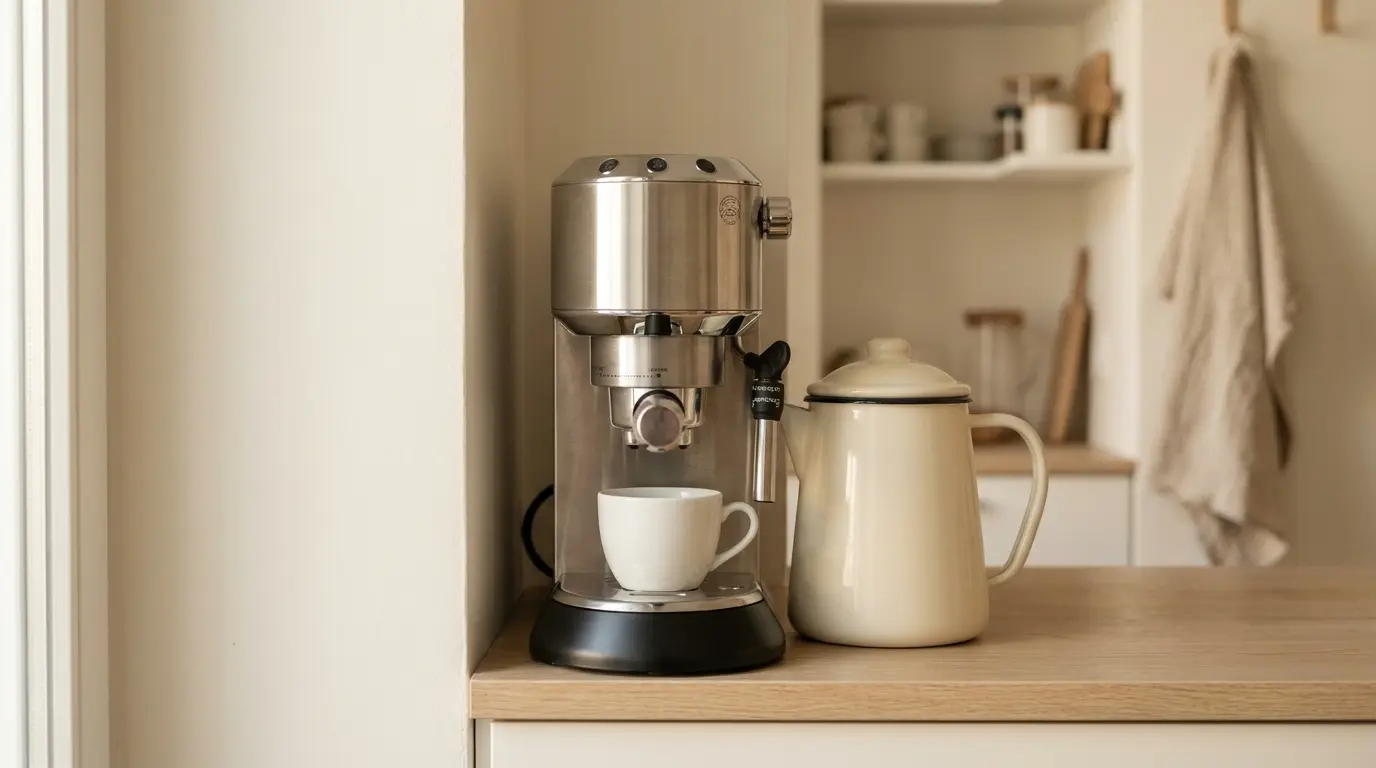
Most espresso machine advice ignores the counter. It compares boilers and pumps and grinders and assumes you have a clear metre of worktop to put the result on. A lot of people do not. They have a gap beside the kettle, a shelf under a cabinet, a galley kitchen, a rented apartment, an office corner. For them the first question is not which design is best but which design fits, and the width of a machine decides that more than anything on the spec sheet.
So this article is organised by width. Three sizes, three designs, and the honest trade each one makes for the space.
Why width decides the design
An espresso machine is mostly a water heater with a pump bolted on, and the kind of heater sets the minimum size. A thermoblock, which heats water as it passes through a hot metal block, can be very small. A single boiler, a tank of a few hundred millilitres with an element, needs a box around it. A heat exchanger needs a boiler of a litre and a half or more, and a dual boiler needs two tanks, so those machines start wide and get wider.
What the heater does not decide is the shot. Pressure at the puck governs extraction more than any other machine variable[1], and a small machine with a real pump delivers it as well as a large one. The grind matters more still[2], and it comes from the grinder, not the machine. So a compact machine chosen well does not make a lesser espresso. It makes the same espresso with a different workflow.
Under about 20 cm: the thermoblock machines
This is the narrowest class that still makes real espresso, and the Breville Bambino is the usual example. A 54 mm portafilter, a pump that delivers proper pressure, a steam wand, and a thermoblock that is ready in a few seconds, in a body not much wider than a large mug. It fits where nothing else does.
The trade is the heater. A thermoblock holds no hot water, so its temperature is harder to keep perfectly steady across a shot, and its steam is weaker and wetter than steam from a pressurised boiler. The Bambino textures milk, and the Plus version does it automatically, but it does so more slowly and only after the shot. For one person making one drink in a small kitchen, that is a trade most people are happy with. For milk drinks in a row, it is the reason to step up a size.
The Bambino and its siblings are covered model by model in Breville espresso machines compared.
Around 23 to 25 cm: the single-boiler workhorses
This is the sweet spot of compact espresso, because two of the best value machines ever made happen to be narrow.
Gaggia Classic Evo Pro. About 23 cm wide, with a commercial 58 mm group, a three-way solenoid, a stainless boiler and a real steam wand. It is a small commercial machine in a consumer price band and the lowest cost at which that sentence is true. It has no temperature control, so it either asks you to time the shot or to add a PID, and it steams after the shot. Everything about it is in Gaggia Classic Pro and Evo Pro.
Rancilio Silvia. A little under 24 cm wide, with a brass boiler roughly three times the Gaggia's size, a heavier frame and the same 58 mm commercial group. More thermal mass, stronger steam, and the same single-boiler sequence: brew, switch, wait, steam. Like the Gaggia it wants a PID. The Silvia and its dual-boiler sibling are compared in Rancilio Silvia vs Silvia Pro X.
The trade in this class is sequence. One boiler does one job at a time, so a milk drink involves a wait between the shot and the steam. What you get for it is a machine built from parts that will be serviced for decades and a shot with no ceiling below a prosumer machine. Both need a separate grinder, which is the next section.
Just above: the smallest dual boiler
The Rancilio Silvia Pro X is the machine that proves compact and serious are not opposites. It holds two boilers, a brew boiler and a steam boiler, each on its own controller, in a body only a few centimetres wider than the single-boiler Silvia. That means a set brew temperature that never drifts, steam that is always ready, and milk textured while the shot runs, in a footprint that the E61 machines it competes with cannot approach.
The trade is money; it costs roughly twice what the Silvia does. If the counter is tight and the mornings are busy, it is the only machine in this article that gives up nothing but the price.
The footprint nobody mentions: the grinder
Every machine above except the Bambino's grinder-equipped siblings needs a separate espresso grinder, and the grinder is often as wide as the machine. This is the hidden half of a compact setup.
It is not optional. The grind decides the shot ahead of anything the machine does[3], and espresso needs a burr grinder fine and consistent enough to make a basket resist nine bar for twenty-five seconds. A compact machine with a built-in grinder saves the width but spends it on a grinder sized to fit the cabinet rather than to do the job. If the counter truly cannot hold two boxes, a hand grinder takes almost no space and, at the same money, grinds better than most built-in units; it costs you a minute of turning per shot. The grinder tiers are laid out in how much to spend on a coffee grinder.
By the gap on your counter
Under 20 cm, one drink, speed matters. Breville Bambino. Add a hand grinder.
Around 23 cm, you want a real shot at the lowest price. Gaggia Classic Evo Pro. Add a grinder and, if you can, a PID.
Around 24 cm, you want more boiler and a heavier build. Rancilio Silvia. Same advice.
Around 25 cm, you want two boilers and no ritual. Rancilio Silvia Pro X. It is the ceiling of compact.
More than that. You are no longer shopping compact, and the heat exchangers open up; the design trade-offs are in dual boiler vs heat exchanger.
The compact machines, narrowest first
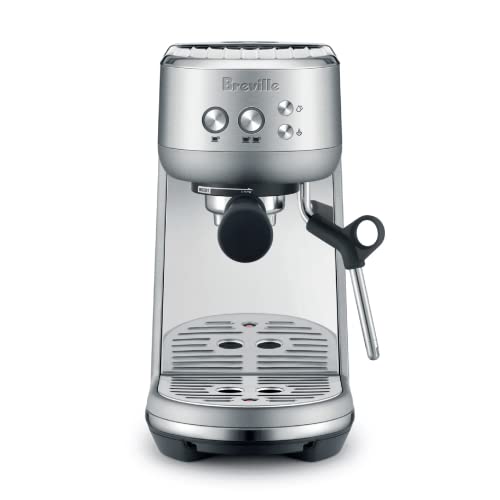 No grinder, manual steam wandBreville BES450BSS Bambino Espresso Machine, Brushed Stainless Steel | Make café-quality espresso, lattes and cappuccinos at home with this compact, manual coffee maker | Beginner-friendlyThe entry point, and the one that assumes you already own a grinder. Heats in a few seconds rather than minutes because it heats water on demand instead of keeping a boiler hot. You texture the milk yourself.amazon.com $299.95 USDamazon.ca $449.99 CADPrice and availability as of View on Amazon
 Single boiler, 58 mm, stainless boilerGaggia RI9380/51 Classic Evo Pro Espresso Machine, Industrial Grey, SmallA small commercial machine at a consumer price: a 58 mm group, a three-way solenoid and a real steam wand on a boiler. The Evo Pro ships at nine bar with a stainless boiler. No temperature control, so plan on timing the shot or adding a PID, and budget for a grinder.amazon.com $529.99 USDamazon.ca $733.15 CADPrice and availability as of View on Amazon
 Single boiler, large brass boilerRancilio Silvia Espresso Machine, Stainless SteelThe heavier single boiler: a 0.3 litre brass boiler, an iron frame and the same 58 mm commercial group, built from parts a technician will still be fitting in fifteen years. Wants a PID and steams after the shot, not during it.amazon.com $995.00 USDamazon.ca —Price and availability as of View on Amazon
 Dual boiler with PID, compactRancilio Silvia Pro X Espresso Machine, 1 liters, Stainless SteelTwo boilers on two controllers in a body only a little wider than the Silvia. Set temperature holds, steam is always ready, milk textures while the shot runs, and nothing needs adding. The smallest serious dual boiler made.amazon.com $2,195.00 USDamazon.ca $3,850.00 CADPrice and availability as of View on Amazon
Product prices and availability are accurate as of the date/time indicated and are subject to change. Any price and availability information displayed on Amazon at the time of purchase will apply to the purchase of this product. Certain content that appears on this site comes from Amazon. This content is provided ‘as is’ and is subject to change or removal at any time.
Common misconceptions
"Small machines make weaker espresso." Pressure comes from the pump and quality from the grind. A small machine with a real pump and a good grinder makes the same shot.
"Compact means a built-in grinder." It usually means the opposite: the compact machines worth owning leave the grinder outside, where it can be good.
"A thermoblock is a toy." The Bambino makes real espresso. Its limit is steam, not the shot.
"Dual boilers are big." Most are. The Silvia Pro X is the exception, and the reason to know it exists.
What we have and have not checked
Widths given are approximate and drawn from the makers' published dimensions; measure the actual gap and check the current specification for the exact finish you are buying, because revisions and colourways differ by a centimetre or two. The design characteristics of thermoblock, single-boiler and dual-boiler machines are intrinsic to those designs. We have not measured these machines ourselves. The product cards show live prices.
The honest summary
Width decides design, and design decides workflow, not shot quality. Under 20 cm you get a thermoblock and seconds to ready. Around 23 to 25 cm you get the two best-value single boilers ever made, which pull a commercial-grade shot and steam after it. Just above, one dual boiler fits where no other does. Measure the gap, choose the class, and leave room beside it for the grinder, because that is where the espresso is actually made.
Frequently asked questions
- What is the smallest espresso machine that makes real espresso?
- The smallest machines that deliver proper pressure at the puck are the thermoblock designs around 20 cm wide, with the Breville Bambino the usual example: a real 54 mm portafilter, nine bar from a pump, and a steam wand, in a body that fits almost anywhere. Below that size you are into capsule machines and hand-pumped devices, which are different categories. The Bambino's trade is that it heats on demand, so steam is weaker and it textures milk after the shot.
- Can a compact espresso machine steam milk properly?
- The boiler machines can. The Gaggia Classic Evo Pro and the Rancilio Silvia, both under 25 cm wide, have a real boiler under pressure and a commercial-style wand, and they texture milk the way a cafe machine does, one pitcher at a time, after the shot. Thermoblock machines steam too, but from a weaker and wetter source, and more slowly. If milk drinks are the point, the boiler machines are worth their extra centimetres.
- Do small espresso machines need a separate grinder?
- Almost all of the ones worth buying do, and that is the hidden footprint. The Gaggia, the Silvia, the Silvia Pro X and the Bambino have no grinder, so the grinder sits beside them and is often as wide as the machine. Compact machines with a built-in grinder exist, but the grinder inside is sized to fit rather than to perform, and grind is the variable that decides the shot. Plan the counter for two boxes, not one.
- Is there a compact dual boiler espresso machine?
- The Rancilio Silvia Pro X is the one most people mean. It holds two boilers, each with its own temperature controller, in a body only a little wider than the single-boiler Silvia, so it steams while the shot runs and holds temperature without a cooling flush in a space that most prosumer machines cannot match. It costs roughly twice what the Silvia does, which is the price of the second boiler.
- What is the best compact espresso machine?
- There is not one; there is a best one for each width. Under 20 cm, the Breville Bambino for speed and simplicity. Around 23 cm, the Gaggia Classic Evo Pro for a commercial-grade shot at the lowest price, or the Rancilio Silvia for a larger boiler and heavier build. Just above that, the Silvia Pro X if you want a dual boiler. Measure the gap on your counter first, then choose the design that fits it.
- How wide is a normal espresso machine?
- Prosumer heat-exchanger and dual-boiler machines with an E61 group typically run 30 cm or more wide and considerably deeper, because of the group projecting at the front and the boiler behind it. Breville's Barista machines with a built-in grinder are around 30 to 35 cm. Anything under about 25 cm is compact by comparison, and that is the range this article covers.
References
Every factual claim in this article is drawn from the sources below. See the source library for how we grade evidence.
- [1]Influence of Water Pressure on the Final Quality of Arabica Espresso CoffeeJournal of Agricultural and Food Chemistry · 2002 · Controlled trial · Tier 2 · Moderate
- [2]The effect of bean origin and temperature on grinding roasted coffeeScientific Reports · 2016 · Controlled trial · Tier 2 · Moderate
- [3]Brewing FundamentalsCoffee Science Foundation · Reference work · Tier 2 · Moderate
Related reading
- Brewing ScienceEspresso Machine Buying Guide: Choosing the Right Type→
- Coffee EquipmentGaggia Classic Pro and Evo Pro: What You Get for the Money→
- Coffee EquipmentRancilio Silvia vs Silvia Pro X: One Name, Two Different Machines→
- Coffee EquipmentDual Boiler vs Heat Exchanger: Which Espresso Machine Design Fits You→
- Coffee EquipmentBreville Espresso Machines Compared: What Actually Differs→
- Coffee EquipmentHow Much to Spend on a Coffee Grinder→