Gaggia Classic Pro and Evo Pro: What You Get for the Money
By Coffee Studies Editorial·Published October 17, 2026·7 min read
Quick answer
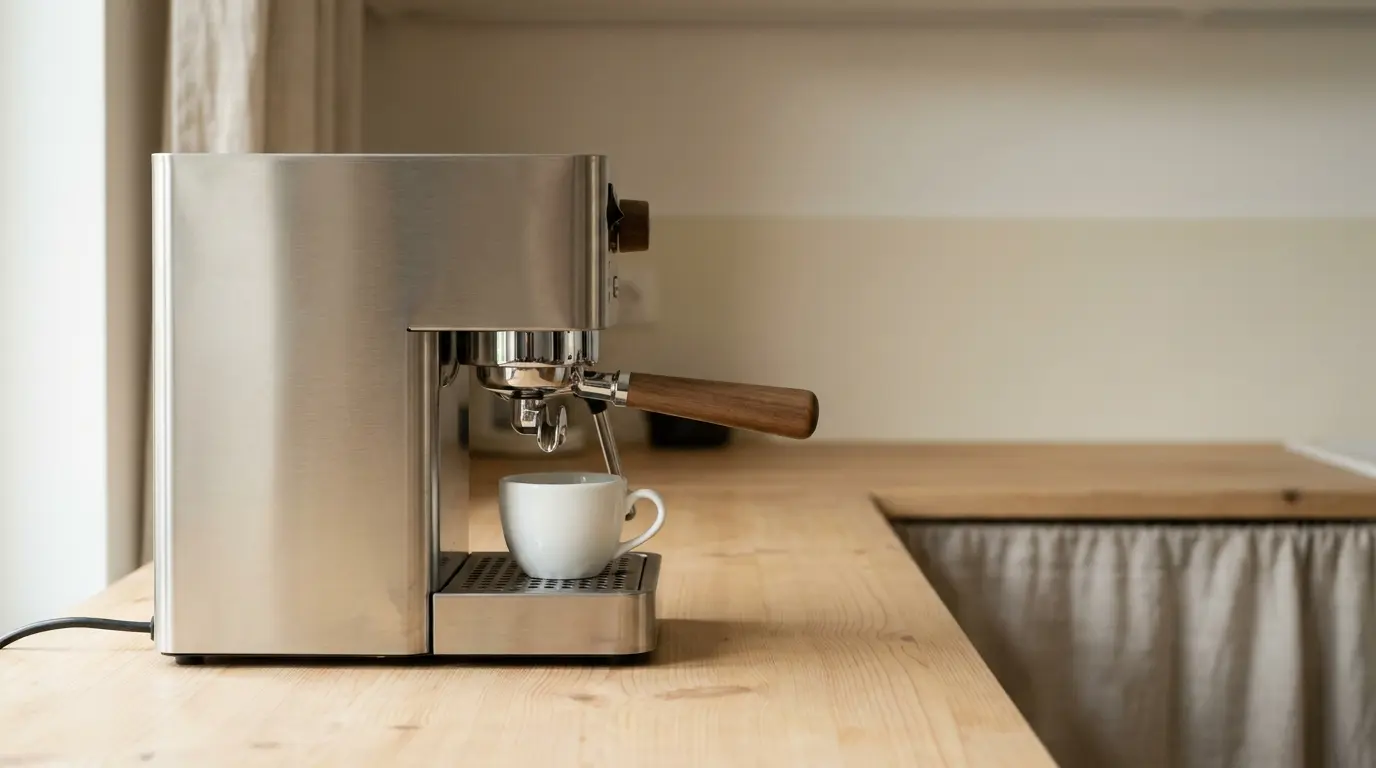
Most espresso machines under a thousand dollars are consumer appliances with an espresso function. The Gaggia Classic is the other thing: a small commercial machine, with a commercial machine's parts and a commercial machine's indifference to whether you know what you are doing. That is why it has been the recommended first serious machine for three decades, and why it is also the machine people abandon in a cupboard. Which of those it becomes depends on understanding what it is.
What the Classic actually is
Start with the parts that are not negotiable at this price and that the Classic has anyway.
A 58 mm group and portafilter. The commercial standard, which means every basket, tamper and bottomless portafilter made for cafe machines fits it. Cheaper machines use 51 or 54 mm, which locks you into a smaller accessory market and a smaller puck.
A three-way solenoid valve. When the shot ends, the valve vents pressure from the group so the puck comes out dry and the portafilter does not spit. Machines without one leave a wet, sucking puck and make backflushing impossible. This is the part that lets you clean the machine properly.
A real steam wand on a real boiler. Not a panarello sleeve that injects air for you, and not a thermoblock that wheezes. The boiler is small, but it holds pressure and the wand gives dry steam. You learn to texture milk on it the way you would in a cafe.
A pump that delivers pressure. Shot quality is governed by pressure at the puck more than by any other machine variable[1], and the Classic's vibratory pump delivers plenty. Too much, on the original Classic Pro, which is the first modification below.
What it does not have is anything electronic beyond two switches and a light. No display, no timer, no programmed doses, no temperature control. You turn it on, wait for the light, and pull.
Classic Pro versus Evo Pro
The Classic Pro arrived in 2019 as a return to the older design after an unloved detour. The Evo Pro, from 2022, is the same machine with three changes worth knowing.
Stainless steel boiler. The Classic Pro's boiler was aluminium. It worked, but aluminium and descaling agents are a poor combination over years, and some owners worried about it. The Evo Pro's boiler is stainless, which descales without concern and is the single biggest reason to prefer the newer one.
Nine bar from the factory. Espresso is pulled at around nine bar at the puck. The Classic Pro's over-pressure valve was set well above that out of the box, which produced harsh, fast shots until the owner fitted a lighter spring. The Evo Pro ships at roughly nine bar. If you buy an older Classic Pro, the spring is a ten-dollar part and a twenty-minute job; on the Evo Pro it is done.
A revised steam wand. The Evo Pro's wand is a commercial-style tube that is easier to position in the pitcher and easier to texture with. It is a quality-of-life change rather than a different result.
Everything else carries over: the frame, the group, the solenoid, the cup tray that warms a little, the two-litre reservoir, the compact footprint that fits under an upper cabinet. If you are choosing between them new, buy the Evo Pro. If you find a used Classic Pro at a good price, the spring brings it most of the way.
The thing it asks of you: temperature
A single boiler with a thermostat cycles between its set points. The element heats the water until the thermostat opens, then the water cools until it closes again, and the band between those two points is several degrees wide. Pull a shot the moment the light goes out and the water is at the top of the band; pull it a minute later and it is near the bottom. Over-hot water pulls bitterness forward and under-hot water leaves the shot sour and thin.
Owners deal with this one of two ways. Temperature surfing means learning the cycle: run a little water to trip the element, wait a counted number of seconds, then pull. It works and it costs nothing, and it is the reason the machine has a learning curve.
Fitting a PID replaces the thermostat with a controller that reads the boiler temperature continuously and pulses the element to hold a set point within about a degree. Kits are made for both versions, the installation is a known procedure with a dozen video guides, and a few retailers sell the machine with the PID already installed. This is the modification that changes what the Classic is. With a PID it stops being a machine you time and becomes a machine you trust, and the shot consistency rivals machines at three times the price.
If you are going to make one change, make this one.
The thing it will not fix: the grinder
Nothing on this page matters without an espresso grinder. Grind particle distribution governs extraction more than any machine variable[2], and espresso needs a grinder that is both fine enough and consistent enough to make a 58 mm basket resist nine bar for twenty-five seconds. Blade grinders cannot; most grinders sold for drip cannot; a pre-ground bag definitely cannot.
Budget between a third of the machine's price and the whole of it again for a grinder, and treat the two as one purchase. A Classic with a good grinder will outperform a machine costing twice as much with a built-in grinder set badly, because the grinder is where the espresso is made[3].
Who it is for, and who should skip it
Buy it if you want to learn espresso as a craft on a machine built from parts that can be replaced for decades, and you are willing to add a grinder and, ideally, a PID. It is the lowest price at which that sentence is true.
Skip it if you want a drink without a learning curve. The Breville Bambino and its siblings automate dosing, tamping or milk and will get a beginner to a drinkable cup faster, at the cost of the ceiling and the longevity. If you make several milk drinks in a row every morning, the single boiler's wait between shot and steam will wear on you, and a heat exchanger is the right design.
Upgrade from it when the ritual stops being charming: to the Rancilio Silvia Pro X if you want a dual boiler in the same footprint, or to a heat exchanger like the Rocket Appartamento if you want the cafe workflow.
The machine, and the next two rungs
 Single boiler, 58 mm, stainless boilerGaggia RI9380/51 Classic Evo Pro Espresso Machine, Industrial Grey, SmallA small commercial machine at a consumer price: a 58 mm group, a three-way solenoid and a real steam wand on a boiler. The Evo Pro ships at nine bar with a stainless boiler. No temperature control, so plan on timing the shot or adding a PID, and budget for a grinder.amazon.com $529.99 USDamazon.ca $733.15 CADPrice and availability as of View on Amazon
 Single boiler, large brass boilerRancilio Silvia Espresso Machine, Stainless SteelThe heavier single boiler: a 0.3 litre brass boiler, an iron frame and the same 58 mm commercial group, built from parts a technician will still be fitting in fifteen years. Wants a PID and steams after the shot, not during it.amazon.com $995.00 USDamazon.ca —Price and availability as of View on Amazon
 Dual boiler with PID, compactRancilio Silvia Pro X Espresso Machine, 1 liters, Stainless SteelTwo boilers on two controllers in a body only a little wider than the Silvia. Set temperature holds, steam is always ready, milk textures while the shot runs, and nothing needs adding. The smallest serious dual boiler made.amazon.com $2,195.00 USDamazon.ca $3,850.00 CADPrice and availability as of View on Amazon
Product prices and availability are accurate as of the date/time indicated and are subject to change. Any price and availability information displayed on Amazon at the time of purchase will apply to the purchase of this product. Certain content that appears on this site comes from Amazon. This content is provided ‘as is’ and is subject to change or removal at any time.
Common misconceptions
"It is a beginner's machine." It is a beginner's serious machine. Plenty of people with far more expensive options keep one because the parts are honest and the shot is real.
"It needs modding to work." It pulls a good shot out of the box, especially the Evo Pro. The PID is the one upgrade that changes the experience; the rest is preference.
"The small boiler means weak steam." The boiler is small but it is a boiler, under pressure, with a real wand. It steams a single pitcher well. What it cannot do is steam while brewing.
"Aluminium boilers are dangerous." The concern was descaling chemistry over years, not safety. The Evo Pro's stainless boiler ends the debate either way.
What we have and have not checked
The mechanical description, the differences between the Pro and Evo Pro, and the behaviour of a thermostat-controlled single boiler are drawn from the maker's published specifications and from the design itself, which has not changed in its essentials since 1991. We have not bench-tested either version. Prices on the product cards are live; the band given in the text is the usual market range, not a quote.
The honest summary
The Gaggia Classic Evo Pro is a small commercial espresso machine sold at a consumer price. It gives you a 58 mm group, a solenoid, a real steam wand and a pump that pulls nine bar, and it asks you to supply the grinder and to deal with a thermostat that wanders unless you fit a PID. Do both and you have a machine that will outlast several of the appliances sold against it. Do neither and it will sit in a cupboard. The machine is the same either way; what changes is whether you meet it halfway.
Frequently asked questions
- What is the difference between the Gaggia Classic Pro and the Classic Evo Pro?
- Three things. The Evo Pro has a stainless steel boiler where the Classic Pro's was aluminium, which matters for longevity and for descaling. The Evo Pro ships with its over-pressure valve set to about nine bar, where the Classic Pro shipped higher and most owners fitted a spring to bring it down. And the Evo Pro has a revised commercial-style steam wand. The frame, the 58 mm group, the three-way solenoid and the single-boiler design are the same machine.
- Does the Gaggia Classic Pro have a PID?
- No. Both the Classic Pro and the Evo Pro use a simple thermostat that cycles the heating element on and off across a band of several degrees, so the brew temperature depends on where in that cycle you pull the shot. Adding a PID controller is the most common modification to the machine and the one that changes it most; kits are made for it and the installation is well documented. Some retailers sell the machine with the PID already fitted.
- Is the Gaggia Classic Pro good for beginners?
- It is the classic beginner's serious machine, with one honesty attached: it does not hide anything from you. There is no auto-dosing, no assisted tamping, no milk automation, and the temperature wanders unless you learn to time it or fit a PID. If you want to learn espresso as a craft, that transparency is the point. If you want a drink in the morning with no learning curve, a machine that automates more will suit you better.
- Can the Gaggia Classic Pro steam milk?
- Yes, and better than most machines at its price, because it has a real steam wand on a boiler rather than a panarello on a thermoblock. It is a single boiler, so you steam after the shot, not during it, and you wait for the boiler to climb to steam temperature first and to fall back before the next shot. The Evo Pro's wand is easier to texture with than the earlier one.
- What grinder do I need for a Gaggia Classic Pro?
- An espresso-capable burr grinder, which means fine enough and consistent enough to choke a 58 mm basket at nine bar. That rules out blade grinders and most grinders sold for drip coffee. Expect to spend between a third and the whole price of the machine again on the grinder; it is not an accessory, it is half the setup.
- How long does a Gaggia Classic last?
- The design has been in production in one form or another since 1991, and machines from the 1990s are still in service, because almost everything in it is a replaceable commercial part: solenoid, element, gaskets, pump, boiler. The Evo Pro's stainless boiler removes the one component on earlier versions that could corrode. Treat it like a small commercial machine, backflush it and descale it, and it is a machine you repair rather than replace.
References
Every factual claim in this article is drawn from the sources below. See the source library for how we grade evidence.
- [1]Influence of Water Pressure on the Final Quality of Arabica Espresso CoffeeJournal of Agricultural and Food Chemistry · 2002 · Controlled trial · Tier 2 · Moderate
- [2]The effect of bean origin and temperature on grinding roasted coffeeScientific Reports · 2016 · Controlled trial · Tier 2 · Moderate
- [3]Brewing FundamentalsCoffee Science Foundation · Reference work · Tier 2 · Moderate
Related reading
- Brewing ScienceEspresso Machine Buying Guide: Choosing the Right Type→
- Coffee EquipmentRancilio Silvia vs Silvia Pro X: One Name, Two Different Machines→
- Coffee EquipmentDual Boiler vs Heat Exchanger: Which Espresso Machine Design Fits You→
- Coffee EquipmentCompact Espresso Machines: What Fits, and What You Give Up→
- Coffee EquipmentHow Much to Spend on a Coffee Grinder→
- Coffee EquipmentHow to Clean an Espresso Machine: The Full Guide→