La Pavoni Europiccola: What a Lever Machine Actually Asks of You
By Coffee Studies Editorial·Published October 17, 2026·6 min read
Quick answer
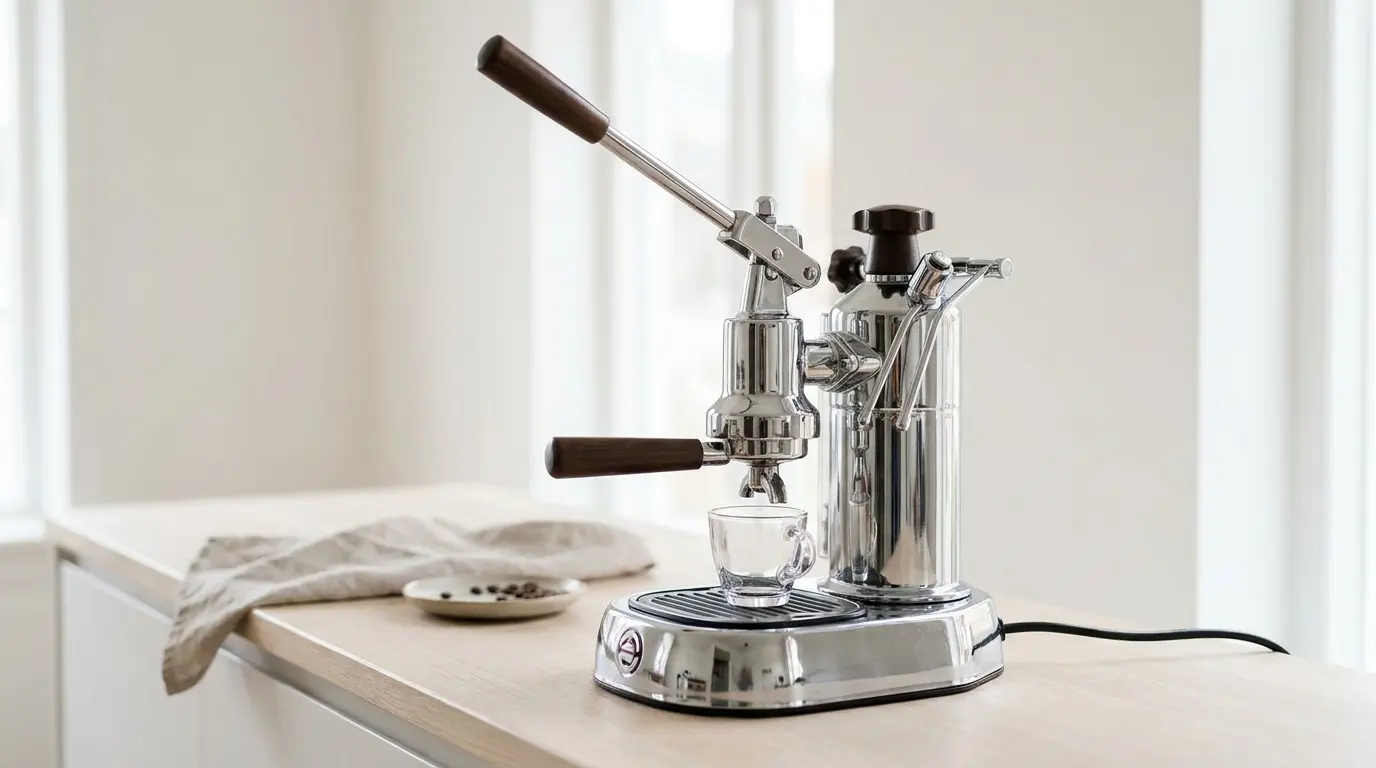
Almost every espresso machine sold today hides the pressure from you. A pump holds roughly nine bar whether you deserve it or not, and your job is to get the grind and dose into the range where that pressure makes sense. The La Pavoni Europiccola does not do this. It has no pump. The pressure is your arm, applied through a lever, and you feel the extraction resist you as it happens.
That one difference explains everything else about the machine, including why people love it and why plenty of people sell it.
What is actually in the box
A brass boiler, a heating element, a lever group bolted to the top of that boiler, a piston inside the group, a portafilter, and a steam wand. On the Europiccola there is a sight glass to show the water level. On the Professional there is a pressure gauge as well. There is no pump, no electronics beyond a thermostat and a switch, and no three-way valve, which means the puck stays wet after the shot and you knock out a slurry rather than a dry disc.
You fill the boiler by hand, switch it on, and wait for it to come up to pressure. Then you raise the lever, which lets hot water into the chamber above the coffee and soaks it at low pressure. Then you pull the lever down, the piston descends, and the shot runs.
Why the lever changes the shot
Pressure at the puck is the machine variable that governs extraction more than any other[1]. On a pump machine that pressure is a flat line at whatever the valve is set to. On a lever it is a curve you draw: a gentle soak, a rising ramp as you push, a peak, and a natural decline as the spring-free piston runs out of travel and your arm tires.
That declining curve is the thing lever owners talk about. A shot that starts gently, peaks, and tails off tends to pull sweetness forward and leave harsher compounds behind, and modern pump machines with flow control hardware are, in effect, trying to recreate by machine what a lever does by physics. On the La Pavoni you get it for free, and you get it slightly differently every time, because your arm is not a servo.
The flip side is that every error is yours. Too fine a grind and the lever will not move. Too coarse and it drops through your hand in eight seconds. Grind consistency drives extraction ahead of anything else in the setup[2], and on a lever that is not a gentle preference, it is a wall.
The heat problem nobody mentions in the listing
The group is bolted directly to the boiler, and there is no temperature control anywhere in the machine. When it first reaches pressure, the group is cooler than the water. Twenty minutes later the group has soaked up boiler heat and is hotter than the water should be, and over-hot brew water pulls bitterness forward[3].
So a La Pavoni has a window. Most owners learn to come up to pressure, pull their drinks in a focused ten or fifteen minutes, and switch off. Those who use it for longer sessions cool the group with a short flush between shots, or stick a temperature strip on the group so they can see what it is doing rather than guess. None of this is difficult. All of it is attention the machine demands and a Breville does not.
Europiccola or Professional
The two models share the lever group, the piston, the process and the learning curve. They differ in two ways.
Boiler size. The Europiccola holds roughly eight cups of water, the Professional sixteen. More water means more thermal mass, so the Professional holds its temperature better through several drinks and needs refilling less often. It also takes longer to heat from cold.
Instrumentation. The Professional adds a pressure gauge. On the Europiccola you judge readiness by the sight glass and by experience. The gauge does not control anything; it tells you what the boiler is doing, which on a machine with no PID is genuinely useful information.
If you make one or two drinks at a time, the Europiccola is the simpler and cheaper machine and there is no quality penalty. If you make several in a row or you want to read the boiler rather than infer it, the Professional earns its premium.
The two lever machines
 Manual lever, 8-cup boilerLa Pavoni EPC-8 Europiccola Lever Style Espresso Machine – Chrome & Silver – Manual Espresso Maker - 0.8 L Water Capacity, Authentic Italian Craftsmanship for Home UseNo pump: the pressure that pulls the shot is your arm through the lever, so you draw the pressure curve yourself and feel the extraction resist. The smaller of the two boilers, with a sight glass rather than a gauge. Expect a learning period and budget for a serious grinder.amazon.com $551.94 USDamazon.ca $1,225.06 CADPrice and availability as of View on Amazon
 Manual lever, 16-cup boiler with gaugeLa Pavoni PC-16 Professional Espresso Machine - 16-Cup Capacity Lever Espresso Maker - Chrome Finish- Solid Brass 38oz Boiler - Dual Frothing Systems & Mounted Pressure Gauge - Made in ItalyThe same lever group and the same manual process with roughly twice the water and a pressure gauge, so it holds temperature better through several drinks and tells you what the boiler is doing instead of leaving you to infer it. Slower from cold.amazon.com $716.09 USDamazon.ca $1,605.84 CADPrice and availability as of View on Amazon
Product prices and availability are accurate as of the date/time indicated and are subject to change. Any price and availability information displayed on Amazon at the time of purchase will apply to the purchase of this product. Certain content that appears on this site comes from Amazon. This content is provided ‘as is’ and is subject to change or removal at any time.
Who should buy one
Buy it if the making is the point. A lever machine is the only kind where you are physically in the extraction, and people who like it tend to describe it as the difference between driving and being driven. It is also small, beautiful in a way few appliances are, has no pump to fail, and is rebuildable with hand tools for decades.
Do not buy it as your only machine if mornings are rushed, if more than one person in the house needs to operate it, or if you want a consistent drink without a learning period. A Gaggia Classic Evo Pro costs about the same, asks far less of you, and will make a more repeatable shot in week one.
Buy it second if you already have a pump machine and want to learn what pressure actually does. That is how a lot of these end up on counters, and it is the use that disappoints people least.
Common misconceptions
"A lever machine is primitive." It is simple, which is not the same thing. The pressure profile it produces by accident is what expensive modern machines add hardware to achieve on purpose.
"No pump means low pressure." A determined pull reaches and exceeds normal brewing pressure easily. The issue is never reaching pressure, it is controlling it.
"It is a beginner machine because it is cheap." It is among the hardest machines to pull a good shot on. Price and difficulty are not related here.
"You can leave it on all day like a cafe machine." You can, but the group will climb well past useful brew temperature. These are session machines.
What we have and have not checked
The mechanical description, the boiler capacities and the difference between the Europiccola and the Professional come from the maker's published specifications and from a design that has changed little since the 1960s. The thermal behaviour described is intrinsic to a group bolted to an uncontrolled boiler. We have not bench-tested either model, and the temperature behaviour will vary with the room, the model year and how long the machine has been on. The product cards show live prices.
The honest summary
The La Pavoni Europiccola is a brass boiler with a lever on top and nothing between you and the coffee. It gives you a declining pressure curve that costs thousands to buy in a modern machine, and in exchange it asks for a good grinder, a short attention span for heat, and a tolerance for bad shots while you learn. The Professional is the same machine with more water and a gauge. Choose one because you want to pull espresso, not because you want to drink it on a schedule.
Frequently asked questions
- How does a lever espresso machine work?
- Raising the lever opens a valve and lets hot water from the boiler fill the chamber above the coffee, wetting the puck at low pressure. Pulling the lever down drives a piston into that chamber, and the force you apply through the lever is the brewing pressure. There is no pump and no motor in the brew path, so the pressure curve across the shot is whatever your arm does, which is why two people can pull noticeably different shots from the same machine and the same coffee.
- What is the difference between the La Pavoni Europiccola and the Professional?
- Boiler size and instrumentation, mainly. The Europiccola holds roughly eight cups of water; the Professional holds about sixteen and adds a pressure gauge so you can read the boiler rather than judge it. Both use the same lever group and the same manual process. The Professional's larger boiler holds heat more steadily through a run of drinks and takes longer to come up from cold. For one or two drinks at a time the Europiccola is the simpler machine.
- Is the La Pavoni hard to use?
- It is the least forgiving machine in common use, and that is the point of it. There is no pump holding pressure steady, no PID holding temperature, and no pressure release valve drying the puck, so grind, dose, tamp, boiler temperature and your own pull all land in the cup together. Most owners describe a few weeks of bad shots before it clicks. If you want a reliable drink on a weekday morning without thinking, this is the wrong machine.
- Does the La Pavoni overheat?
- The group is heated by the boiler it is bolted to, and on a small boiler with no temperature control the group keeps climbing the longer the machine is on. Pull shots soon after it comes up to pressure and the temperature is in range; leave it idling for half an hour and the water arriving at the coffee is too hot, which pushes the shot bitter. Owners manage this by timing their session, cooling the group with a short flush, or fitting a temperature strip to read it.
- What grinder do you need for a La Pavoni?
- A good espresso grinder, and arguably a better one than the machine costs. Because there is no pump forcing a fixed pressure, an uneven or wrongly sized grind shows up immediately as a shot that either gushes or will not move at all. Grind consistency drives extraction more than any part of the machine, so budget for a proper burr grinder before you budget for a nicer lever.
- How long does a La Pavoni last?
- The design dates to the 1960s and the parts reflect that: a brass boiler, a brass group, a piston, gaskets and a heating element, nearly all of which are still sold and swapped by owners at home. Machines from the 1970s are in daily use. Seals are the usual wear item and are replaced as routine maintenance rather than as a repair. It is a machine you rebuild, not one you replace.
References
Every factual claim in this article is drawn from the sources below. See the source library for how we grade evidence.
- [1]Influence of Water Pressure on the Final Quality of Arabica Espresso CoffeeJournal of Agricultural and Food Chemistry · 2002 · Controlled trial · Tier 2 · Moderate
- [2]Brewing FundamentalsCoffee Science Foundation · Reference work · Tier 2 · Moderate
- [3]Effects of brew strength, brew yield, and roast on the sensory quality of drip brewed coffeeJournal of Food Science · 2020 · Controlled trial · Tier 2 · Moderate
Related reading
- Brewing ScienceEspresso Machine Buying Guide: Choosing the Right Type→
- Coffee EquipmentGaggia Classic Pro and Evo Pro: What You Get for the Money→
- Coffee EquipmentDual Boiler vs Heat Exchanger: Which Espresso Machine Design Fits You→
- Coffee EquipmentCompact Espresso Machines: What Fits, and What You Give Up→
- Coffee EquipmentHow Much to Spend on a Coffee Grinder→
- Coffee EquipmentHow to Clean an Espresso Machine: The Full Guide→