How Much to Spend on a Coffee Grinder
By Coffee Studies Editorial·Published October 11, 2026·5 min read
Quick answer
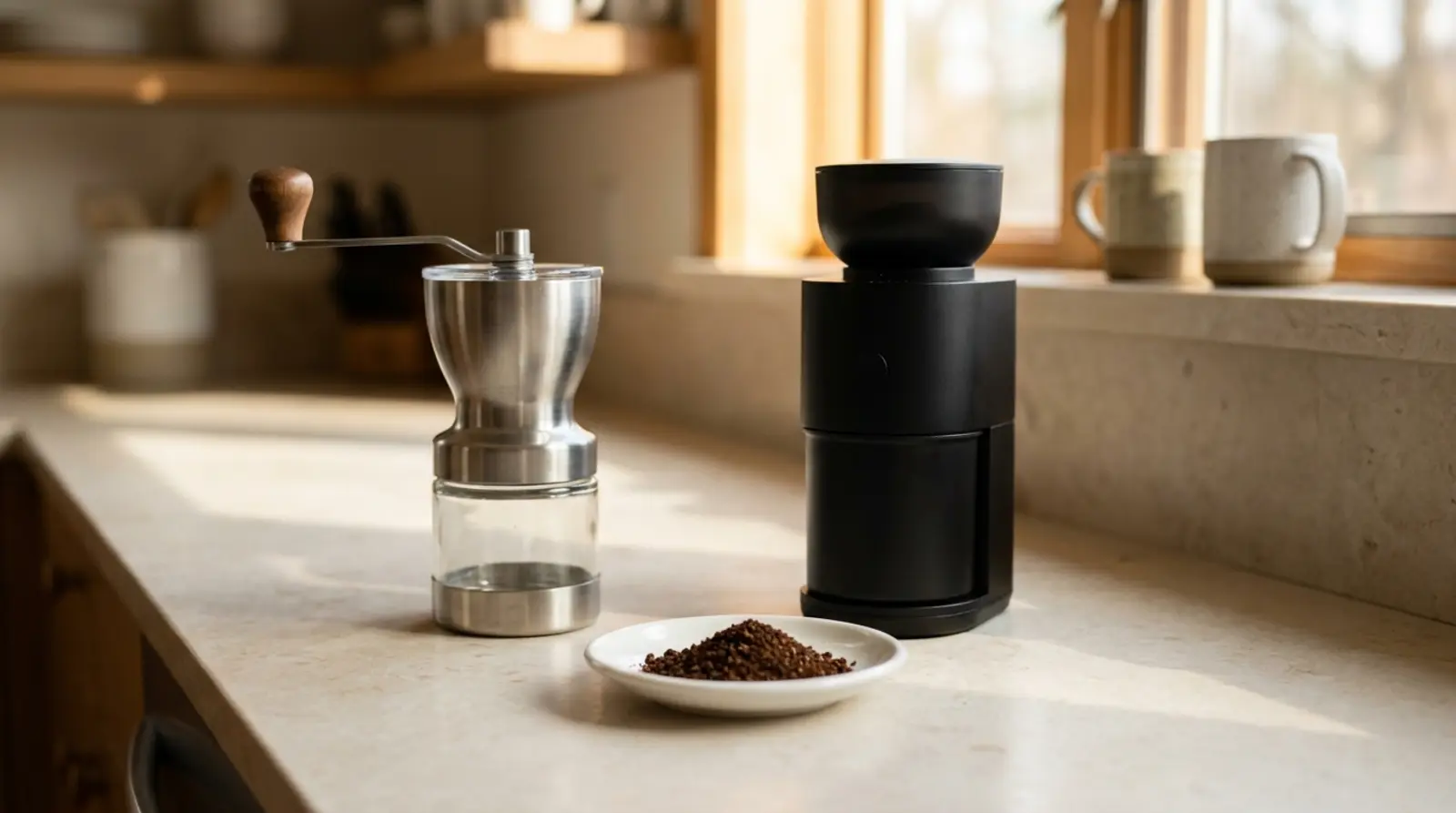
Most people buy the brewer first and the grinder second, with whatever is left. That is backwards, and it is the single most common reason a careful setup makes disappointing coffee.
Sensory quality in filter coffee tracks extraction more closely than it tracks any individual piece of hardware[2], and extraction is governed primarily by particle size and contact time[3]. The grinder is the only device in the chain that sets particle size. Everything else works with what the grinder hands it.
The three jumps that matter
Grinder prices run continuously from about twenty dollars to several thousand, but the improvement is not continuous. There are three steps, and most of the money between them buys refinement rather than transformation.
Jump one: blades to burrs
A blade grinder does not grind. It chops, repeatedly, producing a wide spread of particle sizes at once — boulders and dust in the same dose. The dust over-extracts and tastes bitter and drying; the boulders under-extract and taste sour and thin. Both end up in the same cup, which is why blade-ground coffee often reads as simultaneously harsh and weak.
Burrs crush beans between two surfaces at a set distance, so output clusters around a target size. The distribution is still not perfect — grinding is affected by bean origin, roast and even bean temperature[1] — but it is in a different class.
This is the largest single improvement available to almost any coffee setup, and the full mechanism is in burr vs blade.
Jump two: disposable to serviceable
Somewhere around the entry-electric tier, a grinder stops being an appliance you replace and becomes one you maintain. What changes:
- Stepped adjustment with enough range to move between French press and pour-over meaningfully.
- Burr alignment held well enough to be consistent dose to dose.
- Listed spare parts. This is the underrated one. Burrs outlast everything; gearboxes, motors and hoppers fail. A grinder whose wear parts are available is repairable for a decade, and one whose are not is landfill when a plastic gear strips.
The grind improvement across this jump is real but far smaller than jump one. What you are mostly buying is that it keeps doing it.
Jump three: espresso capability
Espresso needs fineness most filter grinders cannot reach, and adjustment steps small enough to dial in. Because water is forced through the puck under pressure, a small change in particle size produces a large change in flow rate — so a grinder with steps sized for filter will jump straight past the setting you want.
This jump only matters if you pull shots. For filter alone it is range you will never use.
The tiers, and what each actually buys
Hand grinders, roughly $25–100. Real conical burrs for the price of a blade grinder, because there is no motor or gearbox eating the budget. Dollar for dollar the best grind available at the bottom of the market. The cost is effort: a minute or so of cranking per couple of cups, which is fine for one or two and tiresome for a batch or a daily espresso routine.
Entry electric, roughly $100–250. The practical default for filter coffee at home. Conical burrs, enough adjustment range, and — in the ones worth owning — a published parts list. This is where most people should stop unless they are making espresso.
Espresso-capable, roughly $200–450. Finer range, smaller steps, often a chassis shared with the tier below. Worth it when you pull shots, wasted otherwise.
Serious home, roughly $400–700. Larger burrs, better alignment, less retention between doses, quieter. Genuinely better and genuinely incremental — this is refinement, not transformation.
Enthusiast and prosumer, $700 and up. Single-dosing designs, very low retention, flat burrs of 64mm and above. Aimed at people for whom the last few percent is the hobby.
The two jumps most people should make
 Manual burr grinderCEVING Mini Manual Coffee Grinder With 40 Adjustable Settings, BlackA hand grinder gets you real burrs for the price of a blade grinder, with the trade that you turn the handle. For one or two cups a day the time cost is under a minute and the particle distribution is in a different class from a blade.amazon.com $17.99 USDamazon.ca $29.99 CADPrice and availability as of View on Amazon
 Entry-level conical burr grinderBaratza Encore Coffee Grinder ZCG485BLK, BlackThe usual answer to "the cheapest grinder worth owning" for filter coffee. Conical burrs, forty steps, and — the part that matters over years — every wear part is a listed spare, so it is repairable rather than disposable.amazon.com $149.95 USDamazon.ca $199.00 CADPrice and availability as of View on Amazon
 Espresso-capable version of the EncoreBaratza Encore ESP Coffee Grinder ZCG495WHT, WhiteSame chassis as the Encore with a burr set and a gearbox that reach espresso fineness, which the standard Encore cannot. Buy it only if you actually pull shots: for filter alone it is paying extra for a range you will never use.amazon.com $199.95 USDamazon.ca $299.99 CADPrice and availability as of View on Amazon
Product prices and availability are accurate as of the date/time indicated and are subject to change. Any price and availability information displayed on Amazon at the time of purchase will apply to the purchase of this product. Certain content that appears on this site comes from Amazon. This content is provided ‘as is’ and is subject to change or removal at any time.
Flat burrs, conical burrs, and the discussion around them
Flat burrs grind between two parallel rings; conical burrs between a cone and a ring. Flat tends toward a narrower particle distribution and is favoured where espresso clarity is the goal; conical is more common at home prices, retains less coffee between doses and runs cooler at low speed.
At any given price, build quality, burr alignment and burr sharpness do far more than geometry. A well-aligned conical grinder will beat a poorly aligned flat one at the same money, and the difference between two good grinders of different geometry is smaller than the internet's interest in the question implies.
Ceramic versus steel is similarly oversold: ceramic burrs last longer and are more brittle, steel burrs cut faster and dull sooner, and both are fine.
Where the money is best spent
If you are building a setup from nothing and have a fixed budget, the order that produces the best cup is:
- A burr grinder, even a hand one.
- A scale, because dose and ratio are free accuracy.
- Fresh coffee, bought in amounts you will finish.
- A brewer. An inexpensive dripper fed by a good grinder beats the reverse every time[4].
Grinding fresh matters for the same reason: ground coffee stales far faster than whole beans, which is covered in storing coffee beans.
Common misconceptions
"The grinder matters less than the machine." It sets particle size, which sets extraction. Nothing downstream can undo a bad distribution.
"Expensive grinders make stronger coffee." They make more consistent coffee. Strength is dose and ratio.
"A built-in grinder saves money." It puts the grinder inside an appliance budget, so it is usually the weakest part of both.
"Hand grinders are a compromise." At the bottom of the market they are the better grind, with effort as the price.
The honest summary
Three jumps: blades to burrs, disposable to serviceable, and filter to espresso-capable. The first is enormous and cheap, the second is modest and worth it, the third only applies if you pull shots. Between those steps, price buys refinement — tighter distribution, less retention, less noise — not transformation. Buy the grinder before the brewer, favour one with listed spare parts over one with a better spec sheet, and spend what is left on coffee you will finish while it is fresh.
Frequently asked questions
- How much should I spend on a coffee grinder?
- More than you plan to, and more than you spend on the brewer. The single biggest improvement available to most setups is moving from a blade grinder to any burr grinder, and that costs under fifty dollars in hand-grinder form. After that, the entry-electric tier buys consistency and serviceability rather than a dramatically better grind. For filter coffee, a good entry-electric grinder paired with an inexpensive dripper will beat an expensive brewer fed by a cheap grinder every time.
- Is a hand grinder as good as an electric one?
- At the low end, usually better. A hand grinder at fifty dollars has real conical burrs, where a fifty-dollar electric grinder is often still blades or very poor burrs — the motor and housing eat the budget. The trade is effort and throughput: one or two cups is under a minute of cranking, but grinding for a full pour-over batch or for espresso doses every morning gets old quickly.
- Do I need a different grinder for espresso?
- Usually yes. Espresso needs fine grinding with small, precise adjustment steps, because a tiny change in particle size produces a large change in how fast pressurised water passes through the puck. Many good filter grinders either do not reach espresso fineness at all or have steps too coarse to dial a shot in. Buy espresso capability only if you actually pull shots; for filter alone it is paying for a range you will never use.
- Are flat burrs better than conical burrs?
- They are different, and at home the difference is smaller than the discussion around it suggests. Flat burrs tend to produce a narrower particle distribution and are favoured for espresso clarity; conical burrs are more common at home prices, retain less coffee between doses, and run cooler at low speeds. Build quality, alignment and burr sharpness matter far more at any given price than which geometry the box says.
- Does a grinder wear out?
- Burrs dull over time — roughly 500 to 1,000 kg of coffee for steel home burrs, which is many years of domestic use. The parts that fail first are usually the gearbox, the motor and the bean hopper, not the burrs. This is why serviceability matters more than specification at the entry-electric tier: a grinder whose wear parts are listed spares is repairable, and one whose are not is disposable.
- Should I buy a coffee maker with a built-in grinder?
- Generally not. Combination machines put the grinder budget inside an appliance budget, so the grinder is almost always the weakest part, and when either half fails you lose both. A separate grinder also survives changing how you brew. The exception is if counter space genuinely decides the question for you.
References
Every factual claim in this article is drawn from the sources below. See the source library for how we grade evidence.
- [1]The effect of bean origin and temperature on grinding roasted coffeeScientific Reports · 2016 · Controlled trial · Tier 2 · Moderate
- [2]Effects of brew strength, brew yield, and roast on the sensory quality of drip brewed coffeeJournal of Food Science · 2020 · Controlled trial · Tier 2 · Moderate
- [3]Coffee extraction kinetics in a well mixed systemJournal of Mathematics in Industry · 2016 · Review · Tier 2 · Moderate
- [4]Brewing FundamentalsCoffee Science Foundation · Reference work · Tier 2 · Moderate
Related reading
- Brewing ScienceBurr vs Blade Grinder: Which Makes Better Coffee?→
- Brewing ScienceCoffee Grind Size Guide: Which Grind for Which Method→
- Coffee EquipmentPour-Over Coffee Makers: Cone, Flat Bottom, or Chemex→
- Coffee EquipmentHow to Store Coffee Beans to Keep Them Fresh→
- Coffee EquipmentCoffee Machine Descaler: What It Is and What It Fixes→
- Coffee EquipmentCold Brew Coffee Makers: What You Are Actually Buying→