How to Store Coffee Beans to Keep Them Fresh
By Coffee Studies Editorial·Published July 18, 2026·5 min read
Quick answer
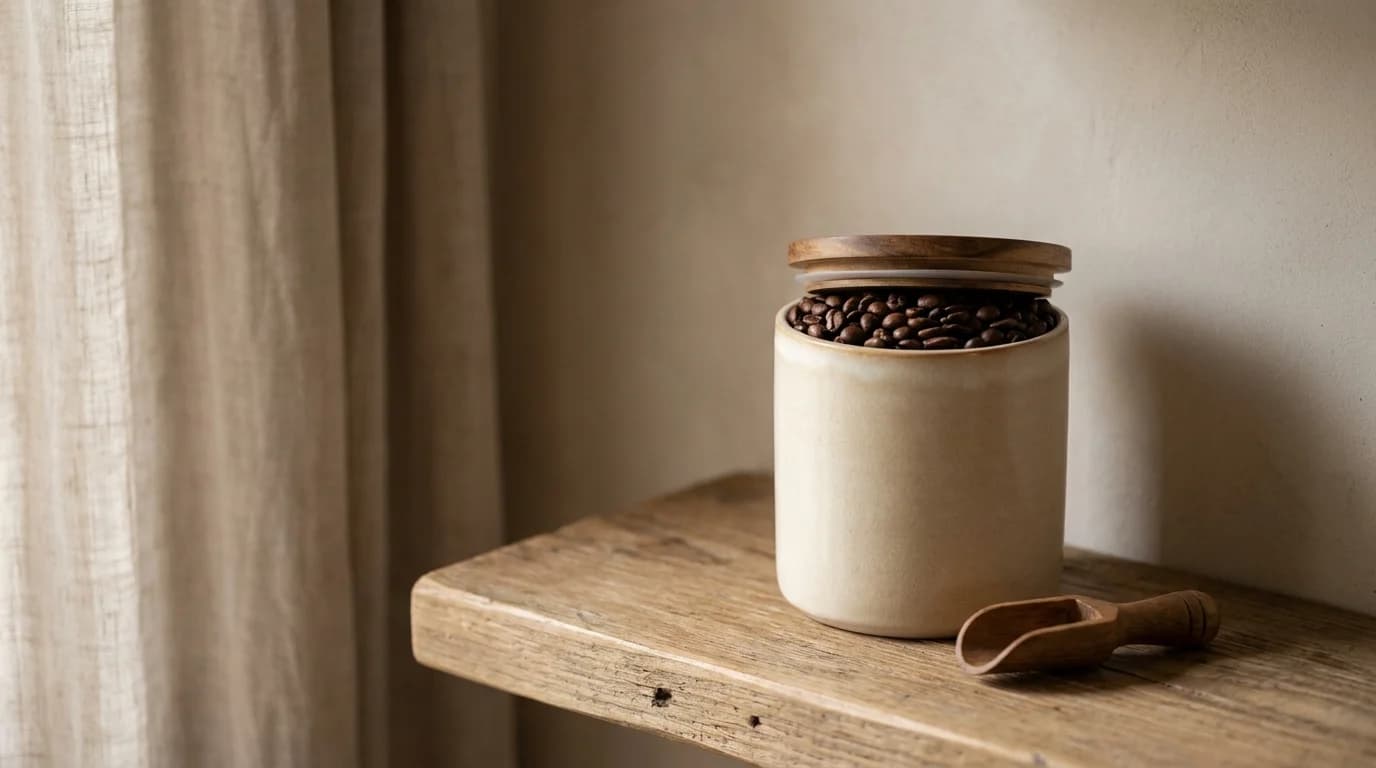
Coffee beans are perishable. Not in the way that meat or dairy are perishable — stale coffee will not make you sick — but in the sense that the compounds responsible for everything interesting about the smell and taste of coffee are actively escaping from the moment roasting is complete.
Storing coffee well is about slowing that escape. The right container, the right location, and a few things to avoid extend the window of peak freshness meaningfully.
4 enemies: oxygen, moisture, heat, light
all four accelerate the chemical reactions that stale coffee — oxidation degrades aromatic compounds, moisture accelerates hydrolysis of acids, heat speeds all reactions, and UV light directly degrades coffee's volatile esters[2]
2–4 weeks at peak after opening
whole beans maintain peak quality for 2–4 weeks after opening; ground coffee is significantly less fresh within 30 minutes of grinding — the surface area increase dramatically accelerates oxidation and volatile loss[1]
Grind immediately before brewing
grinding exposes 10,000× more surface area to air — most of the aromatic volatile compounds in a freshly ground dose escape within 15–30 minutes; pre-grinding and storing is one of the highest-impact ways to degrade coffee quality[3]
What stales coffee
Freshly roasted coffee is rich in volatile aromatic compounds — hundreds of molecules that evaporate readily and produce the complex, layered aroma of quality coffee. These compounds are the first thing lost during storage[2].
Simultaneously, coffee's chlorogenic acids and lipids undergo oxidation — a chemical reaction with oxygen that produces rancid, stale, and bitter flavours. This is the same process that makes butter go rancid, just slower.
The four accelerants:
Oxygen: drives oxidation of lipids and aromatic compounds. Minimising contact with air is the most impactful storage decision.
Moisture: accelerates hydrolysis of acids and makes the beans physically softer and more susceptible to further degradation. Coffee absorbs water vapour from the surrounding air.
Heat: speeds up all chemical reactions. A warm counter or cabinet near the stove significantly accelerates staling compared to a cooler, darker location.
Light: UV light specifically degrades coffee's ester compounds, which carry many of its floral and fruity notes. Glass jars on sunny countertops are particularly damaging.
The right container
Best: opaque container with a one-way CO₂ valve. After roasting, coffee releases CO₂ for days or weeks (the "degassing" process). A one-way valve allows this gas to escape without letting oxygen in. Most specialty coffee bags include a one-way valve for this reason. Dedicated coffee storage canisters with valve lids are available at kitchen and coffee retailers.
Good: airtight opaque canister with tight-fitting lid. If the container has no valve, the CO₂ released by freshly roasted coffee will build up pressure inside. Open briefly once daily for the first week after opening a new bag to release gas. A dark ceramic or stainless steel canister with a tight lid is a practical option.
Acceptable: original sealed bag, resealed. Many specialty coffee bags have a one-way valve and can be resealed by folding the top over and using the bag's notch or a clip. This works well if you use the coffee within two weeks.
Not recommended: glass jar on a sunlit counter, original bag left open, or a container with a loose lid.
Figure
Coffee freshness by storage method (approximate relative quality over 4 weeks)
Values in relative freshness (100 = peak)
Do not refrigerate
The refrigerator is one of the worst places to store coffee[1].
Odour absorption: Coffee is highly porous and absorbs volatile compounds from its surroundings. The fridge contains a continuous mix of food odours — onions, dairy, leftovers — that coffee will absorb within days, adding off-flavours to every cup.
Temperature cycling causes condensation: Each time you remove the bag or container from the fridge, the cold surface meets warmer air and moisture condenses on the beans. This moisture accelerates staling, and it happens every single time you open the fridge. What appears to be "kept cold" is actually being repeatedly moistened.
If the bag is large and you want to preserve part of it, see the freezer guidance below — which is different from refrigerating.
Freezing: when it works and when it does not
Freezing can extend coffee's life if done correctly, but casual freezing is counterproductive.
When freezing works: You have purchased a large quantity (1 kg or more) of a specific roast and want to preserve some of it for more than two weeks. Portion the coffee into individual weekly servings in airtight, freezer-safe containers or zip-lock bags with as much air pressed out as possible. Freeze. When ready to use a portion, remove it and leave it sealed at room temperature for at least one hour before opening, allowing the beans to warm up. Once thawed, use within the week and do not refreeze[3].
When freezing does not work: Keeping the same bag in the freezer and pulling beans out daily. Every opening exposes the beans to warm air and the condensation cycle described above. The temperature fluctuation and moisture do more damage than room-temperature storage in a good container would.
Ground coffee vs whole beans
Ground coffee stales dramatically faster than whole beans. Grinding increases the surface area of coffee by approximately 10,000 times, exposing vastly more of the coffee to oxygen and allowing aromatic volatile compounds to escape rapidly.
Most aromatic degradation in freshly ground coffee occurs within 20–30 minutes of grinding[3]. Buying pre-ground coffee and storing it, even in a good container, means the most aromatic window has already passed before you ever open the bag.
If you brew regularly and care about flavour, a burr grinder and whole beans ground immediately before brewing is the single highest-impact equipment choice you can make.
How long does coffee last
| Form | Peak quality | Still acceptable |
|---|---|---|
| Whole beans, unopened bag | Up to 3 months post-roast | 6–9 months (flat but safe) |
| Whole beans, opened bag | 2–4 weeks | 6–8 weeks |
| Ground coffee (bagged) | Days to 1 week after opening | 2–3 weeks (significantly flat) |
| Freshly ground (brewed same day) | 20–30 minutes after grinding | A few hours (noticeably worse) |
| Frozen whole beans (portioned correctly) | Up to 3 months in freezer | — |
The honest summary
Store coffee beans in an airtight, opaque container at room temperature away from heat and direct light. Oxygen, moisture, heat, and light are the four accelerants of staling — a good container neutralises the first two; location handles the rest. Do not refrigerate coffee: the temperature cycling causes condensation and the fridge environment imparts off-flavours. Only freeze if you have a large quantity you will not touch for two or more weeks, and portion it before freezing. Grind immediately before brewing — ground coffee loses most of its aromatic quality within 30 minutes. Whole beans stay at peak flavour for 2–4 weeks after opening.
Frequently asked questions
- Should I freeze coffee beans?
- Freezing is only appropriate for coffee you will not use for two or more weeks. The problem with casual home freezing: every time you open a freezer bag or container, warm air enters and moisture condenses on the cold beans. This moisture accelerates staling. If you must freeze — buying a large bag of a limited roast, for example — portion the coffee into single-week servings before freezing, in airtight containers. Remove one portion at a time, allow it to reach room temperature before opening, and never refreeze.
- Should I keep coffee in the fridge?
- No. The refrigerator does two things coffee does not need: it exposes the beans to odours from other foods (coffee is highly absorbent and will take on fridge smells) and it creates repeated temperature cycling. Each time you take the bag out of the fridge and return it, warm air enters, causing moisture to condense on the cold beans. Both effects stale coffee faster. Room temperature in an airtight, opaque container is better than the fridge.
- How long do coffee beans last after opening?
- Whole beans: 2–4 weeks after opening the bag at peak quality; they are still drinkable for up to 6–8 weeks but noticeably flatter and less aromatic. Ground coffee: deteriorates much faster — 20–30 minutes after grinding is when most aromatic volatile compounds begin to escape. Coffee bought pre-ground is significantly less fresh than whole beans ground immediately before brewing, regardless of the 'use by' date on the package.
- What is the best container for coffee beans?
- An airtight, opaque container is ideal. Opaque because light (particularly ultraviolet) degrades coffee's aromatic compounds. Airtight to prevent oxygen exposure, which causes oxidation. The best option is a container with a one-way valve — a valve that allows CO₂ (which coffee releases after roasting) to escape without letting oxygen in. Many specialty coffee bags have this valve built in. A plain jar with a tight lid is the next best option; a glass jar works but should be kept in a dark cupboard rather than on a sunlit counter.
- Does coffee go bad or just go stale?
- Coffee does not become unsafe to drink in the way perishable food does — there is no risk of harmful bacterial growth in dry coffee beans. What happens is flavour degradation: the aromatic volatile compounds that give fresh coffee its complexity escape into the air over time, leaving a flat, dull, muted cup. Very old coffee may taste unpleasant, but it is not dangerous. The question is not 'has it gone bad' but 'does it still taste good.'
References
Every factual claim in this article is drawn from the sources below. See the source library for how we grade evidence.
- [1]Brewing FundamentalsCoffee Science Foundation · Reference work · Tier 2 · Moderate
- [2]Coffee volatile compounds and roast markersPMC / NIH · 2016 · Review · Tier 2 · Moderate
- [3]The effect of bean origin and temperature on grinding roasted coffeeScientific Reports · 2016 · Controlled trial · Tier 2 · Moderate
Related reading
- Brewing ScienceCoffee Grind Size Guide: Which Grind for Which Method→
- Beans, Roasts & OriginsLight vs Medium vs Dark Roast: Flavour, Caffeine, Facts→
- Brewing ScienceHow Long Does Coffee Last? Freshness and Shelf Life→
- Beans, Roasts & OriginsThe Coffee Roasting Process: From Green Bean to Brown→
- Coffee EquipmentEspresso Machine for an Office: Match the Machine to Who Refills It→
- Coffee EquipmentAscaso Steel Duo: Two Thermoblocks Instead of Two Boilers→