Light vs Medium vs Dark Roast: Flavour, Caffeine, Facts
By Coffee Studies Editorial·Published July 15, 2026·6 min read
Quick answer
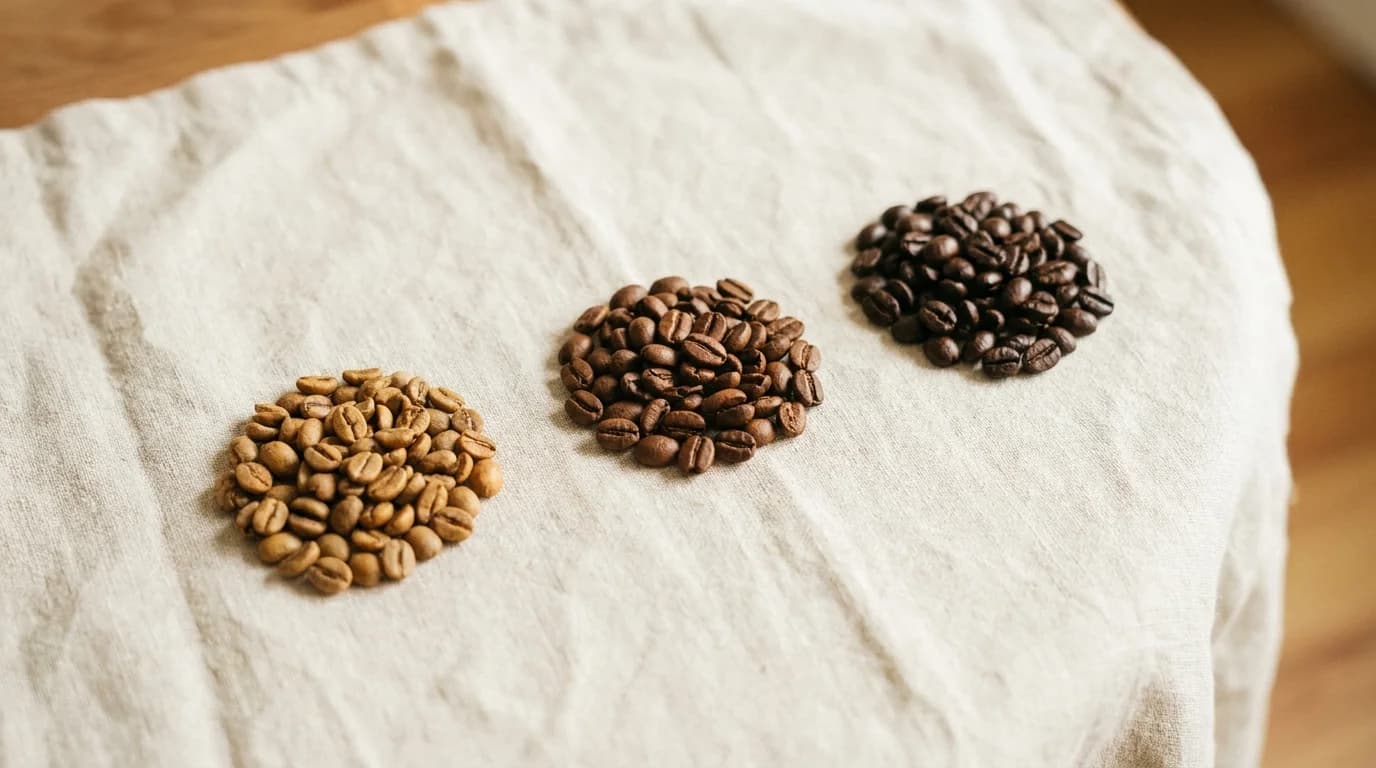
"Light, medium, or dark?" is the first question most coffee shops ask, and the answer has less to do with strength than most drinkers assume. Roast level changes the flavour more than the caffeine, and it changes the chemistry in ways that are documented and reproducible.
Colour = time
darker roasts are darker because they've been in the roaster longer at higher temperatures[1]
~Same caffeine
per gram of beans, caffeine content is nearly identical across roast levels — heat doesn't destroy it[5]
Chemistry shifts
chlorogenic acids drop with heat; melanoidins increase — the roast profile determines the balance[4]
What roasting actually does
Green (unroasted) coffee is dense, vegetal, and smells like wet grass — nothing like the coffee you drink. Roasting transforms it through a series of chemical reactions driven by heat.
Around 100 °C: water evaporates from the bean.
150-200 °C: sugars begin to caramelise (Maillard reactions between sugars and amino acids), creating early flavour compounds. Beans start turning brown.
Around 205 °C: "first crack" — the beans audibly pop as internal water flashes to steam. Bean structure changes; volume expands about 60%. This is the earliest point beans are "drinkable."
205-220 °C: light-to-medium roast range. Origin flavours develop; acidity and fruit character are preserved.
Around 220 °C: "second crack" — a quieter, wetter crack. Oils migrate to the bean surface. This is the start of the dark roast range.
220-240 °C+: dark roast. Chlorogenic acids and origin character continue to break down; bitter, smoky, and burnt notes develop. Some carbonisation.
Beyond around 240 °C, you're past drinkable roast levels and into charred territory[1].
Figure
Chlorogenic acid retention by roast level
Values in % remaining vs green bean
The three roast levels — what changes
| Light Roast | Medium Roast | Dark Roast | |
|---|---|---|---|
| Colour | Light brown | Medium brown | Dark brown to black |
| Surface | Dry, no oil | Slight oil sheen | Oily, glossy |
| Body | Lighter | Medium | Fuller |
| Acidity | High, bright | Balanced | Low |
| Bitterness | Low | Moderate | Higher |
| Sweetness | Fruit-forward | Caramel, chocolate | Bittersweet, roasty |
| Origin character | Very present | Moderately present | Suppressed |
| Chlorogenic acids | High | Moderate | Lower |
| Melanoidins | Lower | Moderate | High |
| Caffeine per gram | Baseline | Baseline | Slightly lower |
| Caffeine per scoop | Higher (denser beans) | Middle | Lower (less dense) |
The chemistry shifts are documented across multiple studies. A 2002 JAFC paper found that antioxidant activity from chlorogenic acids decreases with roast level, while overall antioxidant activity is partially maintained through the formation of new compounds (melanoidins) during roasting[2].
The 2020 Beverages multi-study empirical investigation of roasting conditions found that both roast degree (colour) and roasting time meaningfully affect sensory outcomes — you can reach the same "medium roast" colour via different time-and- temperature paths and get different flavour profiles[1].
The caffeine question, honestly
The most common misconception about roast levels is that dark roast has more caffeine. It doesn't.
Caffeine is thermally stable at roasting temperatures. It doesn't meaningfully break down during roasting, so a gram of light-roast coffee and a gram of dark-roast coffee contain essentially the same amount of caffeine.
The confusion comes from how coffee is measured:
- Dark-roast beans are less dense. They've lost more water and expanded more during roasting.
- A scoop of dark roast weighs less than a scoop of light roast at the same volume.
- So per scoop, dark roast delivers less coffee mass, and therefore less caffeine[5].
Once you weigh coffee in grams (as any consistent brewer should), roast level and caffeine become independent.
Origin flavours vs roast flavours
A key concept in specialty coffee: the lighter the roast, the more you taste the bean; the darker the roast, the more you taste the roast.
At light roast levels, the bean's origin chemistry is largely preserved — fruit acids, floral aromatics, terroir character. A light-roasted Kenyan will taste distinctly different from a light-roasted Colombian.
At dark roast levels, roasting chemistry dominates. The Maillard reactions and pyrolysis products (bittersweet, smoky, roasty notes) mask much of the origin character. A dark-roasted Kenyan and a dark-roasted Colombian will taste much more similar — both taste like "dark roast" first, "specific origin" second.
A 2016 review of coffee volatile compounds documents how roasting produces hundreds of new aroma compounds while also destroying many of the volatiles present in green coffee[3]. The balance shifts as roast progresses.
Which roast for which purpose
Light roast is best for:
- Pour-over and filter brewing (which highlight nuance)
- Single-origin appreciation
- Bright, complex, fruit-forward drinkers
- Cold brew (surprisingly — light roasts can produce very sweet cold brew)
- Anyone curious about what specific origins actually taste like
Medium roast is best for:
- Daily drinking versatility
- Auto-drip machines
- Balanced flavour without extreme brightness or bitterness
- Coffee with milk, but not milk-forward drinks
- Most household preferences by default
Dark roast is best for:
- Espresso (traditional Italian style especially)
- Milk-forward drinks (lattes, mochas) where the bold flavour needs to survive milk
- Consistent, predictable flavour regardless of origin quality
- Drinkers who genuinely prefer bittersweet, smoky, or "bold" coffee character
- Situations where you want to hide origin variation (large batches, commercial supply chains)
Common misconceptions
- "Dark roast is stronger." In flavour intensity, sometimes. In caffeine, no — measured by weight, roasts are essentially identical[5].
- "Light roast is bitter and unfinished." A well-executed light roast is sweet, bright, and complex. A poorly executed light roast (under-roasted, called "baked") can be vegetal. Roast quality matters more than roast level.
- "Dark roast has less acid, so it's better for reflux." Titratable acidity does drop with roast level, so dark roast is genuinely less acidic. Individual reflux triggers vary, though, and dark roasts also have more of certain compounds (like N-methylpyridinium) that some people find harsher.
- "French roast means it's from France." No — French roast is just a style of very dark roast. Origin refers to where the beans grew.
What the research shows
Beyond flavour, the chemistry differences translate to health- adjacent effects:
- Antioxidants: total antioxidant activity of coffee brews doesn't necessarily drop with roasting. Chlorogenic acids decrease, but melanoidins increase and contribute their own antioxidant effects[2].
- Chlorogenic acids specifically: these polyphenols peak in light-to-medium roasts and decline in dark roasts. Chlorogenic acids are one of the compounds credited in coffee's favourable associations with type 2 diabetes and liver disease outcomes[4].
- Aroma compound formation: hundreds of new volatile aroma compounds form during roasting, peaking in specific ranges depending on the compound[3].
None of these differences make one roast objectively "healthier." The evidence for coffee's health associations spans the full roast range.
Dark roasts stale fastest, because the oils already driven to the surface are the part that oxidises — which makes storage a roast-level question as much as a freshness one. See storing coffee beans.
The honest summary
Roast level changes the flavour dramatically, the chemistry meaningfully, and the caffeine barely at all. Light roasts preserve origin character; dark roasts push roasting chemistry further. Neither is objectively better — the right roast is the one that suits your brew method and your palate. If you've only ever had medium and dark, try a single-origin light roast via pour-over. You'll taste why specialty coffee exists.
Frequently asked questions
- Which roast has the most caffeine?
- Per gram of beans, roasts have nearly identical caffeine — caffeine is thermally stable. Per scoop, light roast has slightly more caffeine because light-roasted beans are denser (haven't lost as much water) — a scoop of light roast weighs more than a scoop of dark roast. Measured by weight, the difference disappears.
- Is dark roast healthier than light roast?
- Neither is meaningfully healthier. Dark roasts have lower chlorogenic acid content (destroyed by heat) but higher melanoidin content (formed by heat). Both roast levels contribute meaningful polyphenols and antioxidants. Individual sensitivity to acidity matters more than any population-level health claim.
- Why do darker roasts taste more similar to each other?
- Because dark roasting destroys many of the delicate volatile compounds that give lighter roasts their origin character. A light-roasted Ethiopian and a light-roasted Colombian taste distinctly different; the same beans at a dark roast level taste much more similar because the roast character dominates the origin character.
- Which roast should I buy?
- Depends on what you want. Light roasts for pour-over, filter, and single-origin appreciation — you'll taste more of the bean itself. Medium for versatile daily drinking. Dark for espresso, milk drinks, and consistent bold flavour. Freshness matters more than roast level.
References
Every factual claim in this article is drawn from the sources below. See the source library for how we grade evidence.
- [1]Roasting Conditions and Coffee Flavor: A Multi-Study Empirical InvestigationBeverages (MDPI) · 2020 · Review · Tier 2 · Moderate
- [2]Effect of Roasting on the Antioxidant Activity of Coffee BrewsJournal of Agricultural and Food Chemistry · 2002 · Observational study · Tier 2 · Moderate
- [3]Coffee volatile compounds and roast markersPMC / NIH · 2016 · Review · Tier 2 · Moderate
- [4]Impact of roasting on phenolic and volatile compounds in coffeePMC / NIH · 2022 · Review · Tier 2 · Moderate
- [5]CoffeeEncyclopaedia Britannica · Reference work · Tier 3 · Contextual
Related reading
- Beans, Roasts & OriginsArabica vs Robusta: Taste, Caffeine, and Differences→
- Brewing ScienceCoffee Extraction Explained: TDS, Solubles, and Yield→
- Brewing ScienceCoffee Acidity: pH, Sourness, and What Affects It→
- Caffeine & HealthCoffee Antioxidants: What the Research Shows→
- Coffee EquipmentHow to Store Coffee Beans to Keep Them Fresh→
- Beans, Roasts & OriginsBlack Ivory Coffee: The Elephant-Processed Cup→