Arabica vs Robusta: Taste, Caffeine, and Differences
By Coffee Studies Editorial·Published July 15, 2026·5 min read
Quick answer
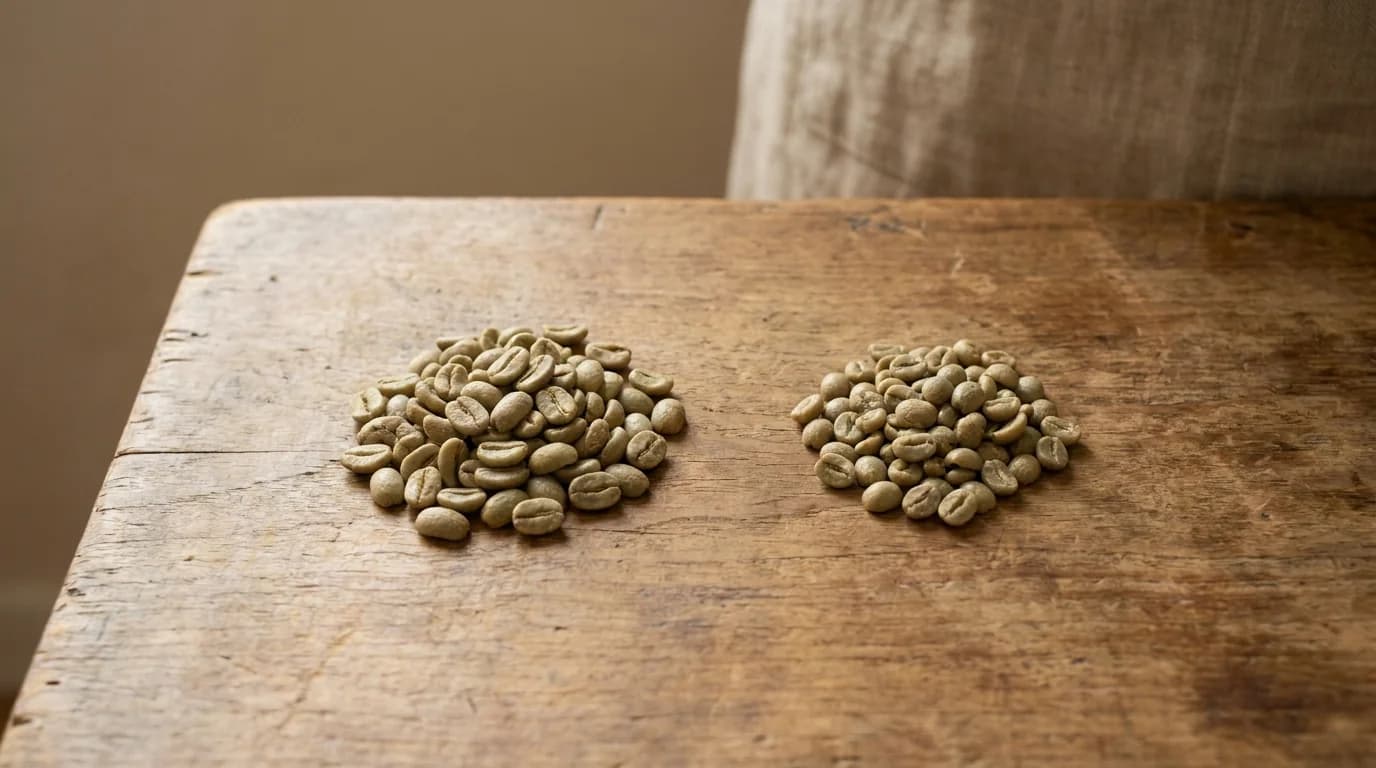
Almost all the coffee in the world comes from two species: Coffea arabica and Coffea canephora (commonly called robusta). They are biologically related but produce quite different drinks, and both have a legitimate place in the coffee world despite the tendency of specialty coffee culture to treat one as "real coffee" and the other as filler.
~60% / 40%
approximate share of world coffee production for arabica vs robusta[4]
~2× caffeine
robusta has roughly twice the caffeine of arabica by weight — a defining chemical difference[1]
Two species
essentially all commercial coffee is one of these two — a handful of others (liberica, excelsa) are regional curiosities[2]
The species, side by side
| Arabica (Coffea arabica) | Robusta (Coffea canephora) | |
|---|---|---|
| World share of production | ~60% | ~40% |
| Caffeine content | ~1.5–1.7% by weight | ~2.5–4% by weight |
| Chlorogenic acid content | Lower | Higher |
| Sugar content | Higher | Lower |
| Bean shape | Larger, elongated oval, curved slit | Smaller, rounder, straighter slit |
| Growing altitude | 600–2,000+ m | 0–800 m |
| Ideal temperature | 15–24 °C | 24–30 °C |
| Growing regions | Latin America, East Africa, some Asia | West Africa, SE Asia (esp. Vietnam), Brazil |
| Yield per hectare | Lower | Higher |
| Disease resistance | Lower (susceptible to leaf rust) | Higher |
| Typical price | Higher | Lower |
| Flavour profile | Sweeter, more complex, more acidic | Woodier, more bitter, heavier body, less nuance |
Composition figures are drawn from analytical studies distinguishing the two species and from broader coffee references[1][2].
Where the differences come from
Arabica and robusta diverged as species tens of thousands of years ago. Arabica is actually a tetraploid hybrid of two other coffee species (robusta being one of the parent species), which is why arabica plants are more genetically complex and more finicky to grow. Arabica's founding hybridisation left it with unusually narrow genetic variation, which is why the crop is so exposed to disease and heat.
The chemical differences that matter most for the finished cup:
Figure
Arabica vs robusta: bean composition (% dry weight)
Values in % of dry bean weight
- Caffeine. Robusta produces roughly twice as much caffeine as arabica by dry weight, and caffeine is bitter — contributing to robusta's harsher taste and less-nuanced profile[1].
- Chlorogenic acids. Robusta contains higher chlorogenic-acid content (about 7–10% vs 5–8% for arabica), which contributes to the woody, sometimes rubber-like character that robusta detractors dislike and robusta appreciators recognise as distinctive.
- Sugars. Arabica has notably higher sugar content, which caramelises during roasting and produces sweeter, more complex flavours.
- Lipids. Arabica also has higher lipid content, contributing to smoother mouthfeel.
The Fourier-transform Raman spectroscopy study cited here (2005, Journal of Agricultural and Food Chemistry) used spectroscopic techniques to reliably distinguish arabica from robusta based on these compositional differences — an active area of research because adulteration of premium arabica with cheaper robusta is a real industry concern[1].
Growing conditions and geography
Arabica needs a temperate, high-altitude climate: cool nights, warm days, well-drained soils, consistent rainfall. It's fussy. The classic arabica-growing regions — the "coffee belt" — include:
- Latin America: Colombia, Brazil (also grows robusta), Guatemala, Costa Rica, Peru
- East Africa: Ethiopia (arabica's genetic homeland), Kenya, Rwanda, Burundi
- Asia: Indonesia (Sumatra, Java), Papua New Guinea, parts of India
Robusta tolerates hotter, wetter, lower-altitude conditions where arabica would struggle:
- West Africa: Ivory Coast, Uganda, Cameroon
- Southeast Asia: Vietnam (now the world's largest robusta producer), Indonesia, India (some regions)
- Brazil: grows both, but the dominant robusta region is in Espírito Santo
Robusta is more disease-resistant, particularly against coffee leaf rust (Hemileia vastatrix), which has devastated arabica crops repeatedly. As climate change affects growing regions, robusta's tolerance profile is becoming more strategically important[3].
Where each species belongs
Arabica dominates:
- Specialty coffee (nearly 100% arabica)
- Pour-over, drip, and other clean-brewing methods
- Single-origin roasts
- Most "premium" or "gourmet" retail coffees
- Third-wave espresso
Robusta commonly appears in:
- Traditional Italian espresso blends (10–30% robusta for body, crema, and caffeine)
- Vietnamese coffee (often near-100% robusta, part of the cultural coffee identity there)
- Commercial instant coffees (robusta's higher solubility yield and lower cost make it attractive)
- Many supermarket "commodity" blends
- Coffee designed to survive milk and sugar in mass production
Fine robusta is a growing category — high-quality single-origin robusta produced with the same care as specialty arabica. Well-produced fine robusta can be delicious, offering a distinct profile rather than a failed imitation of arabica.
The caffeine practical implication
If you specifically want more caffeine per cup, a coffee containing robusta will deliver more caffeine than pure arabica at the same brewing ratio[1]. This is why many "extra strong" or "high caffeine" branded coffees are robusta-forward, and why traditional espresso blends with some robusta hit harder than pure-arabica shots.
Conversely, if you're sensitive to caffeine and drinking a lot of coffee, pure arabica gives you roughly half the caffeine per gram of coffee.
Common misconceptions
- "Arabica is real coffee, robusta is filler." Both are real coffee. Robusta is more common in commodity contexts, but there is high-quality robusta and low-quality arabica.
- "Robusta is always bitter." Well-produced fine robusta can be complex and enjoyable. The bitter reputation comes from low-grade commodity robusta.
- "You can taste robusta immediately." In a heavy espresso blend, sometimes. In a 10% robusta blend, most drinkers can't reliably identify it.
- "Arabica is healthier than robusta." No — both are coffee. Robusta has more caffeine and higher chlorogenic-acid content (a class of antioxidants). Neither species has a clear health edge.
The honest summary
Arabica and robusta are two species of coffee plant that produce different drinks. Arabica is sweeter, more nuanced, and dominates specialty coffee. Robusta has more caffeine, more body, and plays specific roles in espresso, Vietnamese-style coffee, and commercial instant coffees. Neither is objectively better; they're different tools for different jobs. If you drink specialty single- origin, you're drinking arabica. If you drink most commercial espresso, you're probably drinking a blend that includes some robusta — and if the blend is good, that's not a downgrade.
Frequently asked questions
- Which has more caffeine, arabica or robusta?
- Robusta has roughly twice the caffeine of arabica by weight. Typical figures are ~1.5–1.7% caffeine for arabica and ~2.5–4% for robusta. This is why robusta is common in traditional espresso blends and many instant coffees — more caffeine per gram and stronger crema.
- Is arabica always better than robusta?
- Not always. Arabica dominates specialty coffee because it's more nuanced in flavour and sweeter. Robusta has strengths — more body, better crema, higher caffeine, more resistance to pests and climate. Top-quality robusta ('fine robusta') is very good; low-quality arabica can be worse than good robusta.
- Why is robusta cheaper than arabica?
- Robusta is easier to grow — more heat-tolerant, higher-yielding, more disease-resistant — so it produces more coffee per hectare at lower cost. Arabica requires higher-altitude, more temperate growing conditions and is more labor-intensive to farm.
- Can I tell arabica from robusta in the cup?
- Sometimes. Robusta is often described as having a woody, grain-like, or slightly rubbery quality alongside a heavier body, while arabica tends to be sweeter, brighter, and more nuanced. In blends where robusta is a small fraction (say 10–20%), the difference is subtle.
References
Every factual claim in this article is drawn from the sources below. See the source library for how we grade evidence.
- [1]Chemical Discrimination of Arabica and Robusta Coffees by Fourier Transform Raman SpectroscopyJournal of Agricultural and Food Chemistry · 2005 · Observational study · Tier 2 · Moderate
- [2]CoffeeEncyclopaedia Britannica · Reference work · Tier 3 · Contextual
- [3]Coffee Varieties CatalogWorld Coffee Research · Reference work · Tier 2 · Moderate
- [4]International Coffee OrganizationInternational Coffee Organization · Official dataset · Tier 1 · Strong
- [5]FAOSTATFood and Agriculture Organization of the United Nations · Official dataset · Tier 1 · Strong
Related reading
- Caffeine & HealthHow Much Caffeine Is in Coffee?→
- Instant & Decaf CoffeeHow Is Instant Coffee Made? Freeze-Dry vs Spray-Dry→
- Beans, Roasts & OriginsArabica Coffee: The World's Leading Coffee Species→
- Beans, Roasts & OriginsBrazilian Coffee: The World's Largest Producer→
- Caffeine & HealthWhy Do Plants Make Caffeine? The Evolutionary Biology→
- Beans, Roasts & OriginsRobusta Coffee: Caffeine, Taste, and Uses Explained→