Why Arabica Has Almost No Genetic Diversity
By Coffee Studies Editorial·Published September 30, 2026·8 min read
Quick answer
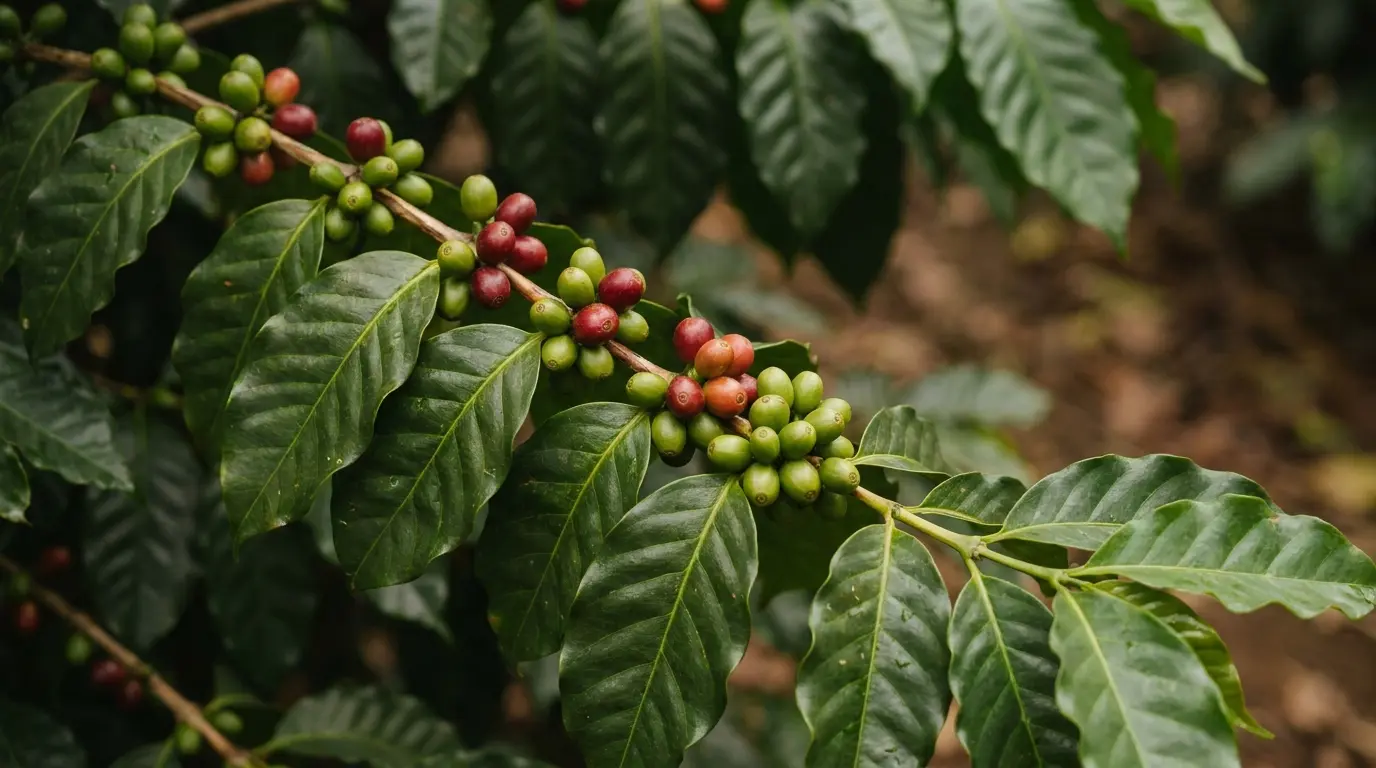
Arabica is the most economically important coffee species on earth, accounting for roughly 60% of world coffee production. It is also, genetically speaking, one of the most fragile crops in commercial agriculture.
Those two facts are connected, and a chromosome-level genome assembly published in Nature Genetics in 2024 finally explained how. The short version is that arabica should probably not exist. It is the product of one accidental hybridisation, in one place, at one moment, and everything grown today descends from that single event.
Founding hybridisation
Wild/cultivar split
Share of world coffee
What arabica actually is
Most coffee species are diploid: two sets of chromosomes, one from each parent, like most animals and many plants. Coffea canephora, the species sold as robusta, is diploid. So is Coffea eugenioides, a little-known East African species.
Arabica is neither. It is an allotetraploid: four sets of chromosomes, derived from two different species. It formed when C. eugenioides and C. canephora crossed, and the resulting hybrid doubled its chromosome count instead of failing, which is the usual outcome of such a cross.
This means two things that sit awkwardly with how coffee is marketed.
Roughly half of arabica's genome is robusta's species. The plant sold as the refined alternative to robusta is, genetically, half robusta. The 2024 assembly found no obvious global subgenome dominance, meaning neither parental contribution has taken over the genome[1]. Both halves are still doing work.
It happened once. Not repeatedly across a population over time, but once. That is the origin of everything that follows.
The 2024 genome, and what it settled
The Nature Genetics study assembled chromosome-level genomes for three things at once: a di-haploid C. arabica accession, and modern representatives of both diploid progenitors[1]. Having all three lets you ask which arabica traits came from which parent, which was not previously possible with confidence.
Four findings are worth carrying away.
The date. The founding polyploidy event occurred roughly 350,000 to 610,000 years ago. That is long before humans cultivated anything. Arabica was a wild species for hundreds of millennia before anyone drank it.
The bottlenecks. The founding event was followed by several pre-domestication bottlenecks, each further narrowing an already narrow pool. By the time humans encountered arabica, its genetic variation was already unusually low, before cultivation narrowed it again.
The split. Wild accessions and the progenitors of modern cultivars diverged about 30,500 years ago, with a subsequent period of migration between the two populations. So the wild Ethiopian populations are not simply the ancestors of cultivated coffee; the relationship is older and messier than that.
The resistance loci. Analysis of modern varieties, including lines historically introgressed with C. canephora, highlighted specific loci that may contribute to pathogen resistance. This is the practical payoff, and we come back to it below.
A 2020 study had already established the mechanism in outline, concluding that the single polyploidization event is itself responsible for the extremely low genetic variation observed in both wild and cultivated arabica germplasm[2]. The 2024 work put dates and population history on that conclusion.
Then it got narrower: Yemen
The genomic bottlenecks are only the first half of the story. Human history supplied the second.
Arabica's cultivation spread from Ethiopia to Yemen, and the coffee that left Yemen for the rest of the world went through an extraordinarily narrow gate. The traditional account, broadly consistent with the genetics, is that the varieties which populated the colonial coffee world descend from a very small number of plants taken out of Yemen. Typica and Bourbon, the two founding cultivar groups behind most of the world's heirloom varieties, trace to that exodus.
So the sequence is: one hybridisation, several pre-domestication bottlenecks, a 30,500-year-old split, and then a handful of seedlings carried onto ships. A crop grown across three continents rests on that.
Why this is not an academic curiosity
Narrow genetic variation has a specific and unforgiving consequence: a pathogen or stress that defeats one plant tends to defeat most of them. There is little variation for selection to work with, either by a breeder or by the population itself.
Coffee leaf rust
Hemileia vastatrix is the clearest demonstration. The fungus has spread through essentially every arabica-growing region on earth over roughly a century and a half[3], and its arrival did not merely reduce yields. It restructured the industry. The collapse of coffee in Ceylon and the pathogen's subsequent spread across Asia reorganised where the world grew coffee and which species it grew, a process one historical analysis frames as the ecological integration of world coffee production after 1850[4].
A more genetically varied crop would have presented rust with a harder problem. A crop descended from one hybridisation event presented it with a very easy one.
Climate
The same logic applies to heat and drought. Arabica is narrowly adapted, and modelling work has consistently found its suitable growing area shrinking as the climate warms, with robusta and arabica affected differently[6].
The most striking finding concerns the wild populations, which are the genetic reservoir any future breeding depends on. A 2019 assessment found that applying climate projections moves wild arabica from Least Concern to Endangered on IUCN criteria[5]. The material that might be used to fix arabica's fragility is itself threatened by the thing that fragility exposes it to.
The three ways out
None is quick. All are real.
1. Cross robusta back in
Since C. canephora is already half of arabica's genome, reintroducing modern canephora genetics is biologically feasible in a way that most interspecies crosses are not. This is what the Timor hybrid and its descendants such as the Catimor group are: arabica carrying deliberate canephora introgression for rust resistance.
The trade-off is well known in the trade, which is that introgressed lines have historically been criticised on cup quality. The 2024 assembly's identification of specific resistance-associated loci in introgressed lines[1] matters precisely here, because knowing which loci carry resistance is the first step toward keeping them without dragging everything else across.
2. Breed from outside the bottleneck
Wild Ethiopian populations and the Sudanese-Ethiopian accessions sit outside the narrow stock that left Yemen, and therefore hold variation the cultivated pool lacks. Work on hybrids involving Sudanese-Ethiopian origins found they could be evaluated on both bean biochemistry and beverage quality against traditional varieties across elevations[7], which is the necessary groundwork: diversity is only useful if the resulting coffee is worth drinking.
This route depends entirely on those wild populations surviving, which brings us back to the Endangered assessment above.
3. Breed with the genome rather than by guesswork
This is what the 2024 paper is actually for. Its authors describe the work as laying the groundwork for genomics-based breeding of C. arabica[1].
Conventional coffee breeding is brutally slow. A tree takes years to bear, selection cycles run to decades, and a breeder crossing for rust resistance has historically had to wait and see what else came along with it. Knowing where the relevant loci sit converts some of that waiting into selection. That will not create diversity arabica never had, but it makes far better use of the little that exists and of what can be borrowed from canephora and the wild populations.
What the research says
The genomic picture is unusually settled for a question this large, because two independent lines of evidence agree.
A 2020 analysis concluded that arabica's single polyploidization event is itself responsible for its extremely low genetic variation, in both wild and cultivated material[2]. The 2024 chromosome-level assembly of arabica plus both diploid parents dated that event to 350,000-610,000 years ago, found no global subgenome dominance, placed the wild/cultivar split at about 30,500 years ago, and identified candidate pathogen-resistance loci in canephora-introgressed lines[1].
What remains open is the practical question. Whether genomics-based breeding can deliver climate-resilient, rust-resistant arabica that people actually want to drink, on a timescale that matters, is not yet demonstrated. The tools are new and coffee breeding cycles are measured in decades.
What it means in your cup
Three things, none of which require any genetics to appreciate.
The variety names on specialty bags are narrower than they sound. Typica, Bourbon, Caturra, Geisha and most of the rest sit within an extremely constrained gene pool. The differences between them are real and they are differences at the margin of a small pool, not between distant relatives.
Robusta deserves less contempt than it gets. It is half of arabica's ancestry, it is the source of the disease resistance arabica has been given, and it is the more genetically robust of the two species. Our arabica versus robusta comparison covers the cup differences honestly.
Price volatility has a genetic component. When a crop this narrowly adapted meets a bad season or a pathogen in a major producing region, there is no genetic slack in the system to absorb it. That is part of why coffee prices move the way they do.
The short version
Arabica is an allotetraploid hybrid of Coffea eugenioides and Coffea canephora, formed once, roughly 350,000 to 610,000 years ago. Several pre-domestication bottlenecks narrowed it further, the wild and cultivated lineages split about 30,500 years ago, and the varieties that colonised the world came from a handful of plants out of Yemen.
That history is why 60% of world coffee production rests on a gene pool narrower than many garden plants, why leaf rust has been able to move through every growing region on earth, and why a warming climate is an existential rather than an inconvenient problem for the species. The 2024 genome assembly did not change any of it. It did, for the first time, give breeders a map.
Frequently asked questions
- Why does arabica have so little genetic diversity?
- Because it began as a single hybridisation event rather than as a population. Arabica formed when Coffea eugenioides and Coffea canephora crossed and the offspring doubled its chromosomes, an event a 2024 genome assembly dated to roughly 350,000 to 610,000 years ago. Everything alive today descends from that one founding, and several population bottlenecks before domestication narrowed the pool further. A 2020 analysis concluded that the single polyploidization event is itself responsible for the extremely low variation seen in both wild and cultivated arabica.
- What is Coffea eugenioides?
- A diploid coffee species native to East Africa, and one of arabica's two parents. It is barely grown commercially, though small amounts are sold at very high prices as a curiosity, and it is naturally low in caffeine. Its importance is genetic rather than commercial: half of arabica's genome came from it, and the 2024 study assembled a modern eugenioides genome specifically to work out which arabica traits came from which parent.
- Is arabica a hybrid of robusta?
- Yes, in the sense that robusta's species, Coffea canephora, is one of its two parents. That is an uncomfortable fact for anyone who treats robusta as arabica's inferior: roughly half of arabica's genome is canephora. It also explains why breeders can cross modern robusta back into arabica to introduce disease resistance, which is exactly what the Timor hybrid and its descendants are.
- What did the 2024 arabica genome study actually find?
- Four things worth knowing. It dated the founding polyploidy event to 350,000 to 610,000 years ago. It found no global subgenome dominance, meaning neither parent's contribution has taken over. It placed the split between wild accessions and cultivar progenitors at about 30,500 years ago, with later migration between those populations. And it identified loci in canephora-introgressed lines that may carry pathogen resistance, which is the practical payoff for breeding.
- Why is arabica so vulnerable to coffee leaf rust?
- Narrow genetic variation means a pathogen that defeats one plant's defences tends to defeat most of them. Hemileia vastatrix, the leaf rust fungus, has spread through essentially every arabica-growing region since the nineteenth century, and its arrival in Ceylon and then across Asia reshaped world coffee production. A crop with more genetic variation would present the pathogen with more obstacles.
- Can arabica's diversity problem be fixed?
- Partly, and slowly. Three routes exist: crossing canephora back in, which is how rust-resistant lines were created; breeding from wild Ethiopian populations and the Sudanese-Ethiopian accessions that sit outside the cultivated bottleneck; and using genomic information to select deliberately rather than by trial. The 2024 assembly matters because it makes the third route possible at all.
References
Every factual claim in this article is drawn from the sources below. See the source library for how we grade evidence.
- [1]The genome and population genomics of allopolyploid Coffea arabica reveal the diversification history of modern coffee cultivarsNature Genetics · 2024 · Official dataset · Tier 1 · Strong
- [2]A single polyploidization event at the origin of the tetraploid genome of Coffea arabica is responsible for the extremely low genetic variation in wild and cultivated germplasmScientific Reports · 2020 · Official dataset · Tier 1 · Strong
- [3]The coffee leaf rust pathogen Hemileia vastatrix: one and a half centuries around the tropicsMolecular Plant Pathology · 2017 · Review · Tier 2 · Moderate
- [4]Global rust belt: Hemileia vastatrix and the ecological integration of world coffee production since 1850Journal of Global History · 2006 · Review · Tier 2 · Moderate
- [5]Least concern to endangered: Applying climate change projections profoundly influences the extinction risk assessment for wild Arabica coffeeGlobal Change Biology · 2019 · Observational study · Tier 2 · Moderate
- [6]A bitter cup: climate change profile of global production of Arabica and Robusta coffeeClimatic Change · 2014 · Observational study · Tier 2 · Moderate
- [7]Comparison of bean biochemical composition and beverage quality of Arabica hybrids involving Sudanese-Ethiopian origins with traditional varieties at various elevations in Central AmericaTree Physiology · 2006 · Observational study · Tier 2 · Moderate
Related reading
- Beans, Roasts & OriginsArabica Coffee: The World's Leading Coffee Species→
- Beans, Roasts & OriginsArabica vs Robusta: Taste, Caffeine, and Differences→
- Beans, Roasts & OriginsArabica Coffee Varieties: Typica, Bourbon, and Geisha→
- Beans, Roasts & OriginsThe Coffee Plant: Biology, Growth, and Cherry Anatomy→
- Beans, Roasts & OriginsCoffee and Climate Change: What the Science Says→
- Beans, Roasts & OriginsRwandan Coffee: Origin, Profile, and Specialty Revival→