Arabica Coffee Varieties: Typica, Bourbon, and Geisha
By Coffee Studies Editorial·Published July 18, 2026·6 min read
Quick answer
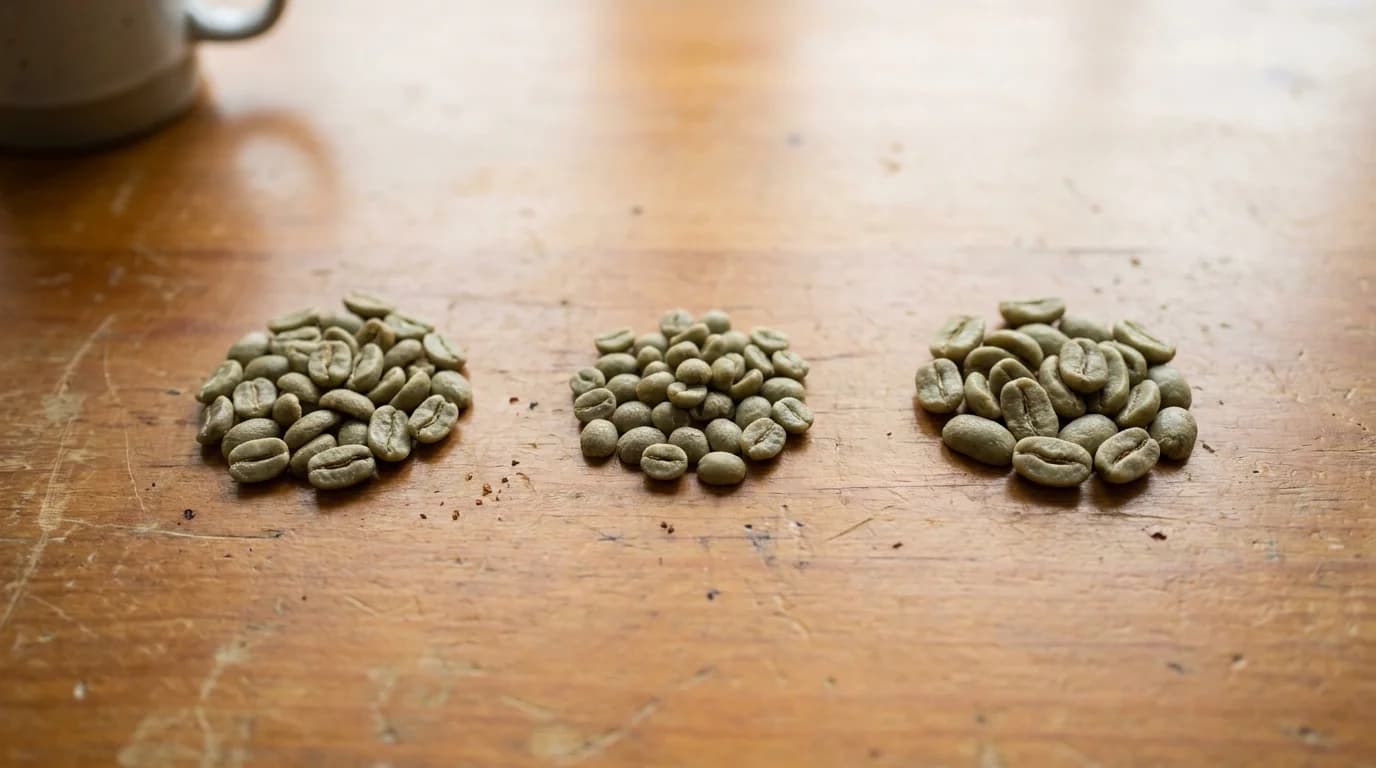
When you read a coffee bag that says "Geisha" or "Bourbon" or "SL28," those words name a variety — a specific genetic population within Coffea arabica with its own yield, structure, and cup character. Knowing what they mean is the difference between buying a label and understanding what you are tasting.
Variety is not the only thing that shapes a coffee's flavour — origin, altitude, processing, and roast all matter — but it sets the ceiling. Some varieties are physiologically capable of producing a floral, jasmine- bergamot cup that almost nothing else can; others produce reliable, pleasant, unspectacular cups regardless of where they are grown.
Two ancestral populations
nearly all modern arabica cultivation descends from Typica and Bourbon — two populations spread from Ethiopia and Yemen across the world from the 16th century onward; every named variety is a selection, mutation, or hybrid of these two lineages[1]
Variety shapes the flavour ceiling
a farmer in an excellent growing region with ideal processing cannot make a Catuai taste like a Geisha — the genetic capacity for certain flavour compounds differs between varieties; origin realises the potential variety sets[3]
Disease resistance vs cup quality trade-off
most high-yield, disease-resistant arabica varieties (Catimor, Castillo) cup below traditional Typica and Bourbon lines; breeders are working to close this gap, but it remains a core tension in arabica development[4]
The arabica family tree
All arabica starts in Ethiopia, where the species evolved over thousands of years. The Arab traders who spread coffee cultivation from Ethiopia via Yemen in the 15th–16th centuries carried two distinct plant populations into global cultivation. These became the ancestors of everything grown today[1].
Typica — the first arabica spread globally. Taken from Yemen to India (via the Dutch, 1600s), then to Indonesia, then to the Americas (French and Dutch, 1700s). Large bean, elegant cup, very low yield. The genetic foundation of most early arabica cultivation.
Bourbon — a natural mutation of Typica, first identified on the island of Bourbon (now Réunion) in the Indian Ocean in the early 18th century. The French spread it to Africa and the Americas. More productive than Typica, slightly smaller bean, distinctive sweetness.
From these two lineages, through natural mutation, deliberate breeding, and interbreeding with Ethiopian wild populations, come all the named varieties used today.
Key varieties
Figure
Arabica varieties: yield vs cup quality generalisation
Values in relative cup quality score (illustrative)
The varieties that matter most
Typica
The original. Taken from Yemen to the world, Typica is the template against which other varieties are measured. It produces a clean, complex, balanced cup — often described as elegant — but yields very little coffee per plant. It is also susceptible to coffee leaf rust (Hemileia vastatrix), which has wiped out Typica cultivation in some regions. Commercially, it has been largely replaced by more productive varieties, though it persists in Java, Papua New Guinea, and parts of Central America and Peru[3].
Bourbon
One of the most widely planted specialty varieties and the ancestor of many others. Bourbon's cup is characterised by sweetness — brown sugar, caramel, red fruit — with moderate acidity and medium body. Red Bourbon (the red-cherry variant) is the most common; Yellow Bourbon has slightly different sweetness. Bourbon is more productive than Typica but still low-yielding by commercial standards, and it is susceptible to rust. It persists widely in Rwanda, Burundi, and El Salvador as a quality-focused choice[2].
Geisha / Gesha
The variety that changed specialty coffee auctions. Geisha traces to the Gesha forest in southwestern Ethiopia and was collected by researchers in the 1930s–50s, brought to Costa Rica's CATIE research institute, and distributed to Central American farmers without much recognition of its potential. When Hacienda La Esmeralda in Boquete, Panama submitted a segregated Geisha lot to the 2004 Best of Panama auction, it sold for a record price and sparked worldwide interest.
Geisha's cup is unlike most arabica: intensely floral (jasmine, bergamot), delicate tea-like body, citrus or tropical fruit, and a clean, lingering finish. It is physiologically unusual — the flavour compounds it can produce are simply not present at the same concentration in other varieties. The trade-off is very low yield and fragile plant structure, making it expensive to grow. Geisha is now cultivated in Ethiopia, Panama, Colombia, Peru, Japan, and elsewhere[1].
SL28 and SL34
Kenya's signature varieties, selected by Scott Laboratories in the 1930s from local populations. SL28 is the more celebrated — its cup is characterised by intense blackcurrant and berry flavour, high acidity, and tomato-like savouriness that is immediately recognisable as "Kenyan." SL34 has a similar but slightly softer, more balanced profile.
Both varieties are drought-tolerant but susceptible to leaf rust and coffee berry disease, which is why Kenya has invested significantly in breeding rust-resistant alternatives. SL28 and SL34 remain the quality benchmark in Kenya despite these limitations[2].
Caturra and Catuai
The workhorses of Latin American coffee. Caturra is a compact Bourbon mutation (Brazil, ~1935) that produces significantly more coffee per plant than Bourbon while occupying less space — allowing denser planting. The cup is pleasant but less complex than Bourbon. Catuai is a later hybrid (Caturra × Mundo Novo, Brazil 1950s–60s) with similar compact structure and high yield.
Together, Caturra and Catuai account for a large share of arabica planted in Brazil, Colombia, Costa Rica, and Central America. They are valued for economic productivity rather than exceptional cup quality, which is why specialty roasters often seek out other varieties[3].
Pacamara
A deliberately bred hybrid from El Salvador (Pacas × Maragogipe, 1958). Maragogipe is a Typica mutation known for producing unusually large beans; Pacamara inherits this trait. The cup can be complex and striking — citrus, stone fruit, floral notes — making it a specialty favourite from El Salvador, Guatemala, and Honduras. The large bean size is visually distinctive and roasts with slightly different heat dynamics.
Catimor and Castillo
The disease-resistant side of the family. Timor Hybrid is a natural Arabica × Robusta hybrid discovered in Timor in the 1920s — it carries robusta genes that confer resistance to coffee leaf rust. Catimor is a cross of Timor Hybrid with Caturra, spreading rust resistance with compact plant structure. The trade-off: robusta genetic contribution often correlates with a harsher, more astringent cup, particularly at the cup quality level below the best specialty lots.
Castillo is Colombia's national rust-resistant variety, bred by CENICAFÉ over decades. Early versions were criticised for cup quality; recent generations are significantly better. Colombia's mass adoption of Castillo after the devastating 2008–2012 rust epidemic reshaped the country's output and sparked debate about whether genetic uniformity and cup quality trade-offs were worth the disease protection[4].
Ethiopian heirloom: the unnamed majority
Ethiopia is the origin of arabica — the wild diversity that exists there has never been fully catalogued. What specialty roasters call "Ethiopian heirloom" or "landrace" varieties refers to the broad, diverse populations of wild and semi-wild arabica plants that farmers cultivate in Ethiopia without formal variety names. These populations contain extraordinary diversity — different farms in the same region may have plants that cup completely differently. World Coffee Research estimates there are thousands of distinct arabica populations in Ethiopia.
This genetic diversity is why Ethiopian coffee can produce cups unlike anything else: the range of flavour compounds encoded in those plants far exceeds what is captured in any named commercial variety.
Origin by origin
 Origin-by-origin referenceThe World Atlas of Coffee 3rd edition: From beans to brewing – coffees explored, explained and enjoyedOrganised by producing country rather than by technique, which makes it the reference to reach for when a bag names a region you do not know. The brewing sections are brief by design; the maps and the origin profiles are the reason to own it.amazon.com $24.86 USDamazon.ca $31.65 CADPrice and availability as of View on Amazon
Product prices and availability are accurate as of the date/time indicated and are subject to change. Any price and availability information displayed on Amazon at the time of purchase will apply to the purchase of this product. Certain content that appears on this site comes from Amazon. This content is provided ‘as is’ and is subject to change or removal at any time.
The honest summary
Arabica coffee variety tells you what flavour potential a coffee has — not what it will taste like. Two varieties dominate the history: Typica (the original, elegant, low- yielding) and Bourbon (sweeter, more productive, still respected). From these, through mutation and breeding, came the modern variety landscape: Geisha (exceptional floral quality, very low yield), SL28 (Kenya's blackcurrant variety), Caturra and Catuai (productive workhorses of Latin America), Pacamara (complex, large-beaned Central American hybrid), and disease-resistant lines (Catimor, Castillo) that trade some cup quality for commercial resilience. When you see a variety named on a specialty bag, it is useful information — it tells you what kind of cup the farmer was growing toward.
Frequently asked questions
- What is the difference between arabica and a coffee variety?
- Coffea arabica is the species — the plant biology. A variety (or cultivar) is a genetically distinct population within that species, bred or selected for specific traits. All arabica varieties are the same species; they differ in yield, plant structure, seed size, disease resistance, and cup flavour potential. Robusta (Coffea canephora) is a different species entirely, not a variety of arabica.
- What is Geisha coffee?
- Geisha (also spelled Gesha) is an arabica variety originating from the Gesha region of southwestern Ethiopia. It was brought to Central America via breeding collections in the mid-20th century but remained obscure until a Hacienda La Esmeralda lot from Boquete, Panama won a specialty auction in 2004 at a record price. Geisha is characterised by an unusually floral, jasmine-bergamot aroma and a tea-like, delicate body — a cup profile very different from most arabica. It is prized in specialty coffee and commands high prices. Its yield is low, making it expensive to produce.
- What are SL28 and SL34?
- SL28 and SL34 are two arabica varieties developed in the 1930s by Scott Laboratories (the 'SL' prefix) in Kenya, selected from local populations for yield and quality. SL28 is particularly celebrated for its distinctive flavour: intense blackcurrant, tomato, and berry acidity that gives Kenyan coffee its immediately recognisable character. SL34 has a similar but slightly more balanced profile. Both are primarily grown in Kenya — SL28 in particular produces flavours rarely found in coffee from any other origin.
- What is Bourbon coffee?
- Bourbon is one of the two primary arabica populations, descended from Typica via a natural mutation. It was identified on the island of Bourbon (now Réunion) in the 18th century and spread throughout the Americas. Bourbon plants have a rounder, smaller bean than Typica and are more productive. The cup tends toward sweetness — brown sugar, caramel, fruit — with moderate acidity. Bourbon exists in yellow, red, and orange variants (the colour of the ripe cherry), each with slightly different flavour tendencies. Many important varieties — Caturra, SL28, Pacas — are selections or mutations from Bourbon.
- What is the difference between Caturra and Catuai?
- Caturra is a naturally occurring compact mutation of Bourbon, first found in Brazil around 1935. It is smaller than Bourbon (a dwarfing mutation) and significantly more productive per plant, making it widely planted across Central and South America. Cup quality is generally lower than Bourbon or Typica — it produces a pleasant but less complex cup. Catuai is a hybrid of Caturra and Mundo Novo (itself a Typica × Bourbon hybrid), developed by Brazil's Instituto Agronômico in the 1950s and 60s. It is similarly compact and very high-yielding. Catuai is one of the most widely planted arabica varieties globally, valued for productivity and disease tolerance more than exceptional cup quality.
References
Every factual claim in this article is drawn from the sources below. See the source library for how we grade evidence.
- [1]Coffee Varieties CatalogWorld Coffee Research · Reference work · Tier 2 · Moderate
- [2]Interactive Coffee Varieties CatalogWorld Coffee Research · Reference work · Tier 2 · Moderate
- [3]Coffee agronomyFood and Agriculture Organization of the United Nations · Reference work · Tier 2 · Moderate
- [4]Coffee leaf rust: a reviewPMC / NIH · 2022 · Review · Tier 2 · Moderate
Related reading
- Beans, Roasts & OriginsArabica vs Robusta: Taste, Caffeine, and Differences→
- Beans, Roasts & OriginsArabica Coffee: The World's Leading Coffee Species→
- Beans, Roasts & OriginsCoffee Origins Around the World→
- Beans, Roasts & OriginsWhat Is Single-Origin Coffee? Why Origin Matters→
- Beans, Roasts & OriginsEthiopian Coffee: Yirgacheffe, Sidamo, and Harrar→
- Beans, Roasts & OriginsLiberica Coffee: The Third Commercial Coffee Species→