Coffee and Climate Change: What the Science Says
By Coffee Studies Editorial·Published July 19, 2026·6 min read
Quick answer
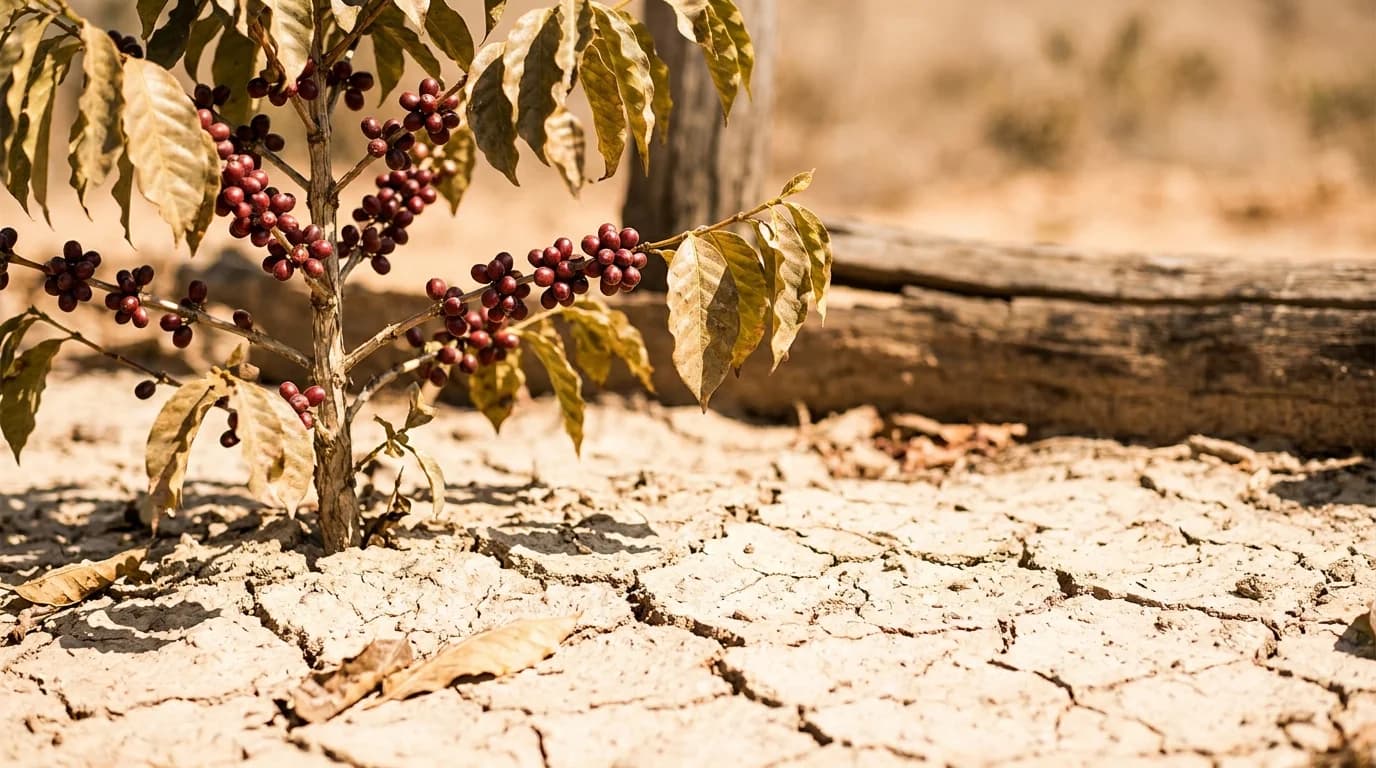
Coffee is a crop with a narrow environmental tolerance window. Arabica — the species behind 60% of global coffee production and essentially all specialty coffee — evolved in the highland forests of Ethiopia at specific elevations, temperatures, and rainfall patterns. Move it too low, too warm, or too dry, and the crop fails. The systematic reviews of climate change impacts on coffee production do not present a subtle picture: the temperature and rainfall shifts projected under current emissions trajectories are, in the models, devastating.
40–60% of arabica land projected unsuitable by 2050 under medium scenarios
systematic reviews of climate impact modelling consistently project that 40–60% of currently suitable arabica cultivation area will become climatically unsuitable by 2050 under medium warming scenarios (approximately 2°C average global warming); under high-emissions pathways the projected losses are substantially larger[1]
Arabica optimal range: 18–22°C — narrow and altitude-dependent
Coffea arabica has an optimal average temperature range of 18–22°C for quality cherry development; sustained temperatures above 23°C disrupt flowering, cherry maturation, and photosynthesis; this range is maintained in current growing areas largely by altitude, which loses roughly 0.6°C per 100 metres — meaning temperature increase is equivalent to losing altitude[2]
Coffee leaf rust spreads faster in warmer, wetter conditions
Hemileia vastatrix, the coffee leaf rust fungus responsible for periodic devastating epidemics, is significantly favoured by warmer temperatures and more variable humidity; climate change is projected to expand rust's altitude range and season, compounding the direct temperature stress on arabica trees with increased pathogen pressure[5]
The temperature problem
Arabica coffee evolved in the Ethiopian highlands at elevations of 1,000–2,000 metres, where average temperatures typically fall in the 18–22°C range year-round. This is not a preference — it is a physiological requirement[2].
Above approximately 23°C sustained average temperature:
- Flowering is disrupted; the plant may flower off-season or fail to set fruit consistently
- Cherry development accelerates, reducing the time for sugars and complex flavour compounds to develop in the fruit — this directly affects cup quality
- Photosynthesis rates decline above certain temperature thresholds
- Water stress is exacerbated — higher temperatures increase transpiration and reduce available moisture
The altitude relationship is direct: because temperature decreases approximately 0.6°C per 100 metres of elevation, a 1°C average temperature increase is equivalent — in its effects on growing conditions — to losing approximately 160 metres of altitude. For farms currently at the lower margins of viable arabica altitude, this translates to conditions moving outside the viable range within years to decades[1].
Projected land loss by origin
Figure
Projected loss of suitable arabica growing area by 2050 (medium warming scenario)
Values in approximate % of current suitable area projected to become unsuitable
The leaf rust amplifier
Coffee leaf rust (Hemileia vastatrix) is the most economically destructive coffee disease — responsible for repeated epidemics that have collapsed production in Ceylon (1870s), the Philippines (1880s), and most recently Central America (2012–2013)[5].
Climate change amplifies rust pressure in two ways:
Range expansion: Leaf rust development is favoured by temperatures of 15–28°C with high humidity. As temperatures rise, the upper altitude limit at which rust can develop moves higher, exposing arabica zones that were previously protected by cool temperatures. Farms at 1,500–1,800 metres that currently have limited rust pressure face growing exposure as warming shifts that boundary upward.
Season extension: Rust development is also affected by the seasonality of temperature and rainfall. In some growing regions, climate change is extending the period in which conditions favour rust development, reducing the seasonal interruption that limits epidemic spread.
The 2012–2013 Central American rust epidemic — affecting over 70% of farms in some countries — is considered by researchers to be a preview of conditions that will become more frequent[1].
Arabica vs robusta vulnerability
Robusta (Coffea canephora) is structurally more resilient to temperature increases than arabica, but not immune[4]:
Robusta's optimal temperature range is approximately 24–30°C, significantly higher than arabica. It grows at lower altitudes (200–800 metres typically) in West and Central Africa, Southeast Asia, and Brazil. Its higher caffeine content may also provide some pest resistance.
However:
- Lower-altitude robusta regions face their own temperature ceiling — sustained temperatures above 32–34°C stress robusta yields
- Drought stress affects both species; increased temperature increases evapotranspiration and water stress
- Robusta is used primarily in commercial blends and instant coffee, which is still a significant market requiring stable supply
The practical implication: some arabica-growing areas may become suitable for robusta as they warm, allowing a crop shift rather than complete abandonment — but robusta trades at significantly lower prices than specialty arabica, making this adaptation economically costly for farmers and communities built around arabica production[3].
Adaptation strategies
The scientific and agricultural community has identified several adaptation pathways[2]:
Elevation migration: Moving coffee cultivation upslope to cooler altitudes. This is occurring organically in some regions. Limitations: mountainous terrain has finite area at higher elevations, and migration often requires converting forest land.
Shade-growing intensification: Multi-layered shade tree canopies buffer temperature extremes — reducing maximum daytime temperature by 2–4°C — and maintain soil moisture. Shade systems also provide carbon sequestration benefits. The tradeoff is typically lower yields per plant.
Variety development: World Coffee Research and national research institutions are developing arabica varieties with higher temperature tolerance and rust resistance. Varieties crossing Timor Hybrid (a natural arabica-robusta cross) into arabica lineages introduce robusta's temperature tolerance with arabica's cup quality. Progress is real but breeding cycles are slow.
Geographic range shifts: Some higher-latitude and higher-altitude areas currently marginal for arabica (parts of China, Papua New Guinea at extreme altitude, some Andean highlands) may become viable. New producing regions face infrastructure challenges but represent genuine long-term options.
Canopy and soil management: Cover crops, mulching, and forest integration can maintain cooler microclimates and more stable soil moisture.
The economic dimension
The supply-side projection is inseparable from the human dimension[3]. Approximately 125 million people globally depend on coffee for their livelihoods — the majority in smallholder farm operations in the tropical belt most exposed to the projected changes.
The specialty market's premium prices for quality, single- origin, and certified coffees provide some economic resilience for farmers who can maintain quality in a changing climate. But for the majority of commodity coffee producers farming at lower altitudes with limited resources for adaptation, the projections represent a structural economic threat that no individual farming choice fully addresses.
The Philippines is one of the clearer case studies in what happens when a producing country loses its arabica altitude band, and its history is in Philippine coffee.
The honest summary
The systematic review literature on coffee and climate change projects consistent, significant losses of suitable arabica growing land by 2050 — approximately 40–60% under medium warming scenarios, more under high-emissions pathways. The mechanisms are rising average temperatures above arabica's 18–22°C optimal range, increased drought, more variable rainfall, and expanded coffee leaf rust pressure. Central America, Mexico, and lower-altitude arabica zones globally face the steepest projected losses. Adaptation strategies — elevation migration, shade-growing, heat-tolerant variety development — exist but do not fully compensate for the scale of projected change. Robusta faces less acute pressure than arabica but is not immune. The 125 million people whose livelihoods depend on coffee production are primarily concentrated in the regions most exposed to these changes.
Frequently asked questions
- How much coffee land will be lost to climate change?
- Estimates vary by warming scenario and modelling approach, but the systematic review literature consistently projects significant losses of suitable arabica growing land by 2050. Under medium warming scenarios (RCP 4.5, roughly 2°C average global warming), estimates cluster around 40–60% loss of currently suitable arabica land. Under high-warming scenarios (RCP 8.5, 3–4°C), some models project losses exceeding 80% in the most vulnerable regions. The projections are not uniform — some higher-altitude or currently-marginal areas could gain suitability as warming opens previously-too-cold elevations.
- Why is arabica more vulnerable than robusta?
- Arabica (Coffea arabica) evolved at elevations of 1,000–2,000 metres in the Ethiopian highlands and has a relatively narrow optimal temperature range of approximately 18–22°C. It is sensitive to temperatures consistently above 23°C, which affects flowering, cherry development, and cup quality. Robusta (Coffea canephora) evolved at lower altitudes in West and Central Africa and tolerates higher temperatures (24–30°C) and more variable conditions. As temperatures rise, arabica faces pressure from below (lower-elevation arabica areas become too hot) and from expanded range of pests and pathogens previously limited by cooler temperatures.
- Which coffee origins are most at risk?
- Central American origins — Guatemala, Honduras, El Salvador, Mexico — face significant projected land loss, particularly at lower elevations. East African origins including Ethiopia (where wild arabica still grows in forests) and Kenya face pressure, though Ethiopia's highland diversity provides some buffer. Southeast Asian origins including Vietnam, Indonesia, and the Philippines face different pressures depending on elevation and variety. Brazil, the world's largest producer (primarily lower-altitude arabica and robusta in Minas Gerais and São Paulo states), faces pronounced pressure from temperature increases in its existing growing areas.
- How is coffee leaf rust connected to climate change?
- Coffee leaf rust (Hemileia vastatrix) is a fungal pathogen that thrives in warmer, more humid conditions. Climate change is expanding the altitude range and season length of leaf rust outbreaks. The 2012–2013 Central American leaf rust epidemic — one of the most severe in decades — was associated with unusually warm and wet conditions linked to climate variability. As temperatures rise, areas previously too cold for leaf rust (such as higher-altitude arabica zones) become vulnerable. The combination of reduced thermal tolerance in arabica trees and expanded rust range is a compound threat.
- Can coffee adapt to climate change?
- Adaptation is occurring through several mechanisms: elevation migration (farmers moving cultivation to higher altitudes), shade-growing intensification (shade trees buffer temperature extremes and maintain soil moisture), development of heat-tolerant and rust-resistant varieties by organisations like World Coffee Research, diversification to more heat-tolerant species and varieties, and geographic range expansion into currently marginal areas like northern elevations. No single strategy fully compensates for the projected changes — the most likely outcome is a combination of reduced overall production, shifted geographic footprint, and significant economic disruption in current producing communities.
References
Every factual claim in this article is drawn from the sources below. See the source library for how we grade evidence.
- [1]Climate change impacts on coffee production: a systematic reviewPMC / NIH · 2023 · Systematic review · Tier 1 · Strong
- [2]Coffee agronomyFood and Agriculture Organization of the United Nations · Reference work · Tier 2 · Moderate
- [3]World Coffee Statistics DatabaseInternational Coffee Organization · Official dataset · Tier 1 · Strong
- [4]Coffee Varieties CatalogWorld Coffee Research · Reference work · Tier 2 · Moderate
- [5]Coffee leaf rust: a reviewPMC / NIH · 2022 · Review · Tier 2 · Moderate
Related reading
- Beans, Roasts & OriginsArabica Coffee: The World's Leading Coffee Species→
- Beans, Roasts & OriginsRobusta Coffee: Caffeine, Taste, and Uses Explained→
- Beans, Roasts & OriginsWhat Is Fair Trade Coffee? Certification Explained→
- Beans, Roasts & OriginsTop Coffee-Producing Countries in the World→
- Beans, Roasts & OriginsArabica Coffee Varieties: Typica, Bourbon, and Geisha→
- Beans, Roasts & OriginsColombian Coffee: Altitude, Acidity, and Variety→