Philippine Coffee: Kapeng Barako and Liberica
By Coffee Studies Editorial·Published July 19, 2026·5 min read
Quick answer
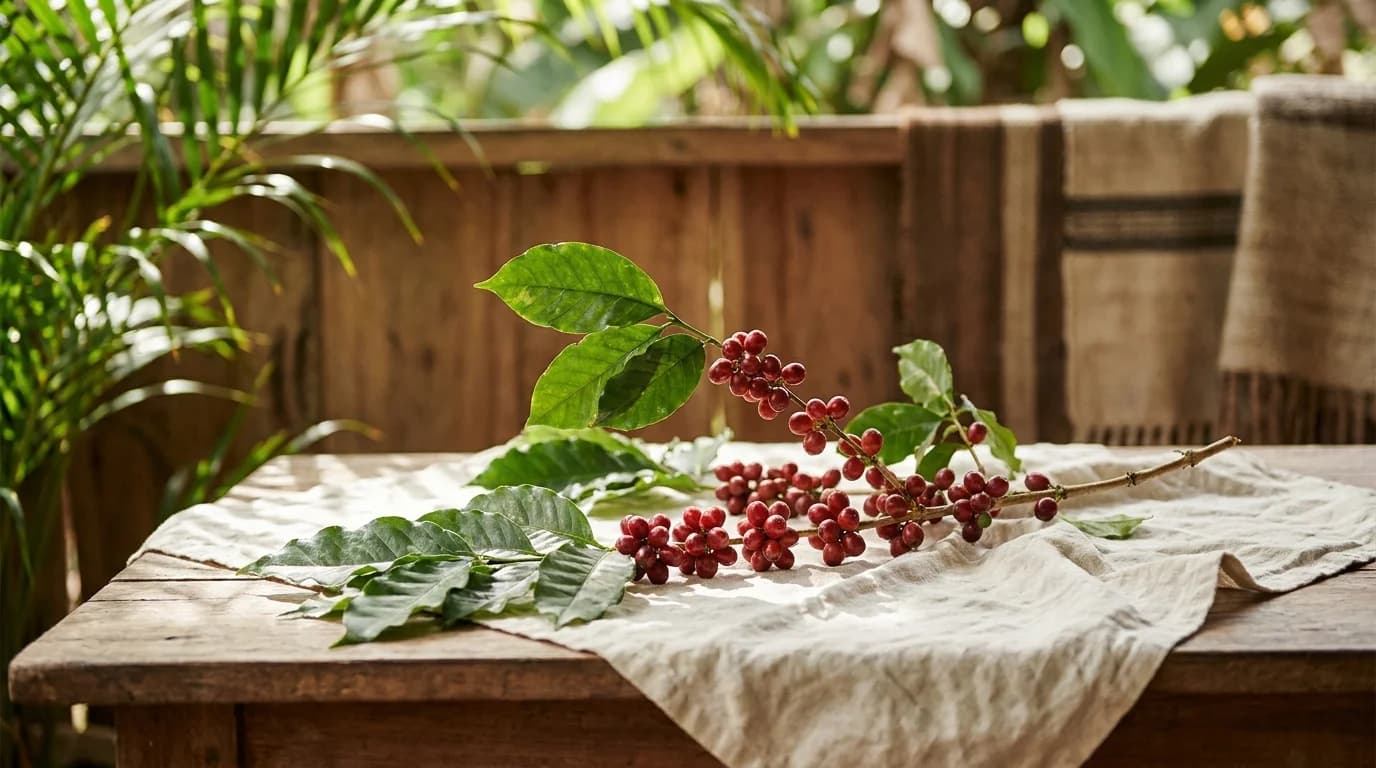
The Philippines occupies a unique position in coffee botany: it is one of the only countries in the world with significant commercial cultivation of all four species — arabica, robusta, liberica, and excelsa. Yet its most distinctive contribution is not any of the first three but a sub-variety of liberica that barely exists elsewhere: Coffea liberica var. barako, a large-beaned, intensely flavoured coffee that has been a Philippine tradition for well over a century and came close to disappearing entirely in the 1880s.
Four species — arabica, robusta, liberica, excelsa
the Philippines is among the handful of countries with meaningful commercial cultivation of all four recognised coffee species; most producing countries grow primarily one or two species; this botanical diversity is a direct consequence of the Philippines' varied geography — from sea-level lowlands to high-altitude Cordillera peaks above 1,800 metres[3]
1880s leaf rust nearly ended Philippine coffee export
Hemileia vastatrix (coffee leaf rust) destroyed Philippine coffee production in the 1880s, mirroring the devastation it caused in Ceylon a decade earlier; the Philippines had been a significant coffee exporter before the outbreak — after it, the industry never fully recovered its pre-rust export scale[5]
Barako beans are among the largest in commercial coffee
Coffea liberica var. barako produces beans significantly larger than arabica or robusta — liberica beans are among the largest in commercial coffee production; the size difference is visible to the naked eye and the large bean contributes to the distinctive extraction characteristics of Barako coffee[3]
Coffee's arrival in the Philippines
Coffee was introduced to the Philippines during Spanish colonial rule, likely in the late 18th century[4]. The Spanish missions and friars established coffee cultivation in Batangas province south of Manila, where the volcanic soil and tropical climate proved suitable for liberica varieties.
By the mid-19th century, Philippine coffee had become a notable export commodity. Batangas in particular was producing coffee at scale, and the local liberica variety — eventually named barako — was the primary crop. The Philippines was one of the significant coffee-exporting countries of the era, with shipments reaching Europe and the Americas[2].
The 1880s collapse
The collapse of Philippine coffee production followed the same pathogen that had devastated coffee in Ceylon (Sri Lanka) a decade earlier: Hemileia vastatrix, the coffee leaf rust fungus[5].
Coffee leaf rust infects the underside of coffee leaves with orange-yellow spore pustules. As the infection progresses, the leaves drop, the plant loses its ability to photosynthesize, and eventually weakens and dies. The fungus spreads rapidly through a plantation via wind-dispersed spores.
The 1880s outbreak devastated Philippine coffee across its growing regions. Batangas — the heart of the liberica barako tradition — was severely affected. Production that had supplied global markets collapsed within years.
Recovery was partial. Some barako cultivation continued in Batangas and neighbouring Cavite province, but at a fraction of pre-rust levels. The Philippines pivoted away from coffee as a primary export crop, and the barako tradition survived primarily as a domestic cultural institution rather than an export commodity[1].
Growing regions and species
Figure
Philippine coffee: approximate production share by species and region
Values in approximate % of national production
Batangas and Cavite: The Barako heartland. Lowland volcanic provinces south of Manila where Coffea liberica var. barako has been cultivated for over 150 years. The tradition is closely tied to local identity — Batangas people are known domestically as coffee drinkers and barako producers. Production is small by global standards but culturally central[3].
Sagada, Mountain Province: A highland municipality in the Cordillera mountain range of northern Luzon, at approximately 1,500 metres. Sagada arabica has developed a strong domestic specialty reputation — sold in Manila's specialty cafés and online roasters as a premium Philippine origin. Coffee tourism to Sagada has grown as visitors seek to experience the highland growing environment alongside the region's other natural attractions.
Benguet: Neighbouring Sagada in the Cordillera, Benguet province also produces arabica at altitude. Benguet coffee is less internationally marketed than Sagada but part of the same highland arabica tradition.
Mt Apo, Mindanao: The highest peak in the Philippines (2,954 metres) has coffee grown on its lower slopes in Davao del Sur province. Arabica from Mt Apo has appeared in specialty competitions and is being developed as a distinct origin[1].
Barako flavour and brewing
The barako cup is immediately distinctive to anyone expecting arabica or robusta[3]:
Appearance: Barako beans are noticeably large — significantly bigger than arabica or robusta beans. The roasted bean has a distinctive shape and the roasted aroma is strong and pungent.
Aroma: Intense. Often described as anise-like, woody, or resinous. Some drinkers find it off-putting; others prize it as the defining character of Philippine coffee.
Cup: Very heavy body. Low to moderate acidity. Woody and earthy core notes. A persistent, pungent finish. The flavour is more polarising than arabica — clearly not subtle.
Barako is traditionally brewed in a clay or metal pot, sometimes as a decoction — grounds added to boiling water, the mixture strained before serving. It is commonly drunk with sugar and, in traditional Filipino households, can be served as barako salabat (barako with ginger).
The contemporary Philippine coffee scene
Manila has a growing specialty coffee scene that includes single-origin Philippine arabica from Sagada, Benguet, and Mt Apo alongside international specialty origins. Philippine barista competitors have competed at international events using Philippine-grown coffees.
The specialty scene and the barako tradition coexist without much overlap. Specialty cafés serve highland arabica with third-wave pour-over equipment; traditional barako remains available in Batangas markets, wet markets in Manila, and domestic food retail. The two exist in different market tiers and cultural contexts[2].
The honest summary
The Philippines grows all four commercially recognised coffee species — arabica, robusta, liberica, and excelsa — but is most distinctively associated with Kapeng Barako, made from Coffea liberica var. barako, a variety grown primarily in Batangas and Cavite provinces south of Manila. Barako produces large beans with an intensely heavy body, woody and anise-like aroma, and strong pungent flavour unlike arabica or robusta. Philippine coffee was devastated by the coffee leaf rust outbreak of the 1880s, eliminating what had been a significant export industry. Recovery has been slow; robusta now dominates production by volume. Highland arabica from Sagada and Benguet in the Cordillera is gaining specialty recognition domestically and internationally. The Philippines remains a small producer by global standards with an outsized cultural coffee identity.
Frequently asked questions
- What is Kapeng Barako?
- Kapeng Barako (also written as baraco) is a coffee made from Coffea liberica var. barako, a variety of the liberica species found primarily in the Philippines. 'Barako' translates roughly as 'wild boar' or 'strong man' in Tagalog, reflecting the coffee's reputation for intensity and boldness. Barako coffee is grown mainly in the lowland provinces of Batangas and Cavite, south of Manila. The cup profile is distinctly different from arabica or robusta — heavier body, woody, earthy, and anise-like notes, stronger and more pungent than most commercially available coffees. It has been a Philippine staple for over a century.
- What happened to Philippine coffee in the 1880s?
- In the 1880s, the coffee leaf rust fungus Hemileia vastatrix — which had already devastated coffee production in Ceylon (Sri Lanka) — swept through the Philippines. The rust attacks arabica and liberica trees, destroying leaves and ultimately killing the plants. Philippine coffee, which had been a significant export commodity, was nearly eliminated. Production collapsed, and the country — which had previously been a notable coffee exporter — shifted to other agricultural products. Recovery was slow; coffee was never fully re-established at the export scale it had reached before the rust outbreak.
- What is special about Philippine highland coffee?
- The Cordillera mountain range in northern Luzon — particularly Sagada (Mountain Province), Benguet, and Kalinga — produces arabica coffee at 1,200–1,800 metres altitude. These highland coffees have gained specialty recognition for fruit and floral characteristics associated with high-altitude arabica. Sagada coffee in particular has developed a reputation as a premium Philippine origin, promoted through local coffee tourism and specialty café culture in Manila. Production volumes are small, and most highland coffee is consumed domestically.
- Does the Philippines grow arabica, robusta, or something else?
- All four commercially recognised coffee species. The Philippines is one of the very few countries growing all of: arabica (highland regions — Sagada, Benguet, Mt Apo in Mindanao), robusta (widely grown in Bukidnon and other lowland regions, the bulk of production), liberica (Batangas and Cavite — the Barako tradition), and excelsa (Coffea liberica var. dewevrei — grown in southern Philippines, sometimes used in blends). This botanical diversity is unusual globally — most producing countries grow primarily one species.
- How does Barako taste compared to arabica or robusta?
- Barako (liberica) has a distinctive flavour profile unlike arabica or robusta. It typically shows: very heavy body, woody and earthy base notes, often a pungent or anise-like aroma, lower acidity than arabica, and a distinctive 'wild' character that is immediately recognisable. The beans are significantly larger than arabica — liberica beans are among the largest coffee beans in commercial use. The cup is intensely flavoured and is considered an acquired taste by coffee drinkers accustomed to arabica or robusta blends.
References
Every factual claim in this article is drawn from the sources below. See the source library for how we grade evidence.
- [1]Coffee agronomyFood and Agriculture Organization of the United Nations · Reference work · Tier 2 · Moderate
- [2]World Coffee Statistics DatabaseInternational Coffee Organization · Official dataset · Tier 1 · Strong
- [3]Coffee Varieties CatalogWorld Coffee Research · Reference work · Tier 2 · Moderate
- [4]Uncommon Grounds: The History of Coffee and How It Transformed Our World (revised edition)Basic Books (Mark Pendergrast) · 2010 · Reference work · Tier 2 · Moderate
- [5]Coffee leaf rust: a reviewPMC / NIH · 2022 · Review · Tier 2 · Moderate
Related reading
- Beans, Roasts & OriginsLiberica Coffee: The Third Commercial Coffee Species→
- Beans, Roasts & OriginsArabica vs Robusta: Taste, Caffeine, and Differences→
- Beans, Roasts & OriginsCoffee Origins Around the World→
- Beans, Roasts & OriginsThai Coffee: Doi Chang Arabica and Oliang Explained→
- Beans, Roasts & OriginsIndian Coffee: Monsoon Malabar and Filter Kaapi→
- Beans, Roasts & OriginsWhy Arabica Has Almost No Genetic Diversity→