Indian Coffee: Monsoon Malabar and Filter Kaapi
By Coffee Studies Editorial·Published July 19, 2026·5 min read
Quick answer
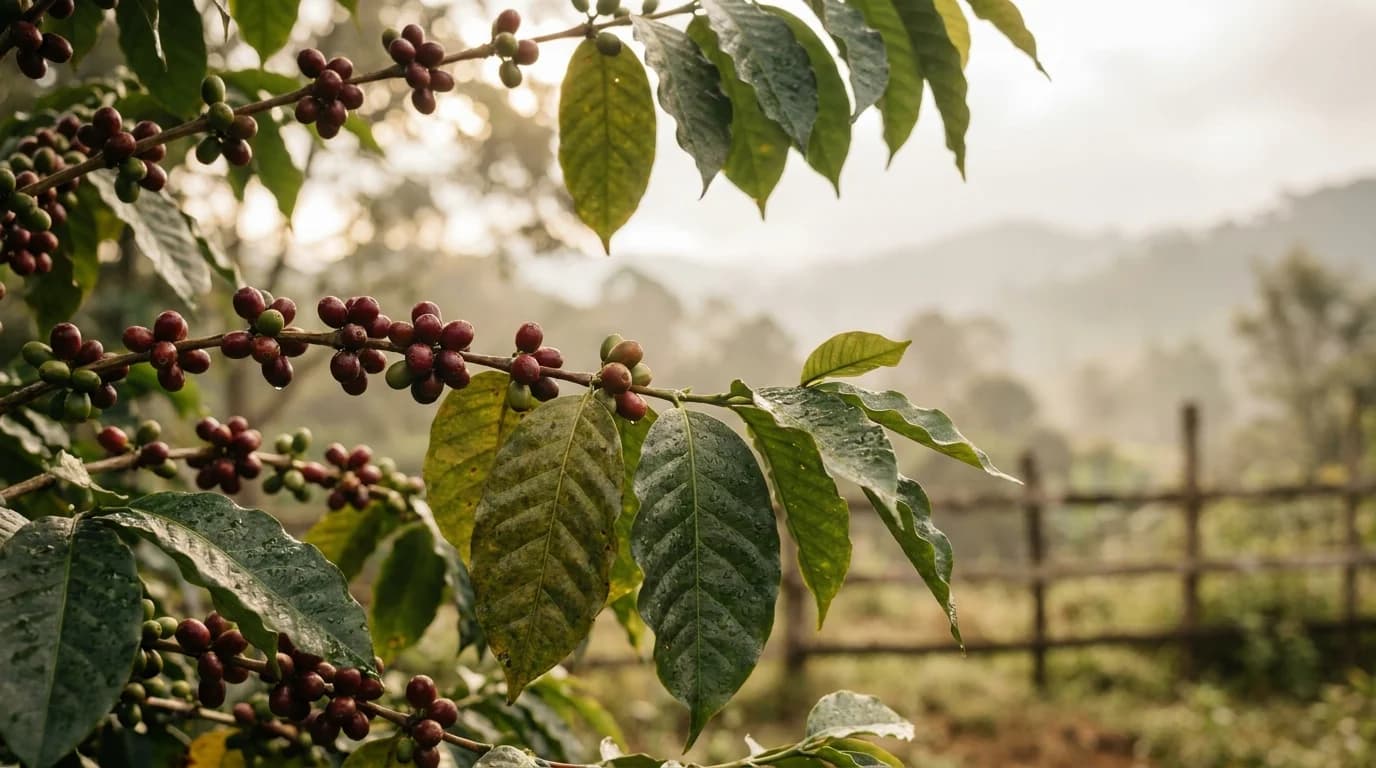
Indian coffee sits at an unusual intersection: it is one of the world's oldest continuous coffee-growing traditions (predating the Brazilian industry by over a century), produces one of the most distinctive processed coffees in the world (Monsoon Malabar), and has an entirely separate domestic drinking culture (South Indian filter coffee) that has almost nothing to do with how Indian coffee is consumed internationally. Understanding Indian coffee means keeping all three in view simultaneously.
6th-largest coffee producer globally
India produces approximately 370,000–400,000 metric tonnes of green coffee annually, making it the world's sixth-largest producer; Karnataka state alone accounts for around 70% of national production[2]
Monsoon Malabar: 12–16 weeks of intentional monsoon exposure
Monsoon Malabar beans are intentionally exposed to monsoon wind and humidity for 12–16 weeks, swelling to up to twice their original size and transforming from green to golden-yellow; the processing was originally accidental during colonial-era sea voyages and was deliberately recreated when faster ships eliminated the natural effect[1]
Shade-grown under spice polycultures
almost all Indian coffee is grown under a multi-layered canopy of shade trees and spice crops — cardamom, pepper, areca nut, banana; the shade-polyculture system creates distinctive micro-climatic growing conditions and allows farmers to diversify income beyond coffee alone[1]
How coffee came to India
The most famous story of coffee's arrival in India is one of smuggling. Around 1600, Baba Budan — a Sufi Muslim pilgrim returning from Mecca — reportedly concealed seven coffee seeds beneath his robes to circumvent the Ottoman ban on exporting viable coffee seeds from Yemen. He planted them on the hillside now known as Bababudangiri (Baba Budan Hills) in the Chikkamagaluru district of Karnataka[3].
Whether the story is strictly historical or partly legend, it is clear that coffee cultivation established itself in the Western Ghats of Karnataka by the early 17th century — centuries before the crop's introduction to Brazil (1727) or the establishment of large-scale colonial plantations.
The British East India Company expanded coffee cultivation commercially in the 19th century, establishing estate plantations across Coorg (Kodagu), Nilgiris, and Wayanad. The Coffee Board of India was established in 1942 and continues to regulate and promote Indian coffee production[1].
Growing regions
Figure
Indian coffee production by state (approximate % of national output)
Values in % of total production
Coorg (Kodagu), Karnataka: The most famous coffee district, centred on the Kodava people's homeland in the Western Ghats. Arabica dominates at higher elevations. Coorg coffee has a mild, balanced character — medium body, moderate acidity, chocolate and fruit notes. Estates here have been operating for 150+ years.
Chikkamagaluru, Karnataka: The birthplace of Indian coffee (Bababudangiri hills). Produces both arabica and robusta. Historically the source of some of India's best-regarded estate coffees.
Wayanad, Kerala: Primarily robusta, grown in a lower- altitude, high-rainfall environment. Wayanad robusta is heavily used in the espresso blend industry and in South Indian filter coffee mixes[4].
Araku Valley, Andhra Pradesh: A highland valley at 900–1,100 metres, developed as a specialty coffee region through tribal cooperative programmes. Araku Valley arabica has won recognition at international specialty competitions and represents one of the most compelling recent developments in Indian specialty coffee.
Monsoon Malabar: the accident that became a product
Monsoon Malabar is the most distinctive Indian coffee product and has no real equivalent anywhere else in the world[1].
The accidental origin: In the 19th century, green coffee from the Malabar Coast was loaded onto sailing ships for the months-long voyage around the Cape of Good Hope to Europe. During the journey, the beans were exposed to humid sea air and monsoon conditions in the ship's hold. By the time they arrived in Europe, the beans were swollen, yellow-golden in colour, and had changed flavour dramatically — losing their acidity and developing a heavy, musty, woody character that Europeans came to associate with Indian coffee.
When the Suez Canal and steam ships dramatically shortened transit time, European buyers complained that the coffee no longer tasted the same. To recreate the original character, Indian producers began intentionally exposing beans to monsoon conditions on the Malabar coast.
The modern process: Green coffee beans (arabica or robusta) are spread in warehouses with open sides on the Malabar Coast — typically in Mangalore or nearby towns — during the Southwest Monsoon season (June–September). Over 12–16 weeks:
- High humidity (70–80%) causes the beans to absorb moisture
- The beans swell to approximately 1.5–2× their original size
- The colour changes from green to pale yellow or golden
- The cell structure of the bean is altered — the internal coffee matrix changes as it expands and contracts
- The natural sugars and acids transform
- The beans are periodically raked and turned to ensure even exposure[1]
The flavour result: Monsoon Malabar produces a distinctively heavy, low-acid cup with pronounced musty, woody, earthy notes — sometimes described as similar to aged spirits, pipe tobacco, or wet earth. Acidity is dramatically lower than conventionally processed Indian coffee. Body is typically very heavy. The profile is polarising — Monsoon Malabar enthusiasts prize its earthiness, while those expecting brighter specialty profiles find it off-putting.
South Indian filter coffee: kaapi culture
South Indian filter coffee (kaapi — the Tamil and Telugu pronunciation of "coffee") is one of the most distinctive regional coffee traditions in the world and one that the international specialty industry has largely overlooked[3].
The equipment: A two-chamber metal filter — stainless steel or sometimes brass. The upper chamber has a perforated bottom and a plunger/press. Ground coffee is packed into the upper chamber; water is poured in; concentrated decoction drips through the perforated base into the lower chamber below.
The blend: Traditional South Indian filter coffee blends combine:
- Dark-roasted arabica or robusta (or both)
- Chicory root (often 15–30% by weight), which adds a distinctive roasty, slightly bitter flavour and helps the decoction achieve a thick consistency
The preparation: The decoction brews slowly (15–20 minutes for a thick concentrate). The resulting dark liquid is mixed with hot milk at approximately a 1:3 ratio (decoction to milk) and sugar to taste.
The defining ritual is the pour: the milk-coffee mixture is poured from height between a small metal tumbler (the cup) and a wide shallow metal bowl (the dabarah), repeatedly. The repeated pouring aerates the coffee, creates a frothy top, and — importantly — cools it to a drinkable temperature. Kaapi served correctly should have a thin head of foam and be hot but not scalding.
The honest summary
India produces approximately 370,000 tonnes of coffee annually from the Western Ghats states of Karnataka (70%), Kerala (23%), and Tamil Nadu (5%), with the emerging Araku Valley specialty region in Andhra Pradesh gaining international recognition. Indian coffee's most unique product is Monsoon Malabar — green beans exposed to monsoon winds and humidity for 12–16 weeks, which swells and transforms them into a low-acid, heavy, earthy coffee with no direct equivalent elsewhere. South Indian filter coffee (kaapi) is a domestic tradition using a metal two-part filter, a dark robusta-chicory blend, and a milk-and-pour technique producing a thick, frothy, sweet coffee entirely distinct from how Indian coffee is consumed internationally.
Frequently asked questions
- Where is coffee grown in India?
- The three main coffee-growing states are Karnataka (approximately 70% of production, with Coorg/Kodagu, Chikkamagaluru, and Hassan as key districts), Kerala (approximately 23%, concentrated in Wayanad district), and Tamil Nadu (approximately 5%, Nilgiris district). A smaller but growing specialty region is Araku Valley in Andhra Pradesh, where tribal communities produce arabica at high altitudes. Bababudangiri in Chikkamagaluru is historically significant as the site where coffee was first cultivated in India, reputedly by Baba Budan in the early 17th century.
- What is Monsoon Malabar coffee?
- Monsoon Malabar is a processing method unique to India in which green (unroasted) coffee beans are exposed to seasonal monsoon winds and humidity for 12–16 weeks in open warehouses on the Malabar Coast (Karnataka and Kerala). The moisture swells the beans significantly, turns them from green to pale yellow or golden, and substantially changes the flavour profile — dramatically reducing acidity and introducing musty, woody, earthy, and full-bodied characteristics unlike any other coffee. The process was originally accidental: pre-20th century export ships travelling around the Cape of Good Hope took months, and the beans were naturally monsoon-treated during the voyage. When faster shipping eliminated this effect, Indian producers intentionally recreated it.
- What is South Indian filter coffee (kaapi)?
- South Indian filter coffee, called kaapi (from the Tamil pronunciation of 'coffee'), is made using a small metal two-part filter: coarsely ground coffee (typically a robusta-arabica blend with some chicory) is packed in the top chamber, and boiling water is poured over it. A concentrated decoction drips into the bottom chamber over 15–20 minutes. This decoction is mixed with hot milk in a ratio of roughly 1:3 (decoction:milk) and sugar to taste, then poured rapidly between two metal tumblers (from height) to create a characteristic frothy top. Served in a small metal tumbler-and-dabarah set.
- Does India produce arabica or robusta?
- Both. India is unusual among large coffee producers in growing significant quantities of both species. Arabica grows at higher altitudes (above 1,000 metres) — primarily in Coorg, Araku Valley, and parts of Chikkamagaluru. Robusta grows at lower altitudes (600–1,000 metres) and at higher volume — particularly in Wayanad (Kerala) and lower Karnataka. Indian robusta is used primarily in espresso blends internationally and in domestic filter coffee blends (often with chicory).
- What makes Indian coffee distinctive?
- Three things: the shade-growing tradition (Indian coffee is almost entirely grown under a multi-layered canopy of shade trees and spice crops including pepper, cardamom, and areca nut — this polyculture creates distinctive growing conditions), Monsoon Malabar processing (unique to India), and the chicory addition in South Indian blends (up to 30% chicory by weight is common in commercial South Indian filter coffee mixes, adding a distinctive roasty bitterness).
References
Every factual claim in this article is drawn from the sources below. See the source library for how we grade evidence.
- [1]Coffee agronomyFood and Agriculture Organization of the United Nations · Reference work · Tier 2 · Moderate
- [2]World Coffee Statistics DatabaseInternational Coffee Organization · Official dataset · Tier 1 · Strong
- [3]CoffeeEncyclopaedia Britannica · Reference work · Tier 3 · Contextual
- [4]Coffee Varieties CatalogWorld Coffee Research · Reference work · Tier 2 · Moderate
Related reading
- Beans, Roasts & OriginsCoffee Processing Methods Explained→
- Beans, Roasts & OriginsCoffee Origins Around the World→
- Beans, Roasts & OriginsTop Coffee-Producing Countries in the World→
- Beans, Roasts & OriginsWhat Is Specialty Coffee? The 80-Point Standard→
- Beans, Roasts & OriginsHoney Process Coffee: Yellow, Red, and Black Honey→
- Beans, Roasts & OriginsPhilippine Coffee: Kapeng Barako and Liberica→