Honey Process Coffee: Yellow, Red, and Black Honey
By Coffee Studies Editorial·Published July 19, 2026·5 min read
Quick answer
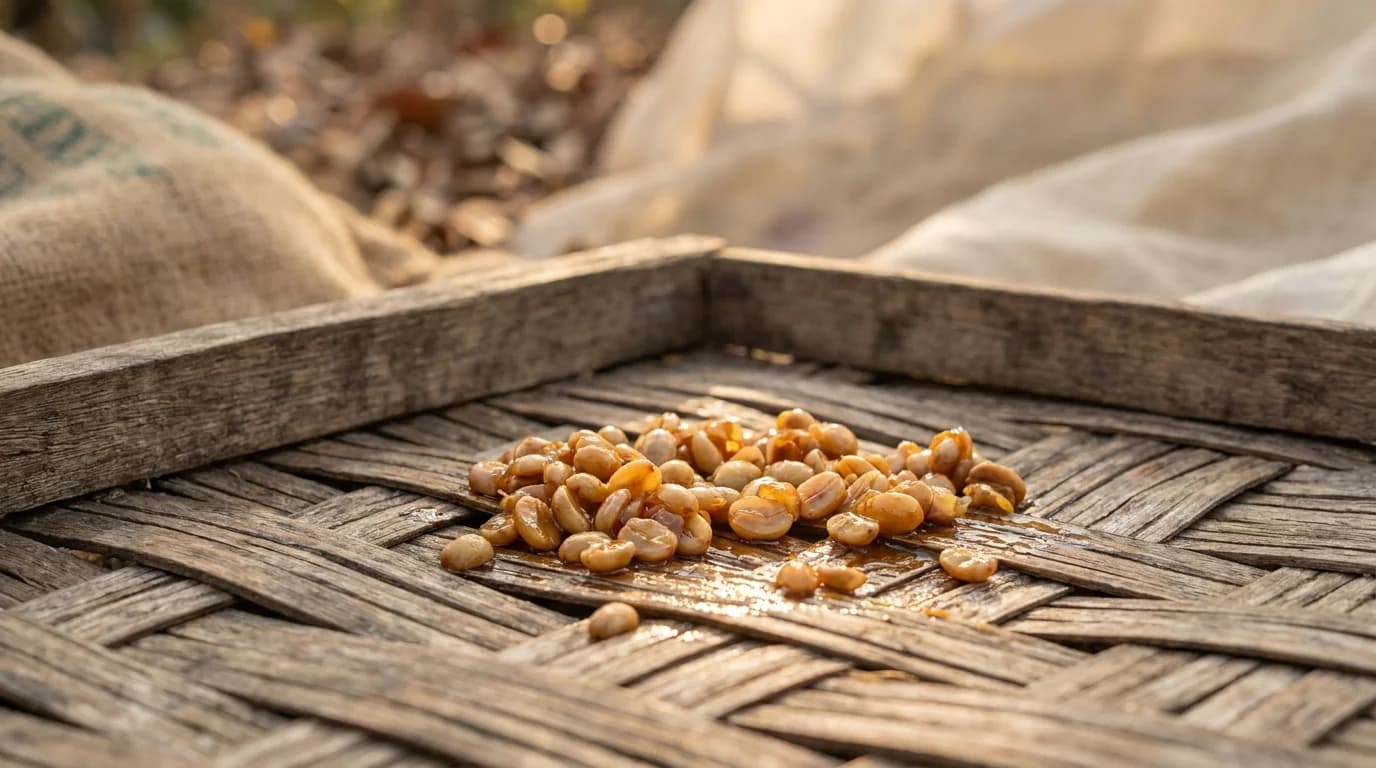
Coffee processing decisions made before roasting have as much influence on the final cup as the roast itself — sometimes more. The choice of how much fruit to leave on a bean during drying determines whether you get a cup that tastes like a clean mineral water pour-over or a glass of stone fruit wine. Honey process is the deliberate middle path between these extremes, and the colour designations — yellow, red, black — are a shorthand for where on that spectrum a given coffee lands.
Honey process means sticky, not sweet — named for mucilage texture
the 'honey' in honey process refers to the texture of the coffee beans during drying — the retained mucilage is sticky like honey — not to any flavour addition; the method adds no ingredients; the sweetness and fruit character in the cup come from the fermentation of retained fruit sugars during drying[1]
Black honey: up to 3–4 weeks drying with full mucilage
black honey coffee retains close to 100% of the mucilage during drying and may take 2–4 weeks to dry fully; the extended mucilage fermentation dramatically increases body and fruit character, placing black honey much closer to natural process on the flavour spectrum[3]
Costa Rica drove honey process development from the 2000s
honey process became a defining feature of Costa Rican specialty coffee production from the 2000s — driven partly by regulations restricting pulping effluent discharge into waterways, which made water-intensive washed processing less viable, and partly by the flavour differentiation the method provided in specialty markets[1]
The anatomy of a coffee cherry
To understand honey process, it helps to know what the layers of a coffee cherry are[1]:
From outside to inside:
- Outer skin (exocarp): The red (or yellow, orange, or pink, depending on variety) outer layer of the cherry
- Mucilage (mesocarp): A sticky, pectin-rich fruit pulp layer under the skin — this is what "mucilage retention" refers to in processing
- Parchment (endocarp): A dry, papery layer encasing the seed
- Silver skin (spermoderm): A thin membrane between parchment and seed
- Seed (the coffee bean): The processed, roasted, and ground product
In washed processing, skin and mucilage are removed before drying. In natural processing, the whole cherry dries intact. In honey process, the skin is removed but varying amounts of mucilage are left on the parchment.
The processing spectrum
Figure
Coffee processing methods: mucilage retention and flavour position
Values in approximate mucilage retention (%)
What happens during honey drying
After the cherry skin is removed, the mucilage-coated beans are spread on raised drying beds or patios[1]. During drying, several simultaneous processes occur:
Mucilage fermentation: The residual sugars and organic acids in the mucilage ferment through microbial activity — yeasts and bacteria, including lactic acid bacteria (LAB), act on the fruit compounds. The fermentation byproducts migrate into the parchment and, to some degree, into the bean itself, influencing the final flavour.
Drying and concentration: As the mucilage dries, its sugars concentrate. The bean is simultaneously drying to its target moisture content (approximately 11–12% for stable export). The longer the drying, the more the mucilage compounds are concentrated and the more fermentation occurs.
Colour development: The remaining mucilage darkens as it ferments and dries, turning from clear/white through yellow, orange, red, and finally dark brown or black. This is why the visual colour designations — yellow, red, black — provide a useful shorthand for how much mucilage was left and how long the drying proceeded[2].
Turning: Honey process beans require careful, regular turning during drying to ensure even drying and prevent mould or over-fermentation on the underside. The stickiness of the mucilage means the beans clump easily — more frequent turning is required compared to natural-processed beans.
Flavour science
The flavour differences between honey types stem from the quantity of mucilage fermentation and the compounds that migrate into the bean[2]:
Sugars: Mucilage is rich in pectin, sucrose, fructose, and glucose. The longer the mucilage remains, the more these sugars are available to fermentation and the more their breakdown products — lactic acid, acetic acid, alcohols, esters — influence the cup.
Organic acids: The fermentation of fruit sugars produces lactic and acetic acids that soften perceived acidity in the cup — which is why honey process coffees often taste less sharp than washed coffees despite the acidity not being dramatically lower in pH.
Esters and fruity volatile compounds: Fermentation produces esters that contribute stone fruit and tropical fruit notes. Higher mucilage retention and longer drying produce more complex ester profiles — this is why black honey approaches natural process character with prominent fruit notes.
Body compounds: The mucilage contributes polysaccharides and lipids that increase the perceived body and mouthfeel of the brewed coffee[3].
Costa Rica and the honey process movement
The honey process is most strongly associated with Costa Rica, where it was extensively refined from the late 2000s onward[1].
Two factors drove its development:
Environmental regulation: Costa Rica has strict regulations on wastewater discharge from coffee processing. The traditional washed process requires large volumes of water for fermentation tanks, washing channels, and rinsing — and the effluent (water mixed with mucilage and pulp) is a significant pollutant if released into waterways. Honey process dramatically reduces water use by skipping the washing stage, making it more compliant with environmental standards.
Market differentiation: As the specialty coffee market developed, producers found that honey process created flavour profiles that distinguished their coffees from standard washed offerings — more sweetness and body without the fermentation risk of natural process.
Small Costa Rican micro-mills (beneficios) competed heavily on honey process innovation, developing more precise colour designations and drying protocols to produce consistent, marketable profiles. This infrastructure and vocabulary subsequently spread to El Salvador, Guatemala, and other Central American origins[4].
The honest summary
Honey process coffee removes the cherry skin but retains varying amounts of the sticky mucilage during drying — roughly 25% for yellow honey, 50% for red honey, and 95% for black honey. The name refers to the sticky texture of the mucilage on the beans during drying, not any added ingredient. The retained mucilage ferments during drying, producing sugars, organic acids, and esters that increase the cup's sweetness and body relative to washed coffee, without reaching the intense fruit character of natural process. Black honey most closely approaches natural process. The method was extensively developed in Costa Rica from the 2000s, partly driven by environmental regulations limiting water use in washed processing. The colour designations — yellow, red, black — provide a practical shorthand for where on the washed-to-natural flavour spectrum a honey process coffee lands.
Frequently asked questions
- What is honey process coffee?
- Honey process coffee is a processing method that removes the outer cherry skin but leaves some or all of the sticky mucilage (the fruit pulp layer between the skin and the parchment) on the bean during drying. The coffee is then dried on raised beds or patios for days to weeks, during which the mucilage ferments and dries onto the parchment. The proportion of mucilage retained — and the drying duration — determines whether the result is called yellow, red, or black honey. The method sits between washed processing (all mucilage removed before drying) and natural processing (dried with the whole cherry intact).
- Does honey process coffee taste like honey?
- No. The name refers to the texture of the beans during processing — the mucilage is sticky like honey — not to any flavour addition or the presence of actual honey. Honey process coffees often taste sweeter and more fruit-forward than washed coffees, but 'honey' is not typically listed as a tasting note by specialty roasters. Common descriptors include: stone fruit (peach, apricot, plum), caramel, brown sugar, mild tropical fruit. The specific flavour depends on the variety, origin, and how much mucilage was retained.
- What is the difference between yellow, red, and black honey?
- The designations refer to mucilage retention and drying time: yellow honey retains roughly 25% of the mucilage and dries relatively quickly (4–8 days), producing a cup closer to washed — clean, brighter acidity, moderate sweetness; red honey retains roughly 50% mucilage and dries for 8–12 days, with more body and sweetness; black honey retains close to 100% mucilage and dries for 2–4 weeks, producing the most fruit-forward, heavy-bodied result approaching natural-process character. Some producers also use white honey (minimum mucilage) and gold honey (intermediate) as additional designations.
- How does honey process compare to washed and natural?
- On a spectrum: washed coffee has all mucilage removed before drying — clean, bright, high acidity, terroir-transparent; natural coffee dries with the whole cherry intact — heavy body, intense fruit, often wine or berry notes, higher fermentation character; honey process sits between these. Yellow honey is closest to washed; black honey is closest to natural. The honey process allows producers to modulate the flavour profile along this spectrum by controlling how much mucilage they leave on and how long they dry.
- Where is honey process coffee most common?
- Honey process is most strongly associated with Costa Rica, where it was extensively developed from the 2000s onward as a middle path between washed and natural that reduced water use (washed requires significant water for fermentation tanks and washing channels) while producing distinctive cup profiles. El Salvador is also closely associated with honey process, and the method is now used across Central America, Brazil, and some producers in Africa and Asia.
References
Every factual claim in this article is drawn from the sources below. See the source library for how we grade evidence.
- [1]Coffee agronomyFood and Agriculture Organization of the United Nations · Reference work · Tier 2 · Moderate
- [2]Coffee volatile compounds and roast markersPMC / NIH · 2016 · Review · Tier 2 · Moderate
- [3]Brewing FundamentalsCoffee Science Foundation · Reference work · Tier 2 · Moderate
- [4]Coffee Varieties CatalogWorld Coffee Research · Reference work · Tier 2 · Moderate
Related reading
- Beans, Roasts & OriginsCoffee Processing Methods Explained→
- Beans, Roasts & OriginsCoffee Fermentation: Microbes, Processing, and Flavour→
- Beans, Roasts & OriginsCarbonic Maceration Coffee: Wine-Inspired Processing→
- Beans, Roasts & OriginsCoffee Origins Around the World→
- Beans, Roasts & OriginsCosta Rica Coffee: Tarrazú, Varieties, and Distinction→
- Beans, Roasts & OriginsWhat Is Peaberry Coffee and Is It Worth the Premium?→