Kissaten: Japan's Historic Coffee Shop Culture
By Coffee Studies Editorial·Published July 19, 2026·6 min read
Quick answer
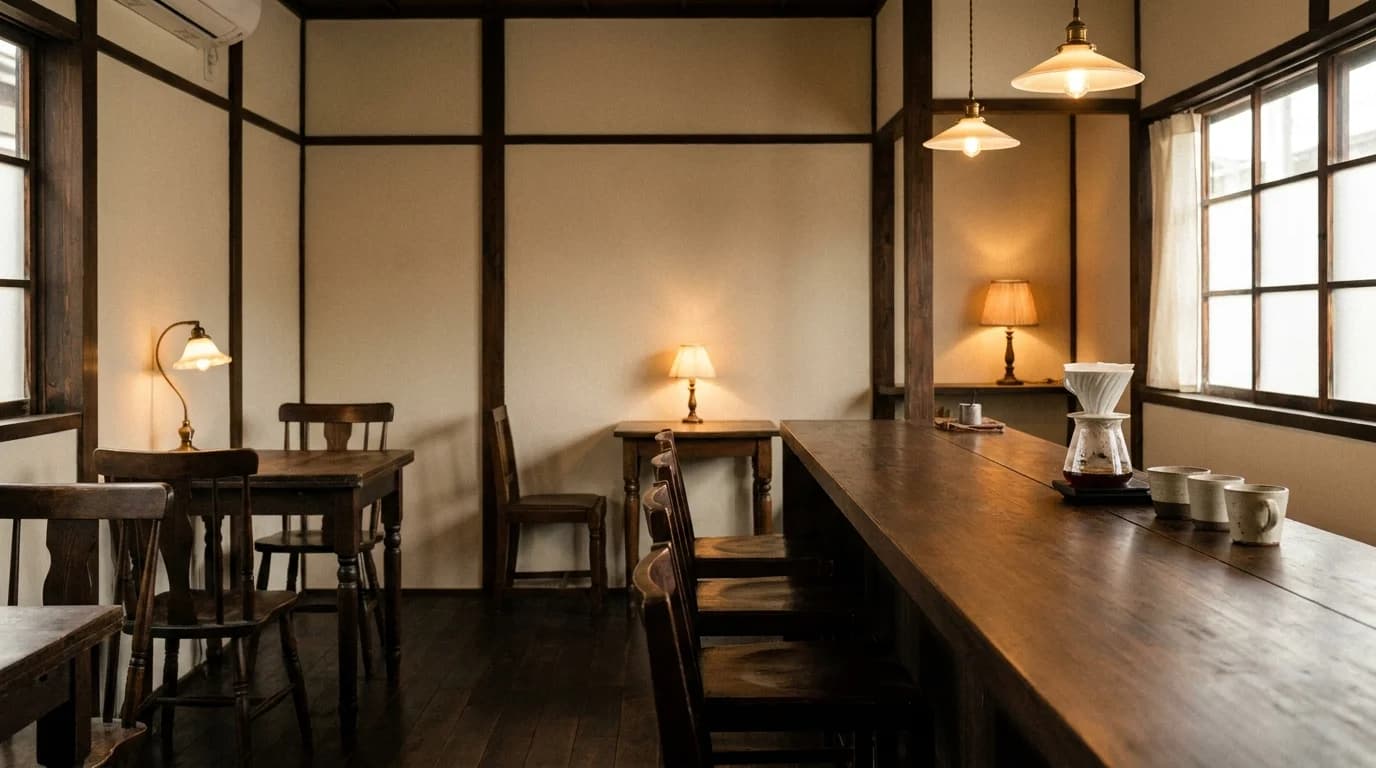
Japan is one of the world's largest coffee importing nations despite growing no coffee domestically and having one of the world's deepest tea cultures. How a country that was not a coffee origin and was deeply invested in tea came to develop arguably the world's most technically precise café tradition is a story about cultural translation, craft obsession, and a particular kind of social space that had no equivalent elsewhere.
~170,000 kissaten at peak in the 1980s
the kissaten was a mass social institution at its height — approximately 170,000 establishments in Japan by the early 1980s, concentrated in cities, serving as third-place social spaces before that concept was formalised[1]
Hario and Kalita — equipment developed for kissaten culture
the pour-over dripper designs that became global third-wave standards — Hario V60, Kalita Wave — were developed for and refined through decades of Japanese kissaten use; the international specialty movement adopted Japanese equipment that already had a half-century of craft tradition behind it[2]
Japan: 3rd-largest coffee importer globally
Japan imports approximately 400,000–450,000 tonnes of green coffee annually, making it the world's third-largest importer after the United States and Germany — a scale driven by the kissaten tradition and contemporary café culture[3]
Coffee's arrival in Japan
Coffee reached Japan in the late 17th century through Dutch traders at Dejima, the artificial island off Nagasaki that was Japan's only permitted point of Western commercial contact during the Edo period. The Tokugawa shogunate's national isolation policy (sakoku) meant coffee remained confined to traders and the few Japanese permitted contact with them[1].
When sakoku ended with the Meiji Restoration in 1868, Japan opened rapidly to Western influences — and coffee was among them. The first kissaten opened in 1888 in Tokyo's Ueno district: Kahiichakan (可否茶館), established by Tei Eikei, a Japanese man who had lived in the United States. It served coffee, offered billiard tables, chess sets, and newspapers — modelled on the European coffeehouse as a social space for intellectual exchange.
The Kahiichakan failed commercially within a few years, but the model it established — the coffeehouse as a social and intellectual venue — persisted. By the early 20th century, Taisho-era kissaten were gathering points for writers, artists, and political activists in a Japan rapidly absorbing Western cultural forms[2].
The kissaten's golden era: 1950s–1980s
The post-war era accelerated kissaten growth dramatically. Japan's economic recovery brought urban wage earners who needed affordable social venues outside home and office. The kissaten filled this gap.
Figure
Estimated kissaten count in Japan by decade
Values in thousands of establishments
The kissaten was not just a place to drink coffee — it was one of Japan's primary third-place social environments. In Japanese urban life, the relationship between home (private) and workplace (formal) left limited space for informal social gathering. The kissaten provided exactly this: a semi-public space with a degree of formality (you paid for your seat, the master was in attendance) but without the social obligations of a home visit or the hierarchy of the office[1].
The craft of the kissaten master
The defining figure of the kissaten was the maister (マスター) — the owner-operator who brewed coffee to order behind the counter. The maister's craft became a central feature of the kissaten's identity and, ultimately, Japan's contribution to global coffee culture.
Several elements distinguished the kissaten approach to coffee:
Hand-drip precision: While espresso was the dominant café format in Italy and spreading across Europe, Japanese kissaten developed hand-drip pour-over as their primary method. The Hario V60 drip was developed for this use. Pouring technique — the spiral pour, the rate of water addition, the temperature control — became a craft discipline with its own masters and techniques[2].
Siphon (vacuum pot) brewing: The siphon coffeemaker — using vacuum pressure to draw brewed coffee from an upper globe to a lower flask — became strongly associated with high-end Japanese kissaten culture. The theatrical visual and precise temperature control of siphon brewing matched the kissaten aesthetic: coffee as performance, precision as respect.
Single-bean sourcing: Before the international specialty movement formalised single-origin coffee as a category, Japanese kissaten masters were often sourcing specific regional coffees, sometimes directly, and explaining their origins to customers. The concept of coffee as a product with a traceable origin — not just a commodity blend — was well-established in Japanese kissaten culture before it became standard international specialty terminology.
Equipment obsession: Japanese craftspeople and companies produced (and continue to produce) coffee equipment held to tolerances not typical in European or American manufacturing. The Hario V60, Kalita Wave, Kono dripper, Takahiro gooseneck kettle — these products refined in the kissaten context became the physical infrastructure of global third-wave pour-over culture.
The jazz kissa and the music café tradition
The kissaten spawned a range of thematic specialisations. Among them, the jazz kissa is the most culturally distinctive[1]:
Jazz kissa (ジャズ喫茶) appeared in the early 1950s as jazz records from the United States became available in Japan. At the time, records were expensive and a jazz collection of any scale represented a significant investment. The jazz kissa provided a service: patrons could pay for coffee and hear jazz recordings played on high-quality equipment.
The format became ritualised: the owner-curator selects and plays records; the sound is the centrepiece; patrons sit and listen in silence. Rules were typically posted:
- No talking
- No mobile phones (in later decades)
- Listening is the activity
This inverts the typical café environment where music is background to conversation. In the jazz kissa, the music is primary and silence is required.
Jazz kissa survived because the listening experience they offered — high-fidelity vinyl on audiophile equipment in an appropriate acoustic space — could not be replicated by streaming services or home listening for patrons without expensive systems. As of the 2020s, approximately 200–300 jazz kissa are estimated to remain operating in Japan, primarily in Tokyo, Osaka, and Kyoto.
Kissaten and third-wave coffee
The international third-wave coffee movement — which emerged in the early 2000s and emphasised single-origin sourcing, precise brewing parameters, transparency of supply chain, and the barista as skilled craftsperson — had Japanese antecedents that are not always acknowledged.
The values the third wave introduced to Western café culture:
- Coffee has distinct flavours by origin and variety
- Brewing parameters (temperature, ratio, time) matter precisely
- The person brewing coffee is performing a skill
- A cup of coffee is worth paying significantly for
These values were already embedded in kissaten culture. When third-wave companies looked for equipment, they found that Japanese drippers, kettles, and brewing accessories — developed over decades for the kissaten market — were already operating at their required quality level[2].
The honest summary
The kissaten is a traditional Japanese coffee shop that emerged in 1888 and became a mass social institution, reaching approximately 170,000 establishments at peak in the early 1980s before declining to around 57,000 by 2020 under competition from convenience store coffee and café chains. The kissaten developed a distinctively precise, craft-focused coffee culture — hand-drip pour-over, siphon brewing, single-bean sourcing, equipment obsession — that predated and directly shaped the global third-wave coffee movement. Equipment developed for kissaten use (Hario V60, Kalita Wave) became global specialty standards. The jazz kissa subtype — where patrons listen to vinyl jazz in required silence — is one of the world's most distinctive café environments and continues to operate in small numbers across Japan's major cities.
Frequently asked questions
- What is a kissaten?
- Kissaten (喫茶店) is the Japanese term for a traditional coffee shop or tea room. The characters literally mean 'drink-tea-shop' but most served coffee alongside tea. The kissaten was a distinctly Japanese social institution — quieter, more contemplative, and more service-focused than Western cafés. Characteristics typically associated with the traditional kissaten include: counter seating where the master (owner-barista) brews coffee to order, hand-drip pour-over or siphon brewing, high attention to water temperature and extraction, cigarette smoke (in older establishments), and a calm, sometimes formal atmosphere.
- How did the kissaten develop Japan's unique coffee culture?
- Japan became a significant coffee importer and consumer despite having no domestic growing tradition and a long-standing tea culture. The kissaten bridged this gap by framing coffee as a craft — the kissaten master's careful brewing was a performance of skill and attention. Over decades, Japanese coffee culture developed its own standards for pour-over precision, water temperature, and grind quality that were in some respects more rigorous than anything in the country of origin. When third-wave coffee developed internationally in the 2000s, many of its values — single-origin sourcing, precise brewing parameters, respect for the barista's craft — resonated with Japanese kissaten traditions that had existed for generations.
- What is a jazz kissa?
- A jazz kissa (ジャズ喫茶, jazu kissa) is a subtype of kissaten specialising in jazz music. The owner curates a vinyl record collection (often thousands of records) played on high-end audiophile equipment — and the point is listening, not background music. Many jazz kissa have posted rules: no talking, no mobile phones. Patrons sit in contemplative silence and listen to the music as an activity in itself. Jazz kissa emerged prominently in the 1950s and 1960s when jazz records from the United States were expensive and rare in Japan; the jazz kissa was a place where people could hear the music they could not afford to own. Many have survived to the present day.
- Why did the kissaten decline?
- The number of kissaten fell from approximately 170,000 at peak in the 1980s to around 57,000 by the late 2010s. Multiple factors contributed: convenience store chains (7-Eleven, FamilyMart, Lawson) introduced affordable drip coffee in the 2000s that challenged the kissaten's price point; fast food chains like Doutor, Starbucks Japan, and Komeda's Coffee offered lower-priced café seating; smoking bans increasingly applied to restaurants; the demographic of regular kissaten patrons aged without being fully replaced by younger customers. High rent in Japanese cities made small independent operations economically difficult.
- What is the connection between kissaten and third-wave coffee?
- Several Japanese coffee professionals and companies were direct bridges. Omotesando Koffee and Blue Bottle Japan brought Japanese precision aesthetics to specialty café design. Japanese equipment brands (Hario, Kalita) whose products were developed for the kissaten market became global standards of the third-wave pour-over movement. Barista competitions in Japan featured Japanese technique for decades before the global specialty scene formalised those practices. The cultural attitude of the kissaten — that brewing coffee is a craft deserving serious attention — is philosophically continuous with third-wave values, even if the specific cultural context differs.
References
Every factual claim in this article is drawn from the sources below. See the source library for how we grade evidence.
- [1]Uncommon Grounds: The History of Coffee and How It Transformed Our World (revised edition)Basic Books (Mark Pendergrast) · 2010 · Reference work · Tier 2 · Moderate
- [2]CoffeeEncyclopaedia Britannica · Reference work · Tier 3 · Contextual
- [3]World Coffee Statistics DatabaseInternational Coffee Organization · Official dataset · Tier 1 · Strong
Related reading
- Beans, Roasts & OriginsThe History of Coffee Houses: From Mecca to London→
- Beans, Roasts & OriginsFika: The Swedish Coffee Culture→
- Beans, Roasts & OriginsThird Wave Coffee: The Specialty Coffee Movement→
- Brew MethodsPour-Over Coffee Guide: Ratios, Bloom, and Technique→
- Beans, Roasts & OriginsWhat Is Specialty Coffee? The 80-Point Standard→
- Beans, Roasts & OriginsThai Coffee: Doi Chang Arabica and Oliang Explained→