Siphon Coffee: How Vacuum Brewing Works and Tastes
By Coffee Studies Editorial·Published July 15, 2026·9 min read
Quick answer
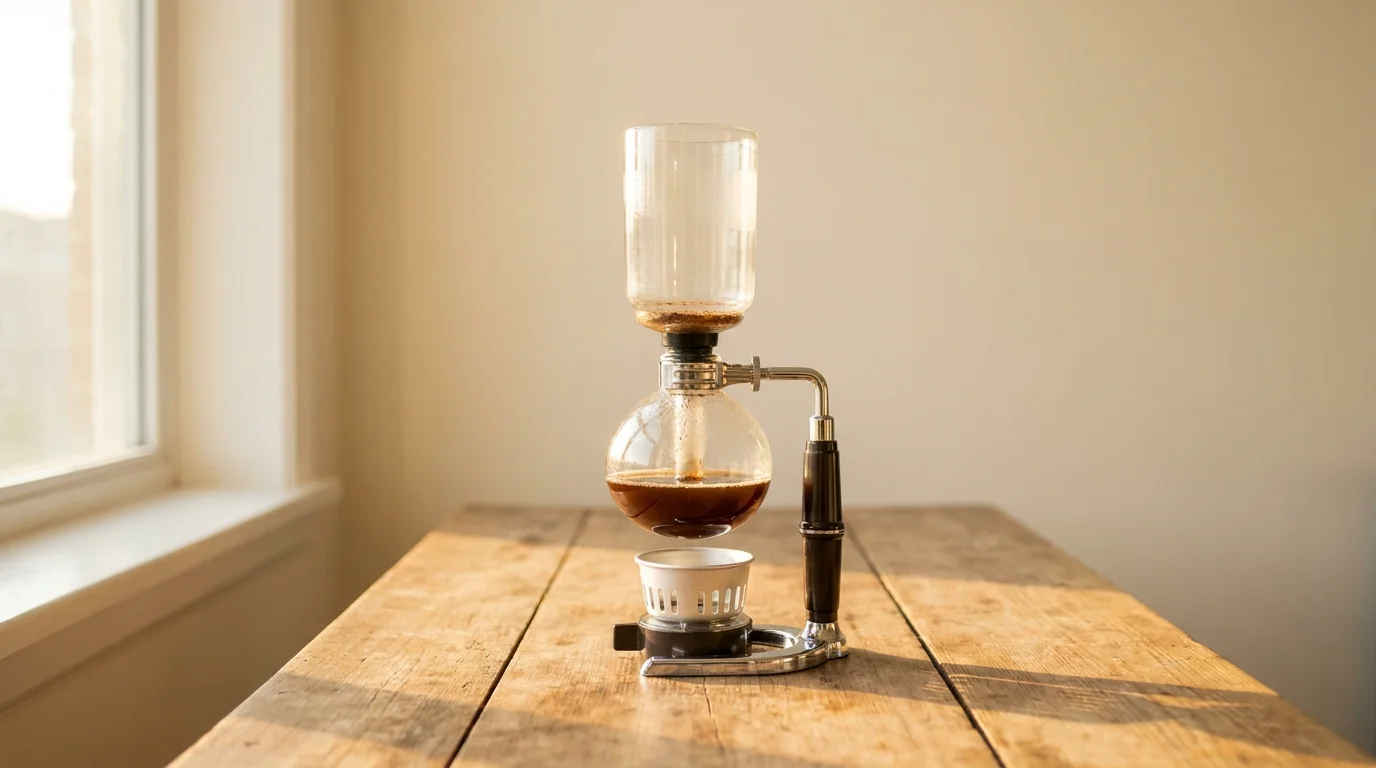
Siphon coffee sits in an odd position in the coffee world: it's one of the oldest brewing methods still in use (older than espresso, older than most drip machines), one of the most visually spectacular, and one of the least practiced by home enthusiasts. The physics is beautiful, the theatre is real, and the coffee is genuinely distinctive — but the equipment is fragile, the technique is fiddly, and the results don't obviously beat much simpler methods. It has a devoted following, particularly in Japanese specialty coffee culture, where siphon brewing is often the reference method rather than pour-over.
Vapor-pressure
water is pushed upward by expanding steam and pulled back down by partial vacuum[1]
1830s
original vacuum pot patents date from Berlin (Loeff) and refined in France a decade later[1]
Full-immersion + filter
unique brewing method that combines immersion extraction with paper or cloth filtering — like French press meets pour-over[2]
Anatomy of a siphon brewer
A siphon (or vacuum pot) has several distinct parts:
Lower chamber
Lower chamber (bulb). A round glass vessel that holds the brewing water. Sits directly over the heat source. Usually holds 300-700 mL depending on size.
Upper chamber
Upper chamber. A cylindrical glass vessel that holds the ground coffee during brewing. Has a long tube extending downward from its base.
Tube and filter
Tube (siphon). The narrow glass tube that connects the upper chamber down into the lower chamber. Water rises through this tube during heating; brewed coffee flows back down through it during cooling.
Filter. Sits at the bottom of the upper chamber, above where the tube meets the upper chamber's floor. Types vary:
- Cloth filter — traditional Japanese siphon standard. Produces the cleanest cup; requires care (must stay wet between uses; needs regular cleaning).
- Paper filter — used in some designs, produces similar clarity to Chemex.
- Metal mesh filter — reusable, faster flow, more body but more sediment.
Seal and heat source
Seal. The upper chamber sits into the lower chamber's neck with a rubber gasket that maintains an air-tight seal during brewing.
Heat source. Traditionally an alcohol burner (spirit lamp) or gas burner. Modern electric siphon brewers use a halogen heat lamp or electric coil.
Stand
Stand. Holds the whole assembly upright, particularly during the transition when the upper chamber is empty and top-heavy.
How siphon brewing actually works
The physics is elegant. Here's the sequence:
Setup phase
Setup phase:
- Water goes into the lower chamber.
- The upper chamber is positioned above (usually resting on the lower chamber's neck, but not yet sealed).
- Coffee goes into the upper chamber (grounds sit on the filter).
- Heat is applied to the lower chamber.
Rising phase
Rising phase:
- Water heats. As it warms, the air trapped in the lower chamber expands.
- Once the water reaches roughly 90°C, some starts to vaporise. Vapour pressure adds to the expanding-air pressure.
- Combined pressure pushes water up through the tube into the upper chamber.
- The upper chamber now contains water and coffee grounds — brewing begins.
Brewing phase
Brewing phase:
- With the upper chamber full, the tube is submerged in water at the bottom of the upper chamber. The system reaches an equilibrium — a small amount of water may remain in the lower chamber; hot vapor continues to bubble through the tube.
- Coffee brews at high temperature (around 90-95°C) for a set time — typically 60-90 seconds after full transfer.
- Stir gently once or twice during brewing to promote even extraction.
Return phase
Return phase:
- Heat is removed. The lower chamber immediately begins to cool.
- Cooling air and vapor contract, creating a partial vacuum in the lower chamber.
- The vacuum pulls brewed coffee back down through the filter and tube into the lower chamber.
- Ground coffee stays in the upper chamber, trapped by the filter.
- Return takes about 30-60 seconds depending on brew size.
Result: brewed coffee in the lower chamber, ready to pour. Empty grounds and filter in the upper chamber, ready to remove.
The classic recipe
Equipment:
- Standard 3-cup Hario Technica or similar siphon (~360 mL capacity).
- Cloth or paper filter fitted in the upper chamber.
- Alcohol burner, gas burner, or halogen electric heat.
- Timer.
- Bamboo stir paddle (traditional) or long spoon.
- Scale, grinder, and hot water source.
Beans:
- 20 g of medium-roast whole beans, ground medium (roughly V60 grind, slightly coarser than pour-over).
Water:
- 320 g of pre-heated water (bring to about 90°C off-heat before adding to the siphon).
Process:
- Pre-heat the water — either bring separately to near-boiling in a kettle, or start with hot water and let the siphon heat it. Starting hot dramatically reduces brew time and equipment stress.
- Add water to the lower chamber.
- Wet the filter in the upper chamber. Attach it in place if not already fitted.
- Seat the upper chamber on top of the lower chamber. Ensure a good seal.
- Apply heat. Water will begin to rise into the upper chamber as it heats.
- Add coffee once water has fully transferred. Start timer.
- Stir once to break the crust and promote wetting of grounds.
- Brew for 60-90 seconds. Do not walk away — heat and timing both matter.
- Optional second stir at about 45 seconds.
- Remove heat. The vacuum will begin drawing coffee back into the lower chamber.
- Wait for full return (30-60 seconds). The upper chamber should be empty of liquid.
- Break the seal and lift the upper chamber off (careful — hot). The lower chamber now contains your brewed coffee.
- Pour and serve.
What siphon coffee tastes like
Siphon produces a distinctive flavour profile that distinguishes it from other methods:
More body than pour-over, less than French press. The paper/cloth filter removes oils and fines (like a pour-over) but the full-immersion brewing extracts more heavily than a percolation method (closer to French press territory).
Clean and articulated flavours. Because temperature stays consistently high throughout the brew (the water is continuously heated during the extraction phase), extraction is very even. Individual flavour notes come through clearly.
Bright acidity — the high consistent temperature enhances the extraction of acidic compounds. Light-roast single-origin coffees particularly shine in siphon brewing.
No sediment — the filter catches everything. The finished cup is completely clear.
Fuller aroma — because brewing happens in an enclosed system with the upper chamber's opening constrained, aromas concentrate rather than dissipating as they might in an open pour-over.
Siphon is often considered particularly good for:
- Light-roast single-origin coffees (Ethiopian Yirgacheffe, Kenyan AA, Panama Geisha).
- Coffees with delicate floral or fruity notes.
- Situations where you want to serve coffee as a sensory experience with theatrical elements.
Less ideal for:
- Dark roasts (may accentuate bitterness).
- Everyday high-volume brewing (too complex and fragile).
Alcohol burner vs halogen electric
Alcohol burner:
- Traditional; produces gentle, adjustable heat.
- Portable; works anywhere without power.
- Requires fuel (denatured alcohol / methylated spirits).
- Open flame — safety considerations.
- Slower to heat.
- Aesthetically the classic siphon look.
Halogen electric:
- Modern; consistent controllable heat.
- No open flame — safer.
- Requires an outlet.
- Faster to heat.
- More expensive equipment.
- Reference in Japanese specialty siphon cafés (Hario Beam Heater and similar).
Gas burner:
- Uses butane or propane cartridge.
- Faster heat than alcohol.
- Portable but requires fuel.
For home use, alcohol is the classic and cheapest option. Halogen is the professional standard but expensive. Any option produces essentially the same coffee — the heat source is a means of temperature control, not a flavour determinant.
Common problems
Water won't rise
Water doesn't rise into the upper chamber:
- Seal isn't tight (check the gasket, reseat the upper chamber).
- Water was too cold to reach vapor pressure.
- Not enough heat.
- Some water left in lower chamber can be normal (system reaches equilibrium).
Coffee won't return
Coffee doesn't return to the lower chamber:
- Heat wasn't fully removed (or heat is still radiating from a hot lower chamber).
- Filter is clogged (fines from too-fine a grind, or old cloth filter needing replacement).
- Vacuum broke — a partial seal loss will disrupt return. Check gasket.
Under-extraction
Brew is under-extracted (sour, thin):
- Not enough contact time in the upper chamber. Extend to 90-120 seconds.
- Grind too coarse. Grind slightly finer.
- Water not hot enough at brew time.
Over-extraction
Brew is over-extracted (bitter, dry):
- Too much contact time. Shorten to 45-60 seconds.
- Grind too fine.
- Water too hot (unlikely with alcohol burners, possible with high-power halogen).
Glass cracks
Glass cracks:
- Thermal shock — hot lower chamber, cold water added, or vice versa. Always add room-temperature water to a room- temperature chamber, or hot water to a warm chamber.
- Dropped or knocked. Siphons are all-glass; treat them like laboratory glassware.
Cleaning and maintenance
After each brew:
- Empty grounds from upper chamber; rinse.
- Pour out any remaining water; rinse lower chamber.
- Wipe glass exterior.
Cloth filter care (Japanese tradition):
- Rinse thoroughly after use.
- Store the filter submerged in clean water in the fridge between uses (this prevents oxidation and staling of trapped oils).
- Change the water daily.
- Replace the filter every 2-3 months of regular use.
Deep cleaning:
- Occasional soak with coffee-equipment cleaning solution (Cafiza or similar) removes built-up oils from the glass.
Siphon in context
Compared to other brewing methods:
- Vs Chemex: siphon has more body due to full-immersion brewing; both produce very clean cups; siphon is more complex to operate but produces more consistent extraction at scale.
- Vs French press: siphon has less body and less sediment (filter present); siphon is more complex but produces cleaner cups.
- Vs pour-over: siphon is full-immersion (pour-over is percolation); siphon requires no pouring technique; siphon is more equipment-intensive.
- Vs espresso: completely different — siphon is a larger-format, filtered brew with delicate profile; espresso is small, unfiltered, concentrated.
Common misconceptions
- "Siphon coffee is old-fashioned." Old (invented in 1830s), but with an active third-wave revival — particularly in Japanese and increasingly North American specialty cafés.
- "Siphon is just theatre." The visual show is real, but the flavour result is distinctive and worth the effort for the right coffees.
- "Siphon is dangerous." Modern siphons are as safe as any kitchen appliance. Handle hot glass carefully; don't thermal-shock the equipment.
- "You need Japanese-brand equipment." Hario and Tiamo are the Japanese reference brands, but Bodum, Yama, and other manufacturers make functional siphons at various price points.
The honest summary
Siphon coffee is a full-immersion vacuum brewing method with elegant physics and distinctive results — clean, articulated, fuller-bodied than pour-over, cleaner than French press, and theatrical in preparation. It's one of the oldest brewing methods still in use and remains the reference for high-end Japanese specialty coffee. The equipment is fragile and the technique takes practice, but the coffee is genuinely distinctive and the ritual is part of the appeal. Not an everyday brewer for most people, but worth trying if you enjoy brewing as a practice rather than just a means to caffeine.
Frequently asked questions
- What is siphon coffee?
- Siphon coffee (also called vacuum coffee) is a brewing method invented in the 1830s that uses vapour pressure and a partial vacuum to circulate water between two chambers. Water heats in a lower chamber, is pushed up into an upper chamber holding coffee grounds, brews there, then is pulled back down through a filter when the lower chamber cools. The result is a full-immersion brew with paper- or cloth-filter clarity.
- Who invented the siphon brewer?
- The vacuum pot was patented around 1830 by Loeff of Berlin, and refined by French inventor Marie Fanny Amelne Massot (Madame Vassieux) in the 1840s. The Cona brand made it popular in Britain in the early 20th century. Japanese coffee culture adopted and refined the method extensively — modern siphon brewers are often Japanese-made (Hario is the dominant modern brand) and Japanese siphon technique is the current reference for the method.
- How does siphon coffee actually work?
- Physics: air trapped in a sealed container expands when heated. In a siphon, water and air are trapped in the lower chamber. As you heat the water, the air (and eventually water vapor) expands, creating enough pressure to push water up through a narrow tube into the upper chamber. When you remove the heat, the lower chamber cools rapidly, gases contract, and the resulting partial vacuum pulls the brewed coffee back down through a filter.
- Is siphon coffee better than other methods?
- Different, not better. Siphon produces a clean cup similar to Chemex but with more body — the extraction happens at consistent high temperature throughout, which gives you fuller flavour extraction than a pour-over. It's also visually spectacular, which is part of its appeal in third-wave cafés. Practical downsides: complex, breakable glass equipment, needs a stable heat source, and the technique curve is real.
- Is siphon coffee dangerous?
- It uses hot water, hot glass, and often an open flame — so basic safety applies. The main risks are burning yourself on hot glass and cracking the vessel with thermal shock (cold water into a hot chamber). Modern electric siphon brewers eliminate the flame risk. As long as you handle the equipment carefully and let it cool gradually, siphon coffee is no more dangerous than any other kitchen appliance.
References
Every factual claim in this article is drawn from the sources below. See the source library for how we grade evidence.
- [1]Brewing FundamentalsCoffee Science Foundation · Reference work · Tier 2 · Moderate
- [2]Coffee extraction kinetics in a well mixed systemJournal of Mathematics in Industry · 2016 · Review · Tier 2 · Moderate
- [3]Effects of brew strength, brew yield, and roast on the sensory quality of drip brewed coffeeJournal of Food Science · 2020 · Controlled trial · Tier 2 · Moderate
- [4]Comparison of nine common coffee extraction methods: instrumental and sensory analysisEuropean Food Research and Technology · 2013 · Controlled trial · Tier 2 · Moderate
Related reading
- Brew MethodsChemex Brew Guide: Ratios, Grind, and Technique→
- Brew MethodsFrench Press Guide: Ratios, Steep Time, and Technique→
- Brew MethodsPour-Over Coffee Guide: Ratios, Bloom, and Technique→
- Brew MethodsAeroPress Brew Guide: Ratios, Inverted Method, Tips→
- Brew MethodsKalita Wave Brew Guide: Ratios, Technique, and Results→
- Brew MethodsMoka Pot Guide: How to Brew Stovetop Espresso at Home→