How to Make Turkish Coffee: Cezve, Grind, and Serving
By Coffee Studies Editorial·Published July 15, 2026·9 min read
Quick answer
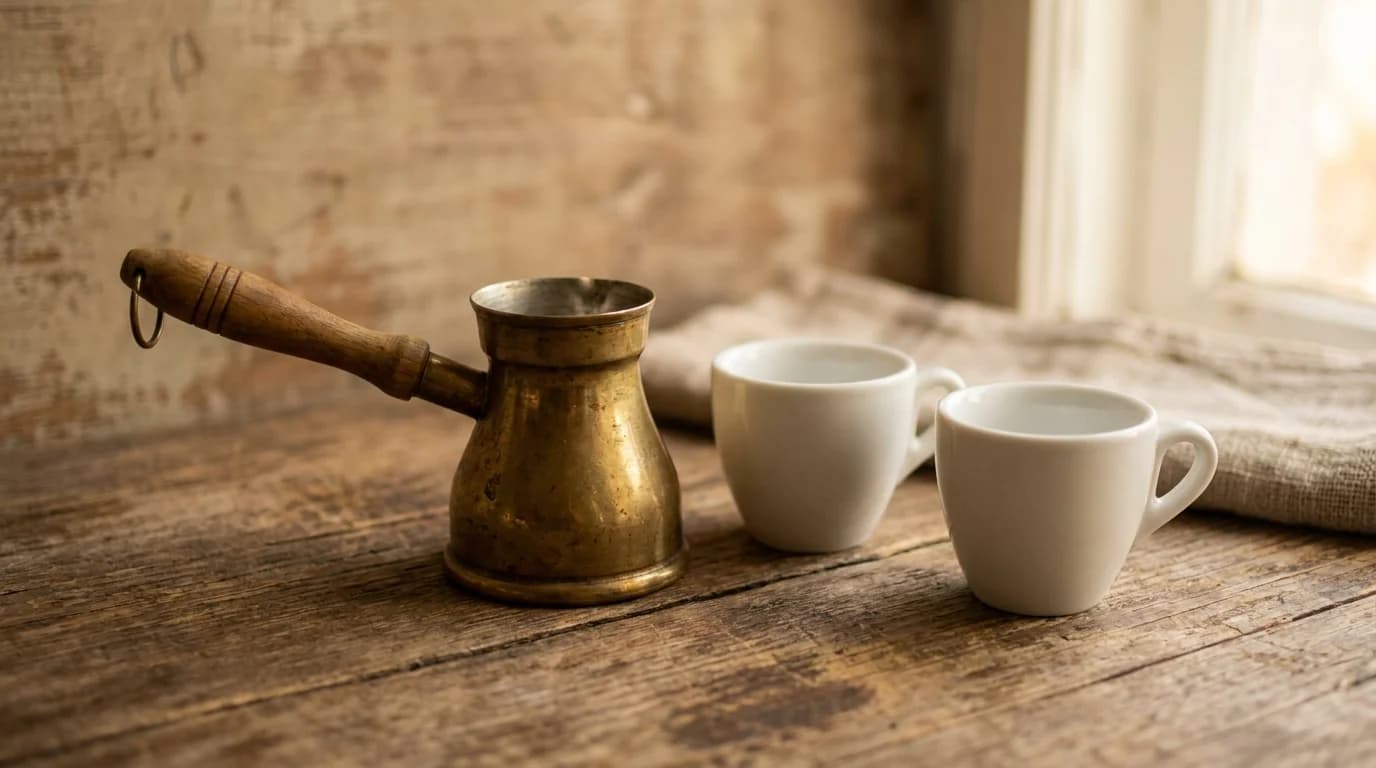
Turkish coffee is one of the oldest continuously practised coffee brewing traditions — largely unchanged for hundreds of years, still made the same way in homes and cafés across Turkey, the Levant, the Balkans, Greece, and the Caucasus. It also predates every other named brewing method the world uses today. When people started brewing coffee as a beverage in 15th- century Yemen (see Yemen and the Port of Mocha), what they were making was essentially a version of this: powder-fine coffee, simmered in a small pot with water and sugar.
Powder-fine grind
finer than espresso — essentially the consistency of flour or powdered sugar[2]
Cezve / ibrik
small long-handled pot, traditionally copper, brewing 1-4 demitasses at a time[1]
UNESCO heritage
Turkish coffee culture and tradition inscribed as Intangible Cultural Heritage in 2013[5]
What Turkish coffee actually is
Turkish coffee is defined by three inseparable features:
The grind
The grind. Coffee for Turkish preparation is ground much finer than for any other brewing method — finer than espresso, essentially powder consistency. This ultra-fine grind is what allows the brewing method to work.
The vessel
The vessel. The cezve (Turkish) or ibrik (Arabic/Greek) is a small, narrow pot with a long handle. Traditional design is copper (often with a tin interior lining), brass, or a mix. Modern versions are made in stainless steel. The narrow top concentrates the foam; the wide bottom sits over the heat; the long handle keeps your hand away from the heat source.
The method
The method. Water and coffee (and usually sugar) are combined cold in the cezve and warmed slowly over low heat without stirring. As the coffee heats, a thick layer of foam forms on top. The pot is removed just before boiling, the foam distributed, and the process repeated (traditionally three times, though this varies). The finished coffee is poured — grounds and all — into small demitasse cups. The grounds settle to the bottom over 1-2 minutes, and you drink the coffee down to the sludge[3].
The unfiltered nature is central — everything that was in the cezve ends up in your cup, including the finest particles suspended in the liquid.
The classic recipe
Equipment:
- A cezve/ibrik, ideally copper or brass; stainless steel works.
- Traditional demitasse cups (~60 mL / 2 oz each).
- Extra-fine ground Turkish coffee (pre-ground is fine; grinding fine enough at home requires a specialised grinder).
- A low-heat source — traditionally hot sand (still done in some Turkish cafés), but a gas or electric stovetop on low works fine.
Per demitasse:
- 1 heaped teaspoon (approximately 5-7 g) of extra-fine coffee.
- 60-70 mL cold water (roughly one demitasse's worth, plus a little for evaporation).
- Sugar to taste — see the sugar section below.
Process (traditional three-foam method):
- Cold water into the cezve. Measure by pouring the demitasse cups you intend to serve.
- Add sugar (if using) and stir to dissolve at this stage — after coffee is added, stirring is minimal.
- Add coffee on top of the water. Don't stir. Let it float for a few seconds, then it will sink.
- Very gentle stir to just combine — this is the last stirring you'll do.
- Heat on low. Watch closely. Do not walk away.
- First foam. As the coffee warms, a thick foamy crust forms on the surface. Just before the whole thing boils over, remove the cezve from heat and spoon a bit of the foam into each demitasse cup.
- Return to heat. Repeat the process — let foam rise again to near-boil, then distribute more foam.
- Third foam. Do it once more. This is optional but traditional. Some regional traditions do more or fewer foamings.
- Final pour. Pour the rest of the coffee slowly into the cups over the foam. Grounds will come with; that's expected.
- Settle and serve. Let cups rest for 1-2 minutes before drinking — grounds sink and form a thin sludge at the bottom.
Total brewing time: 4-6 minutes for a small batch.
The sugar question
Turkish coffee sugar is not added at the table — it's brewed into the pot. Traditional levels:
- Sade (plain, no sugar) — the strongest and most intense, often preferred by experienced Turkish coffee drinkers.
- Az şekerli (little sugar) — approximately ½ teaspoon per demitasse.
- Orta şekerli (medium sugar) — approximately 1 teaspoon per demitasse.
- Şekerli (sweet) — approximately 2 teaspoons per demitasse — noticeably sweet but not dessert-level.
The reason sugar goes in during brewing is dissolution: after brewing, the coffee cools quickly in small demitasses and sugar doesn't dissolve well; also, stirring after brewing disrupts the sludge separation. Cook it in.
Cardamom (Arab/Levantine variant)
In much of the Arab world, Turkish-style coffee is prepared with cardamom — either whole crushed pods added to the water, or ground cardamom mixed into the coffee. This is standard in Saudi Arabian, Yemeni, and Lebanese preparations. In Turkey itself, cardamom is less common but not unknown.
Ratio: 1 crushed green cardamom pod per demitasse of water, or about ⅛ teaspoon ground cardamom mixed into the coffee grounds.
Foam matters
The foam (kaymak) is considered essential to a properly-made Turkish coffee. A cezve of coffee that reaches the cup with no foam has been ruined — usually by overheating or by stirring during the brewing process.
Good foam should:
- Be thick and stable — a few millimetres deep on the finished cup, holding its shape for at least a minute.
- Have a fine texture — not big bubbles.
- Cover the surface completely — a cup with foam only in one place suggests uneven pouring.
Getting the foam right takes practice. Common mistakes:
- Heat too high — foam forms too fast and gets destroyed before you can distribute it.
- Stirring after the coffee sinks — disrupts foam formation.
- Not enough coffee — insufficient grounds to create proper foam.
- Overheating past the first foam — boil-over destroys the foam.
Serving traditions
Turkish coffee has an unusually developed serving etiquette:
Table etiquette
- Water is served alongside — a small glass of water to clear the palate before drinking. Custom holds that drinking the water before the coffee indicates you're thirsty (the host may have failed to hydrate you); drinking after suggests the coffee was good.
- Sweets accompany — traditionally lokum (Turkish delight), baklava, or another small sweet. This offsets the intensity of the coffee.
- Small sips — Turkish coffee is not gulped. Small sips, slow appreciation, and conversation are the point.
- Stop at the sludge — don't drink the grounds. Stop when the coffee becomes noticeably gritty.
Fortune telling
In many households the finished cup was traditionally inverted onto its saucer and the pattern of grounds left inside "read" for fortune-telling (kahve falı). This tradition continues in some family and social contexts.
Turkish coffee and cholesterol
Because Turkish coffee is unfiltered, it retains the full complement of cafestol and kahweol — the diterpene compounds that raise LDL cholesterol. Traditional Turkish coffee is among the highest-cafestol brewing methods in the world (see Coffee and Cholesterol).
For most healthy adults drinking Turkish coffee occasionally this isn't a practical concern. For daily-multiple-cups Turkish coffee drinkers managing cholesterol, this is worth discussing with a clinician — brewing method matters more than caffeine content for cardiovascular risk.
Caffeine and volume
A single traditional demitasse of Turkish coffee is about 60 mL and contains roughly 40-60 mg of caffeine. That's similar to a single espresso shot despite a very different extraction method — the very fine grind and long contact time extract most of the available caffeine.
Typical serving is 1-2 demitasses (60-120 mL); a heavy drinker might have 3-4 in a day. Well within the FDA/Health Canada 400 mg/day general adult limit.
What "Turkish" coffee culture actually includes
The term "Turkish coffee" refers to a preparation method, not an origin — the coffee itself doesn't come from Turkey (Turkey doesn't produce coffee agriculturally). The cultural tradition extends across:
Regional naming
- Turkey — the eponymous tradition, dating from Ottoman adoption in the 16th century.
- Greece — where the same preparation is called "Greek coffee" (particularly emphasised since Greek-Turkish political tensions in the 20th century made "Turkish" a loaded term). Same method, different name.
- Cyprus — split naming between Turkish and Greek Cypriot communities.
- The Levant — Lebanon, Syria, Palestine, Jordan — where the tradition is essentially the same and often called Arabic or Levantine coffee (frequently with cardamom).
- The Balkans — Serbia, Bosnia, Bulgaria, and neighbouring countries have their own naming and slight regional variations of the same core method.
- The Caucasus — Armenia and Georgia have traditions variously called Armenian or Georgian coffee — same method.
All are essentially the same brewing tradition inherited from Ottoman-era coffee culture (see [The History of Coffee Houses](/beans-roast-origin/history-of-coffee-houses))[4].
Beans for Turkish coffee
Traditional Turkish coffee beans are:
- Arabica — most Turkish coffee is arabica, often medium-roast to slightly dark.
- Origin — historically Yemeni; contemporarily much of the coffee sold in Turkey comes from Brazil, Ethiopia, or Central America.
- Pre-ground — the vast majority of Turkish coffee consumed at home is bought pre-ground. Kurukahveci Mehmet Efendi (a famous Istanbul brand) is a common reference point.
If buying pre-ground at a specialty shop, ask for "Turkish grind" specifically — coffee shop grinders can typically go that fine, and pre-ground bags labeled "Turkish" have the appropriate consistency.
Common misconceptions
- "Turkish coffee is just espresso brewed differently." Different beans, different grind, different brewing method, different serving format, different cultural context. Basically nothing in common except concentration.
- "You can make Turkish coffee in any small pot." The cezve shape (narrow top, wide bottom, long handle) is functional — the narrow top concentrates foam and slows boil-over. A regular saucepan doesn't work well.
- "You should stir throughout brewing." Stir once at the start to combine, then don't stir again — the foam formation depends on undisturbed heating.
- "Boiling it is fine." No — Turkish coffee should reach near-boiling but never fully boil. Once it boils over, the foam is destroyed and the coffee is over-extracted.
The honest summary
Turkish coffee is one of the oldest and most distinctive coffee brewing traditions in the world — extra-fine grind, warmed (not boiled) in a small long-handled cezve, served unfiltered in small demitasses with grounds settling to the bottom. It's the closest surviving relative of the earliest brewed coffee in Yemen and the beverage's original spread through the Ottoman Empire in the 16th century. The technique is unforgiving — heat control, timing, and the foam-and- distribute rhythm all take practice — but the equipment is cheap and the result is unlike any modern brewing method. If you've never tried it, seek out a traditional preparation before trying to make one at home; the sensory template matters.
Frequently asked questions
- What is Turkish coffee?
- Turkish coffee is the traditional coffee preparation of Turkey and much of the former Ottoman Empire — a method of brewing extra-finely ground coffee by warming (not boiling) it in a small long-handled pot called a cezve (Turkish) or ibrik (Arabic and Greek). The coffee is served unfiltered, with grounds settling at the bottom of a small demitasse cup. UNESCO recognised Turkish coffee culture as Intangible Cultural Heritage in 2013.
- What is the difference between cezve and ibrik?
- They refer to essentially the same thing: a small pot with a long handle used for brewing Turkish-style coffee. 'Cezve' is Turkish; 'ibrik' is Arabic-derived (and used in Greek and other languages of the region). The design is similar across the region — narrow at the top, wider at the bottom, with a distinctive pouring spout and a heat-shielded long handle. Traditional cezves are copper (often with tin lining) or brass; modern ones may be stainless steel.
- What grind is Turkish coffee?
- Powder-fine — much finer than espresso, essentially the consistency of powdered sugar or flour. Most home coffee grinders cannot grind fine enough for authentic Turkish coffee. Specialised Turkish coffee grinders (traditional hand mills or specific electric burr grinders) can achieve this consistency. Pre-ground Turkish coffee (widely available) is the practical choice unless you commit to specialised equipment.
- Do you drink the grounds in Turkish coffee?
- You drink until the grounds. Because the coffee is served unfiltered, grounds settle at the bottom of the cup during the few minutes before drinking. You sip the liquid on top and stop when you reach the sludge. Some traditions (fortune-telling with the grounds) inverted the cup after drinking to read the pattern left by the settled grounds.
- Is Turkish coffee stronger than espresso?
- It's more concentrated but not necessarily higher in caffeine per serving. A traditional Turkish coffee serving is small (30-60 mL), similar to an espresso. The very fine grind and long contact time extract very fully, producing a thick, syrupy, intense cup. Caffeine per serving is roughly comparable to espresso, but the flavour intensity is often perceived as stronger.
References
Every factual claim in this article is drawn from the sources below. See the source library for how we grade evidence.
- [1]Brewing FundamentalsCoffee Science Foundation · Reference work · Tier 2 · Moderate
- [2]Coffee extraction kinetics in a well mixed systemJournal of Mathematics in Industry · 2016 · Review · Tier 2 · Moderate
- [3]Coffee and Coffeehouses: The Origins of a Social Beverage in the Medieval Near EastUniversity of Washington Press (Ralph S. Hattox) · 1985 · Reference work · Tier 2 · Moderate
- [4]Uncommon Grounds: The History of Coffee and How It Transformed Our World (revised edition)Basic Books (Mark Pendergrast) · 2010 · Reference work · Tier 2 · Moderate
- [5]CoffeeEncyclopaedia Britannica · Reference work · Tier 3 · Contextual
Related reading
- Caffeine & HealthCoffee and Cholesterol: Cafestol, Diterpenes, and Risk→
- Beans, Roasts & OriginsThe History of Coffee Houses: From Mecca to London→
- Beans, Roasts & OriginsYemen, the Port of Mocha, and Coffee's Commercial Birth→
- Brew MethodsV60 Pour-Over Guide: Ratios, Technique, Step by Step→
- Brew MethodsNitro Cold Brew: How Nitrogen Makes Coffee Creamy→
- Brew MethodsCafé de Olla: Mexico's Traditional Spiced Coffee→