Coffee and Cholesterol: Cafestol, Diterpenes, and Risk
By Coffee Studies Editorial·Published July 15, 2026·6 min read
Quick answer
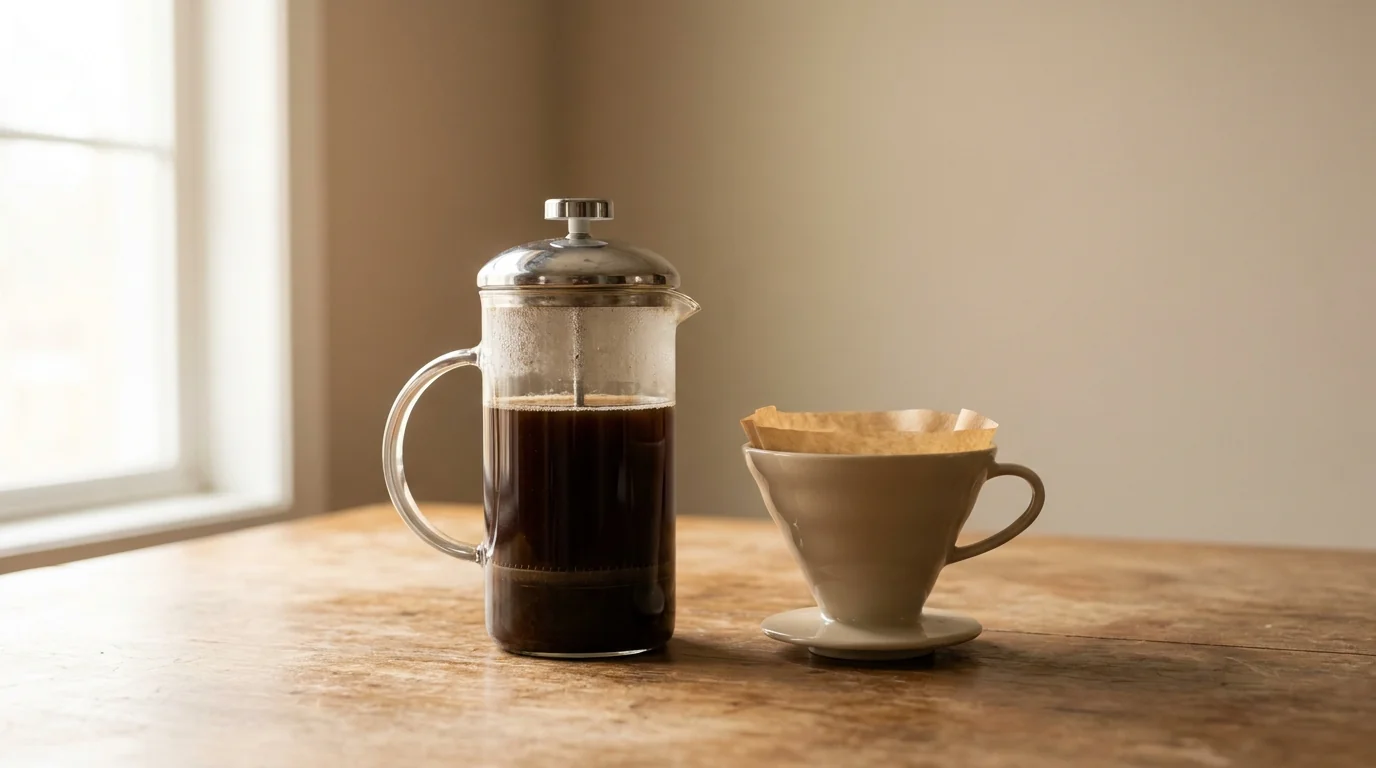
The coffee-and-cholesterol question has a cleaner answer than most coffee-and-health questions: the brewing method matters more than the amount. Two specific compounds — cafestol and kahweol — raise LDL cholesterol when they end up in the cup. A paper filter catches most of them. Metal filters and no-filter methods let them through.
Cafestol + kahweol
two diterpenes in coffee oil that raise LDL cholesterol in a dose-dependent way[1]
Paper filter
traps most of the cholesterol-raising compounds; drip coffee has little to no effect on lipids[2]
~15 mg/dL
typical LDL rise from habitual unfiltered coffee at moderate daily intake in randomised trials[2]
What actually raises the cholesterol
Coffee beans contain a small amount of oil, and in that oil are two closely related diterpene molecules: cafestol and kahweol. When coffee is brewed in a way that lets the oil pass into the cup — boiled coffee, French press, espresso, moka pot, Turkish — these compounds end up in what you drink. When coffee is brewed through a paper filter, the paper physically traps most of the oil and its diterpene payload.
Cafestol is the more potent of the two for raising cholesterol. Mechanistic work has traced its effect to interference with bile acid metabolism and cholesterol homeostasis in the liver — it suppresses the expression of genes that would normally regulate LDL clearance[1].
Kahweol has a similar but somewhat weaker effect.
The important point: it's not the caffeine. Decaf coffee brewed by the same unfiltered method has essentially the same cholesterol effect as regular. The cholesterol question is a brewing question, not a caffeine question.
What the meta-analyses show
A 2001 meta-analysis in the American Journal of Epidemiology synthesised the randomised trials on coffee and blood lipids. The pattern was clear[2]:
- Unfiltered coffee raised total cholesterol and LDL in a dose-dependent way. The effect was around 15-20 mg/dL total cholesterol at typical habitual intakes.
- Filtered coffee showed a small, often non-significant effect.
- The magnitude of the unfiltered effect was clinically meaningful — enough to matter for cardiovascular risk stratification.
A 1989 NEJM randomised trial by Bak and Grobbee — one of the foundational studies on this question — assigned participants to either filter-brewed or boiled coffee for nine weeks. Boiled- coffee drinkers had substantially higher total cholesterol and LDL than filter-coffee drinkers; the difference disappeared when boiled-coffee drinkers switched to filter coffee[3].
The 2017 BMJ umbrella review of coffee and health outcomes addresses this directly: the cardiovascular findings for coffee depend heavily on brewing method, and the cholesterol pathway is the clearest example[4].
Ranking brewing methods by cafestol
Figure
Cafestol content by brewing method
Values in mg per cup (approx.)
The diterpene content per cup varies substantially by method. Approximate ordering, highest to lowest:
- Scandinavian boiled coffee, Turkish coffee — highest, and the methods where the cholesterol effect was originally identified.
- French press — high; the metal mesh doesn't catch oil.
- Moka pot — meaningful amounts.
- Espresso — meaningful per volume, but serving sizes are small, so total daily intake depends on how many shots.
- Metal mesh / cloth filter pour-over — lower than paper but more than filtered drip.
- Paper-filtered drip, pour-over, and most espresso machines with a filter cartridge — lowest.
If you drink several French press cups a day and have elevated LDL, this is a plausible contributor. If you drink paper-filtered drip coffee, the cholesterol effect is small.
What "unfiltered" really means
Some sources of confusion:
- Espresso is unfiltered in the diterpene sense — the metal puck screen doesn't remove cafestol. Espresso serving sizes are small, but if you drink multiple shots per day (as milk- drink bases or as straight espresso), it adds up.
- AeroPress with a paper filter behaves like paper drip. With a metal AeroPress filter, more diterpenes pass through.
- Cold brew made with paper filtration is closer to paper drip. Cold brew concentrate made in a French press-style vessel and served over ice is unfiltered.
- Instant coffee is generally low in cafestol/kahweol because the manufacturing process removes most oil.
The rule of thumb: if the brewed coffee has visible oil on the surface or a metal-mesh brewing element, it's on the higher- cafestol end. A clear surface and a paper filter means low-cafestol.
If you are switching to a filtered method specifically to cut cafestol, the filter is the part doing the work, not the brewer around it. Paper traps the diterpenes; metal mesh and cloth do not.
 Cone dripper, 60-degreeHARIO V60 Ceramic Coffee Dripper, Size 02, White | Handmade Porcelain Coffee Maker with Conical Shape and Spiral Ridges for Heavier FlavorThe reference cone: steep walls, one large hole, and spiral ribs that keep the paper off the wall so air can escape. All three features hand flow control to the person pouring, which is why the V60 rewards technique and punishes inattention.amazon.com $25.00 USDamazon.ca $32.00 CADPrice and availability as of View on Amazon
 The filters a Chemex needsChemex Unbleached, Pour Over FSU-100, 100ct | Unbleached Oxygen-Cleansed Paper, Thicker, Eco-FriendlyNot optional and not interchangeable with ordinary cone papers: the thickness is the whole reason the brewer tastes the way it does. Unbleached and bleached behave the same once rinsed; rinse either way, because dry paper of this weight contributes a noticeable taste.amazon.com $19.49 USDamazon.ca $29.99 CADPrice and availability as of View on Amazon
Product prices and availability are accurate as of the date/time indicated and are subject to change. Any price and availability information displayed on Amazon at the time of purchase will apply to the purchase of this product. Certain content that appears on this site comes from Amazon. This content is provided ‘as is’ and is subject to change or removal at any time.
Why the effect can be dose-dependent
The compounds accumulate with intake — daily consumption of unfiltered coffee produces steady exposure, and the LDL effect builds over weeks and stabilises. A single espresso doesn't appreciably shift cholesterol; a habit of four French press cups a day for months does.
The reversibility is also documented: switching from unfiltered to filtered coffee brings LDL back down over a similar timescale[2].
What the research says
The 2001 American Journal of Epidemiology meta-analysis is the clearest synthesis of randomised trials: unfiltered coffee raises LDL and total cholesterol in a dose-dependent way, while filtered coffee has little to no effect[2].
The Urgert & Katan 1997 Annual Review of Nutrition paper is the mechanistic foundation — cafestol and kahweol are the cholesterol-raising factors, and they end up in the cup only when coffee is brewed by methods that don't filter out oil[1].
The 1989 NEJM randomised trial by Bak and Grobbee is the foundational human evidence that switching from boiled to filter coffee reversibly lowers serum cholesterol[3].
The BMJ umbrella review notes that coffee's cardiovascular associations are strongly modified by brewing method — the cholesterol pathway is the mechanistic reason[4].
Harvard's summary of the evidence base reaches the same practical conclusion: for people managing cholesterol, brewing method is the modifiable factor[5].
Common misconceptions
- "All coffee raises cholesterol." No — the effect is brewing-method specific. Paper-filtered drip and pour-over coffee have little to no cholesterol impact.
- "Decaf is safe for cholesterol." Depends on brewing. Decaf French press still contains cafestol; decaf paper drip doesn't.
- "If my coffee is dark and strong, it's worse for cholesterol." Colour and strength don't correlate directly. Brewing method does. A dark-roasted paper-drip coffee is fine; a light-roast French press has real cafestol.
- "Espresso is filtered — it comes through a screen." The screen doesn't remove diterpenes. Espresso is unfiltered in the cholesterol sense.
Practical rules
If your cholesterol is normal:
- Any brewing method is reasonable at moderate intake.
- The overall coffee-and-cardiovascular literature is favourable at 3-4 cups per day for most healthy adults[4].
If your LDL is elevated:
- Switching to paper-filtered brewing is a low-effort change with real evidence.
- If you drink multiple French press or espresso cups daily, the switch is more likely to matter.
- Give it 4-8 weeks and retest cholesterol.
If you're on lipid-lowering medication:
- Coffee brewing method won't undo statin effects but can slightly offset them at high unfiltered intake.
- Bring the topic up with your care team so your total picture is clear.
Regardless of cholesterol status:
- Stay under 400 mg caffeine per day (or 300 mg during pregnancy per Health Canada) — this is a separate limit, driven by cardiovascular and sleep considerations, not cholesterol[6][7].
The honest summary
Cafestol and kahweol in coffee oil raise LDL cholesterol in a dose-dependent way — but only in coffee brewed by methods that don't filter out the oil. Paper-filtered drip and pour-over coffee have little to no cholesterol effect. If you're managing cholesterol and drink French press, espresso, or moka pot coffee regularly, switching to paper-filtered is the highest-leverage change. Decaf doesn't fix the problem because the compounds aren't caffeine — the brewing method is what matters.
Frequently asked questions
- Does coffee raise cholesterol?
- It depends on the brewing method. Unfiltered coffee — French press, espresso, moka pot, Turkish — contains cafestol and kahweol, diterpenes that raise LDL cholesterol in a dose-dependent way. Paper-filtered drip coffee traps most of these compounds and has little to no effect on cholesterol.
- Which brewing methods raise cholesterol the most?
- Scandinavian boiled coffee and Turkish coffee have the highest cafestol and kahweol content — these are the brewing methods where the cholesterol effect was originally identified. French press and moka pot are next. Espresso contains meaningful amounts too but the serving sizes are smaller. Paper-filtered drip coffee has the lowest levels.
- How much does unfiltered coffee raise cholesterol?
- Meta-analyses of randomised trials show that unfiltered coffee raises total cholesterol by roughly 15-20 mg/dL and LDL by 10-15 mg/dL at typical daily intakes, with the effect scaling with dose. Filtered coffee shows a small or non-significant change in the same trials.
- Is decaf coffee better for cholesterol?
- Caffeine isn't the compound raising cholesterol — cafestol and kahweol are. Decaf coffee brewed by the same method has a similar cholesterol effect to regular. If you're managing cholesterol, switching to paper-filtered coffee matters more than switching to decaf.
- Should I stop drinking coffee if my cholesterol is high?
- Not necessarily — but switching to paper-filtered brewing is a low-effort change with real evidence behind it. If you drink several French press or espresso cups per day and have elevated LDL, changing brewing method is worth trying. Discuss with your care team, especially if you're on lipid-lowering medication.
References
Every factual claim in this article is drawn from the sources below. See the source library for how we grade evidence.
- [1]The cholesterol-raising factor from coffee beansAnnual Review of Nutrition · 1997 · Review · Tier 1 · Strong
- [2]Coffee consumption and serum lipids: a meta-analysis of randomized controlled clinical trialsAmerican Journal of Epidemiology · 2001 · Meta-analysis · Tier 1 · Strong
- [3]The effect on serum cholesterol levels of coffee brewed by filtering or boilingNew England Journal of Medicine · 1989 · Controlled trial · Tier 1 · Strong
- [4]Coffee consumption and health: umbrella review of meta-analyses of multiple health outcomesBMJ · 2017 · Umbrella review · Tier 1 · Strong
- [5]Coffee — The Nutrition SourceHarvard T.H. Chan School of Public Health · Reference work · Tier 2 · Moderate
- [6]Spilling the Beans: How Much Caffeine Is Too Much?U.S. Food and Drug Administration · 2024 · Agency guidance · Tier 1 · Strong
- [7]Caffeine in foodsHealth Canada · 2022 · Agency guidance · Tier 1 · Strong
Related reading
- Caffeine & HealthIs Coffee Healthy? What Large Studies Actually Show→
- Caffeine & HealthCoffee and Blood Pressure: What the Research Shows→
- Instant & Decaf CoffeeDecaf Coffee: Benefits and Risks→
- Caffeine & HealthDoes Coffee Raise Blood Sugar?→
- Caffeine & HealthCoffee and Pregnancy: Safe Limits and What Research Shows→
- Caffeine & HealthCoffee Antioxidants: What the Research Shows→