What Is Fair Trade Coffee? Certification Explained
By Coffee Studies Editorial·Published July 18, 2026·6 min read
Quick answer
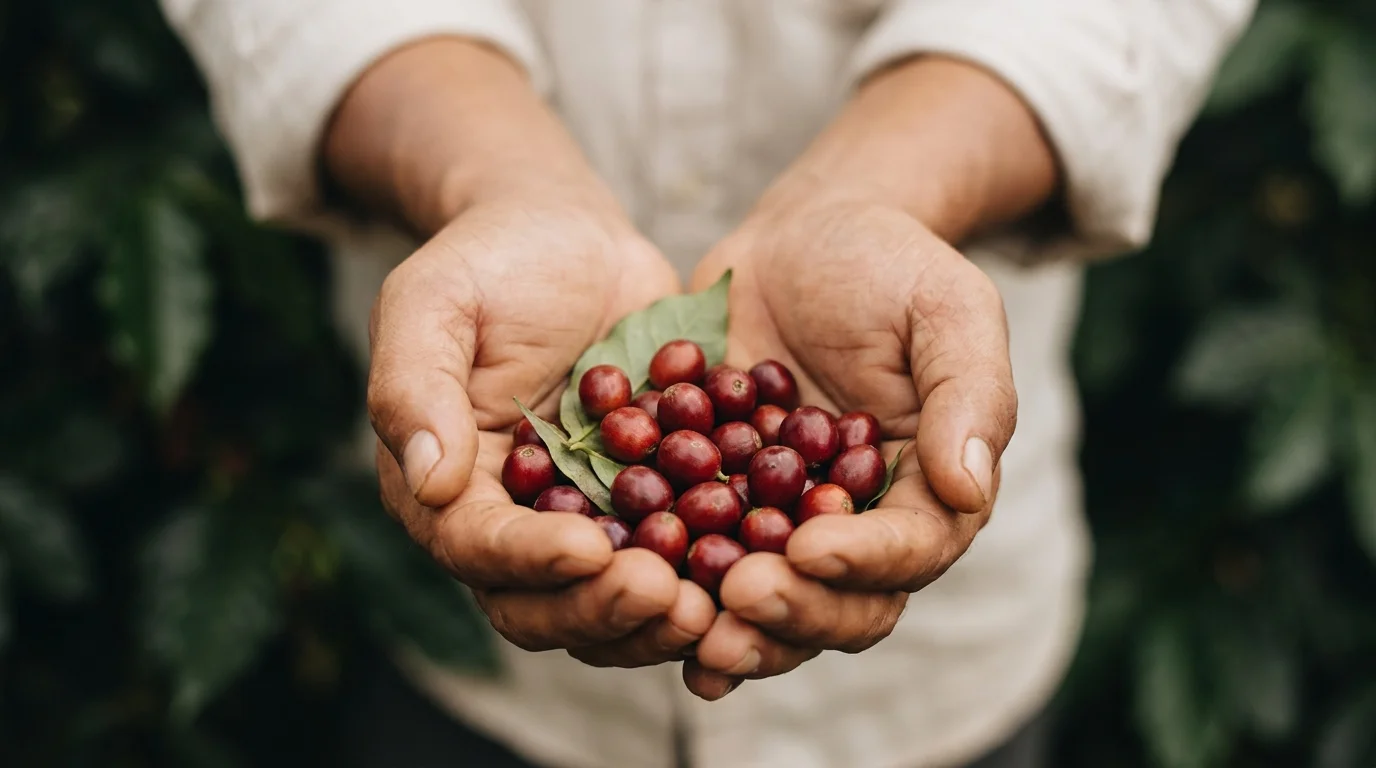
Fair trade coffee is one of the most discussed labels in the food industry, and one of the most frequently misunderstood. The label doesn't describe a roast level, a flavour, or a place of origin. It describes a transaction: how the coffee was bought from farmers, under what price terms, and with what minimum social commitments. Whether those terms reliably deliver what the label implies is a more contested question than the certification mark suggests.
$1.80/lb minimum
the Fairtrade International floor price for arabica washed coffee (FOB) as of 2023 — designed to be above the cost of production for smallholders[1]
+$0.20/lb premium
the Fairtrade social premium paid on top of the floor price, managed by the cooperative for community investment (schools, water, health)[1]
Cooperatives, not farms
Fairtrade International certifies cooperatives — groups of smallholder farmers — not individual farms; how much reaches each farmer depends on cooperative governance[3]
How the certification works
Fairtrade International (FLO — Fairtrade Labelling Organizations International, based in Bonn, Germany) sets the standards and licenses the use of the Fairtrade mark. In Canada, the UK, and most of Europe, the Fairtrade mark on coffee means the certifying body is FLO and its national partner organisations[1].
Who can be certified: Under FLO standards, only smallholder farmer cooperatives can be certified for coffee. A cooperative is a democratically governed organisation of farmers who collectively sell their coffee under the Fairtrade terms.
The price mechanism:
- Buyers must pay at least the Fairtrade Minimum Price (currently $1.80/lb for arabica washed, FOB) or the current market price — whichever is higher. When commodity prices are above the Fairtrade minimum, sellers receive market price, not minimum. The floor only activates when market prices fall below it.
- On top of price, buyers pay the Fairtrade Premium ($0.20/lb for arabica) directly to the cooperative. The cooperative's democratic assembly must decide how to use the premium — typical uses include building schools, clean water infrastructure, medical clinics, farm productivity improvements, or climate adaptation.
Labour standards: Fairtrade certification prohibits forced labour and child labour, requires safe working conditions, and mandates that cooperatives use the premium for the community's benefit. Environmental standards include restrictions on certain pesticides, though full organic practice is not required (a separate organic certification covers that).
Fairtrade International vs Fair Trade USA
In 2011, Fair Trade USA (formerly TransFair USA) split from FLO over a policy dispute. The core disagreement: FLO restricts certification to smallholder cooperatives; Fair Trade USA wanted to expand certification to large plantations and estates.
Figure
Fairtrade International vs Fair Trade USA: key differences
Values in comparison (not numerical)
The two marks look different on packaging. Fair Trade USA uses a person in motion on a black background; Fairtrade International uses a blue-and-green figure on a green field. In the US, you may see either; in Canada and Europe, you typically see the FLO mark.
What the premium actually pays for
The $0.20/lb Fairtrade Premium is meaningful but modest. A typical smallholder coffee farm in Ethiopia or Honduras produces roughly 200–400 kg of green coffee per year. At $0.20/lb, the premium on 400 kg (~880 lbs) is $176 per year for that farmer's entire production — before the cooperative takes any share for administration or collective projects.
This doesn't mean the premium is worthless. Collective premium use funds infrastructure that no individual farmer could afford: a school, a water system, a shared processing facility. But the direct income impact per individual farmer can be small, particularly in large cooperatives.
Research on the welfare impact of Fairtrade certification is genuinely mixed: some studies find improved farmer income, food security, and community investment; others find minimal impact or find that the premiums flow primarily to better-resourced cooperatives that were already relatively well-off[3].
Fair trade vs direct trade vs specialty
These three categories are frequently conflated but address different things:
| Fair trade | Direct trade | Specialty | |
|---|---|---|---|
| What it certifies | Price floor + social conditions | Nothing formal — a business relationship | Cup quality (SCA 80+ points) |
| Certifying body | FLO / Fair Trade USA | No certifying body | SCA (Q Graders) |
| Price mechanism | Minimum floor + premium | Negotiated directly, usually above FT | No minimum; market price |
| Quality requirement | None | Informal; usually quality-driven | Required (80+ cupping score) |
| Who it covers | Cooperatives (FLO) or farms (FTUSA) | Individual farms or cooperatives | Green bean at point of export |
| Mark on bag | Yes (trademarked mark) | No formal mark | SCA does not certify bags |
Direct trade is more common in specialty coffee: a roaster travels to origin, cups the coffee, builds a relationship with a specific farm or cooperative, and pays a negotiated price — often substantially above the Fairtrade minimum — in exchange for exclusive or priority access to quality lots. The transparency is higher (many roasters publish what they pay); the reach is narrower (a small roaster buying from 5 farms helps 5 farms)[3].
Fair trade reaches more farmers at a lower premium; direct trade reaches fewer farmers at a potentially higher premium. Neither is strictly better — they address different parts of the supply chain and operate at different scales.
What the label does and doesn't tell you
Does tell you:
- The coffee was purchased from a certified cooperative at or above the Fairtrade minimum price.
- A $0.20/lb social premium was paid to the cooperative.
- The cooperative prohibits forced and child labour.
- The certifying body audited these conditions.
Does not tell you:
- How much of the premium reached individual farmers.
- What the coffee tastes like or what quality grade it is.
- Whether the cooperative is well-governed.
- Whether the price paid was significantly above the floor (when commodity prices are high, Fairtrade buyers may be paying market price, not a premium).
- Whether the producer's environmental practices are good (a separate organic certification covers that).
Is fair trade worth paying for?
From a consumer standpoint, a fair trade certified coffee provides reasonable assurance that the cooperative received the minimum floor price and premium — better than no protection at all, and better than an uncertified commodity coffee bought at the lowest possible price.
From a systemic standpoint, critics argue that fair trade could do more: higher minimums, stricter quality coupling, better governance requirements for cooperatives, and more transparency about cooperative-to-farmer distribution. The International Coffee Organization has periodically called for price floors that better reflect the actual cost of production for smallholders[2].
The honest answer: buying fair trade certified coffee is a better choice than buying uncertified commodity coffee at equivalent price and quality, all else equal. It is not a guarantee of exceptional farmer welfare, and it is not the only route to ethical purchasing. Direct trade from specific roasters who publish their farm-gate prices may provide more transparent and sometimes higher premiums to fewer farmers.
Common misconceptions
- "Fair trade coffee costs more because it's better quality." Fair trade certification is about price and social conditions, not quality. Many fair trade coffees are commodity grade.
- "The farmer gets the full premium." The premium goes to the cooperative, not the individual farmer directly. Distribution depends on cooperative governance.
- "All fair trade is the same." Fairtrade International and Fair Trade USA have different standards, particularly around plantation certification.
- "Direct trade is better than fair trade." Direct trade can deliver higher premiums with more transparency, but it covers far fewer farmers. Both have a role.
- "The Fairtrade minimum is always above market price." When commodity coffee prices are high, market price exceeds the Fairtrade minimum — the floor only activates during price crashes.
The honest summary
Fair trade coffee is certified under price-floor and social-condition standards set by Fairtrade International or Fair Trade USA, aimed at protecting smallholder farmers from market crashes below production cost. The Fairtrade minimum of $1.80/lb (arabica, FOB) and $0.20/lb social premium provide a meaningful floor, but the premium goes to cooperatives and its distribution to individual farmers varies by governance. Fair trade certification says nothing about cup quality. Evidence on farmer welfare impact is mixed. The certification is better than no protection but is not a guarantee of exceptional working conditions or income. For consumers wanting higher transparency on price, direct trade roasters who publish farm-gate prices are an alternative worth considering alongside fair trade.
Frequently asked questions
- What is fair trade coffee?
- Fair trade coffee carries a certification from a recognised fair trade body (most commonly Fairtrade International / FLO or Fair Trade USA) indicating that the coffee was purchased from certified farmer cooperatives under terms including a minimum floor price, a social premium, and environmental and labour standards. The floor price is designed to protect smallholder farmers from market crashes below the cost of production.
- What is the Fairtrade minimum price for coffee?
- As of 2023, the Fairtrade International (FLO) minimum price for arabica washed coffee is $1.80/lb green (FOB, free on board — meaning at the point of export). Robusta minimum is $1.00/lb. An additional Fairtrade Premium of $0.20/lb is paid on top of the minimum price or market price (whichever is higher) and must be managed by the cooperative democratically to invest in community projects.
- Does fair trade money reach farmers?
- Partially and variably. The Fairtrade Premium goes to cooperatives, not directly to individual farmers — how much trickles down depends on the cooperative's governance, size, and financial management. Research on this is mixed: some studies find significant farmer benefit; others find the premium is absorbed by cooperative administrative costs, infrastructure, or distributed unevenly. Direct trade (where roasters buy directly from farms) is often argued to deliver higher and more transparent premiums than certification-based systems.
- What is the difference between Fairtrade International and Fair Trade USA?
- Fairtrade International (FLO, based in Germany) is the global certification body; its mark is used in most countries outside North America. Fair Trade USA split from FLO in 2011, partly over a disagreement about whether to certify large plantations alongside smallholder cooperatives (FLO restricts certification to cooperatives; Fair Trade USA allows plantation certification). Their standards and premiums differ slightly, and their marks look different on packaging.
- Is fair trade coffee better quality?
- Not necessarily. Fair trade certification addresses price and social conditions, not cup quality. Many fair trade coffees are commodity-grade; some are specialty-grade. The certification does not require a minimum cupping score or physical quality standard. Some critics argue that minimum price guarantees reduce incentives for quality improvement; others argue stable prices enable investment in quality. In practice, fair trade and specialty certifications frequently co-occur on the same bag.
- What is direct trade?
- Direct trade is a term used by specialty coffee roasters for buying relationships where the roaster purchases directly from a farm or cooperative, often at prices higher than the Fairtrade minimum, with transparent pricing, farm visits, and quality feedback. Direct trade is not a formal certification — there is no certifying body or standard. It is a business relationship, and the terms and prices vary entirely by roaster and farm.
References
Every factual claim in this article is drawn from the sources below. See the source library for how we grade evidence.
- [1]Fairtrade Standard for Small Producer OrganizationsFairtrade International (FLO) · Reference work · Tier 3 · Contextual
- [2]World Coffee Statistics DatabaseInternational Coffee Organization · Official dataset · Tier 1 · Strong
- [3]Uncommon Grounds: The History of Coffee and How It Transformed Our World (revised edition)Basic Books (Mark Pendergrast) · 2010 · Reference work · Tier 2 · Moderate
- [4]CoffeeEncyclopaedia Britannica · Reference work · Tier 3 · Contextual
Related reading
- Beans, Roasts & OriginsWhat Is Specialty Coffee? The 80-Point Standard→
- Beans, Roasts & OriginsWhat Is Single-Origin Coffee? Why Origin Matters→
- Beans, Roasts & OriginsTop Coffee-Producing Countries in the World→
- Beans, Roasts & OriginsThird Wave Coffee: The Specialty Coffee Movement→
- Beans, Roasts & OriginsCoffee and Climate Change: What the Science Says→
- Beans, Roasts & OriginsKopi Luwak: The Controversial Civet-Processed Coffee→