The Coffee Plant: Biology, Growth, and Cherry Anatomy
By Coffee Studies Editorial·Published July 18, 2026·7 min read
Quick answer
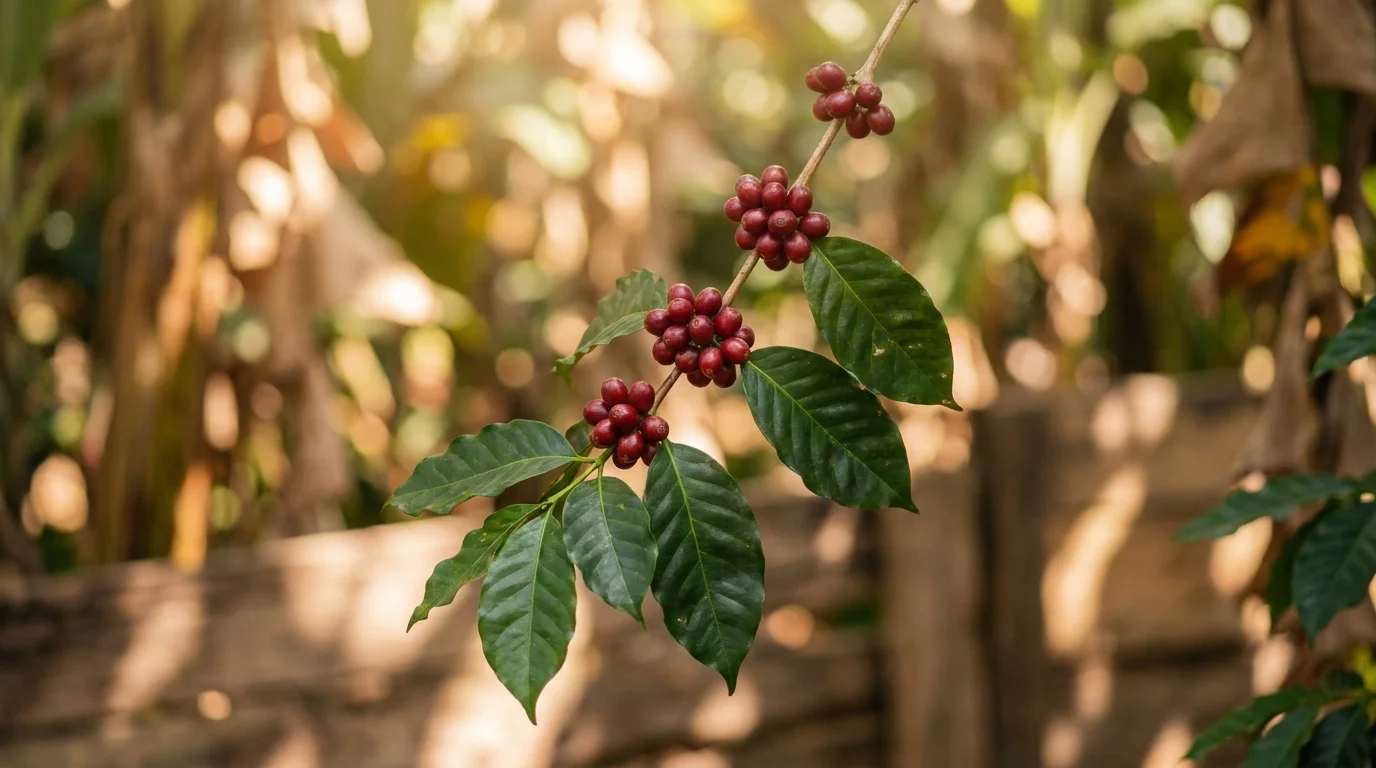
Every cup of coffee begins with a seed from a tropical shrub. The plant responsible — genus Coffea, family Rubiaceae, native to the forests of Ethiopia and Madagascar — is an unremarkable-looking thing in person: glossy dark leaves, small white flowers that smell briefly of jasmine, and clusters of round red fruit roughly the size of grapes. Those fruits are the coffee cherries. Inside each cherry, under layers of skin and sweet pulp and parchment, sit two seeds pressed flat-side together. Those seeds, dried, roasted, and ground, are coffee.
Understanding the plant answers a lot of questions that seem unrelated: why altitude matters, why some coffees taste fruity, why robusta is bitter, why climate change threatens supply, and why your single-origin bag lists a specific farm and elevation. It all comes back to what the plant is, where it grows, and what it takes to ripen a cherry well.
~130 Coffea species
the genus is large, but two species — arabica and robusta — account for nearly all coffee consumed globally[1]
3–4 years to first harvest
a coffee plant grown from seed takes three to four years before it produces a commercial crop; peak yield comes around year 7–8[2]
5 layers in a cherry
exocarp (skin), mesocarp (pulp), endocarp (parchment), spermoderm (silverskin), endosperm (the bean) — each removed during processing[2]
The four commercial species
The genus Coffea contains roughly 130 described species, but four are cultivated commercially, and two of them produce nearly everything in the global market[1].
Coffea arabica
The dominant species: roughly 60% of global production and all specialty coffee. C. arabica is unusual in the genus because it is a tetraploid — a natural hybrid of C. canephora (robusta) and C. eugenioides that arose in the highland forests of southwestern Ethiopia some 10,000–15,000 years ago[3]. That hybrid origin gave arabica its distinctive genetics and, indirectly, its flavour profile: lower caffeine (~1.2% dry weight) than robusta, higher sugars and lipids, and significantly more aromatic complexity. Arabica's founding hybridisation left it with unusually narrow genetic variation, which is why the crop is so exposed to disease and heat.
Arabica is a high-altitude crop — grown primarily between 1,000 and 2,000+ metres, in cooler temperatures, with moderate rainfall. It is also more genetically fragile than robusta: more susceptible to disease (particularly coffee leaf rust, Hemileia vastatrix) and more sensitive to temperature fluctuation.
Coffea canephora (robusta)
Robusta accounts for roughly 40% of global production. Compared to arabica it is hardier — grows at lower elevation, survives higher temperatures, resists more pests — but produces chemically different and generally lower-quality coffee: roughly twice the caffeine (~2.2% dry weight), more chlorogenic acids (which contribute bitterness), fewer sugars and lipids[4]. Robusta is the backbone of espresso blends (for body and crema) and most instant coffee.
Coffea liberica and Coffea excelsa
Coffea liberica is a minor commercial crop grown mainly in the Philippines, Malaysia, and parts of West Africa — once briefly considered a replacement for arabica when leaf rust devastated 19th-century Ceylon. It produces large, asymmetrical fruits with a distinctive smoky, woody, sometimes fruity flavour that arabica drinkers often find polarizing. Coffea excelsa (now classified as a variety of C. liberica) grows mainly in Central Africa and Southeast Asia and has a cult following in the Philippines.
Figure
Commercial coffee species: caffeine content (% dry bean weight)
Values in % dry weight
The coffee cherry: anatomy
What looks like a simple berry is built from five distinct layers, each removed during processing to reveal the seed inside. Processing methods — washed, natural, honey — differ primarily in which layers are removed and how.
Figure
Cross-section of a coffee cherry
Working from outside in:
Exocarp (outer skin) — the cherry's outer surface. Green when unripe, turning red, yellow, orange, or purple when ripe depending on the variety. Thin and tough; removed mechanically in wet processing or left to dry off in natural processing.
Mesocarp (pulp) — the sweet, mucilaginous flesh under the skin. High in sugars — this is where the fruit's sweetness sits. Fermentation during processing targets this layer. In natural-processed coffees the fruit dries around the bean and the sugars migrate inward, producing fruity, wine-like cup notes. In washed processing the pulp is removed quickly to limit fruit influence and produce cleaner, more acidic flavour[2].
Endocarp (parchment) — a dry, papery hull surrounding each seed. This layer protects the bean through fermentation and drying. Removed by milling (hulling) before export. Coffee shipped in parchment (café pergamino) keeps better than hulled coffee.
Spermoderm (silverskin) — a thin, delicate membrane clinging directly to the bean. Most of it rubs off during milling; a small amount remains and becomes chaff during roasting.
Endosperm (the coffee bean) — the seed itself. This is the coffee bean: a dense, green seed roughly 10–15 mm long, oval in cross-section. It stores the plant's energy reserves — mostly complex carbohydrates, lipids, proteins, and green chlorogenic acids — which transform dramatically during roasting. The flat side of each bean has a longitudinal groove (the "centre cut") where the two seeds pressed against each other inside the cherry.
The plant itself
A mature arabica coffee plant in cultivation is a woody shrub pruned to 1.5–3 metres — compact enough for workers to harvest without ladders. Left unpruned, it grows to 5–10 metres. Robusta grows somewhat larger. Both are evergreen, with paired glossy leaves arranged on branches that grow in a characteristic horizontal plane from the central stem.
Roots: coffee has a deep taproot that can reach 1–2 metres into the soil, important for drought tolerance, plus a spreading network of lateral roots in the topsoil that absorb most of the plant's nutrients.
Branches: new fruiting wood grows from leaf axils on primary (main) branches. Crucially, coffee only fruits on wood that grew in the previous season — which means heavy pruning has a one-year lag on production, and management practices matter significantly for yield consistency.
Flowers: white, five-petalled, clustered in groups of 4–8 at each leaf node, strongly fragrant — jasmine is the standard comparison. A mature tree may carry thousands of flowers simultaneously during bloom. Arabica flowers are primarily self-pollinating; robusta requires cross-pollination from another plant, which makes variety placement in the field matter[2].
Fruit development: from pollination to ripe cherry takes 6–11 months, with the range depending heavily on elevation and temperature — slow ripening at altitude, fast in warm lowlands. This variation is one of the primary mechanisms by which altitude affects cup quality.
The lifecycle: seed to spent tree
Figure
Coffee plant lifecycle: arabica, typical commercial orchard
Altitude and cup quality
Altitude affects coffee quality through temperature: higher elevation means cooler nights, smaller diurnal temperature swings, and slower cherry development. That slower pace allows the fruit to accumulate more sugars, organic acids, and aromatic precursors than a cherry that ripens quickly in hot lowland conditions[5].
Figure
Typical growing altitude by species and quality tier (metres above sea level)
Values in metres
The altitude-quality relationship explains why so many high-scoring coffees come from Kenya (1,400–2,100 m), Ethiopia (1,700–2,200 m), and highland Colombia (1,200–2,000 m), while lower-altitude farms in the same countries produce commodity-grade lots for blends and instant.
A practical corollary: climate change is a direct threat to coffee quality and supply. A 1–2 °C warming effectively shifts the "altitude equivalent" of any given location downward by several hundred metres. Research modelling the 2050 climate scenario projects significant reductions in suitable arabica growing area globally — even where rainfall stays adequate, temperature alone may push quality down[5].
Where coffee grows: the coffee belt
Coffee — both species — grows in a band roughly between 25°N and 30°S latitude, where the combination of warm temperatures, defined wet-dry seasons, and in arabica's case, high elevation, creates the conditions the plant requires. The International Coffee Organization tracks production across more than 50 countries in this belt[6].
Major arabica producers: Brazil (the world's largest coffee producer, primarily lower-altitude arabica in the cerrado), Colombia (all arabica, some of the world's most consistent high-altitude farms), Ethiopia (arabica's origin country, extraordinary genetic diversity), Honduras, Peru, Guatemala, Kenya, Mexico.
Major robusta producers: Vietnam (the world's second-largest coffee producer overall, overwhelmingly robusta), Brazil (both species), Indonesia (mixed), Uganda, Côte d'Ivoire.
The "coffee belt" framing is accurate but slightly misleading: within the belt, vast areas are too hot, too dry, too wet, or too flat to grow quality coffee. What matters is the microclimate — elevation, slope, cloud cover, and soil chemistry — not just latitude.
Why this matters in the cup
Understanding the coffee plant grounds several things that otherwise seem arbitrary:
Variety names on bags (Typica, Bourbon, Geisha, SL28) are cultivated varieties of Coffea arabica — genetic subgroups with distinct agronomic traits and cup profiles, catalogued by World Coffee Research[1]. They are not processing styles or roast profiles.
Processing method names (washed, natural, honey) describe which layers of the cherry are removed and in what order — the anatomy above makes those terms literal rather than abstract.
Elevation on a bag is a flavour claim: higher altitude = slower ripening = more complexity. It is verifiable (though not always verified).
"100% arabica" is a species claim, distinguishing the bag from robusta-containing blends. It is a floor, not a ceiling — there is enormous quality variation within arabica.
See Arabica Coffee for a deep dive on C. arabica specifically, Arabica vs Robusta for the commercial quality comparison, and Coffee Processing Methods for what happens to the cherry after harvest.
Frequently asked questions
- What kind of plant is coffee?
- Coffee plants are woody shrubs or small trees in the genus Coffea, family Rubiaceae. In the wild they grow to 5–10 metres; cultivated plants are usually pruned to 1.5–3 metres for easier harvesting. They are evergreen, with glossy dark-green leaves and small, fragrant white flowers. Native to tropical Africa and Madagascar, they now grow commercially throughout a tropical belt roughly between the Tropics of Cancer and Capricorn.
- What is a coffee cherry?
- A coffee cherry is the fruit of the coffee plant — a round or oval drupe, about 1–1.5 cm in diameter, that turns red (or yellow, in some varieties) when ripe. Like any drupe (think olives or cherries), it has an outer skin, a layer of sweet mucilaginous pulp, and a hard pit at the centre. The 'pit' contains two seeds sitting flat-side to flat-side — and those seeds are what we call coffee beans.
- How long does a coffee plant take to produce fruit?
- A coffee plant grown from seed takes 3–4 years to produce its first commercial harvest. It reaches peak productivity at around year 7–8 and continues bearing fruit for 20–30 years, after which yields decline. Some well-maintained trees produce for 50+ years, but commercial orchards typically rejuvenate plants after 20–25 years.
- Why does altitude affect coffee quality?
- Higher elevation means cooler temperatures, which slows the development of the coffee cherry. A slower ripening period allows the fruit to accumulate more sugars, organic acids, and aromatic compounds than cherries that ripen quickly in hot lowland conditions. As a general principle, arabica grown above 1,500 metres tends to show higher acidity and more complex aromatics than the same variety grown at lower elevation.
- What are the main coffee species?
- Four Coffea species are commercially cultivated: Coffea arabica (60% of production, all specialty coffee), Coffea canephora/robusta (roughly 40%, used in blends and instant), Coffea liberica (minor commercial crop in Southeast Asia and West Africa), and Coffea eugenioides (obscure; one parent species of arabica — occasionally grown as a specialty curiosity). Arabica and robusta account for nearly all coffee consumed globally.
- Do coffee plants have flowers?
- Yes. Coffee plants produce clusters of small, white, five-petalled flowers with a strong jasmine-like fragrance. They bloom for only a few days — often triggered by rain — and must be pollinated (arabica is largely self-pollinating; robusta requires cross-pollination) before the fruit begins to develop. The flowers appear on the same branch as the previous year's fruit, so a mature plant may simultaneously hold flowers, unripe green cherries, and ripe red cherries.
References
Every factual claim in this article is drawn from the sources below. See the source library for how we grade evidence.
- [1]Coffee Varieties CatalogWorld Coffee Research · Reference work · Tier 2 · Moderate
- [2]Coffee agronomyFood and Agriculture Organization of the United Nations · Reference work · Tier 2 · Moderate
- [3]Comparison of the Effectiveness of Fatty Acids, Chlorogenic Acids, and Elements for the Chemometric Discrimination of Coffee (Coffea arabica L.) Varieties and Growing OriginsJournal of Agricultural and Food Chemistry · 2008 · Observational study · Tier 2 · Moderate
- [4]Caffeine and related purine alkaloids: biosynthesis, catabolism, function and genetic engineeringPhytochemistry · 2008 · Review · Tier 2 · Moderate
- [5]Climate change impacts on coffee production: a systematic reviewPMC / NIH · 2023 · Systematic review · Tier 1 · Strong
- [6]World Coffee Statistics DatabaseInternational Coffee Organization · Official dataset · Tier 1 · Strong
- [7]CoffeeEncyclopaedia Britannica · Reference work · Tier 3 · Contextual
Related reading
- Beans, Roasts & OriginsArabica Coffee: The World's Leading Coffee Species→
- Beans, Roasts & OriginsArabica vs Robusta: Taste, Caffeine, and Differences→
- Beans, Roasts & OriginsCoffee Processing Methods Explained→
- Beans, Roasts & OriginsWhere Did Coffee Originate? Ethiopia, Yemen, History→
- Caffeine & HealthWhy Do Plants Make Caffeine? The Evolutionary Biology→
- Beans, Roasts & OriginsRobusta Coffee: Caffeine, Taste, and Uses Explained→