Why Do Plants Make Caffeine? The Evolutionary Biology
By Coffee Studies Editorial·Published July 19, 2026·6 min read
Quick answer
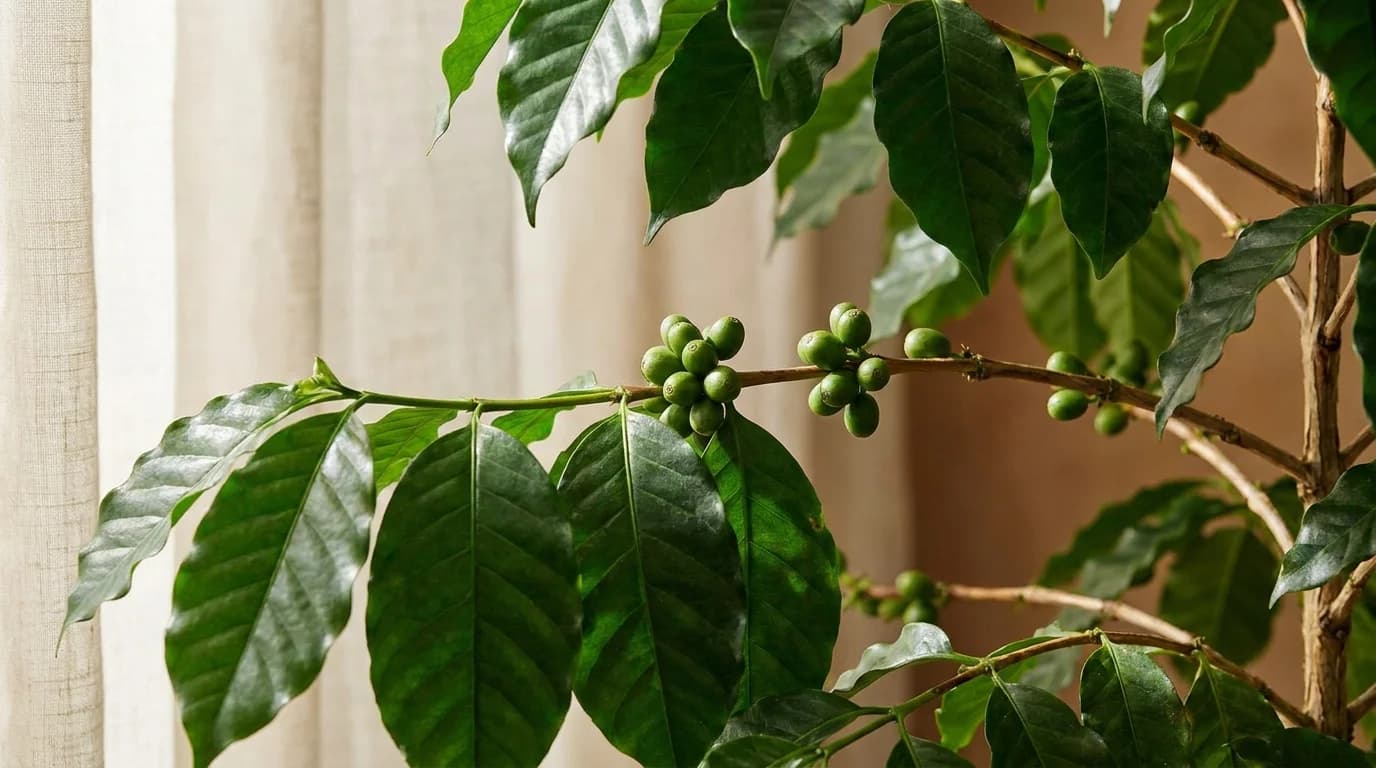
Caffeine did not evolve for humans. We are not its intended audience. The world's most widely consumed psychoactive compound is, from the plant's perspective, a weapon — a chemical deployed in leaf tissue to make eating the plant a bad experience for insects, and possibly in soil to make growing near the plant a bad experience for competitors. That caffeine happens to block the same adenosine receptors in a human brain as it does in an insect nervous system is an evolutionary coincidence we have built an entire global industry around.
Caffeine evolved independently at least four times — convergent evolution
caffeine appears in at least four unrelated plant lineages — coffee (Rubiaceae), tea (Theaceae), cacao and guarana (Sapindales), and holly plants including yerba maté and guayusa (Aquifoliaceae) — each with distinct enzymatic pathways producing the same molecule; this is convergent evolution, the same solution arising independently to solve the same ecological problem[1]
Young leaves have the highest caffeine — where defense is needed most
caffeine concentrations within a coffee plant are highest in young, unfurled leaves — the most nutritionally valuable and vulnerable tissue for herbivorous insects; as leaves mature, caffeine concentrations typically decline; this distribution pattern is consistent with caffeine's proposed role as a defense compound targeting tissue where damage would be most costly[3]
Caffeine in nectar: possible pollinator manipulation
coffee plants produce caffeine in their flower nectar as well as in defensive tissues; research suggests that caffeine in nectar may improve bee memory of the floral scent, increasing the probability that bees will preferentially return to caffeinated flowers — a possible second evolutionary function beyond defense, manipulating pollinator behaviour for reproductive advantage[1]
The problem caffeine solves
Plants cannot run from herbivores. They cannot fight back physically. Their primary defense toolkit is chemical — compounds that make plant tissue unpleasant, toxic, or disorienting to the insects, fungi, bacteria, and larger animals that would otherwise consume them[3].
Caffeine is one of the most successful chemical defenses in plant evolutionary history, for a specific reason: adenosine receptors are ancient and highly conserved across the animal kingdom. Humans, bees, beetles, flies, and most other animals use adenosine signalling for fundamental physiological processes. A compound that disrupts adenosine signalling is therefore broadly toxic across a wide range of potential herbivores — not just the specific insects that eat coffee, but essentially anything with a nervous system.
At the concentrations found in young coffee leaves, caffeine:
- Disrupts learning and memory formation in insects (reducing the insect's ability to navigate back to the plant and build a feeding routine)
- Impairs motor coordination in high doses
- Is directly toxic at concentrations present in the most caffeine-rich tissues
The coffee plant invests energy in producing caffeine specifically in the tissues most likely to be eaten — young leaves and developing seeds — and at concentrations calibrated to deter without necessarily killing (which would attract scavengers)[1].
Caffeine content across plants that independently evolved it
Figure
Caffeine content across plants with independently evolved caffeine synthesis
Values in approximate % caffeine in dry weight of most caffeinated tissue
The biochemistry of convergent evolution
The most striking aspect of caffeine's evolutionary story is that it was independently invented multiple times[1].
When researchers mapped the specific enzymes used to build caffeine in different plant lineages, they found that coffee plants and tea plants — despite producing the same final molecule — use different sequences of biochemical steps and different specific enzyme variants to get there:
Coffee's pathway: Xanthosine → 7-methylxanthosine → 7-methylxanthine → theobromine → caffeine. The specific N-methyltransferase enzymes catalysing each step in coffee have distinct gene sequences from those in tea.
Tea's pathway: Related but uses different intermediate steps and different gene sequences for the methyltransferase enzymes at each stage. The same purine base building blocks, different enzymatic routes.
Holly plants (maté, guayusa): Yet another independently evolved pathway confirmed by different gene sequences.
This is convergent molecular evolution — the same compound arising through different biochemical routes in different lineages. The evolutionary pressure to make caffeine was strong enough that at least four plant families each found their own path to the same molecule.
Why arabica has less caffeine than robusta
The caffeine content difference between arabica and robusta has a plausible evolutionary explanation[2]:
Coffea arabica evolved in the cool highland forests of Ethiopia at 1,000–2,000 metres elevation. At these altitudes, insect populations are less dense and diverse than at lower elevations — the cold limits insect activity and reproduction. Arabica therefore evolved under lower insect selection pressure and invested less metabolic energy in caffeine production (~1.5% of dry bean weight).
Coffea canephora (robusta) evolved at lower altitudes in West and Central Africa, where insect pressure is considerably higher. Robusta contains approximately 2.7% caffeine — nearly double arabica. This higher caffeine content provides greater defense against the larger and more diverse insect community it evolved alongside.
The practical implication: robusta has noticeably better natural pest resistance than arabica in field conditions, partly because insects that encounter it receive a higher caffeine dose. Arabica's lower caffeine is one factor in its greater susceptibility to coffee berry borer and other pests — a vulnerability that requires more pesticide use or careful management in arabica cultivation.
Allelopathy: caffeine in the soil
Beyond insect defense, caffeine appears to serve a second chemical defense role: allelopathy — the inhibition of competing plants through chemicals released into the environment[1].
Caffeine leaches from fallen coffee leaves and from coffee seeds (including the hulls and pulp of processed coffee) into the soil. Laboratory studies have shown that caffeine in soil suppresses the germination of seeds from many plant species — reducing competition for light, water, and nutrients around the coffee plant.
This allelopathic function is less well-characterised than the insect defense function, and the ecological significance under field conditions (where soil chemistry is highly variable) is debated. But the seed germination inhibition has been replicated sufficiently to be taken seriously as a secondary evolutionary function.
Caffeine in nectar: the pollinator manipulation hypothesis
Coffee plants also produce caffeine in their flowers, and specifically in the nectar of their flowers — which is visited by bees and other pollinators. At first, this seems counterproductive to a defense compound: nectar is meant to attract and reward pollinators, not deter them.
Research has found a possible explanation: caffeine in floral nectar appears to improve the memory of foraging bees for the floral scent associated with caffeinated nectar. Bees that encounter caffeinated flowers show higher rates of returning to plants with that same scent compared to bees that received uncaffeinated nectar.
If this finding reflects a real ecological dynamic, it represents a second evolved function for caffeine in coffee: not just deterring the insects that eat leaves, but improving the fidelity of the pollinators that service flowers[1]. This would make caffeine a molecule serving two opposite evolutionary purposes in the same plant — defense against enemies, loyalty manipulation of allies.
Engineering caffeine-free coffee
Understanding caffeine biosynthesis at the molecular level has enabled a third application: genetic engineering[1].
Once researchers identified the specific N-methyltransferase genes responsible for caffeine synthesis in coffee, it became possible to suppress them using RNA interference — effectively turning off the plant's caffeine production. Research groups have produced coffee plants that make significantly reduced amounts of caffeine through gene silencing, without (in initial studies) substantially affecting the plant's cup chemistry or growth.
This would represent natural decaffeination at the plant level, eliminating the chemical solvent or water-based decaffeination processes currently required to remove caffeine post-harvest. The practical and commercial barriers are significant — regulatory approval, consumer acceptance of GMO coffee, agronomic performance — but the molecular biology is established.
The honest summary
Plants make caffeine as a chemical defense compound — an insecticide that disrupts adenosine signalling in the nervous systems of insects eating plant tissue, targeted toward the most vulnerable tissues (young leaves, developing seeds) at concentrations calibrated to deter. Caffeine is the most successfully convergently-evolved chemical in the plant kingdom: it arose independently in at least four unrelated plant families (coffee, tea, cacao/guarana, holly plants including maté and guayusa), each through distinct enzymatic pathways to the same molecular endpoint. A secondary allelopathic function — inhibiting germination of competing plants through soil leaching — is supported by laboratory evidence. The presence of caffeine in coffee flower nectar may represent a third function: improving bee memory of the floral scent to increase pollinator fidelity. Understanding the biosynthesis pathway has also enabled engineering of caffeine-reduced coffee plants through gene silencing. Arabica contains less caffeine than robusta because it evolved at higher altitude under lower insect pressure — less defense investment required.
Frequently asked questions
- Why do plants make caffeine?
- The primary evolutionary explanation is chemical defense. Caffeine is toxic to many insects — it interferes with adenosine receptors (a conserved molecule across animals) and disrupts the nervous system of insects that consume plant tissue. Young leaves and developing seeds, which are most vulnerable to insect damage, typically contain the highest caffeine concentrations. Secondary hypotheses include allelopathy (caffeine leaching into soil from fallen leaves and seeds inhibits the germination of competing plants) and pollinator manipulation (caffeine in nectar may improve bee memory of the flower, increasing revisit rates).
- What is convergent evolution in caffeine?
- Convergent evolution occurs when unrelated organisms independently evolve similar traits to solve similar problems. Caffeine evolved independently in at least four distinct plant lineages — coffee (family Rubiaceae), tea (Theaceae), cacao and guarana (related families in the Sapindales order), and holly plants including yerba maté and guayusa (Aquifoliaceae). These plant families are not closely related; they did not inherit caffeine synthesis from a common ancestor. Each evolved different enzymatic pathways to build the same molecule. The fact that caffeine was independently 'invented' four or more times suggests it is a highly effective solution to a common ecological problem.
- Does all of the coffee plant contain caffeine, or just the beans?
- Caffeine is present throughout the coffee plant but in different concentrations in different tissues. Young leaves contain the highest caffeine concentrations — this is where insect pressure is greatest, as young leaf tissue is most nutritionally valuable to herbivores. Mature leaves have somewhat lower concentrations. Coffee seeds (the beans inside the cherries) contain substantial caffeine; the flesh of the fruit (pulp/mucilage) contains less. Coffee flowers and nectar contain small amounts. The differential distribution — highest where insect damage would be most costly — is consistent with the defensive function hypothesis.
- Is caffeine actually toxic to insects?
- Yes, at the concentrations found in plant tissues. Caffeine is an adenosine receptor antagonist, and adenosine receptors are conserved across animal species — caffeine affects insect nervous systems through similar mechanisms to its effects in mammals. At concentrations present in young leaves, caffeine has been shown to reduce feeding by specialist and generalist herbivores, impair learning and memory in insects, and increase mortality at higher concentrations. The defensive function is well-supported by both biochemical and ecological evidence.
- How do coffee plants make caffeine biologically?
- Coffee plants synthesise caffeine from xanthosine — a purine nucleoside — through a sequence of N-methylation steps involving specific enzymes (methyltransferases). The pathway goes: xanthosine → 7-methylxanthosine → 7-methylxanthine → theobromine → caffeine. Tea plants use a related but distinct pathway with different intermediate steps and different specific enzymes, which is how researchers confirmed the two lineages evolved caffeine synthesis independently. The final gene sequences coding for the methyltransferase enzymes differ between coffee and tea, even though the end product is the same molecule.
References
Every factual claim in this article is drawn from the sources below. See the source library for how we grade evidence.
- [1]Caffeine and related purine alkaloids: biosynthesis, catabolism, function and genetic engineeringPhytochemistry · 2008 · Review · Tier 2 · Moderate
- [2]Coffee Varieties CatalogWorld Coffee Research · Reference work · Tier 2 · Moderate
- [3]Coffee agronomyFood and Agriculture Organization of the United Nations · Reference work · Tier 2 · Moderate
- [4]CoffeeEncyclopaedia Britannica · Reference work · Tier 3 · Contextual
Related reading
- Caffeine & HealthThe Caffeine Chemical Structure→
- Caffeine & HealthHow Caffeine Works: The Adenosine Mechanism→
- Beans, Roasts & OriginsThe Coffee Plant: Biology, Growth, and Cherry Anatomy→
- Beans, Roasts & OriginsArabica vs Robusta: Taste, Caffeine, and Differences→
- Caffeine & HealthCaffeine Tolerance: How It Builds and How to Reset It→
- Caffeine & HealthDoes Coffee Cause Bloating? Gut Effects Explained→