How Is Instant Coffee Made? Freeze-Dry vs Spray-Dry
By Coffee Studies Editorial·Published July 14, 2026·8 min read
Quick answer
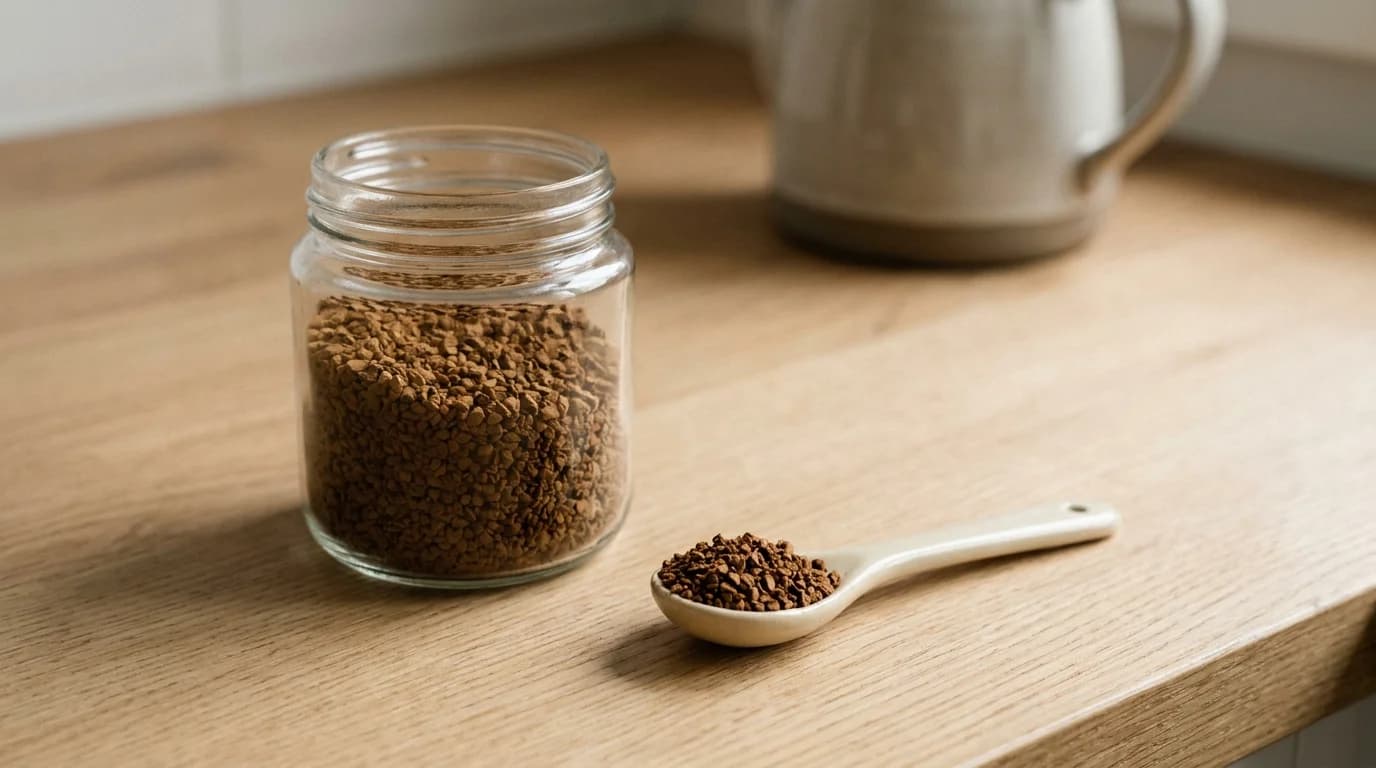
Instant coffee has a reputation problem, but the manufacturing process is straightforward and well understood: it is brewed coffee with the water taken out. The choices manufacturers make along the way — bean, extraction, drying method — decide how much of the original cup survives.
~1.8 g
typical amount of instant coffee that reconstitutes into an 8 oz cup[3]
2 methods
spray drying and freeze drying account for essentially all commercial instant coffee[1]
Since 1901
instant coffee has been produced commercially in some form for more than a century[2]
The five steps, in order
Every commercial instant coffee — whether it comes as a jar of freeze-dried granules or a stick of spray-dried powder — goes through the same basic sequence.
1. Green bean sourcing and roasting
Green (unroasted) coffee is delivered to the factory, cleaned, and roasted. Roast profiles for instant coffee are chosen to survive the extraction and drying steps that follow. Traditional instant blends often include robusta for body and yield[2]; specialty and freeze-dried premium instants may be arabica-only.
2. Grinding
Roasted beans are ground to a coarse-to-medium consistency. The grind size is matched to the extraction system — coarser than espresso, roughly comparable to filter drip — so water flows evenly through large industrial percolators without clogging.
3. Extraction
Ground coffee is loaded into a series of pressurized percolation columns. Hot water is pushed through the beans, extracting the soluble solids. Unlike a home brew, the goal is to pull as much soluble material as possible from each batch, so temperatures and pressures are higher and multiple columns are run in series to recover the last extractable solids[3].
3a. Inside the extraction battery
Industrial extraction is not one big brewer but a train of five to eight percolation columns run in series, each filled with fresh grounds and fed counter-currently with hot water[3]. Water entering the first column is already loaded with dissolved solids from previous columns; only the freshest grounds see clean water. Temperatures are staged deliberately: the first columns run at roughly 100 °C to pull the readily soluble compounds — sugars, chlorogenic acids, caffeine — and the later columns push higher, above 150 °C under pressure, to hydrolyse insoluble carbohydrates into soluble ones and squeeze the last usable material out of the spent grounds[7].
The upside is that soluble yields far exceed what home brewing achieves — often 40–50% of the roasted mass, compared to about 20% for a filter brew — which is what makes the economics of instant coffee work. The downside is that the high-temperature stages also generate compounds a regular brew never sees, contributing to the distinctive character of traditional instant.
4. Concentration
The resulting extract — essentially a very dilute coffee — is concentrated before drying, which cuts the drying load. This is done by evaporation (heating under vacuum) or by freeze concentration (partially freezing the extract and removing pure ice crystals). Concentration typically brings the extract from around 15% to 30–50% coffee solids by weight[3].
5. Drying
This final step is the one people usually mean when they ask how instant coffee is made, and it is the one that most affects the finished cup. There are two methods in commercial use.
Spray drying
The concentrated extract is sprayed as a fine mist into a tall tower of hot air (typically well above 200 °C at the inlet). Water evaporates almost instantly, and dry particles fall to the bottom of the tower as a fine powder[1].
Spray drying is fast, high-throughput, and comparatively cheap. The main trade-off is thermal exposure: high temperatures can drive off volatile aroma compounds, which is why traditional spray-dried instant is often described as having a flatter, more roasted flavor. Manufacturers often "agglomerate" the fine powder into larger granules afterward — spraying water back on and re-drying — to improve solubility and appearance.
Freeze drying
Instead of evaporating water with heat, freeze drying removes it as vapor directly from ice. The steps:
- The concentrated extract is frozen into a slab, typically at around −40 to −50 °C.
- The frozen slab is broken into granules of the desired size.
- The granules are placed in a vacuum chamber. Under low pressure, the ice sublimates — passes directly from solid to vapor — without ever becoming liquid[1].
Because the process never applies significant heat, more of the coffee's low-boiling aroma compounds survive into the finished product. The trade-off is cost and time: freeze drying is more energy-intensive and slower than spray drying, which is why freeze-dried instant typically sits at a higher price point[1].
Aromatisation: putting the smell back in
High-temperature extraction and drying both drive off volatile aroma compounds, and coffee has hundreds of them[6]. Manufacturers know the loss is unavoidable and often compensate for it with an aromatisation step, in which volatile aromas are captured during earlier stages — from grinding, roasting off-gas, or the first condensate of the drying tower — and reintroduced onto the finished granules just before packaging.
Aromatisation is why opening a fresh jar of quality instant produces a much more coffee-like smell than the dry powder itself contributes when brewed. It is also why the aroma of instant coffee often fades faster than the cup: the added volatiles sit on the granule surface and escape into the headspace of the jar. Not every product is aromatised; premium freeze-dried brands often skip it because their base granule retains more native aroma to begin with.
Agglomeration: why granules stick together
Fresh spray-dried coffee comes out as a very fine, dusty powder that does not wet easily — dropped into a mug, it tends to float and clump. To fix this, most manufacturers agglomerate the powder in a second step: the fine particles are lightly re-wetted with steam or fine water mist, allowed to stick together into larger clusters, and re-dried into uniform granules[3].
Agglomerated granules pour cleanly, wet quickly, and dissolve without clumping. They also look more like the freeze-dried product on the shelf, which is a marketing advantage. The physical difference — a spray-dried agglomerate is a cluster of small dense particles glued together, while a freeze-dried granule is a single porous piece — is only visible under magnification.
Comparing the two drying methods
| Spray drying | Freeze drying | |
|---|---|---|
| Water removal | Hot air, evaporation | Sublimation of ice under vacuum |
| Typical temperature | Very high (inlet air >200 °C) | Very low (−40 °C or below) |
| Aroma retention | Lower | Higher |
| Speed and throughput | Fast | Slow |
| Cost per finished kg | Lower | Higher |
| Typical appearance | Fine powder or small agglomerated granules | Chunky, crystalline granules |
Both methods produce a shelf-stable powder that dissolves in hot water. Neither adds anything to the coffee; both simply take water away.
What ends up in the jar
A finished instant coffee is essentially concentrated brewed coffee in dry form. Standard commercial instants are typically dosed at around 1.8–2 grams of powder per 8 oz cup[3], giving a caffeine content roughly in the same range as a light drip coffee.
Because water has been fully removed, instant coffee is dense in soluble coffee solids and shelf-stable for long periods when kept sealed and dry. The trade-offs relative to fresh-brewed coffee show up mostly in aroma complexity, which is fundamentally a drying-method question, not a "real coffee vs fake coffee" one.
Quality tiers within instant coffee
"Instant coffee" is not a single product category. On any well-stocked shelf there are at least four distinct tiers:
- Bulk spray-dried powder — the workhorse of institutional coffee, vending machines, and 3-in-1 stick packs. Usually a robusta or robusta-heavy blend, chosen for yield and body rather than aroma.
- Standard spray-dried instant — the everyday supermarket jars. Often agglomerated for appearance and solubility; typically blends of arabica and robusta.
- Freeze-dried instant — the premium mass-market tier. Nescafé Gold, Moccona, Taster's Choice and equivalents. Usually higher arabica proportion, better aroma retention.
- Single-origin freeze-dried specialty instant — the newest tier, produced by specialty roasters using traceable arabica lots and small freeze-dryers. Sold in single-serve sachets at price points comparable to whole-bean specialty coffee.
Within each tier, the drying method is only one input. Bean quality, freshness of the extract before drying, and whether aromatisation is used all separate a good jar from a mediocre one at the same drying technology.
Scale of the global industry
Instant coffee is a genuinely global commodity. The International Coffee Organization tracks soluble coffee as one of the two main product forms in world coffee trade, alongside roast-and-ground, with soluble consumption growing especially fast in emerging markets in Asia and Eastern Europe[5]. A handful of processors — Nestlé, JDE Peet's, Tata Consumer, Olam, Cofco — account for the bulk of industrial soluble production, and a single large factory can turn out tens of thousands of tonnes of finished powder per year. The scale is part of why instant remains cheap: the fixed cost of a spray tower or freeze-drying line is amortised across enormous volumes.
Where the industry is heading
Global demand for instant coffee is significant — the International Coffee Organization tracks it as a major category of world coffee consumption alongside roast-and-ground[4]. Newer techniques such as spray-freeze-drying combine features of both processes and show promise for aroma retention, though they have yet to be widely industrialized[1].
For most drinkers, though, the meaningful question is not the drying technology itself — it is which drying method a particular product uses and whether the beans behind it were worth preserving in the first place.
Frequently asked questions
- Is instant coffee real coffee?
- Yes. Instant coffee is brewed from roasted coffee beans, then dried into a soluble form. Rehydrating it with hot water reconstitutes the brew. It is not a synthetic or coffee-flavored substitute.
- What is the difference between freeze-dried and spray-dried instant coffee?
- Both remove water from brewed coffee. Spray drying uses hot air to evaporate water from a fine mist; freeze drying freezes the extract and removes water as vapor under vacuum. Freeze-dried coffee generally preserves more aroma but costs more to produce.
- How much coffee is used to make instant coffee?
- Manufacturers brew a very concentrated extract — much stronger than a normal cup — so that after drying, a small amount of powder (about 1.8–2 grams for a typical serving) reconstitutes into an 8 oz cup.
- Does instant coffee use lower-quality beans?
- Historically, much instant coffee has been made from robusta and blends chosen for yield and body. That is a sourcing choice, not a requirement of the process itself; freeze-dried arabica-only instants also exist.
References
Every factual claim in this article is drawn from the sources below. See the source library for how we grade evidence.
- [1]Spray-freeze-drying as emerging and substantial quality enhancement technique in food industryPMC / NIH · 2024 · Review · Tier 2 · Moderate
- [2]CoffeeEncyclopaedia Britannica · Reference work · Tier 3 · Contextual
- [3]Instant coffeeWikipedia · Reference work · Tier 3 · Contextual
- [4]International Coffee OrganizationInternational Coffee Organization · Official dataset · Tier 1 · Strong
- [5]World Coffee Statistics DatabaseInternational Coffee Organization · Official dataset · Tier 1 · Strong
- [6]Coffee volatile compounds and roast markersPMC / NIH · 2016 · Review · Tier 2 · Moderate
- [7]Coffee extraction kinetics in a well mixed systemJournal of Mathematics in Industry · 2016 · Review · Tier 2 · Moderate
Related reading
- Instant & Decaf CoffeeFreeze-Dried vs Spray-Dried Coffee→
- Instant & Decaf CoffeeIs Instant Coffee Bad for You?→
- Beans, Roasts & OriginsArabica vs Robusta: Taste, Caffeine, and Differences→
- Instant & Decaf CoffeeThe Best Instant Coffee Brands→
- Instant & Decaf CoffeeThe History of Nescafé: How Nestlé Invented Instant Coffee→
- Instant & Decaf CoffeeEthyl Acetate ('Natural') Decaffeination→