Freeze-Dried vs Spray-Dried Coffee
By Coffee Studies Editorial·Published July 14, 2026·8 min read
Quick answer
The choice between freeze-dried and spray-dried instant coffee comes down to one question: how do you remove water from brewed coffee without destroying what makes it taste like coffee?
Both methods produce a shelf-stable, water-soluble powder. Both start from the same input: a concentrated brewed extract of roasted coffee — see how instant coffee is made for the full production sequence. What differs is the physics of the drying step, and that physics is what determines how much of the original cup ends up in the jar.
>200 °C
typical inlet air temperature in a spray drying tower[1]
−40 °C
typical starting temperature for freeze-drying coffee extract[1]
Sublimation
freeze drying skips the liquid phase — ice becomes vapor directly under vacuum[1]
A short history of the two methods
The two drying technologies did not arrive at the same time. Spray drying was patented in the 1860s and industrialised for milk and food powders during the late 1800s and early 1900s, and it became the default route for soluble coffee once shelf-stable coffee powders reached the mass market in the early twentieth century[4]. Nestlé's launch of Nescafé in 1938 established spray-dried instant as a global category, and it remained the only commercial drying route for coffee for decades[2].
Freeze drying is much older as a laboratory technique — its principles were described in the 1890s and 1900s — but it did not reach coffee at industrial scale until the 1960s, when vacuum equipment became cheap enough to run continuously. Maxwell House and several European brands introduced freeze-dried instants during that decade, marketed explicitly on aroma quality[1]. Today both methods run side by side in the same category, with freeze drying occupying the premium tier and spray drying the mass tier.
How spray drying works
In a spray dryer, concentrated coffee extract is atomized into a fine mist at the top of a large tower and meets a stream of very hot air. Water flashes off the tiny droplets almost instantly, and dry particles fall to the bottom as a fine powder[1].
The upside is speed and throughput: spray drying is the workhorse of the soluble food industry and remains the most economical route for mass-market instant coffee[1]. The downside is that high temperatures drive off many of the volatile aroma compounds that give brewed coffee its complexity. The result tends to taste flatter and more one-dimensional than the extract it came from.
Manufacturers often "agglomerate" spray-dried powder by lightly re-wetting it and re-drying, producing the larger, uniform granules common in supermarket instant coffee. Agglomeration improves solubility and appearance but does not undo the aroma loss from the initial drying.
How freeze drying works
Freeze drying — technically lyophilization — takes the opposite approach: instead of adding heat, it removes water from ice without ever melting it.
The sequence:
- Concentrated coffee extract is frozen into slabs, typically at around −40 to −50 °C.
- The frozen slabs are broken into granules of the desired size.
- The granules are placed in a vacuum chamber. Under sufficiently low pressure, water skips the liquid phase entirely: ice sublimates directly into vapor and is drawn away[1].
Because nothing gets hot, more of the aromatic compounds that would boil off in spray drying stay locked into the finished granule. That is the central reason freeze-dried instant tends to taste closer to a real cup of brewed coffee.
Side-by-side comparison
| Spray drying | Freeze drying | |
|---|---|---|
| Process | Hot air evaporates water from a mist of extract | Water sublimes out of frozen granules under vacuum |
| Temperature | High (>200 °C at inlet) | Very low (−40 °C or below) |
| Time | Minutes | Many hours per batch |
| Aroma retention | Lower | Higher |
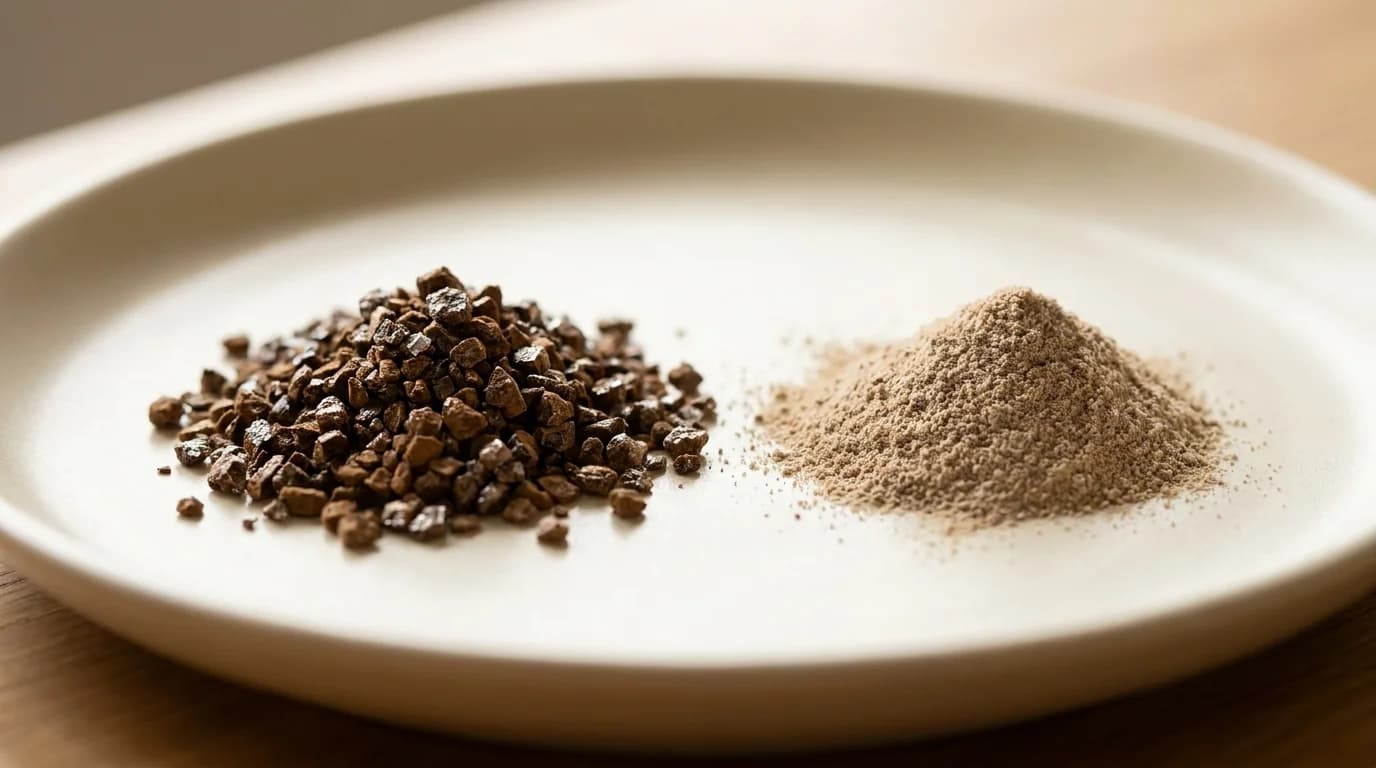
| Typical appearance | Fine powder or small agglomerated granules | Chunky, irregular, crystalline granules |
| Cost per finished kg | Lower | Higher |
| Typical use | Stick packs, budget jars, coffee mixes | Premium jars, specialty instants |
What each method does to the cup
The differences that show up in the mug come mostly from the aroma-retention gap. Coffee flavor is dominated by hundreds of volatile compounds, and it takes very little heat to drive many of them off[2]. Spray-dried instant has cleared most of that volatile inventory before it reaches the jar; freeze-dried instant holds onto more of it.
Caffeine, by contrast, is thermally stable and is not meaningfully affected by either drying method[2]. So a "freeze-dried strong coffee" versus "spray-dried strong coffee" difference at the same serving size is a taste difference, not a caffeine one — and it doesn't change whether instant coffee is bad for you either way.
Solubility is roughly comparable when products are well-made. Freeze-dried granules can look like they might take longer to dissolve, but their porous internal structure means water penetrates them quickly[1].
How each type rehydrates
The two granule structures dissolve differently, and that shows up in the first few seconds after water hits the jar. Spray-dried powder is made of small, dense particles with limited internal porosity; it dissolves by surface wetting and disperses quickly into a uniform liquid. Freeze-dried granules are larger but riddled with fine channels left behind where ice crystals sublimated away, so water penetrates the interior almost as fast as it wets the outside[1]. In practice, a well-made freeze-dried granule collapses into solution in a similar time to spray-dried powder — the appearance of chunkiness is misleading.
Water temperature matters more than granule shape. Both types dissolve cleanly in water above about 80 °C. Below that, either can leave a fine sediment or take longer to disperse, which is why cold-water instant coffees are formulated specifically for that use rather than being ordinary jars sold with a cold-brew label.
Brands that use each method
Freeze-dried instants tend to sit at the premium end of the shelf and are usually labelled as such. Nescafé Gold Blend, Nescafé Azera, Moccona (Douwe Egberts in some markets), Taster's Choice, Waka, Mount Hagen freeze-dried arabica, and most single-origin specialty instants use freeze drying. Spray drying dominates the mass-market and private-label tier: standard Nescafé Classic, Maxwell House regular, Folgers Classic Instant, most supermarket house brands, and the base powder inside 3-in-1 stick packs and vending mixes are typically spray-dried, often followed by an agglomeration step that turns fine powder into small uniform granules[3].
Reading the label is the most reliable signal. Freeze drying is used as a marketing claim; jars that qualify almost always say so on the front panel. Jars that describe themselves only as "instant coffee" or "granulated coffee" without mentioning freeze drying are almost certainly spray-dried.
Energy use and environmental footprint
The methods differ substantially in energy intensity. Spray drying uses a large volume of hot air but very short residence times, and the process runs continuously with high throughput per unit of energy. Freeze drying requires refrigeration to below −40 °C, sustained vacuum, and drying cycles measured in many hours per batch, which raises the electricity demand per finished kilogram noticeably[1].
Neither is inherently green or dirty; the footprint depends on the grid the factory runs on and the scale of the equipment. But for a given kilogram of finished powder, freeze drying is the more energy-intensive route, which is one reason freeze-dried instant carries a price premium even before accounting for bean quality.
Storage and shelf life
Both methods produce a powder that is stable for a long time when kept sealed and dry. Water activity in a properly dried instant is low enough that microbial spoilage is not a practical concern; the limiting factor is aroma loss over time as volatile compounds escape and residual oxygen oxidises the surface of the granules[6].
Freeze-dried granules, with their higher internal surface area, can actually lose aroma faster once a jar is opened repeatedly, because more surface is exposed to air with every scoop. Spray-dried powders start from a lower aroma baseline but degrade more slowly per week of open shelf life. In both cases, sealed and cool storage — a closed jar in a cupboard, not a jar left open on the counter — preserves the cup for months rather than weeks.
How to tell them apart on the shelf
- Look for the label. Freeze-dried is generally called out on the package because it is a marketing advantage; if the label says nothing, it is very likely spray-dried.
- Inspect the granules. Freeze-dried coffee looks irregular and crystalline, almost like broken shards. Spray-dried coffee is either fine powder or small, uniform, rounded agglomerates.
- Feel the density. Freeze-dried granules are typically less dense and more porous than spray-dried agglomerates.
Which one to buy
For everyday instant coffee where cost matters more than nuance, spray-dried works fine. For instants you want to enjoy on their own merits — sipped black, judged as a cup rather than a stimulant delivery — freeze-dried tends to have the edge, especially if it is made from arabica beans rather than robusta[2].
The drying method is not the only thing that matters — bean quality, extraction, and freshness all count — but between two otherwise equal products, freeze drying is doing more of the work of preserving what came out of the pot.
Frequently asked questions
- Is freeze-dried coffee better than spray-dried?
- For aroma and cup quality, freeze-dried is generally considered superior because it avoids the high heat of spray drying. For cost, shelf stability, and single-serve applications, spray-dried performs well. Neither is more or less 'real' — both are brewed coffee with the water removed.
- How can I tell if instant coffee is freeze-dried?
- Freeze-dried coffee typically appears as irregular, chunky granules that look almost crystalline. Spray-dried coffee is usually a fine powder or small, uniform agglomerated granules. Labels also often state 'freeze-dried' explicitly, since it is used as a marketing signal.
- Does freeze-dried coffee have more caffeine?
- No. Caffeine is a stable compound that is not meaningfully affected by either drying method. Caffeine content depends on the beans used and the amount of powder per serving, not on whether drying was by heat or by sublimation.
- Why is freeze-dried coffee more expensive?
- The freeze drying process is energy-intensive, slow, and requires low-temperature vacuum equipment. Producing a batch takes many hours rather than minutes, and throughput per machine is much lower than spray drying, so unit costs are higher.
References
Every factual claim in this article is drawn from the sources below. See the source library for how we grade evidence.
- [1]Spray-freeze-drying as emerging and substantial quality enhancement technique in food industryPMC / NIH · 2024 · Review · Tier 2 · Moderate
- [2]CoffeeEncyclopaedia Britannica · Reference work · Tier 3 · Contextual
- [3]Instant coffeeWikipedia · Reference work · Tier 3 · Contextual
- [4]The History of CoffeeNational Coffee Association · Reference work · Tier 3 · Contextual
- [5]International Coffee OrganizationInternational Coffee Organization · Official dataset · Tier 1 · Strong
- [6]Coffee volatile compounds and roast markersPMC / NIH · 2016 · Review · Tier 2 · Moderate
Related reading
- Instant & Decaf CoffeeHow Is Instant Coffee Made? Freeze-Dry vs Spray-Dry→
- Instant & Decaf CoffeeIs Instant Coffee Bad for You?→
- Instant & Decaf CoffeeThe Best Instant Coffee Brands→
- Instant & Decaf CoffeeCO2 (Supercritical) Decaffeination→
- Instant & Decaf CoffeeHalf-Caff Coffee: What It Is and Why It Works→
- Instant & Decaf CoffeeHow to Make Instant Coffee Taste Better→