Half-Caff Coffee: What It Is and Why It Works
By Coffee Studies Editorial·Published July 16, 2026·8 min read
Quick answer
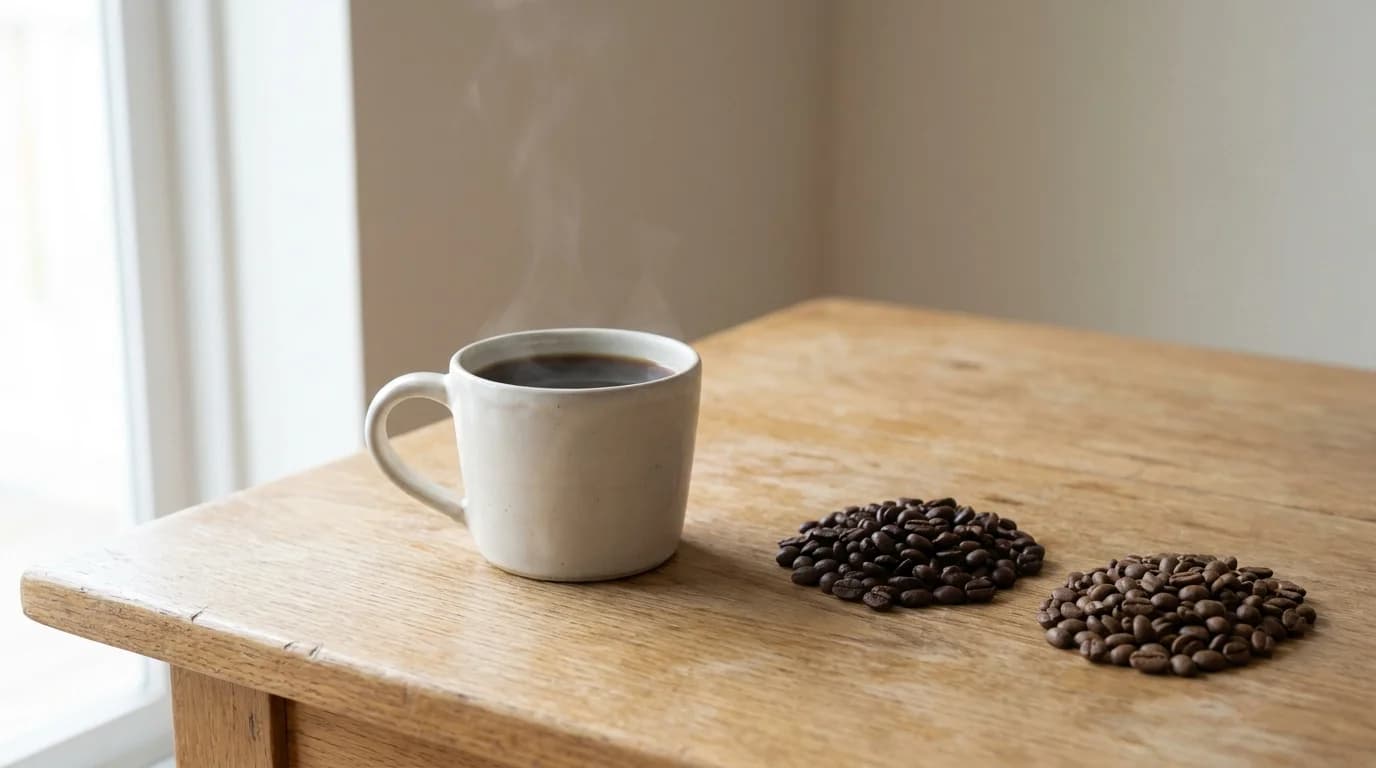
Half-caff is one of the simplest ideas in coffee: take regular and decaf beans, blend them roughly in half, and you get a cup with around half the caffeine and almost all the flavor. It's popular for people who want to stay under caffeine limits, older adults who've become more sensitive, pregnant women following Health Canada's 300 mg-per-day guidance, and anyone who wants a second cup in the afternoon without disrupting sleep.
~40–50 mg
typical caffeine content in an 8 oz cup of half-caff, roughly half of a regular cup[5]
≤300 mg/day
Health Canada's caffeine guidance during pregnancy — half-caff is a practical way to stay under this without cutting cups[3]
50/50 blend
commercial half-caff coffees are typically half regular arabica and half decaf, though ratios vary[7]
What half-caff actually is
Half-caff coffee is a blend of roughly equal parts regular and decaffeinated coffee beans. That's the whole definition. Commercial half-caffs blend the beans before grinding and packaging; you can do the same at home by combining any regular and decaf coffee in equal weights.
The "half" is approximate. A regular arabica bean has around 1.2% caffeine by dry weight[8], and a decaf bean has around 0.03% (97% removed). A 50/50 blend, brewed at normal strength, produces around 40-50 mg of caffeine per 8 oz cup — compared to 80-100 mg for regular brewed[5][1].
The math doesn't need to be exact for the concept to work. Some brands blend 60/40 or 70/30 in either direction, and different beans have different natural caffeine content (robusta has roughly twice what arabica does). The point is that half-caff hits a caffeine level that most people find gentler than full coffee without disappearing entirely into decaf territory.
Caffeine content, in context
Figure
Caffeine per 8 oz cup by coffee type
Values in mg caffeine per 8 oz cup
For most drinkers, a 40-50 mg dose sits in a comfortable zone: enough to produce a mild alertness effect, well under the level that tends to cause jitters, insomnia, or afternoon crashes in sensitive people.
For reference, the FDA cites 400 mg per day as an amount not generally associated with dangerous effects in healthy adults[1], and Health Canada uses the same 400 mg guidance for non-pregnant adults[2]. Two cups of half-caff a day (about 80-100 mg total) leaves plenty of room in that budget for tea, chocolate, or an occasional full-strength coffee.
Who half-caff is for
Sleep-sensitive drinkers
Caffeine has a half-life of about five to six hours in most healthy adults — meaning a 90 mg cup at noon still has about 45 mg circulating at 6 PM. A well-controlled 2024 sleep study confirmed that afternoon and evening caffeine reliably degrades sleep onset, duration, and quality, and that the effect is dose-dependent[6]. Cutting your afternoon cup to half-caff halves the residual caffeine at bedtime.
Older adults
Caffeine metabolism slows with age. Many drinkers who tolerated four cups a day at 30 find they can't sleep well drinking two at 60. Half-caff is a straightforward workaround: keep the ritual, cut the dose. It's why several supermarket brands specifically position their half-caff line at older buyers.
Pregnancy
Health Canada recommends pregnant women limit caffeine to 300 mg per day[3]. Two half-caff cups plus a piece of dark chocolate is comfortably under that budget; two regular coffees might exceed it. Half-caff is a common recommendation for pregnant women who don't want to quit coffee entirely. Full decaf still contains 2-15 mg per cup[4], so it's not functionally different from half-caff at low intake.
People cutting back gradually
Abrupt caffeine reduction reliably produces withdrawal symptoms — headache, fatigue, difficulty concentrating — for regular caffeine users. Half-caff is the mildest possible taper: cut your intake by half without changing cup count. Most people find they can drop from regular to half-caff over a week or two without noticing much beyond maybe a mild first-day headache.
People with mild anxiety or heart palpitations from caffeine
If you enjoy coffee but full-strength cups leave you feeling jittery or trigger heart flutters, half-caff often lands in the sweet spot. The lower dose is less likely to push adenosine-receptor blockade to the level that triggers those sympathetic-nervous-system responses.
How to make half-caff at home
The DIY version is trivial and gives you more control than any commercial half-caff.
Whole bean method
- Buy a bag of regular coffee and a bag of decaf you like (ideally from the same roaster, so the roast profile matches).
- Weigh equal amounts of each into your grinder — say, 25 g of regular and 25 g of decaf — and grind together.
- Brew as normal.
The advantage of this method is that you can adjust the ratio to your preference. Start at 50/50. If it's still too strong for evening drinking, go to 30/70 (30% regular, 70% decaf). If it's not enough kick, try 70/30 the other way.
Ground coffee method
Same idea, less precision. Use a measuring spoon to combine equal scoops of ground regular and ground decaf. Store in an airtight container. Brew as usual.
Bean pairing tip
Match the roast profiles. A dark-roast regular blended with a light- roast decaf will taste imbalanced. Pick two coffees of similar roast level — ideally the caffeinated and decaf versions from the same roaster, since many roasters (Peet's, Kicking Horse, Counter Culture) offer both.
Commercial half-caff brands
Most large coffee brands offer a half-caff SKU. A few well-known picks:
Kicking Horse Kick Ass Half Caff — the Canadian roaster's dark- roast blend of regular and Swiss Water Process decaf. Whole bean, widely available in North American supermarkets[7].
Trader Joe's Bay Blend Half Caff — Trader Joe's medium-roast half-caff, ground. Popular for its price point.
Peet's Half Caff — half of Peet's Major Dickason's regular and half of the decaf version. Whole bean or ground, widely distributed.
Green Mountain Half Caff K-Cups — the mainstream single-serve half-caff option for Keurig users.
Caribou Half Caff — Caribou's medium-roast half-caff, available whole bean and ground.
Nescafé and Folgers half-caff instants — for the instant tier, both major supermarket brands offer half-caff instant coffee. Not exciting, but they exist.
Waka Half Caff instant packets — arabica freeze-dried single- serve packets in a half-caff format, from Waka's specialty instant line.
Taper strategy: from regular to half-caff to decaf
If your long-term goal is to reduce or eliminate caffeine, half-caff is the tool that makes the transition sustainable. A typical taper looks like:
- Weeks 1-2: Replace one regular cup per day with half-caff. If you drink three cups, do 2 regular + 1 half-caff.
- Weeks 3-4: Half your cups regular, half half-caff.
- Weeks 5-6: All half-caff.
- Weeks 7-8: Blend half-caff with decaf, moving progressively toward decaf.
- Week 9+: Full decaf, or eliminate entirely.
The point of the slow taper is to minimize withdrawal symptoms. Caffeine withdrawal peaks 20-50 hours after the last dose and can persist for a week for heavy users; a gradual reduction gives your adenosine receptors time to readjust[2].
Half-caff vs decaf vs "just drink less coffee"
Three practical strategies exist for reducing caffeine intake, and half-caff is the most sustainable for most people:
Just drink less coffee. Cut from three cups to two. This works, but you lose ritual and the second-cup pleasure — most people find it hardest to stick to.
Switch to decaf. Zero (well, 2-15 mg) caffeine per cup, same ritual. Works if you genuinely don't need any caffeine effect. Many people report the transition to decaf feels like giving up something even though the flavor is fine.
Switch to half-caff. Same cup count, same ritual, half the caffeine. Preserves both the ceremonial and physiological aspects of coffee at a lower dose. This is generally the easiest sustained reduction strategy.
None of these are inherently better; they solve different problems. For most people cutting back for the first time, half-caff is where to start.
Downsides and edge cases
Not all decaf beans are equal. A commercial half-caff uses a specific decaf; if that decaf was processed with a method or bean you don't like, the half-caff inherits those characteristics. Making it at home gives you control.
Caffeine content is approximate. The 40-50 mg per cup figure assumes 50/50 blending and typical arabica beans. If the regular half is dark-roast robusta and the decaf half is arabica, actual caffeine will be higher. If both are arabica and the blend leans toward decaf, actual caffeine will be lower.
Marketing claims vary. Some products marketed as "half caff" are 60/40 or 70/30 blends, or use lower-caffeine arabica for the "regular" half. Read the label if the exact number matters to you.
Doesn't help if the issue is coffee compounds, not caffeine. If coffee upsets your stomach or gives you heartburn, that's typically about acidity and chlorogenic acids, not caffeine — and half-caff won't help. Try a lower-acid brewing method (cold brew, Aeropress) or a different roast level instead.
For more on decaf specifically, see decaf coffee benefits and risks and the best decaf coffee brands. For the underlying process of how decaf is made, see Swiss Water decaf.
The honest summary
Half-caff coffee is a simple, practical, under-appreciated tool. Half the caffeine, most of the flavor, same ritual. It works well for sleep-sensitive drinkers, older adults, pregnancy (within Health Canada's 300 mg per day guidance)[3], and anyone tapering off caffeine gradually. Blend it yourself for maximum control, or buy a commercial half-caff — Kicking Horse Kick Ass, Trader Joe's Bay Blend, Peet's Half Caff, or the equivalent from your local roaster. The important thing is that it gives you a usable middle ground between full-strength coffee and full decaf, and for a lot of people, that middle ground is exactly right.
Frequently asked questions
- How much caffeine is in half-caff coffee?
- Roughly 40 to 50 mg per 8 oz cup — about half of a typical 80–100 mg regular cup. The exact number depends on the ratio of regular to decaf beans and the residual caffeine in the decaf (typically 2 to 15 mg per cup, not zero).
- Is half-caff coffee good for you?
- It's not a distinct health category — it's just coffee with less caffeine. The general coffee-and-health evidence still applies, and half-caff is a practical way to stay under caffeine limits like the FDA's 400 mg per day guidance or Health Canada's 300 mg per day pregnancy guidance without giving up coffee.
- Can I make half-caff coffee at home?
- Yes, and it's the easiest way to control the ratio precisely. Blend regular and decaf whole beans in equal weights and grind them together, or mix equal scoops of ground regular and decaf. You can also brew half-strength by using a lighter dose of regular ground coffee — technically not the same but similar caffeine effect.
- Is half-caff good for people who are cutting back on caffeine?
- It's one of the most effective taper strategies. Sudden caffeine reduction commonly causes withdrawal headaches, fatigue, and irritability. Half-caff lets you drop caffeine intake by roughly half without changing the number of cups you drink, which is generally more sustainable than trying to cut cup count.
- Do I still get an alertness boost from half-caff?
- Yes, but a smaller one. A 40–50 mg dose is still enough to produce a mild alertness effect — comparable to a strong tea or a smaller espresso — but noticeably less than the jolt from a full cup. This is a feature, not a bug, for people who find full-caffeine coffee too stimulating.
References
Every factual claim in this article is drawn from the sources below. See the source library for how we grade evidence.
- [1]Spilling the Beans: How Much Caffeine Is Too Much?U.S. Food and Drug Administration · 2024 · Agency guidance · Tier 1 · Strong
- [2]Caffeine in foodsHealth Canada · 2022 · Agency guidance · Tier 1 · Strong
- [3]Caffeine in Food — Pregnancy and Breastfeeding GuidanceHealth Canada · 2022 · Agency guidance · Tier 1 · Strong
- [4]Caffeine Content of Decaffeinated CoffeeJournal of Analytical Toxicology · 2006 · Observational study · Tier 2 · Moderate
- [5]FoodData CentralU.S. Department of Agriculture · Official dataset · Tier 1 · Strong
- [6]Dose and timing effects of caffeine on subsequent sleep: a randomized clinical crossover trialSLEEP · 2024 · Controlled trial · Tier 2 · Moderate
- [7]Kicking Horse Coffee — About Our CoffeeKicking Horse Coffee · 2024 · Reference work · Tier 3 · Contextual
- [8]CoffeeEncyclopaedia Britannica · Reference work · Tier 3 · Contextual
Related reading
- Instant & Decaf CoffeeDecaf Coffee: Benefits and Risks→
- Instant & Decaf CoffeeBest Decaf Coffee Brands: Ranked by Method and Taste→
- Instant & Decaf CoffeeSwiss Water Decaf: How Chemical-Free Decaf Works→
- Instant & Decaf CoffeeIs Instant Coffee Bad for You?→
- Instant & Decaf CoffeeEthyl Acetate ('Natural') Decaffeination→
- Instant & Decaf CoffeeCO2 (Supercritical) Decaffeination→