Ethyl Acetate ('Natural') Decaffeination
By Coffee Studies Editorial·Published July 16, 2026·10 min read
Quick answer
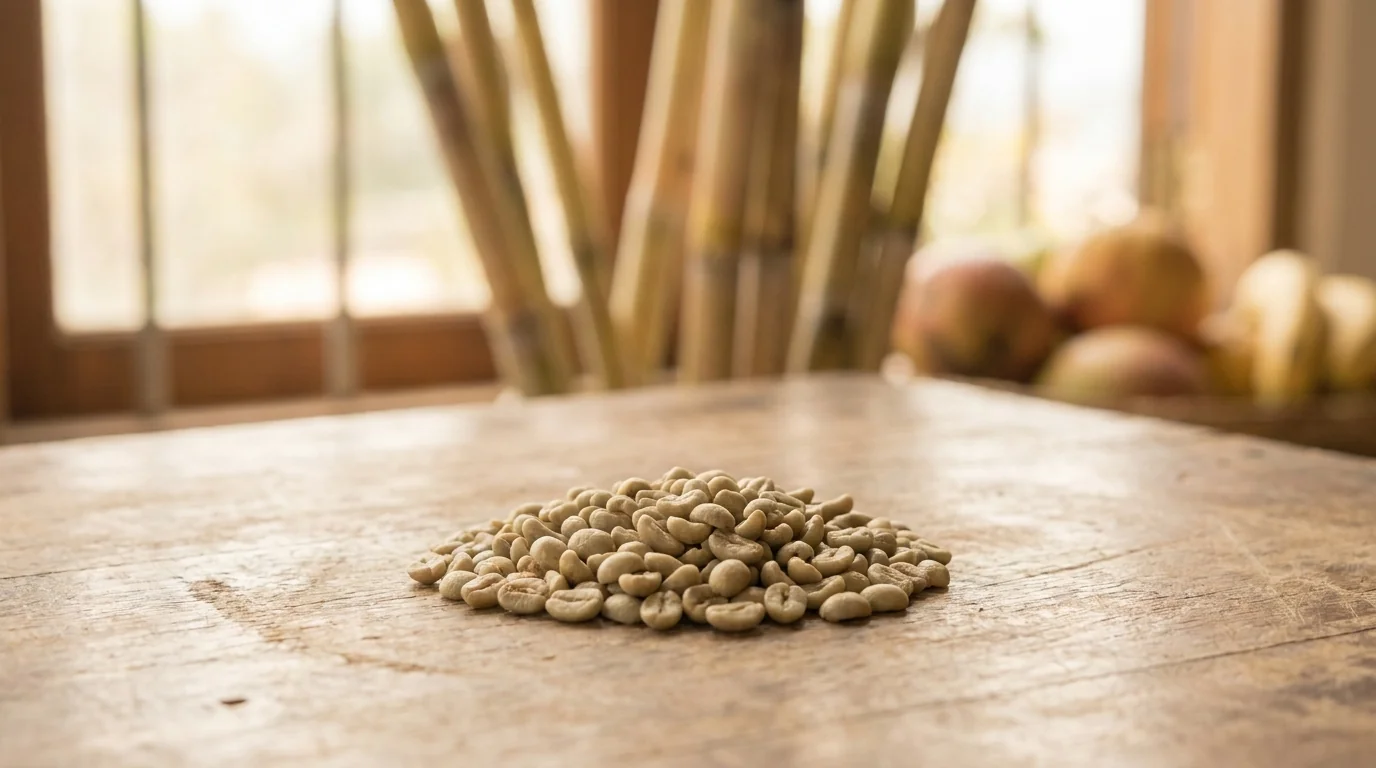
Ethyl acetate decaffeination — often labelled "natural decaf," "sugar cane decaf," or "EA process" — is one of the three methods you'll see on specialty coffee bags today, alongside Swiss Water and supercritical CO2. It is a direct-solvent method: ethyl acetate contacts the green beans, pulls caffeine out, and is then steamed off before roasting. The reason it gets the "natural" label is that ethyl acetate occurs in ripening fruit and can be produced from fermented sugar cane, giving it a cleaner marketing story than the older dichloromethane process it largely replaced.
30 ppm
US FDA residue cap on ethyl acetate in finished decaf coffee beans — parts per million[3]
GRAS status
ethyl acetate is Generally Recognized As Safe by the FDA and occurs naturally in fruit and fermentation[2]
99.9% caffeine removal
the industry-standard removal level that qualifies as 'decaffeinated' in most jurisdictions, achievable with EA[1]
What ethyl acetate actually is
Ethyl acetate is a small ester molecule — chemical formula CH3COOCH2CH3 — with a sweet, fruity smell that you already know. It is a major aroma component of ripening bananas, apples, and pears, and it forms naturally during alcoholic fermentation, contributing to the aroma of wine and beer. It also forms in your own gastrointestinal tract as bacteria metabolise ethanol and acetic acid.
Industrially, ethyl acetate can be produced two ways:
- Petrochemical synthesis — from ethanol and acetic acid derived from natural gas or petroleum feedstocks. This is the cheapest bulk source and dominates industrial supply.
- Fermentation from sugar cane — sugar cane molasses is fermented to ethanol, then combined with acetic acid (also fermentation-derived) to yield ethyl acetate. This is the "natural" or "sugar cane" pathway.
Chemically, the two ethyl acetate molecules are identical. The difference is in the origin and the marketing story. Regulators treat both the same way; consumers who want a "more natural" decaf gravitate toward the sugar-cane-origin version. Coffee processors who source sugar-cane EA — most notably Descafecol in Manizales, Colombia — market it accordingly as sugar cane process decaf.
How the process works, step by step
Ethyl acetate decaffeination is a direct solvent method, which means the solvent physically contacts the green coffee beans. This is the same category as the older dichloromethane (methylene chloride) process; the difference is which solvent is used and how it's marketed[1].
Step 1: Steam pre-treatment.
- Green (unroasted) coffee beans are steamed for around 30 minutes.
- The steam swells the beans and opens the pores of the cellular matrix, making caffeine molecules accessible to the solvent.
- Moisture content rises from the storage level (~11-12%) to around 30-40%.
Step 2: Solvent wash.
- The swollen beans are placed in extraction vessels and repeatedly washed with warm ethyl acetate — typically at 60-80 °C over 8-12 hours.
- Ethyl acetate has a chemical affinity for caffeine and selectively dissolves it out of the swollen bean matrix.
- The caffeine-loaded EA is drained off and processed separately to recover the caffeine (which is sold to soft-drink and pharmaceutical customers).
Step 3: Solvent removal.
- The now-decaffeinated but EA-soaked beans are steamed again — often for 8-10 hours — to volatilise and remove residual solvent.
- Ethyl acetate has a low boiling point (77 °C) and is easily driven off by steam.
- The recovered EA is condensed and recycled back into the process.
Step 4: Drying.
- Beans are dried back to normal green-coffee moisture (~11-12%) and are then ready to ship to roasters.
The finished bean is 99.9% decaffeinated and contains ethyl acetate residues below the regulatory limit of 30 parts per million in the US[3]. For comparison, ripe bananas typically contain ethyl acetate in the low single-digit parts-per-million range as a natural aroma component — the residue levels in decaf coffee are in the same order of magnitude as what you already eat.
Why "natural" — the fruit ester connection
The "natural decaf" marketing rests on a real chemistry fact: ethyl acetate is not exotic to the food system. It is one of the most common esters in nature, produced by:
- Fruit ripening — bananas, apples, pears, strawberries, pineapples, and many other fruits generate ethyl acetate as they ripen, contributing to the characteristic ripe-fruit aroma.
- Alcoholic fermentation — yeast produces ethyl acetate as a fermentation by-product; it's a normal component of wine, beer, and cider.
- Human digestion — gut bacteria produce small amounts during normal metabolism.
None of this makes the industrial process itself "natural" in a strict sense — the solvent is concentrated, warmed, and applied to beans in an industrial vessel — but it does mean the molecule itself is one your body encounters constantly. That is the basis for the FDA's GRAS classification and for the "natural" marketing that EA decaf processors lean on[2].
Contrast this with dichloromethane (methylene chloride), the older industrial decaf solvent: dichloromethane is a chlorinated synthetic compound, does not occur in food naturally, and is a suspected human carcinogen at high exposure levels. It's still legal for coffee decaffeination in the US at very low residue limits, but consumer preference has moved sharply against it, and Europe has been phasing it out. EA sugar cane process is the "natural" alternative that captures that consumer shift.
Safety and residue limits
Regulators around the world have set specific residue caps for ethyl acetate in decaf coffee:
- United States (FDA): ethyl acetate residues in finished decaf beans capped at 30 parts per million, and EA itself is GRAS-listed for food use[3][2].
- European Union: similar low residue limits, with EA explicitly permitted as a decaffeination solvent.
- Health Canada: aligns with FDA-style limits and treats approved decaf methods as equivalent for safety purposes[8].
At these residue levels, EA exposure from decaf coffee is trivial compared to dietary exposure from fruit and fermented foods. A single ripe banana can contain more ethyl acetate as a natural aroma compound than several cups of EA decaf combined. Regulatory agencies consider approved decaf methods — Swiss Water, CO2, EA, and dichloromethane — all safe at typical exposure levels, though consumer preference has driven the market toward the chemical-free (Swiss Water, CO2) and "natural" (EA) options.
Taste and quality implications
Well-processed EA decaf from good beans can be excellent coffee. But the direct-solvent process does have some taste implications that specialty tasters notice:
What's typically preserved:
- Body and mouthfeel — usually good, sometimes slightly enhanced vs Swiss Water on the same origin.
- Sugars and acids — mostly intact.
- Origin character — bright acidity in washed Ethiopians, chocolate notes in Brazilians, etc., all generally survive.
What can be affected:
- Some tasters report a faint sweet, fruity, or slightly wine-like note in EA decaf that they attribute to residual solvent character. Others don't notice it at all.
- Occasional loss of the most delicate aromatic top notes vs the same beans caffeinated.
- Some subtle flatness in the finish compared to Swiss Water processing on the same origin.
The 2023 comprehensive review of decaffeination methods concluded that all modern processes — Swiss Water, CO2, and EA — can produce good decaf when applied to good beans, and that bean quality, freshness before decaffeination, and roast profile after processing matter more than the decaffeination method itself for the final cup score[1].
Where EA decaf is made
The single most important EA decaffeination facility in the specialty world is:
- Descafecol in Manizales, Colombia — the primary EA sugar cane processor for Colombian and other South American origins. Descafecol sources its ethyl acetate from fermented sugar cane molasses grown in the Cauca Valley of Colombia, which is what enables the "sugar cane process" branding on Colombian decaf.
Other EA decaffeination facilities operate in Europe (for domestic mass-market decaf) and in various origin countries, but the specialty EA decaf market is heavily dominated by Colombian sugar cane process coffees from Descafecol.
Because Descafecol is co-located with Colombian coffee production, EA decaf can offer a shorter supply chain than Swiss Water (where green coffee has to travel to the Swiss Water facility in Burnaby, British Columbia, then back to roasters) or CO2 (where dedicated processing sites are concentrated in a few countries). For Colombian coffee specifically, EA is often the freshest available decaf option.
Cost vs Swiss Water and CO2
EA decaf typically carries a smaller premium over regular coffee than either Swiss Water or CO2:
| Method | Approximate green premium | Retail cost tier |
|---|---|---|
| EA sugar cane process | + $1-3/lb | Medium |
| Swiss Water process | + $2-5/lb | Higher |
| Supercritical CO2 | + $2-6/lb | Higher |
| Dichloromethane (bulk) | + $0.50-1/lb | Lowest |
Direct-solvent processing has lower capital equipment requirements than Swiss Water's trademarked GCE circulation system or CO2's high-pressure vessels, which keeps operating costs down. For roasters, that means EA decaf can hit a lower shelf price than Swiss Water or CO2 without cutting into margins.
For consumers, this makes EA sugar cane decaf a genuinely attractive middle option: better marketing story than unspecified solvent decaf, better economics than Swiss Water or CO2, and cup quality that can hold its own on good beans.
Environmental footprint
EA decaffeination has a modest environmental footprint compared to Swiss Water and CO2:
- Energy: direct solvent processes use less energy per kg of decaffeinated coffee than either Swiss Water (which requires extensive water heating and carbon filtration cycles) or CO2 (which requires very high pressures and compression energy).
- Water: EA processing uses less water than Swiss Water, which is water-intensive by definition.
- Solvent recovery: ethyl acetate is condensed and recycled within the process, so net solvent consumption per batch is small.
- Sugar cane sourcing: sugar cane cultivation has its own environmental profile (irrigation, land use), which factors into a full life-cycle view of "sugar cane process" decaf.
For a Colombian roaster sourcing from local origins and sending beans a short distance to Descafecol, EA sugar cane decaf can have a materially lower carbon footprint than the same beans shipped to Vancouver for Swiss Water processing and back.
How to spot EA decaf on the label
You'll see EA decaf labelled several ways:
- "EA sugar cane process" or "EA process decaf" — specialty coffee's preferred labelling; unambiguous.
- "Sugar cane decaf" or "Sugar cane process" — synonymous with EA sugar cane process; common on Colombian coffee.
- "Natural decaf" or "Naturally decaffeinated" — usually EA, but vague; verify with the roaster if it matters.
- "Colombia decaf" without further specification — often EA from Descafecol.
- "European process" — historically indicated direct solvent, either EA or dichloromethane.
If a package specifies neither Swiss Water, CO2, nor EA, and just says "decaf," it's likely solvent-processed and possibly dichloromethane at the mass-market end.
Common misconceptions
- "Ethyl acetate is a harsh chemical." Ethyl acetate is one of the most common natural esters in the food supply, produced by ripening fruit and fermentation. Residue levels in finished decaf are trivial compared to dietary exposure from fruit.
- "Sugar cane decaf means it tastes sweet." The sugar cane refers to the origin of the ethyl acetate solvent, not to any sweetness added to the coffee. Any perceived sweetness in EA decaf is coffee's own sweetness (or a very subtle residual solvent note).
- "Natural decaf is chemical-free." No. EA decaf uses ethyl acetate as a chemical solvent that directly contacts the beans. It's "natural" only in the sense that the solvent molecule itself occurs in nature. If chemical-free is your priority, Swiss Water or CO2 are the correct choices.
- "All Colombian decaf is EA." Most is, because Descafecol is the dominant regional processor, but Colombian coffee is also shipped to Swiss Water in Vancouver or to CO2 facilities in Europe for those processing options.
Practical guidance
If you want the "natural" story and cost efficiency: EA sugar cane process decaf, especially from Colombian origins, is the sweet spot. Cup quality is comparable to Swiss Water on good beans, and the price premium is smaller.
If chemical-free is non-negotiable: choose Swiss Water or CO2 (see the Swiss Water Decaf and CO2 Decaffeination articles). EA is a solvent-based process, even if the solvent is naturally occurring.
If maximum caffeine removal matters: all three modern methods (Swiss Water, CO2, EA) achieve 99.9% removal — typically 2-5 mg caffeine per cup vs ~95 mg in regular coffee[5]. No decaf method is literally 100% caffeine-free.
If freshness matters: for Colombian coffee, EA processing at Descafecol means shorter travel time from farm to processing to roaster than Swiss Water (which requires shipping to Canada and back).
The honest summary
Ethyl acetate decaffeination is a direct-solvent process that uses a naturally occurring ester — the same molecule that makes ripe bananas smell sweet — to strip caffeine from green coffee beans. When the EA is sourced from fermented sugar cane (as it is at the dominant Descafecol facility in Manizales, Colombia), the process is marketed as "sugar cane" or "natural" decaf. Regulators consider it safe within strict residue limits, and cup quality on good beans can match Swiss Water and CO2 processing. It sits in a genuine middle ground: better marketing than unspecified solvent decaf, lower cost than Swiss Water or CO2, and — for Colombian coffee especially — a shorter supply chain than the North American water-process option.
Frequently asked questions
- Is ethyl acetate decaf safe to drink?
- Yes, at the residue levels found in finished decaf coffee. Ethyl acetate is listed as Generally Recognized As Safe (GRAS) by the US FDA for use as a synthetic flavouring substance, and the FDA specifically permits it as a decaffeinating agent for coffee, with residues in the finished bean capped at 30 parts per million. EA also occurs naturally in fruit — bananas, apples, pears, wine — and in your own body during normal digestion. Health Canada, EFSA, and other regulators consider EA-processed decaf safe within these limits.
- Why is ethyl acetate decaf called 'natural' decaf?
- Because ethyl acetate is a naturally occurring compound — it forms during fruit ripening and fermentation and gives ripe bananas and pears part of their aroma — and because the ethyl acetate used for coffee decaffeination is commonly produced from fermented sugar cane molasses rather than synthesised from petrochemical feedstocks. That sugar cane origin is why you'll also see it labelled 'sugar cane decaf' or 'EA sugar cane process,' especially on Colombian decaf. The 'natural' label is about the origin of the solvent; the process itself is a direct solvent extraction.
- Does ethyl acetate decaf taste different from Swiss Water?
- Slightly, and opinions differ. EA decaf generally preserves body well and some tasters describe a mild sweet, fruity note in the cup that they attribute to residual solvent character. Swiss Water and CO2 are widely regarded as the most flavour-neutral methods — meaning the decaf tastes as close as possible to the same beans caffeinated. In blind cupping, well-processed EA decaf from a good origin can score comparably to Swiss Water, so bean quality and roast freshness matter as much as the decaffeination method.
- Is ethyl acetate decaf cheaper than Swiss Water?
- Usually yes. EA processing is a direct-solvent method with lower capital equipment requirements than Swiss Water (which needs the trademarked GCE circulation system) or supercritical CO2 (which needs high-pressure vessels). At the green-coffee wholesale level, EA decaf typically carries a smaller premium over regular coffee than Swiss Water or CO2 does. Retail price differences depend more on bean quality and roaster margins than on the decaffeination method itself.
- Which coffee brands use ethyl acetate decaf?
- Many Colombian specialty decafs are EA sugar cane process, because Descafecol in Manizales is one of the largest EA decaffeination facilities in the world and processes coffee for both domestic Colombian roasters and export customers. You will see EA decaf under labels like 'EA sugar cane process,' 'sugar cane decaf,' 'natural decaf,' or 'Colombia decaf.' In North America, brands including Counter Culture, Onyx, and various specialty roasters have offered EA decaf lots. Mass-market European decaf has also historically used EA.
References
Every factual claim in this article is drawn from the sources below. See the source library for how we grade evidence.
- [1]Decaffeination processes and their impact on coffee quality: a reviewComprehensive Reviews in Food Science and Food Safety · 2023 · Review · Tier 2 · Moderate
- [2]21 CFR 182.60 — Ethyl acetate (Generally Recognized As Safe synthetic flavoring substance)US Food and Drug Administration / Code of Federal Regulations · 2023 · Agency guidance · Tier 1 · Strong
- [3]21 CFR 173.228 — Ethyl acetate as a decaffeinating agent for coffee (residue limit)US Food and Drug Administration / Code of Federal Regulations · 2023 · Agency guidance · Tier 1 · Strong
- [4]The Swiss Water Process — Chemical-Free DecaffeinationSwiss Water Decaffeinated Coffee Company · 2024 · Reference work · Tier 3 · Contextual
- [5]Caffeine Content of Decaffeinated CoffeeJournal of Analytical Toxicology · 2006 · Observational study · Tier 2 · Moderate
- [6]CoffeeEncyclopaedia Britannica · Reference work · Tier 3 · Contextual
- [7]Spilling the Beans: How Much Caffeine Is Too Much?U.S. Food and Drug Administration · 2024 · Agency guidance · Tier 1 · Strong
- [8]Caffeine in foodsHealth Canada · 2022 · Agency guidance · Tier 1 · Strong
Related reading
- Instant & Decaf CoffeeSwiss Water Decaf: How Chemical-Free Decaf Works→
- Instant & Decaf CoffeeCO2 (Supercritical) Decaffeination→
- Instant & Decaf CoffeeDecaf Coffee: Benefits and Risks→
- Instant & Decaf CoffeeFreeze-Dried vs Spray-Dried Coffee→
- Instant & Decaf CoffeeHalf-Caff Coffee: What It Is and Why It Works→
- Instant & Decaf CoffeeHow to Make Instant Coffee Taste Better→