CO2 (Supercritical) Decaffeination
By Coffee Studies Editorial·Published July 16, 2026·11 min read
Quick answer
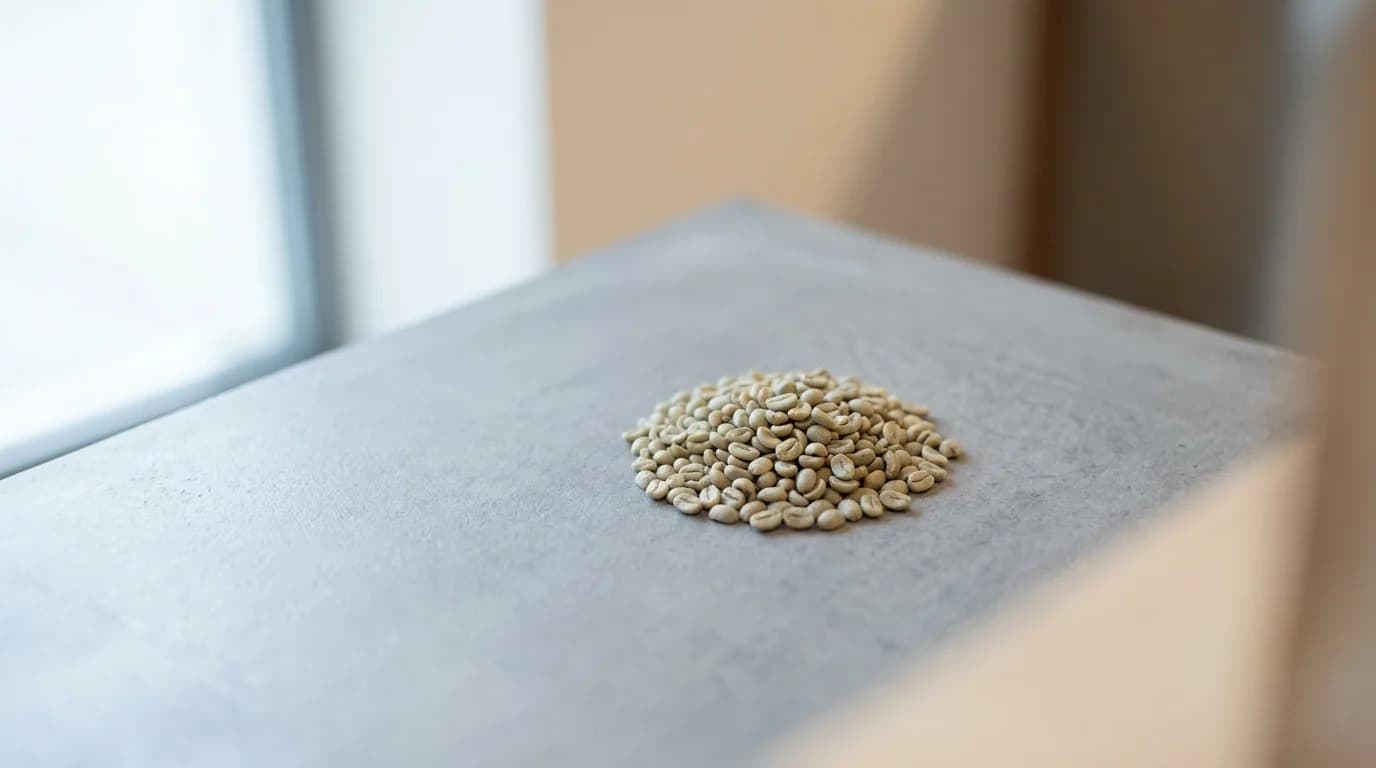
Supercritical CO2 decaffeination is the third of the three modern decaf methods you'll see on specialty coffee bags, alongside Swiss Water and ethyl acetate sugar cane process. It uses carbon dioxide — the same gas dissolved in every can of sparkling water — held under high pressure to a state where it behaves as both a liquid and a gas. In that state, CO2 is unusually selective for caffeine and unusually gentle on the flavour compounds that make coffee taste like coffee. The method is expensive to run because of the equipment required, but the cup quality is genuinely excellent, which is why it occupies the premium chemical-free tier of the decaf market alongside Swiss Water.
31 °C, 74 bar
the critical point of CO2 — above this temperature and pressure, CO2 becomes a supercritical fluid[1]
Patented 1974
Kurt Zosel filed the supercritical CO2 caffeine extraction patent in 1971; granted 1974[1]
Zero residue
CO2 evaporates completely after depressurisation, leaving no solvent trace in the finished bean[2]
The physics: what a supercritical fluid is
Every substance has a critical point — a specific temperature and pressure above which the distinction between liquid and gas disappears. Below the critical point, you have a phase transition (evaporation, condensation); above it, the substance is a single supercritical fluid that isn't quite either.
For carbon dioxide, the critical point is:
- Critical temperature: 31.1 °C (about room temperature on a warm day).
- Critical pressure: 73.8 bar (about 73 times atmospheric pressure — comparable to the pressure at 730 metres of ocean depth).
Above 31.1 °C and 73.8 bar, CO2 becomes a supercritical fluid with a combination of properties that don't exist in ordinary liquids or gases[1]:
- Gas-like diffusivity — it flows through porous materials (like green coffee beans) as easily as a gas.
- Liquid-like density — it dissolves compounds as effectively as a liquid solvent.
- Tunable solvent strength — small changes in temperature and pressure dramatically change what compounds it will dissolve, giving operators fine control over selectivity.
These properties make supercritical CO2 an unusually good industrial extraction solvent — not just for coffee. The same technology is used to extract hops for beer brewing, essential oils for cosmetics, and cannabinoids for legal cannabis extracts.
Why supercritical CO2 is selective for caffeine
The specific chemistry that makes CO2 useful for decaffeinating coffee — rather than stripping out everything soluble — comes down to molecular affinity.
Supercritical CO2 is a non-polar solvent with a slight quadrupole moment that gives it moderate affinity for certain polar compounds. Caffeine happens to sit in a sweet spot:
- Caffeine dissolves well in supercritical CO2 at moderate pressures (about 200-300 bar operating pressure).
- Coffee oils, waxes, and lipids dissolve much less readily and mostly stay in the bean.
- Sugars and organic acids are too polar for supercritical CO2 and stay in the bean.
- Chlorogenic acids — the major bioactive polyphenols in coffee — are largely retained.
- Aromatic volatiles are only partially extracted.
The result is a decaffeination process that pulls out caffeine at 99.9% efficiency while leaving most of the compounds that matter for cup quality intact[2]. This is fundamentally different from older direct-solvent processes — dichloromethane and even ethyl acetate — which also remove some flavour compounds along with the caffeine.
The industrial process, step by step
Supercritical CO2 decaffeination looks like a small chemical plant more than a coffee facility. The equipment is sized to hold significant pressure safely.
Step 1: Bean preparation.
- Green coffee beans are pre-moistened, typically to 30-50% water content, by steaming or water soaking.
- Moisture is important because it swells the beans and makes caffeine more accessible to the CO2. Dry beans release caffeine much more slowly.
Step 2: Loading and pressurisation.
- Beans are loaded into an extraction vessel — a thick-walled steel pressure vessel typically several metres tall.
- The vessel is sealed and CO2 is pumped in and compressed to operating pressure (typically 200-300 bar, well above the 74 bar critical pressure).
- Temperature is maintained at 40-80 °C — above the critical temperature but well below anything that would damage coffee.
Step 3: Extraction.
- Supercritical CO2 flows through the bean bed continuously for 8-12 hours.
- The CO2 dissolves caffeine out of the beans as it passes through.
- The caffeine-loaded CO2 exits the extraction vessel and flows to a separation vessel.
Step 4: Caffeine separation.
- In the separation vessel, pressure is dropped (typically to about 60 bar).
- Below the critical pressure, CO2 loses much of its solvent power and caffeine precipitates out.
- The now-clean CO2 is recompressed and pumped back to the extraction vessel — the CO2 is recycled continuously throughout the run.
- Recovered caffeine is collected for sale to the pharmaceutical and soft-drink industries (this is a significant revenue offset for CO2 decaffeinators).
Step 5: Depressurisation and drying.
- After 8-12 hours, when caffeine content is below 0.1% by weight, the extraction vessel is depressurised.
- CO2 evaporates completely from the beans — there is no residue, because CO2 is a gas at atmospheric pressure.
- Beans are dried back to normal green-coffee moisture (~11-12%) and shipped to roasters.
The finished bean is 99.9% decaffeinated, contains zero solvent residue, and has been exposed only to CO2 and moderate heat. That's the appeal.
The history: Zosel, Roselius, and Kaffee HAG
The CO2 decaffeination story runs through two remarkable German inventors and one German company.
Ludwig Roselius (1874-1943) was a Bremen coffee merchant who lost his father to what he believed was excessive caffeine consumption. Motivated to develop caffeine-free coffee, he worked with chemists to develop a decaffeination process using benzene as the solvent, patented in 1906. In 1906 he founded Kaffee HAG (Kaffee-Handels-Aktien-Gesellschaft) in Bremen to commercialise the world's first branded decaf coffee[3]. The HAG brand and its French counterpart Sanka became global icons of the decaf category for most of the 20th century.
The Roselius method used benzene — later recognised as a human carcinogen — and HAG shifted to dichloromethane (methylene chloride) as the industry adopted safer solvents in the mid-20th century.
Kurt Zosel (1913-1988) was a chemist at the Max Planck Institute for Coal Research in Mülheim, West Germany. In the late 1960s Zosel developed the supercritical CO2 extraction process for caffeine and filed his landmark patent — US Patent 3,806,619, "Process for the Recovery of Caffeine from Vegetable Materials" — in 1971. The patent was granted in 1974 and assigned to Studiengesellschaft Kohle mbH, the technology-transfer arm of the Max Planck Institute[1].
HAG AG licensed Zosel's process and by the late 1970s was running commercial supercritical CO2 decaffeination in Bremen — the world's first industrial-scale application of the technology. Kaffee HAG became one of the first mass- market coffees to advertise chemical-free decaffeination.
The Zosel process has since been adopted by other decaffeination facilities globally and extended to other extraction applications (hops, spices, cannabis, essential oils). It is one of the more consequential food-processing patents of the 20th century.
Advantages over other decaf methods
Highly selective for caffeine.
Supercritical CO2 is unusually good at pulling out caffeine without pulling out other coffee compounds. In head-to-head comparisons of decaf methods, CO2-processed decaf typically retains more aromatic volatiles and chlorogenic acids than solvent-based methods and comparable amounts to Swiss Water[2].
Zero chemical residue.
CO2 is not a chemical solvent in the toxicological sense — it's the gas you exhale and the fizz in sparkling water. After depressurisation, it evaporates completely, leaving no detectable residue in the finished bean. Regulators do not even require residue testing for CO2 decaf because there is nothing to test for.
Recyclable solvent.
CO2 is recirculated through the process continuously — the same CO2 molecules cycle between extraction and separation vessels for the duration of a run. Net CO2 consumption per batch of decaffeinated coffee is very small.
Caffeine recovery.
The pure caffeine extracted from the beans is a valuable by-product. Recovered caffeine is sold to soft-drink manufacturers (Coca-Cola, Pepsi) and to pharmaceutical companies for use in over-the-counter pain relievers and energy products. This offsets a meaningful fraction of the processing cost.
Scale efficiency.
Once you have the capital equipment, per-batch operating costs at scale are competitive with other methods.
Disadvantages
Capital cost.
The pressure vessels required for supercritical CO2 processing are expensive industrial equipment. A commercial CO2 decaffeination plant is a capital investment measured in tens of millions of dollars — comparable to a small chemical plant. This limits the number of facilities globally and keeps per-pound premiums high.
Energy intensity.
Compressing CO2 to 200-300 bar and maintaining that pressure for 8-12 hours per batch requires significant electrical energy. Modern facilities have engineered around this with heat recovery and efficient compressors, but energy per kg of decaffeinated coffee is higher than for direct solvent methods (though comparable to Swiss Water's water heating and carbon regeneration).
Fewer facilities.
Only a handful of commercial supercritical CO2 coffee decaffeination facilities operate globally — concentrated in Germany, Canada, and a few other locations. This limits supply chain flexibility and can add shipping time for origins far from a CO2 facility.
Complexity.
Running a supercritical CO2 plant safely and consistently requires more technical expertise than water or direct- solvent processing. Operator skill is a real factor.
Where CO2 decaf is made
The main commercial supercritical CO2 coffee decaffeination facilities include:
- CR3-Kaffeeveredelung in Bremen, Germany — descended from the original HAG/Kaffee HAG facility that first commercialised the Zosel process in the 1970s. Still one of the largest CO2 decaffeinators in the world.
- Swiss Water Decaffeinated Coffee Company in Burnaby, BC also operates a CO2 line at the same facility as their signature water process, marketed as "Sparkling Water Method" for some clients[4].
- Smaller facilities in Mexico, Colombia, and other origin countries operate CO2 lines for domestic and export markets.
The Bremen facility historically supplied much of the European premium decaf market. North American specialty decaf under the "CO2 processed" label often comes from either Bremen or Burnaby.
Brands using CO2 decaf
- Kaffee HAG (Jacobs Douwe Egberts, Europe) — the original CO2 decaf, still marketed as chemical-free decaffeinated using the Zosel process.
- Sanka (JDE, US and Europe) — historically part of the HAG family; process has varied by market and era.
- Peet's Decaf Major Dickason's Blend and other Peet's decafs — CO2-processed for many years.
- Illy Decaf and other Italian specialty decafs — CO2 is common in the Italian espresso market.
- Various specialty single-origin decafs from roasters who source from CO2-processed lots.
You will also see the process labelled "Sparkling Water Process" — a marketing term that refers specifically to Swiss Water Company's CO2 line at their Burnaby facility.
Quality vs Swiss Water and EA
In head-to-head sensory evaluations, supercritical CO2 decaf and Swiss Water decaf produce cup quality that is very close and generally very good[2]. Well-processed EA decaf from good beans is also competitive.
Where the three methods tend to differ subtly:
| Attribute | Swiss Water | Supercritical CO2 | EA (sugar cane) |
|---|---|---|---|
| Aroma retention | Very good | Excellent (most selective) | Good |
| Body preservation | Excellent | Very good | Very good |
| Origin character | Preserved | Preserved | Mostly preserved |
| Chemical residue | None | None | Below 30 ppm regulatory cap |
| Cost tier | Higher | Higher | Medium |
For most drinkers, the difference between a high-quality Swiss Water decaf and a high-quality CO2 decaf on the same beans is imperceptible. The choice often comes down to what's available fresh from a trusted roaster.
Reading CO2 decaf labels
Coffee labelled with any of the following has been processed using supercritical CO2:
- "CO2 processed" or "CO2 decaffeinated" — most direct and unambiguous.
- "Sparkling Water Process" — Swiss Water Company's branded CO2 line.
- "Chemical-free decaf" without further specification — could be either Swiss Water or CO2; ask the roaster if it matters.
- "Zosel process" — occasionally used by European brands referencing the original patent inventor.
Common misconceptions
- "CO2 decaf uses dry ice." No — dry ice is solid CO2 at atmospheric pressure. Supercritical CO2 is a fluid state that only exists above 31 °C and 74 bar of pressure. The processing conditions are moderate heat and high pressure, not extreme cold.
- "CO2 is a greenhouse gas so CO2 decaf is bad for the climate." The CO2 used in decaffeination is recirculated within the process — net CO2 consumption per batch is small. Most facilities source CO2 as a by-product of other industrial processes (fertilizer production, ethanol fermentation), so the incremental climate impact is modest.
- "CO2 decaf tastes carbonated." No. The CO2 evaporates completely from the finished bean. There is no residual carbonation in the cup.
- "All chemical-free decaf is Swiss Water." No — CO2 is equally chemical-free. "Chemical-free decaf" on a label could be either method.
Practical guidance
If you want the most flavour-neutral decaf method: supercritical CO2 has an edge in aromatic preservation, but the difference vs Swiss Water is small.
If chemical-free is the priority: either Swiss Water or CO2 delivers this — both are legitimate chemical-free methods. See Swiss Water Decaf for the water-process alternative.
If cost matters: EA sugar cane process is generally cheaper than CO2, while still offering better cup quality than commodity dichloromethane decaf. CO2 sits at the premium end alongside Swiss Water.
If you want the historical pedigree: Kaffee HAG (Bremen) has been running the Zosel CO2 process continuously since the 1970s and remains the archetypal CO2 decaf. It's the direct descendant of the world's first commercial decaf brand.
The honest summary
Supercritical CO2 decaffeination uses carbon dioxide held above its critical point (31 °C, 74 bar) as a highly selective solvent for caffeine. Patented by Kurt Zosel in the 1970s and commercialised by the German company HAG (makers of Kaffee HAG), it removes 99.9% of caffeine from green coffee beans while leaving oils, sugars, chlorogenic acids, and most aromatic compounds intact. There is zero chemical residue because CO2 evaporates completely after depressurisation. The main downside is capital cost — the pressure vessels are expensive industrial equipment — which keeps CO2 decaf at the premium end of the market alongside Swiss Water. For specialty coffee drinkers who want chemical-free decaf with excellent flavour preservation, CO2 and Swiss Water are the two options worth seeking out.
Frequently asked questions
- What is supercritical CO2 and why is it used for decaf?
- Supercritical CO2 is carbon dioxide held above its critical temperature (31.1 °C) and critical pressure (73.8 bar). In this state it isn't quite a liquid and isn't quite a gas — it has gas-like ability to flow through porous materials but liquid-like ability to dissolve compounds. This combination makes it an unusually good extraction solvent: it penetrates green coffee beans easily and preferentially dissolves caffeine while leaving oils, sugars, and most flavour compounds behind. Depressurising the CO2 causes caffeine to precipitate out, and the CO2 is recompressed and reused.
- Who invented the CO2 decaffeination process?
- German chemist Kurt Zosel of the Max Planck Institute for Coal Research patented the supercritical CO2 decaffeination process in the early 1970s (US Patent 3,806,619, filed 1971, granted 1974). The process was commercialised by HAG AG — the same German company Ludwig Roselius founded in 1906 to sell the world's first branded decaf coffee, Kaffee HAG. HAG's original method used benzene and later dichloromethane; the CO2 method replaced these older solvents and became the premium industrial decaf technology in Europe.
- Is CO2 decaf better than Swiss Water?
- Both are chemical-free methods and both are considered top-tier for flavour preservation, so which is 'better' depends on the specific coffee and roaster. Supercritical CO2 is highly selective for caffeine, arguably better than Swiss Water at leaving delicate aromatic compounds untouched. Swiss Water is often described as preserving body slightly better. In blind cupping, well-processed decaf by either method scores very close to the same beans caffeinated. Bean quality, freshness, and roast profile matter more than the choice between these two methods.
- Why is CO2 decaf more expensive?
- Supercritical CO2 processing requires pressure vessels rated for 74+ bar of pressure operating at moderate heat — this is serious industrial equipment closer to what a chemical plant runs than what a coffee facility typically houses. Capital cost per installation is high, energy for compression is significant, and fewer facilities exist globally. Those fixed costs get amortised across the coffee processed, pushing up the per-pound premium. Swiss Water uses much simpler equipment (tanks and carbon filters) and can operate at lower capital cost per unit output.
- Does CO2 decaf have residues in it?
- No solvent residues, because CO2 is not a chemical solvent in the traditional sense — it's just carbon dioxide, the same gas exhaled by every breathing organism and dissolved in every carbonated drink. After decaffeination the pressure is released and the CO2 evaporates completely, leaving no residue. This is why CO2 decaf, like Swiss Water, is marketed as chemical-free. The caffeine content in the finished bean is around 0.1% by weight — the standard 99.9% removal benchmark — with typical residual caffeine in a cup of 2-5 mg vs about 95 mg in regular coffee.
References
Every factual claim in this article is drawn from the sources below. See the source library for how we grade evidence.
- [1]US Patent 3,806,619 — Process for the Recovery of Caffeine from Vegetable MaterialsUnited States Patent and Trademark Office (Kurt Zosel, inventor; Studiengesellschaft Kohle mbH, assignee) · 1974 · Reference work · Tier 3 · Contextual
- [2]Decaffeination processes and their impact on coffee quality: a reviewComprehensive Reviews in Food Science and Food Safety · 2023 · Review · Tier 2 · Moderate
- [3]Kaffee HAG — History of Decaffeinated CoffeeEncyclopaedia Britannica · 2023 · Reference work · Tier 3 · Contextual
- [4]The Swiss Water Process — Chemical-Free DecaffeinationSwiss Water Decaffeinated Coffee Company · 2024 · Reference work · Tier 3 · Contextual
- [5]Caffeine Content of Decaffeinated CoffeeJournal of Analytical Toxicology · 2006 · Observational study · Tier 2 · Moderate
- [6]CoffeeEncyclopaedia Britannica · Reference work · Tier 3 · Contextual
- [7]Spilling the Beans: How Much Caffeine Is Too Much?U.S. Food and Drug Administration · 2024 · Agency guidance · Tier 1 · Strong
- [8]Caffeine in foodsHealth Canada · 2022 · Agency guidance · Tier 1 · Strong
Related reading
- Instant & Decaf CoffeeSwiss Water Decaf: How Chemical-Free Decaf Works→
- Instant & Decaf CoffeeEthyl Acetate ('Natural') Decaffeination→
- Instant & Decaf CoffeeDecaf Coffee: Benefits and Risks→
- Instant & Decaf CoffeeFreeze-Dried vs Spray-Dried Coffee→
- Instant & Decaf CoffeeHow to Make Instant Coffee Taste Better→
- Instant & Decaf CoffeeBest Decaf Coffee Brands: Ranked by Method and Taste→